The Steam Tunnel Repair That DisappearedRIOC studied it, designed a repair, called it a public-safety problem and repeatedly placed millions of dollars into its capital plans. Then the construction money went to zero.
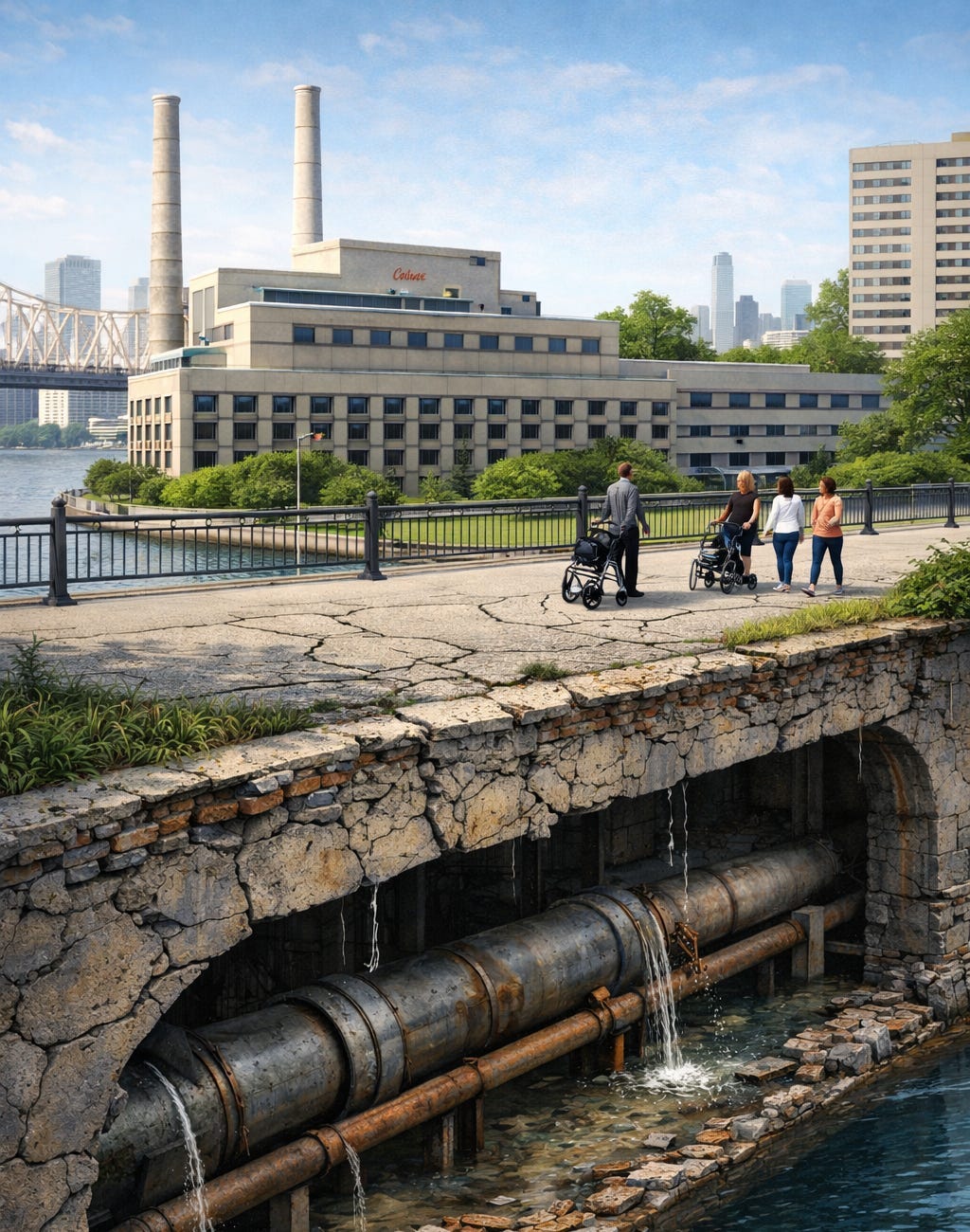
Capital projects change. Costs rise, engineering evolves, funding moves and questions of ownership can complicate even urgent work. But the Roosevelt Island Steam Tunnel was not a speculative improvement that simply slipped down a priority list. RIOC’s own records describe an infrastructure problem known for decades. In 2001, the U.S. Army Corps of Engineers concluded that approximately 4,200 linear feet of the tunnel also functioned as part of Roosevelt Island’s seawall and required repairs. RIOC later said that those repairs were never made. Langan Engineering examined the tunnel again in 2018 and 2020 and found further deterioration. The steam tunnel no longer carries steam, but it still serves as part of Roosevelt Island’s seawall beneath the eastern promenade. By the time RIOC began designing a repair, it was addressing a structural problem government had already known about for years.
RIOC Started Designing the FixBy October 2021, RIOC had moved beyond documenting deterioration. Management was asking the board to authorize a repair design. The memorandum supporting the Langan contract described a tunnel in a condition presenting serious safety concerns and warned of further deterioration and possible failure if nothing was done. The same memo acknowledged that RIOC and the City were still negotiating over who was responsible for the repairs. RIOC chose to move forward anyway, telling the board that it did not want to wait because the tunnel presented a health and public-safety concern. But the Corporation also took care to state that proceeding with the work did not mean it accepted ownership of the tunnel or legal responsibility for fixing it. That formulation is notable in light of Rosenthal’s earlier dispute with Albany. She had argued that responsibility for the tunnel was being avoided while the danger remained unresolved. By 2021, RIOC had found a way to advance the repair while preserving its legal position. It hired Langan to perform surveys and geotechnical work, prepare design documents, support a future construction solicitation and provide construction-administration services. RIOC’s FY2024-25 procurement report later listed the contract at $452,750, with approximately $375,250 already spent. Which raises a straightforward public-records question: what did Roosevelt Island receive for that money? The contract contemplated surveys, designs, repair drawings and a construction scope. Those records should show what engineers proposed, how extensive the repair was expected to be and how close the project came to construction.
Then Construction Became ZeroRIOC’s capital budgets show a project growing larger before it disappears. The fiscal 2019-20 capital plan contemplated approximately $3.98 million in future Steam Tunnel construction and another $513,000 for design. By fiscal 2023-24, RIOC was programming $8.19 million for construction over two years and explicitly identifying Steam Tunnel work as a major driver of increased infrastructure spending. The project then began moving outward. The fiscal 2024-25 budget reduced the near-term allocation and said Steam Tunnel construction was being “pushed back.” But the following capital plan did not abandon the repair. RIOC’s fiscal 2025-26 plan projected roughly $19 million in Steam Tunnel construction across three future fiscal years. Then the construction program disappeared. The fiscal 2026-27 comparative capital plan showed $2 million previously approved for construction, no actual construction spending against that line and no future Steam Tunnel construction allocation in the years displayed. A separate Steam Tunnel entry showed only about $35,000 in actual spending. After years of multimillion-dollar projections, the construction line had become zeros. That does not tell us whether the project was cancelled, transferred, rescoped or deferred again. It tells us something more basic: RIOC’s public capital plan stopped showing the repair, and no comparable public explanation accompanied its disappearance. If nobody cancelled the Steam Tunnel project, where did it go? A Public-Safety Project Without a Public ExplanationThe unexplained disappearance is harder to reconcile with RIOC’s own earlier position. In 2021, management said it would not wait for the City-State responsibility dispute because the tunnel presented a health and public-safety concern. RIOC then spent hundreds of thousands of dollars developing the repair and repeatedly reserved millions more for construction. Five years later, the ownership dispute appears unresolved, the repair remains unbuilt and the construction money has disappeared from the capital plan. That makes the design records and the budget history more than an accounting exercise. Together, they should tell residents what RIOC intended to build, how much progress it made and when the decision was made not to proceed as previously planned. Capital projects do not erase their own funding. Someone decided to remove, transfer, defer or otherwise change this one. Perhaps responsibility shifted to the City. Perhaps negotiations produced another arrangement. Perhaps the cost became unacceptable. Whatever happened, the Corporation once considered the tunnel urgent enough to proceed without waiting for those questions to be settled. The public deserves to know what changed. And while the budget changed, the underlying structure did not. The tunnel remains beneath the eastern promenade, performing a seawall function government has known about for at least a quarter century. The Next DealThe contrast with the Steam Plant makes the unanswered question harder to ignore. The City found money to demolish the plant, hired a contractor and moved the work forward. The City, State and RIOC are now discussing possible redevelopment of that property. The Steam Plant found a government process. The Steam Tunnel found a jurisdictional dispute. That is particularly uncomfortable given Rosenthal’s earlier allegation that responsibility for the tunnel and control of the Steam Plant property had once been discussed together. We still do not know what became of those negotiations. What we can see is that one piece of infrastructure moved toward demolition and redevelopment while the other moved from engineering studies and multimillion-dollar repair budgets to a capital plan with no construction funding. The Steam Plant found a demolition budget. The Steam Tunnel once had a repair budget. Only one of those projects survived. This newsletter travels best hand to hand. If you know someone who would read this all the way through, they are probably who it is for. Subscribe for free to receive updates on new posts and support our work.
|