[New post] January 5 2022 Anticorruption Protests in Kazakhstan Challenge Russian Dominion
jayofdollhousepark posted: " The people of Kazakhstan have seized control of the capital city, captured the offices of the state and the airport, and the fortresslike City Hall is in flames. What began last weekend as a protest against fuel prices during a b"
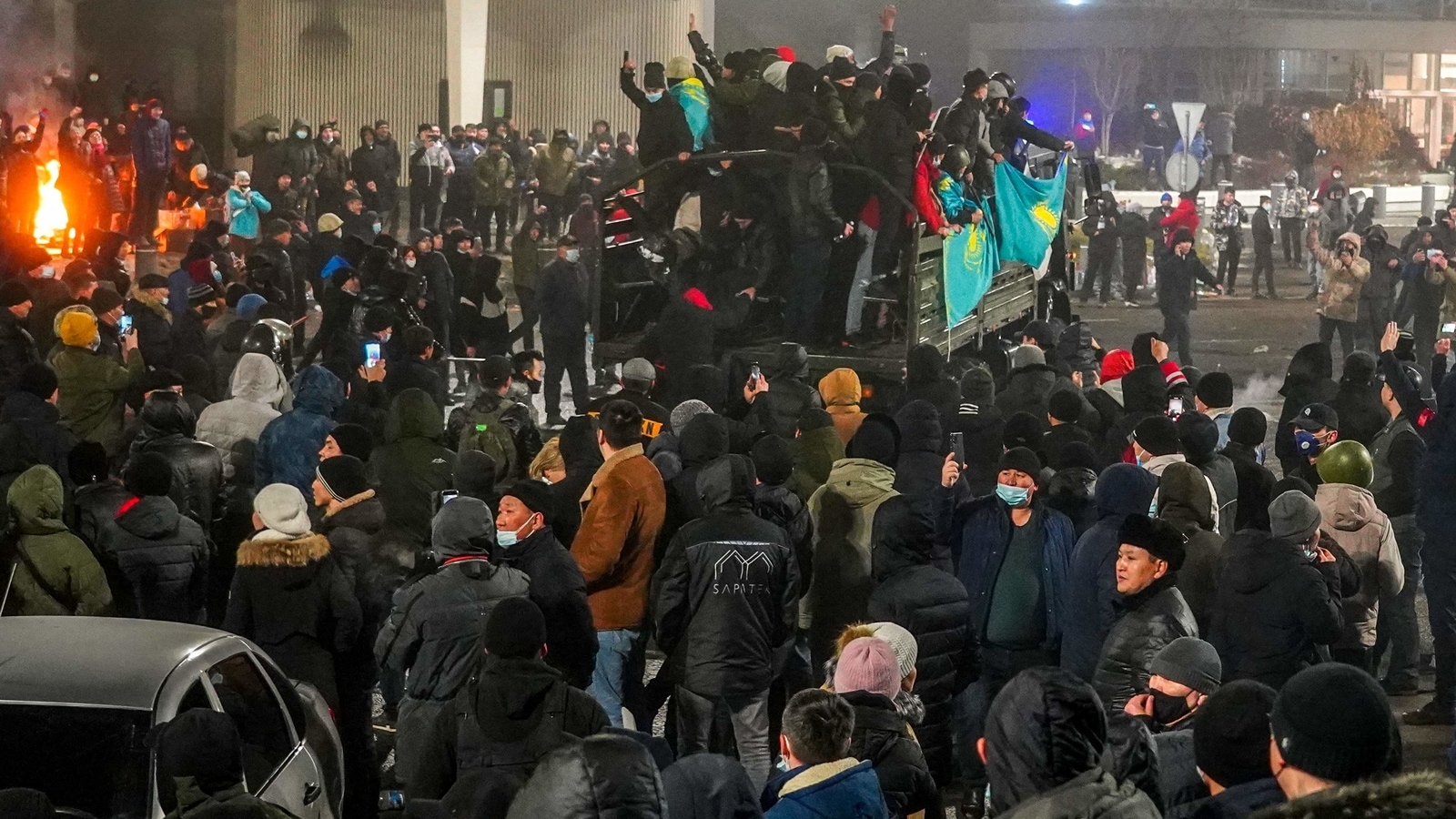
The people of Kazakhstan have seized control of the capital city, captured the offices of the state and the airport, and the fortresslike City Hall is in flames. What began last weekend as a protest against fuel prices during a brutal winter has become a revolt against the corrupt regime of the Soviet-era tyrants allied with Putin, and may soon become a revolution as Putin is sending troops to put down the revolt.
Why do tyrants believe they can solve everything with force and control? Because they know they have no legitimacy or just authority, and state terror is all that remains.
In sending an imperial army of occupation, Putin has ceded legitimacy to the revolt. Here I make distinction between a revolt and a revolution precisely because systems are not yet in question; the people may fear the police and forces of repression of the carceral state and its foreign overlord Russia, but for now they are more afraid of freezing to death. War and state terror are unpredictable and familiar risks, but winter is a death sentence from which there is no appeal without fuel for heat.
The truly desperate, who have no hope of victory or even survival, are free to act without fear of reprisal. This great truth of liberation and revolutionary struggle was first presented to me by Jean Genet in Beirut in 1982, in a burning house, in a lost cause, in the moments before we expected to be burned alive by Israeli soldiers after refusing to come out and surrender; "When there is no hope, we are free to do impossible things, glorious things."
This is the primary human act, the refusal to submit to authority, in which we become Unconquered. And this is the point at which force fails when it meets disobedience, for force is hollow, fragile, and brittle when it has no legitimacy. And this is the gift of Chaos we must seize now to transform revolt into revolution.
Guillermo del Toro, in his magnificent epic of migration and racial equality Carnival Row, episode seven The World to Come, has a scene in which two young successors to leadership of traditionally rival factions find themselves in love and in need of allies in a subplot which reimages Romeo and Juliet; the rebellious hellion Jonah Breakspear asks his Machiavellian lover Sophie Longerbane, "Who is chaos good for?" To which she replies, "Chaos is good for us. Chaos is the great hope of the powerless."
This cusp moment between revolt and revolution offers opportunities for both the apologetics of state power and for the resistance; whoever can turn the heat back on and help the people survive the winter will win in the short term, and whoever can restore public faith and trust by reforming a corrupt system will win the long game. As Shakespeare wrote in Henry the Fifth; "When lenity and cruelty play for a kingdom, the gentler hand is the surest winner."
If I were Putin I would depose the corrupt leaders who have betrayed their citizens to their deaths, reform the corrupt system so that it cannot threaten to destabilize the nation and turn an ally into an enemy, use the military now en route to fairly distribute fuel and other necessities, and march into the capital city as a liberator leading the revolt. But tyrants never think this way, and this is why tyranny must inevitably fail.
The people of Kazakhstan have natural allies with which to stand in solidarity against Russia, both in their fellow Cossacks of Ukraine and possibly among their fellow Islamic nations and former Soviet republics which comprise a vast region between China, Afghanistan, Iran, and Russia, Kazakhstan itself being as large as the whole of Europe. Turkey would leap at the chance to forge a unified front against Russia.
This also means the risk of a civil war becoming a Great Powers proxy war as in Syria and Libya has just become possible, should Russian and Turkish armies make a wishbone of Kazakhstan. This evening I am gaming out the scenarios of such a conflict, and I don't like what I am finding.
There is a way to de-escalate the conflict, and it requires presenting Putin with a new Kazakhstan as a fait accompli, which requires in turn two developments; transforming revolt into revolution and a movement of national independence and democracy, and recognition of the sovereignty of the new state by the international community led by NATO and America.
Now is the time to run amok and bring the Chaos to Kazakhstan.
As written by Shaun Walker in The Guardian this evening in his article headlined Kazakhstan protests: Moscow-led alliance sends 'peacekeeping forces', Protesters storm government buildings, Former Soviet states respond to pleas from Kazakh president Kassym-Jomart Tokayev as he tries to regain control; ""Peacekeeping forces" from a Russia-led military alliance will be sent to Kazakhstan to help the country's president regain control, it was announced on Wednesday night, as violent clashes continued after fuel price rises triggered widespread protests.
Armenia's prime minister, Nikol Pashinyan, said the Collective Security Treaty Organization (CSTO) – an alliance of Russia, Armenia, Belarus, Kazakhstan, Kyrgyzstan and Tajikistan – would dispatch forces to "stabilise" the Central Asian country.
The announcement came after Kazakhstan's president, Kassym-Jomart Tokayev, appealed to the bloc for help, decrying the actions of "terrorists" and alleging the country had been the victim of "attacks" by foreign-trained gangs.
On Wednesday, demonstrators took over government buildings and reportedly stormed the airport in Almaty, the country's commercial capital and largest city.
"Almaty was attacked, destroyed, vandalised, the residents of Almaty became victims of attacks by terrorists, bandits, therefore it is our duty … to take all possible actions to protect our state," said Tokayev, in his second televised address in a matter of hours.
The Kazakh events come at a time when all eyes have been on a possible Russian intervention in Ukraine. Images of police being overpowered by protesters are likely to cause alarm in Moscow, as another country neighbouring Russia succumbs to political unrest. Kazakhstan is part of an economic union with Russia and the two countries share a long border.
It was not clear how many troops the CSTO would send and how long they would stay in the country.
There was no immediate comment from the Kremlin, but Russian MP Leonid Kalashnikov told Interfax that the troops would stay "for as long as the president of Kazakhstan believes it necessary". He said they would mainly be engaged in protecting "infrastructure" in the country.
The announcement came just hours after Dmitry Peskov, Putin's spokesperson, said it was important no foreign countries interfered in Kazakhstan.
Earlier in the evening, Tokayev spoke to the Belarusian president, Alexander Lukashenko, who crushed a huge uprising with brutal force in 2019. Before calling Tokayev, Lukashenko spoke to Putin, the Belarusian news agency Belta reported.
The protests began in the west of the country at the weekend, after a sharp rise in fuel prices, but have spread quickly and taken Kazakhstan's authorities and international observers by surprise.
On Wednesday, there were further reports of violent clashes and shooting in Almaty and other cities, as well as unverified videos suggesting casualties among protesters.
Kazakh media outlets cited the interior ministry as saying 317 police and national guard servicemen were injured and eight killed "by the hands of a raging crowd". There have been no reliable estimates of civilian casualties.
Earlier in the day, the Almaty mayor's office was set on fire, with smoke and flames visible from several floors of the imposing building. Many flights were diverted or cancelled after the apparent storming of the airport. Kazakh media outlets reported authorities took the airport back under control after a firefight.
In other cities, including Aktobe in the west of the country, crowds tried to storm government buildings. There were reports and videos of police cars set on fire and security vehicles seized by the crowd.
Tokayev accepted the resignation of the government on Wednesday morning and introduced a state of emergency in several provinces in an attempt to gain control of the situation. Later, the state of emergency was extended to the entire country.
Tokayev also announced that his predecessor and benefactor, 81-year-old Nursultan Nazarbayev, would step down as head of the security council.
Much of the anger has been directed at Nazarbayev, a former Soviet-era communist boss who became Kazakhstan's first president and ruled until 2019 and who wielded immense power behind the scenes.
"The authorities are trying everything to calm things down, with a mix of promises and threats, but so far it's not working," said Dosym Satpayev, an Almaty-based political analyst. "There will be imitations of dialogue but essentially the regime will respond with force, because they have no other tools."
At times, authorities have shut down mobile internet and blocked access to messaging apps, and on Wednesday the internet went down across much of Kazakhstan. Authorities said army units had been brought into Almaty to restore order.
The trigger for protests in Kazakhstan was a sharp rise in the price of liquefied petroleum gas (LPG), used by many to power their cars, particularly in the west of the country. Protests began at the weekend in the oil city of Zhanaozen, where in December 2011 police fired on protesters, killing at least 16 people.
It soon became clear that the anger was not focused only on LPG prices, and a government announcement that the price would be fixed at a lower level has done nothing to quell the protest.
Instead, there is broader discontent with Tokayev, president since 2019, and Nazarbayev.
"Nazarbayev and his family have monopolised all sectors, from banking to roads to gas. These protests are about corruption," said 55-year-old Zauresh Shekenova, who has been protesting in Zhanaozen since Sunday.
"It all started with the increase in gas prices but the real cause of the protests is poor living conditions of people, high prices, joblessness, corruption."
Darkhan Sharipov, an activist from the civil society movement Wake Up, Kazakhstan, said: "People are sick of corruption and nepotism, and the authorities don't listen to people … We want President Tokayev to carry out real political reforms, or to go away and hold fair elections."
The five former Soviet Central Asian republics have been largely without protest in their three decades of independence, with the exception of Kyrgyzstan, which has had several revolutions.
Kazakhstan has never held an election judged as free and fair by international observers. While it is clear there is widespread discontent, the cleansing of the political playing field over many years means there are no high-profile opposition figures around which a protest movement could unite, and the protests appear largely directionless.
"There are some local figures, but nobody who could unify forces across the country, though with time they could appear," said Satpayev."
And in an earlier article today also by Shaun Walker in The Guardian, Kazakhstan protests: government resigns amid rare outbreak of unrest; President appoints acting prime minister after earlier declaring a state of emergency to tackle widespread demonstrations over rising fuel prices; "Kazakhstan's president has accepted the resignation of the government, hours after he declared a state of emergency in large parts of the country in response to a rare outbreak of unrest.
Kassym-Jomart Tokayev has appointed Alikhan Smailov as acting prime minister, the president's office said early on Wednesday. Smailov was previously the first deputy prime minister.
The political moves follow protests, sparked by rising fuel prices, that began in the west of the country over the weekend and have spread quickly.
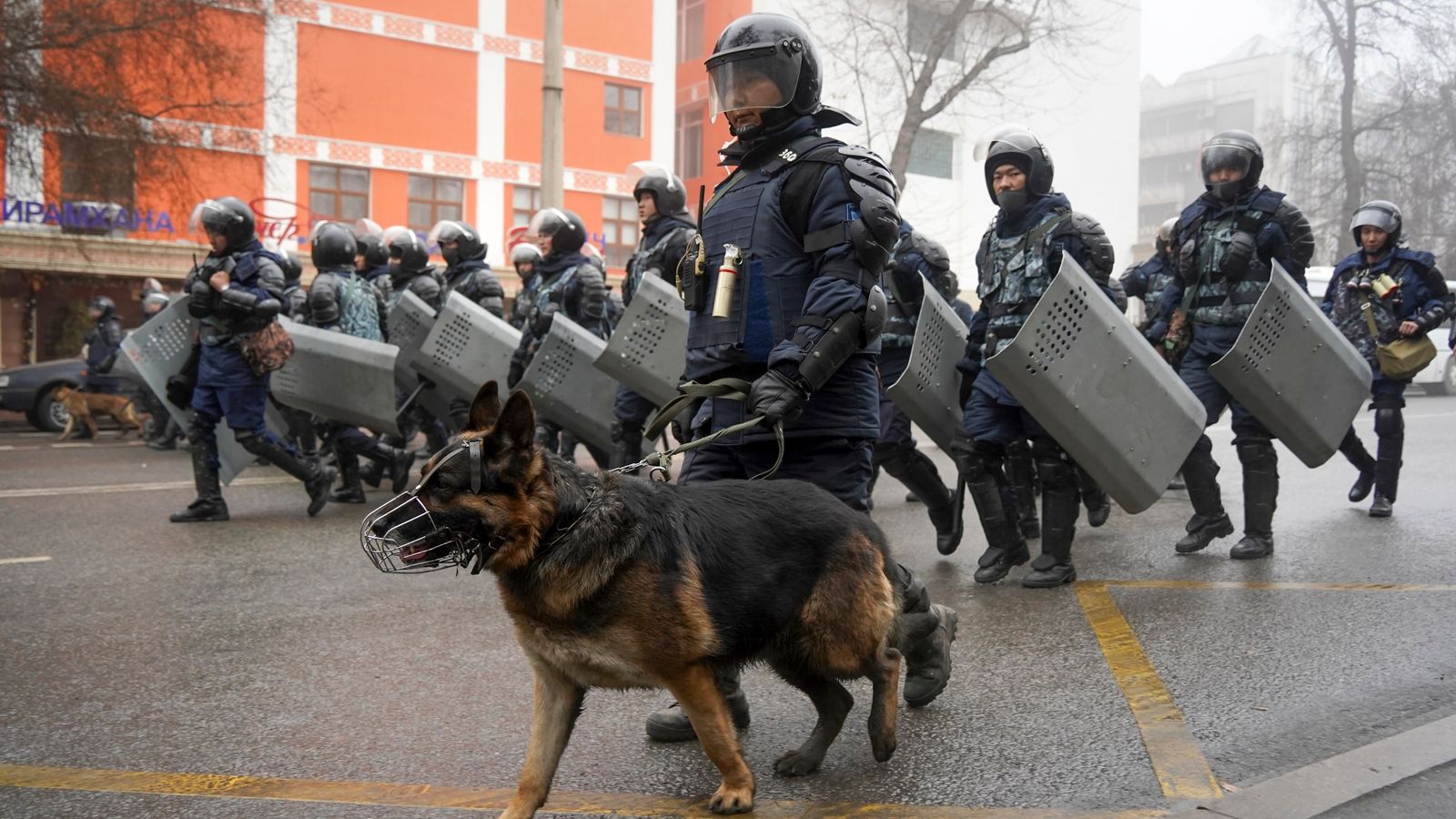
On Tuesday evening, video footage from Almaty, Kazakhstan's largest city, showed lines of riot police and numerous crowd control vehicles massed in the centre of the city.
Police used stun grenades and teargas after crowds refused to disperse, AFP reported, estimating there were more than 5,000 people present. Later, there were unverified reports of police cars on fire in Almaty, and videos from a number of other cities appeared to show protesters braving subzero temperatures and a large presence of security forces.
Mobile internet was down and messaging apps were blocked across large parts of the authoritarian Central Asian nation.
"All calls to storm or attack government buildings are absolutely illegal," Tokayev said in a video address on Tuesday evening.
In a tweet, Tokayev blamed the protests on "destructive individuals who want to undermine the stability and unity of our society". In an attempt to quell the unrest, however, he said the government would meet on Wednesday to discuss "the socio-economic demands" of protesters.
Late on Wednesday, he imposed a state of emergency covering Almaty and the western Mangystau province, which is due to last for two weeks.
The protests began over the weekend in the oil city of Zhanaozen, the same place where, in December 2011, police fired on protesters killing at least 16 people.
The initial spark for outrage was the sharply rising price of liquefied petroleum gas (LPG), used by many to power their cars, particularly in the west of Kazakhstan. The price doubled in a matter of days.
Tokayev said the government would introduce a price cap of 50 tenge (about 8p) a litre on LPG, roughly half the current market price, in Mangystau province.
Speaking to acting cabinet members, Tokayev ordered them and provincial governors to broaden the LPG price controls to gasoline, diesel and other "socially important" consumer goods.
He also ordered the government to develop a personal bankruptcy law and consider freezing utilities' prices and subsidising rent payments for poor families.
He said the situation was improving in protest-hit cities and towns after the state of emergency was declared which included a curfew and movement restrictions.
Tokayev is the handpicked successor of Nursultan Nazarbayev, a Soviet-era Communist boss who became Kazakhstan's first leader after independence and ruled for nearly three decades until he stepped down in 2019. The 81-year-old still wields enormous power behind the scenes, and the country's capital city was renamed Nur-Sultan in his honour in 2019.
Under Nazarbayev and his successor, a small elite have amassed enormous wealth, while life for many ordinary Kazakhs is still hard-going, particularly in the resource-rich west of the country. Rare protests have been ruthlessly crushed, and the regime faces no real opposition in parliament.
Separately, the interior ministry said that in addition to Almaty, government buildings were attacked in the southern cities of Shymkent and Taraz overnight, with 95 police officers wounded in clashes. Police have detained more than 200 people.










 WordPress.com



No comments:
Post a Comment