genderequalitygoals

genderequalitygoals

Friday, 27 January 2023

[New post] Explaining College Attendance Gaps: Academic Preparation

Site logo image conversableeconomist posted: " There are large gaps in college attendance between men and women and across ethnic groups. To what extent might these differences reflect academic preparation of students? Sarah Reber and Ember Smith provide some baseline information on these issues in "" Conversable Economist

Explaining College Attendance Gaps: Academic Preparation

conversableeconomist

Jan 27

There are large gaps in college attendance between men and women and across ethnic groups. To what extent might these differences reflect academic preparation of students? Sarah Reber and Ember Smith provide some baseline information on these issues in "College Enrollment Disparities: Understanding the Role of Academic Preparation (January 2023, Center on Children and Families at Brookings). They point out:

In 2022, young men [age 25-29] were nine percentage points less likely to have a bachelor's degree than young women (35% and 44%). ... Disparities in bachelor's degree attainment by race and ethnicity are large: 68% of Asian or Pacific Islander adults aged 25 to 29 have a bachelor's degree, compared with 45% of white,
28% of Black, and 25% of Hispanic young adults.

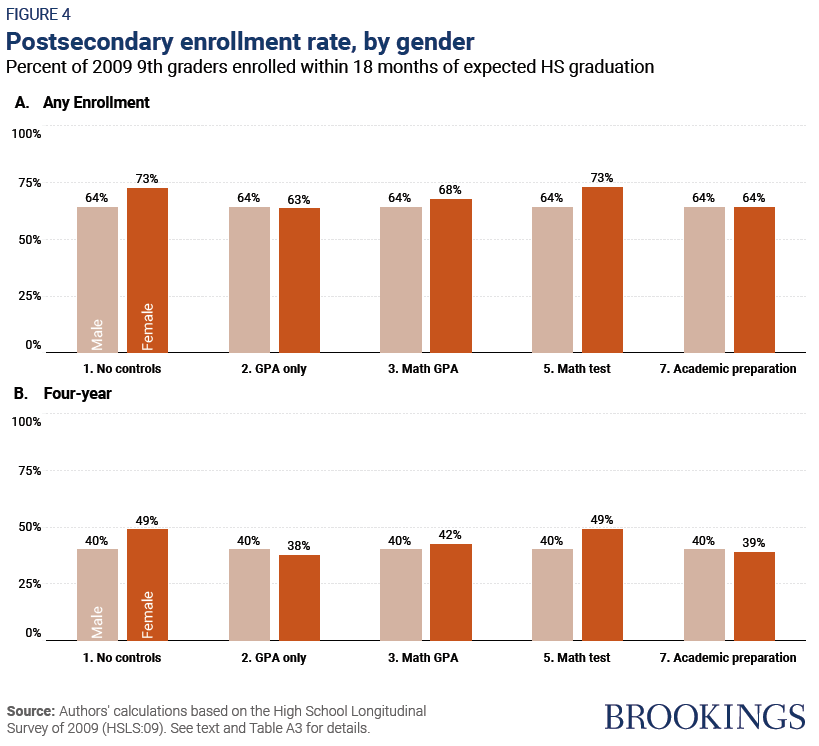
But what do these gaps look like if one takes academic preparation into account. In the figure, the top set of bars shows the likelihood of men and women enrolling in college at all--including two-year and four-year colleges--while the second set of bars shows only the likelihood of enrolling in a four-year college. The "No Controls" shows the overall average for males and females. But notice that when you compare those with similar grade point averages or levels of academic preparation, the gap goes away.

The authors write: "Taken together, the results by gender suggest that most or all gender gaps in college enrollment
are explained by differences in academic preparation. However, ... GPA explains essentially all, and math test score
explains none, of the gaps."

What are the patterns by ethnicity? Again, the top row of bars shows all colleges, and the bottom row shows just four-year colleges. The "No controls" shows the overall averages for each group. The striking pattern is that on average, Asians are more likely to attend college. But if one adjusts for grade point average or for overall academic achievement, blacks become the most likely group to attend college. The final two sets of bars show an adjustment for "socioeconomic status," which clearly reduces the differences across groups, and then a joint adjustment for socioeconomic status and academic preparation, which looks a lot like the adjustment just for academic adjustment alone.
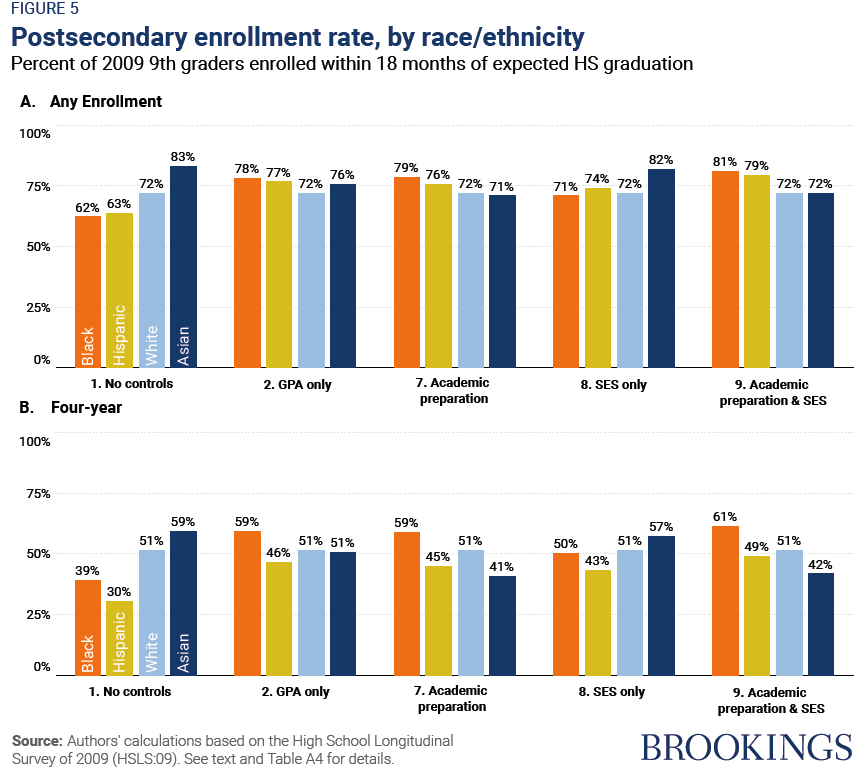
These types of results are just descriptions of patterns in the data. They are not studies that dig into cause-and-effect relationships or offer policy recommendations. In addition, the grade point average or academic preparation of a high school student is partly about the performance of K-12 schools, but also about differences across families, peer groups, and neighborhoods. But in my reading, this evidence strongly suggests that college attendance gaps across men and women, or across ethnic groups, largely reflect the academic preparation of high school students.


Unsubscribe to no longer receive posts from Conversable Economist.
Change your email settings at manage subscriptions.

Trouble clicking? Copy and paste this URL into your browser:
https://conversableeconomist.com/2023/01/27/explaining-college-attendance-gaps-academic-preparation/

Powered by WordPress.com
Download on the App Store Get it on Google Play
at January 27, 2023
Email ThisBlogThis!Share to XShare to FacebookShare to Pinterest

No comments:

Post a Comment

Newer Post Older Post Home
Subscribe to: Post Comments (Atom)

New Endorsement From Kelly Mahler For Restorying Autism

Pre-order while you can! ͏     ­͏     ­͏     ­͏     ­͏     ­͏     ­͏     ­͏     ­͏     ­͏     ­͏     ­͏     ­͏     ­͏     ­͏     ­͏     ­͏  ...

  • [New post] “You Might Go to Prison, Even if You’re Innocent”
    Delaw...
  • Autistic Mental Health Conference 2025
    Online & In-Person ͏     ­͏     ­͏     ­͏     ­͏     ­͏     ­͏     ­͏     ­͏     ­͏     ­͏     ­͏     ­͏     ­͏     ­͏     ­͏     ­͏    ...
  • [Blog Post] Principle #16: Take care of your teacher self.
    Dear Reader,  To read this week's post, click here:  https://teachingtenets.wordpress.com/2025/07/02/aphorism-24-take-care-of-your-teach...

Search This Blog

  • Home

About Me

GenderEqualityDigest
View my complete profile

Report Abuse

Blog Archive

  • January 2026 (48)
  • December 2025 (52)
  • November 2025 (57)
  • October 2025 (65)
  • September 2025 (71)
  • August 2025 (62)
  • July 2025 (59)
  • June 2025 (55)
  • May 2025 (34)
  • April 2025 (62)
  • March 2025 (50)
  • February 2025 (39)
  • January 2025 (44)
  • December 2024 (32)
  • November 2024 (19)
  • October 2024 (15)
  • September 2024 (19)
  • August 2024 (2651)
  • July 2024 (3129)
  • June 2024 (2936)
  • May 2024 (3138)
  • April 2024 (3103)
  • March 2024 (3214)
  • February 2024 (3054)
  • January 2024 (3244)
  • December 2023 (3092)
  • November 2023 (2678)
  • October 2023 (2235)
  • September 2023 (1691)
  • August 2023 (1347)
  • July 2023 (1465)
  • June 2023 (1484)
  • May 2023 (1488)
  • April 2023 (1383)
  • March 2023 (1469)
  • February 2023 (1268)
  • January 2023 (1364)
  • December 2022 (1351)
  • November 2022 (1343)
  • October 2022 (1062)
  • September 2022 (993)
  • August 2022 (1355)
  • July 2022 (1771)
  • June 2022 (1299)
  • May 2022 (1228)
  • April 2022 (1325)
  • March 2022 (1264)
  • February 2022 (858)
  • January 2022 (903)
  • December 2021 (1201)
  • November 2021 (3152)
  • October 2021 (2609)
Powered by Blogger.