Alison posted: " When I was writing JULIA PRIMA, my research about her hometown of Virunum uncovered the story of the Youth of Magdalensberg (Der Jüngling vom Magdalensberg), an ancient Roman bronze statue dating to the first century BC. Now, Romans, statues – nothing n" Alison Morton's Thrillers
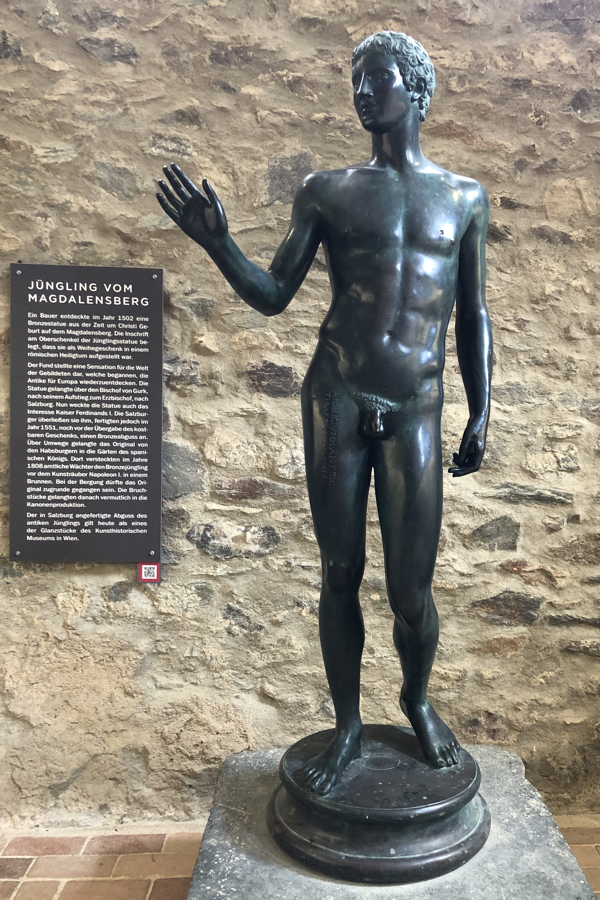
Modern copy in the collection of the Landesmuseum Kärnten at Magdalensberg
When I was writing JULIA PRIMA, my research about her hometown of Virunum uncovered the story of the Youth of Magdalensberg (Der Jüngling vom Magdalensberg), an ancient Roman bronze statue dating to the first century BC. Now, Romans, statues – nothing new, you might think. There are thousands of them; we know the Romans left a lot of 'stuff' behind.
But this one is surrounded, or even shrouded, in mystery as it's been missing since the 1810s and is now presumed lost.
I did promise in June to relate this story, but the York and Colchester festivals intervened. However, this mystery has existed for a couple of centuries, so I hope you forgive me a couple of months' delay.
So, let's unravel it…
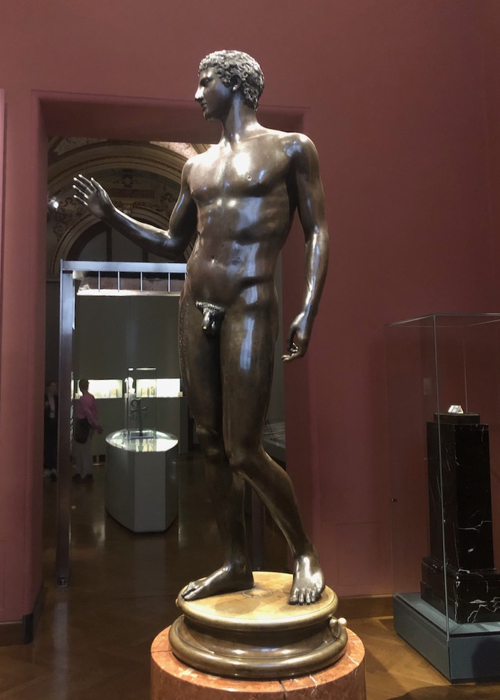
The statue of a rather well-formed, naked young man was discovered in 1502 in Carinthia in the south of Austria on the Magdalensberg mountain, once the major late Celtic and early Roman city of Noricum that we know and love. But what we see today is a 16th century cast now held in the Kunsthistorisches Museum, Vienna and until 1986 was mistakenly regarded as the original.
16th century 'original copy' of the Youth of Magdalensberg in the Kunsthistorisches Museum, Vienna
When I visited the Magdalensberg this summer, I was delighted to see the Youth in his splendid beauty as in the photo above. It's a remarkably intact and high quality find – well buried apparently. But this is a modern copy of the one in Vienna.
Imagine how pleased I was to see the 'original copy' – the 16th century cast – when I visited the Kunsthistorisches Museum in Vienna a week later. It's a huge, awe-inspiring building in itself in the grand imperial style, but I confined myself to visiting the Roman rooms – I was on a mission!
When I found him – it was quite a quest given the richness and variety of stunning exhibits – I actually said out loud, 'There you are' as if I knew him personally. Other visitors nearby moved on quickly. They must have been wondering who this mad Englishwoman was.
(The light wasn't very good in the museum as it's deliberately kept subdued so as not to batter ancient objects with too many lumens, so my photo is a bit dark.)
But the Youth's story is tied up firmly with the history of Virunum and Noricum itself.
Let's get into detail
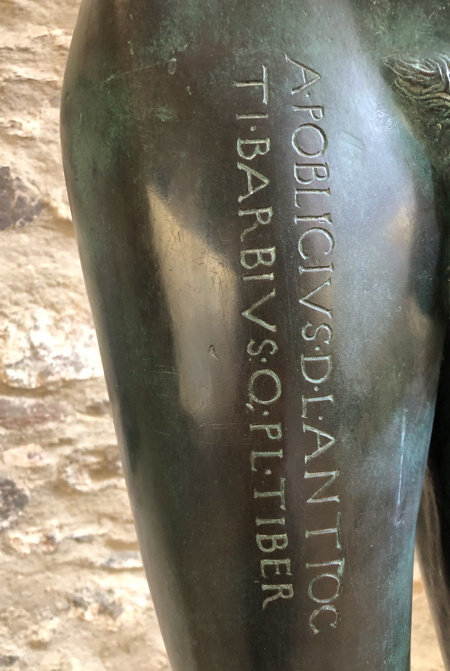
The statue is about life size, more precisely 1.85 metres (6'1"). His right thigh is of great interest. (No, not that sort!)
English: (M[arcus] Gallicinus, son of Vindilus; L[ucius] Barb[ius] Philoterus, fr[eedman] of L[ucius]; Craxsantus, s[lave] of Barbi[us] P[ublius])
The donors of the shield seem to be a free Celt, a freedman of the North Italian gens Barbia and local Celtic slave of the same family. One of the two donors of the Youth itself was also from this family.
But who is the statue meant to represent?
Of course, no nobody agrees. The inscriptions by themselves don't identify the figure as a god. Recent interpretations think it might be a cult statue of a Celtic Mars from the sanctuary on the mountaintop, or as a priest from Noreia (the ancient lost city of Noricum - see the note in this post about my scepticism). Could it have been part of a statue group dedicated to Noreia, or as a statue of Mercury which stood in the town's forum?
I have my own thoughts which I shall be including in the sequel to JULIA PRIMA.
The disappearing statue – a historical mystery of its own
The Youth was found in 1502 by a farmer ploughing on a terrace south of the summit. Soon afterwards, it 'came into the possession' of Matthäus Lang von Wellenburg, the Bishop of Gurk . (Make your own conclusion how that happened.) He took it with him to Salzburg in 1519 when he became Archbishop of Salzburg.
Until the 1980s it was assumed that the statue had come from Salzburg to Vienna in 1806 following the Peace of Pressburg. However, investigations of the casting technique and scientific analysis of the metal in 1986 led to the realisation that the statue in Vienna was a cast made in the sixteenth century.
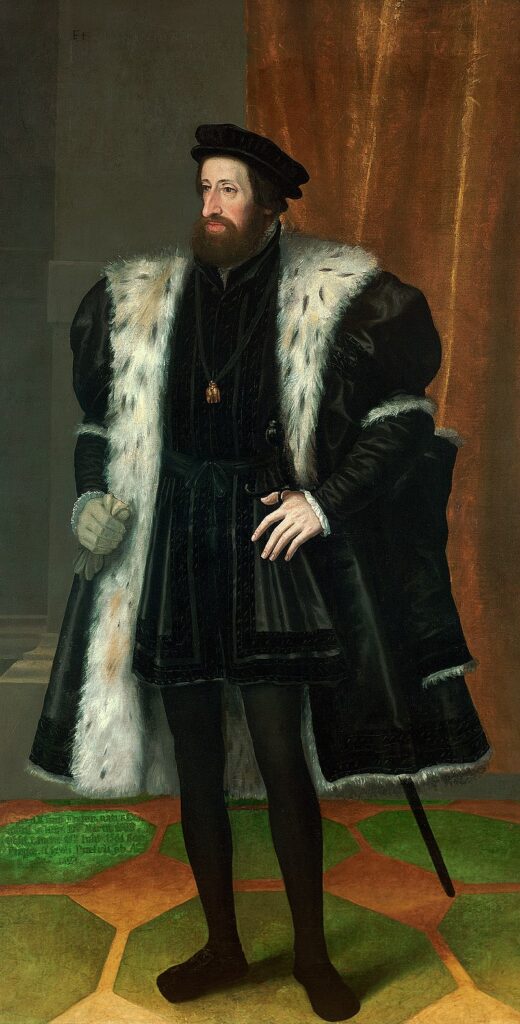
Ferdinand I by (the said) Hans Bocksberger the Elder
Then everything becomes very murky. Documents in the Salzburg cathedral chapter reveal that Emperor Ferdinand I owned it in 1551. A cast was made which ended up in Vienna in 1806. The original was moved to Spain, where it is attested in 1662 and 1786 as being in the gardens of the Royal Palace of Aranjuez.
But one thing is sure – the original definitely existed. The Youth is the only ancient full-size bronze statue known from the Eastern Alpine region and therefore is of great significance in Austria.
Two illustrations of the original statue are known. The first comes from Peter Apian and Bartholemew Amand's Inscriptiones Sacrosanctae Vetustatis of 1534, the other from a fresco by Austrian painter Hans Bocksberger the Elder in the chapel aisle of the Landshut Residence, Lower Bavaria from 1542.
But from the beginning of the 19th century, the original statue disappears. Did it end up in a private collection? Is it mouldering away in somebody's garden and turned green? Was it melted down for the bronze? Or did it return incognito to a small country in central Europe that still lived by Roman values and culture…?






No comments:
Post a Comment