In all of classical music, is there a composition more instantly recognizable around the world than "The William Tell Overture" by Gioachino Rossini? I think not. "The William Tell Overture" is a twelve minute long composition that is broken down into four sections. It is the finale, or final part, of these four sections that has made this overture famous. If you are old enough to have ever watched The Lone Ranger on TV or at the movies, then you have heard "The William Tell Overture". For that matter, if you have ever watched a chase scene on horseback, chances are "The William Tell Overture" has been the soundtrack to that scene. It isn't by fluke that this overture has come to be associated with horses and with action scenes. The original composition by Rossini is from an opera entitled Guillaume Tell, which is a musical retelling of the legend of the man named William Tell. To understand the cultural significance of "The William Tell Overture", it is helpful to know the story of William Tell itself. So let's start there. To do that, we must travel to the majestic Swiss Alps, specifically to Lake Lucerne in Switzerland, because the story of William Tell is actually the story of how Switzerland came to be as a nation.
I'll be honest with you. Prior to conducting my research, I did not know that William Tell was Swiss. Like many of you I assume, I had a passing familiarity with the legendary tale which included knowing about him shooting an apple off of his son's head, but truthfully, I didn't know much more than that. To be doubly honest, I never really cared to know more. The world is filled with bits of information all clamouring for my attention. That bit about the apple and the arrow never really seemed that worthy of my thoughts. In fact, if you had asked me a week ago if the legend of William Tell was a factual story or a work of creative fiction and storytelling, I would probably have put my money down on the latter. I would have been poorer as a result, because the story of William Tell is, in fact, based on true historical events that helped shape the Swiss nation into the country that we know today. Here is what you need to know.

A statue of William Tell and his son.
Almost a millennium ago (and half a century before Rossini wrote his famous overture), the area that is now known as Switzerland was part of The Habsburg Empire of Austria. The original inhabitants of what was to become Switzerland lived in three areas, or cantons, known as Uri, Unterwalden and Schwyz. At the time, in the 1300s, Austria ruled the region with an iron fist. There was much discontent among those who lived under such rule. Eventually, there was talk of an uprising. In the canton of Uri, a new district manager named Albrecht Gessler was appointed by the Habsburg royal court to investigate the rumours of insurrection that were swirling. When he arrived in Uri, he immediately removed his hat, attached it to a flagpole in the centre of town, raised it to the sky and commanded everyone who walked under his hat to bow down to him and submit to his authority. The legend of William Tell states that he and his son walked past Gessler and under the flagpole with the most polite of manners but without bowing in subjugation as ordered. Gessler immediately had the two arrested and threatened them both with execution. But then Gessler had an evil idea which pleased him to no end. He knew who William Tell was and that he had a reputation as being an expert marksman, so he offered to spare his life and that of his son. But first, Tell would have to shoot an apple off of the top of his son's head. If he missed the apple, he and the boy would be killed. If Tell missed the apple and ended up hitting his son in the head, the son would still be killed anyway and William Tell would be executed shortly thereafter. Gessler wagered that the odds of Tell hitting a small apple off of the head of a small boy from a great distance were in his favour. He felt giddy with anticipation. William Tell had no choice but to accept the challenge. His son was placed with his back against a tree. Tell was marched some distance away. At Gessler's command, William Tell reached into his quiver and, unbeknownst to Gessler, withdrew two arrows. Tell placed the two arrows, one atop the other, against his bow. He drew the bow back and let the first arrow fly. As you may know, that arrow sliced the apple in half, without touching a single hair on his son's head. William Tell had saved his son's life! Much to his chagrin, Gessler acknowledged that by the terms of his challenge they both could now go freely on their way. But then he noticed the second arrow still in William Tell's hand. He asked why it was there. Tell replied that if he had hurt his son with the first arrow, then the second arrow was going straight for Gessler's heart. Gessler's tone changed immediately, and once again he commanded that William Tell be arrested and executed. But William Tell was prepared this time. He let the arrow fly and assassinated Gessler, striking a blow against tyranny for his compatriots. In the confusion that followed, William Tell attempted to escape but was captured by Habsburg guardsmen. He was taken to Lake Lucerne, placed in a boat with a crew of guardsmen, and together they set sail. Not long after departing, the boat began to take on water and sink. The guardsmen did not know how to save the boat, but they knew that William Tell had expertise in sailing, in addition to marksmanship. After a short discussion, it was decided that Tell should be unshackled under the condition that he helm the ship and get everyone safely back to shore. If he was to do so, then his assistance would be taken into consideration at his trial. Naturally, William Tell had no intention of saving the Habsburg guardsmen. He did get the ship close to shore, but then he jumped out and swam the rest of the way to safety. While this was going on, Swiss militiamen from several other cantons had organized themselves and appeared on the shore to welcome William Tell back. The entire incident was the start of an uprising that ended with the various cantons coming together to form the Swiss Confederacy.
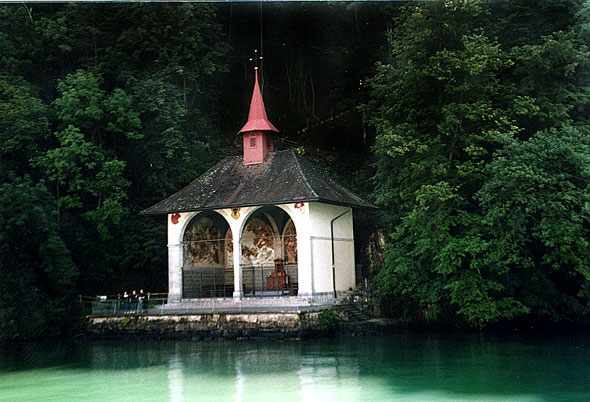
Tellsplatte on the shores of Lake Lucerne in Switzerland.
The events that form the legend of William Tell were first recorded in old songs that were passed down from generation to generation. In time, these events were chronicled in a historical record known as The White Book of Samen. Over the course of several generations, a variety of writers added detail and clarity to the words recorded in The White Book of Samen, the most famous being a man named Aegidius Tschudi, whose version of the historical record is the one most commonly referenced whenever the story of William Tell is told. It was the Tschudi account that formed the basis of Gioachino Rossini's operatic take known as Guillaume Tell. In Rossini's opera, his overture is played during the scenes that reenact the assassination of Gessler by Tell. William Tell's escape while being pursued by the Habsburg guardsmen is the scene that is performed on stage while the classic finale to the overture (or The Lone Ranger theme) plays on. To this day, if you ever find yourself in Switzerland and specifically at Lake Lucerne, keep your eye out for a church along the shore that is known as Tellsplatte (or Tell's Slab) which marks the exact spot that William Tell was able to leap from the boat and make it safely back to shore. Tellsplatte is directly across the Bay of Uri from a place called a Rütli, or a meadow, on the banks of Lake Lucerne. It was at the Rütli that William Tell and the leaders of the other Swiss cantons swore an oath of unity and cooperation that served as the foundation of the creation of The Swiss Confederacy. The Rütli Oath is one of the most historically important moments in Swiss history. It is also an integral part of the legend of William Tell, which the "William Tell Overture" helped to make famous in the rest of the world.
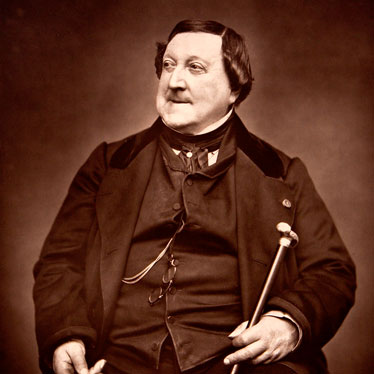
Gioachino Rossini
There is an interesting side note to all of this. Gioachino Rossini was known throughout Europe for his operas. In addition to Guillaume Tell, Rossini is also credited with another one of the most famous operas of all time, The Barber of Seville. He created thirty-nine operas in all over the course of his career. Rossini was only 37 years of age when he composed "The William Tell Overture" for his opera Guillaume Tell. Like many of his previous works, Guillaume Tell was performed to great acclaim. It was performed dozens of times at all of the greatest opera houses in Europe. In particular, "The William Tell Overture" was received with a level of adoration akin to that of modern day rock stars when they perform their hits in concert. Rossini's fans, patrons and admirers waited in breathless anticipation to see what he would come up with to top his overture. They waited. They waited some more. All to no avail because, just like that, at the height of his fame and his compositional prowess, Gioachino Rossini retired from public life. Until his death forty years later, Rossini completely disappeared from the great stages of the world. He was content to host intimate recitals at his home on a vineyard that he bought. Rossini never gave a reason for his decision to withdraw from public life, but many have speculated that he viewed "The William Tell Overture" as a composition so perfect in every way that he could never top it no matter how hard he tried. So, instead of trying and failing, he decided to walk away after having achieved the pinnacle of success. That must not have been an easy decision to make. Thirty-seven is still awfully young to cease being creative. But from everything that I have read about him, he was at peace with his decision and lived out the rest of his days in happiness. Who am I to disagree with what he did? Good for Gioachino Rossini. Knowing yourself and what is right for you is one of the keys to living a happy life. Regardless of his retirement, the world is left with one of the most beloved and replicated pieces of classical music ever recorded. That was Rossini's gift to us, just as the story of the overture is about William Tell's gift to his homeland of Switzerland. All in all, a job well done, gentlemen. A job well done, indeed.
The link to the video for the composition "The William Tell Overture" by Gioachino Rossini can be found here. ***NOTE: The overture is performed in four parts. The first part is a calm, pastoral section that was inspired after Rossini had watched a performance of Beethoven's Eroica, which was about French Emperor Napoleon. *(Eroica was written about in a previous post that you can read here). The heroic nature of Beethoven's work is said to have encouraged Rossini to create a similar hero-centric work in Guillaume Tell. In any case, the famous "Lone Ranger" section happens in the fourth part, just so you know.
The link to an official website for Gioachino Rossini can be found here.
The link to an official website for William Tell can be found here.
The link to the official website for the Lake Lucerne region of Switzerland can be found here.
***As always, all original content contained within this post remains the sole property of the author. No portion of this post shall be reblogged, copied or shared in any manner without the express written consent of the author. ©2023 http://www.tommacinneswriter.com




No comments:
Post a Comment