It was over eighty years ago that The Wizard of Oz had its premiere. It was being filmed at the same time as other classic movies such as Gone With the Wind, Mr. Smith Goes to Washington and many more. These movies were made during a time that has come to be known as the golden age of cinema. This was a period in the history of film making that solidified the transition from silent movies to "talkies". It was also a period of technical innovation and creativity when it came to how movies were filmed and how they were viewed. It was a time when people like Clark Gable, Jimmy Stewart, Vivian Leigh, Humphrey Bogart and Lauren Bacall all became household names. Finally, it was the height of an era in Hollywood known as the studio system, where iron-fisted movie moguls controlled every aspect of how films were made and who got to make them. All of these moments from the golden age of cinema play a part in the telling of the story of The Wizard of Oz. It is a story of fantastic technical innovation, the carving out of career-defining roles, the introduction of a film genre that is still thriving today, the politics of the Communist witch hunts of the 1950s and finally, it is the story of abuse that eventually ended up being cited as one of the reasons for the formation of acting unions and of the introduction of labour laws that helped protect actors and film crews while making movies in Hollywood. There are few movies in the history of cinema quite like The Wizard of Oz and few more beloved songs than "Over the Rainbow". Let's lower the lights and open the curtains, the show is about to begin. Enjoy.

The Wizard of Oz was based upon the children's novel The Wonderful Wizard of Oz by L. Frank Baum. The movie was made in 1939. Two years earlier, Walt Disney had stunned the world when he released his full-length animated feature Snow White and the Seven Dwarfs to much acclaim and box office success. Hollywood then was no different than Hollywood now. When someone had great success with an original idea, suddenly there were imitators everywhere. What Walt Disney proved with Snow White and the Seven Dwarfs was that there was a market for full-length movies aimed at children and families. Up until that time, the vast majority of movies were made for adult audiences. The rights to Baum's The Wonderful Wizard of Oz were purchased by MGM Studios, who hoped to replicate Walt Disney's success. The reason that this particular book was chosen by Samuel Goldwyn (the "G" in MGM Studios) was because its setting and storyline were such that they provided the studio with an opportunity to dive headlong into a new form of technology called Technicolor. Colour plays a very prominent role in The Wizard of Oz. Its significance can be found in the yellow brick road that the characters follow, the grandeur of the Land of Oz, the riot of colours in Munchkin Land and, of course, we have Dorothy's ruby red slippers and the Wicked Witch of the West's ugly green skin and so much more. Colour is used in this movie for more than just the visual effect of it all. The Wizard of Oz is, above all else, one of those movies in which a life journey is a major plot device that propels the storyline forward. As this journey unfolds, colours become significant to the setting of moods and emotions and the development of individual characters and their quests for completeness, too. Thus, the novel seemed like the perfect vehicle for MGM Studios to experiment with the use of Technicolor technology over the course of an entire film. Technicolor, as associated with filmmaking, was a technique that was developed at the Massachusetts Institute of Technology in Boston. (The "Tech" in Technicolor comes from M.I.T.). Without going into too much detail, Technicolor was a process of saturating film with bright light in a way that made the colours seem extra vibrant and rich. This technique was achieved on set by the use of extra studio lights, beyond the normal amount that would be needed to light a scene. Thus, when Dorothy emerged from her house after the tornado, leaving drab sepia-toned Kansas behind and emerging into the vibrantly-coloured Land of Oz, the effect on screen was startling to audiences in 1939. Furthermore, the fact that L. Frank Baum's novel was a fantasy novel allowed MGM Studios to use special effects (for the tornado scene and for the flying monkeys) and makeup in ways that had never been attempted before in a feature film. The Wizard of Oz is consistently rated by fans and critics alike as being one of the best films of all time. It is easy to allow nostalgia to colour our perceptions in cases like this, but the truth of the matter is that The Wizard of Oz was one of the most technologically advanced movies of its day. Its use of colour and live action paved the way for every other movie that Hollywood has produced since. The Wizard of Oz comes by its accolades honestly.
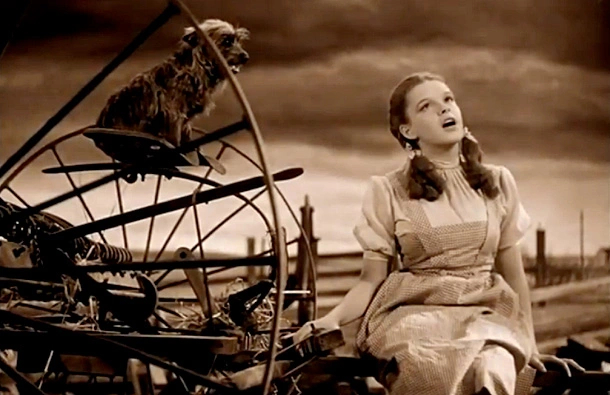
Judy Garland sings "Over the Rainbow". Note the sepia tone of the film's colour.
At the very beginning of the film, a young girl named Dorothy finds herself in Kansas being pestered by a cranky old lady who has issues with Dorothy's dog, Toto. When Dorothy complains about this lady to Auntie Em, she is told to mind her business and find somewhere else to play. As Dorothy gazes out at the endless yellow/brown countryside of Kansas before her, she feels as though her life will never change. It will always be drab and boring, and she and Toto will never have the freedom to live as they wish. Thus, she begins to sing a song whose lyrics dream of a world of magical possibilities. This song was "Over the Rainbow". It is a song laden with emotions that any teenager could relate to such as feeling grown up but not being allowed yet to follow your own dreams. Because "Over the Rainbow" was the first song sung in a movie that was actually a musical, audiences didn't automatically know that "Over the Rainbow" would come to symbolize the life journey that Dorothy would undergo by the time she finally met the Wizard of Oz and dispatched the Wicked Witch of the West. Growing up happens for all of us in very different ways. For Dorothy, some of those ways involved looking beyond herself to learn that by helping others find happiness, she could find happiness, too. "Over the Rainbow" was released as part of the original soundtrack for the movie, making this soundtrack one of the very first feature film soundtracks to ever be produced and sold in stores. It also became the theme song for which Judy Garland became famous. Finally, it was given the Academy Award for Best Song. "Over the Rainbow" has come to be synonymous with the movie itself. It is routinely ranked as the #1 song from any movie in the history of Hollywood moviemaking.
Despite all of the fondness with which The Wizard of Oz is viewed as part of Hollywood's cinematic canon, there is a tawdry tabloid side to the making of this film, too. In fact, there are whole books written about how difficult an experience it was to make this movie for almost everyone involved. The stories that I read about it reminded me of the stories I read about Francis Ford Coppola and the making of the film Apocalypse Now in the jungles of Cambodia in the 1970s. For what was ostensibly a children's movie, The Wizard of Oz turned out to be one of the most difficult and dangerous movies ever made. The impact of the experience of filming it changed those who were involved, emotionally, spiritually and physically, as you shall see. Let's start where we left off, with the song "Over the Rainbow".
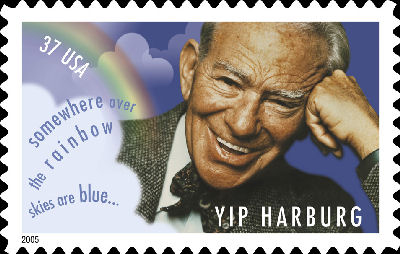
"Over the Rainbow" was written by two men named Harold Arlen and Yip Harburg. Arlen composed the musical structure of the song and Harburg wrote the lyrics. The two men formed a musical partnership that began long before The Wizard of Oz. Initially, Harburg was a librettist, which, as you may remember from our Keepin' It Classy series, was a person who wrote the words for the scenes in operas so that audiences could follow along with the singing as it all went on. Harburg and Arlen had worked together on many films, but "Over the Rainbow" was their first Oscar win. Winning an Academy Award thrust both men into the spotlight and brought more attention to them than they had ever experienced before. Harburg, in particular, warmed to the spotlight and used this opportunity to promote his political views which, as it turned out, were socialist in nature. After WWII and into the 1950s, Harburg ended up being one of the many Hollywood figures who found themselves singled out by Sen. Joseph McCarthy and his hearings aimed at uprooting Communist sympathizers from positions of influence in America. Harburg ended up being blacklisted and never again worked on a film set until the mid-1960s. If not for the success of "Over the Rainbow", Harburg may have flown under the radar and enjoyed an uninterrupted career.
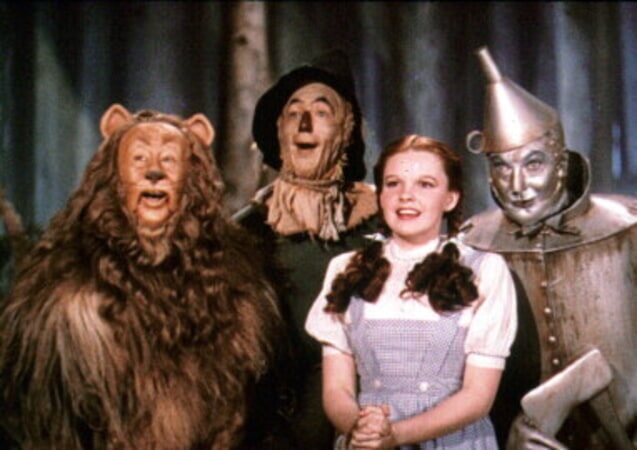
Bert Lahr, Ray Bolger, Judy Garland and Jack Haley (who replaced Buddy Ebsen).
When Judy Garland was given the role of Dorothy, she was only sixteen years old (she turned seventeen as filming progressed). Technically, she was still considered a child in the eyes of the law. Unfortunately for Garland, child labour laws did not apply to her at that time. At the time when movie studios were at the heights of their power and control, actors and crew members alike had little say in their working conditions. They were hired and fired at will. They were paid very little and asked to work long hours under conditions that could be deemed unsafe and unhealthy. They were often viewed as chattel. This was certainly the case for the child actor known as Judy Garland. You may recall in a previous post that I wrote about the movie Home Alone (that you can read here), I talked about how Macaulay Culkin's age and the laws that came into play to protect him made it challenging for the movie's directors to film many of his scenes. Well, the laws that were in place to protect Culkin and other child actors today came about partly as a result of what happened to Judy Garland while filming The Wizard of Oz. Although The Wizard of Oz was a children's movie, Judy Garland was the only child on set. In a cast that could number into the hundreds for certain scenes, Judy Garland was not only the only child on the set, but she was often the only female. Aside from those scenes in which she was with one of the witches, the teenage Garland was constantly surrounded by men. It was not easy to be a teenage girl on a male-dominated set back way before #MeToo sentiments became more readily accepted by society. There are many reports of Garland having to have her breasts bound to hide her maturity, being groped by fellow actors and crew and being subjected to catcalls and other misogynistic behaviour. As if that wasn't enough, it was quite common for filming to start in the early morning and extend into the night. There were no laws that limited the amount of hours Garland was being forced to work. In order to get her through those long work days, she was put on a diet of medication that caused her to stay alert longer than a child would normally be able to do. So while Judy Garland gained fame from her role as Dorothy and got a song to sing that became her signature song in "Over the Rainbow", she paid a terrible price. There are many who claim that her addiction to pills and alcohol began because of her experience on the set of The Wizard of Oz.
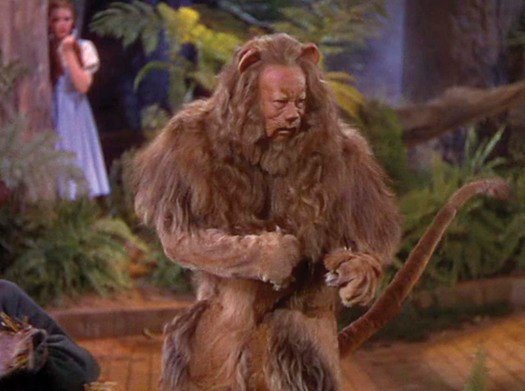
Note the heavy costume that Bert Lahr was required to wear each day on set. The pelt was made from real lion fur and weighed between fifty-one hundred pounds.
If labour laws aimed at protecting a child like Judy Garland were basically non-existent, perhaps, you might think, there were laws that at least protected the adults on set. Well, the answer to that is no, as well. It wasn't just what happened on the set of The Wizard of Oz that prompted the eventual formation of acting unions like the Screen Actors Guild, but it certainly played a historic part. Because of the extensive use of makeup and of some of the technological innovations that were being introduced, the set of The Wizard of Oz was a dangerous place to be. Three quick examples can be found in the use of Technicolor itself, the application of makeup that contained toxic chemicals and the use of fire on the set as well. First things first: as mentioned earlier in this post, Technicolor required the use of extra stage lights in order to saturate colours with as much light as possible. If you have ever stood on a regular stage being lit with regular lighting, you will understand that stage lights create warmth for the actors on stage. Under normal circumstances, the warmth that emanates from these stage lights is noticeable but manageable and functions at a safe and acceptable level for the health of the actors. Well, on the set of The Wizard of Oz, the amount of normal lighting was often doubled so as to get the Technicolor effect that filmmakers were looking for. This caused the temperature on set to often soar to over one hundred degrees. If you combine that with the very long hours that the actors and crew were forced to work each day, you can see how this could create a dangerous set of working conditions. Many of the actors and crew became dehydrated on set and several ended up becoming sick. Hydration breaks, cooling stations and, most importantly, shorter work days were not things available to those working on The Wizard of Oz. Secondly, in association with the heat from the lights, many of the actors who regularly wore makeup became sick and/or disfigured because of the makeup they were required to wear on set. In some cases the makeup, itself, was composed of toxic chemicals which caused respiratory illness or skin diseases. A prime example of this happened with actor Buddy Ebsen (who went on to gain a measure of fame as Jed Clampett on The Beverly Hillbillies TV show). He was the original actor signed on to play the Tin Man. As you may know, the Tin Man's face was slathered in silver "paint". The chemicals in this "paint" caused Ebsen to develop throat problems and forced him to drop out of production. Bert Lahr, who played the Cowardly Lion, was forced to wear thick rubber-based masks that were glued on to his skin each day. This rubber compound was dense and did not allow for air to reach his skin. Under the intense heat of the stage lights, Lahr developed skin problems and even had scarring around his mouth from the constant removal of the glue used to affix his rubber mask each day. Margaret Hamilton, who played the Wicked Witch of the West, had the same skin reaction as Buddy Ebsen due to the toxic chemicals in the green paint used on her face. But she also had a different dangerous thing happen to her. During a scene in which Dorothy throws water upon her and she, in character, melts and disappears in a puff of smoke, real flames were used to create the smoke. When it came time to actually film this scene, as Hamilton's character was lowered below the soundstage (as she "melted" away), her costume caught fire and she received third degree burns. She was forced into hospital and any scenes involving her had to be shot weeks later, thus prolonging the length of the movie's production. I won't even begin to get started on how little the "munchkins" actors were paid for the amount of time they worked nor some of the things that happened while trying to make monkeys fly, but suffice it to say, a movie set in the 1930s during the apex of the studio system was not the safest place to be.
It is easy to look back upon labour stories such as this with shock and disgust. However, many workplaces at the time were not governed by workplace safety laws and thus, the work life expectancy of a daily labourer was not all that high. It was through the efforts of activists back in the day who experienced the horror of inhaling toxic chemicals, working with dangerous materials or in unsafe locations and yes, seeing children being made to perform difficult tasks while denying them the protection that would be afforded them by a parent, guardian or caring adult in normal circumstances, that paved the way for many of the labour laws we have in place today. Sure, Judy Garland gained fame and got to sing a career-defining song, Yip Harburg won an Oscar for himself, and MGM Studios got to produce one of the most beloved movies ever made, but the greater legacy may just be the safer movie sets that exist today that came into being as a result of what happened on the set of The Wizard of Oz. There is an element of magic when it comes to movie making in Hollywood. That magic certainly was brought to life in The Wizard of Oz, but, as we all found out when the curtain was pulled back on the Wizard, himself, sometimes that magic has to come from each of us. Not all magical moments come complete with a Technicolor dreamscape. Sometimes, the magic is in simply caring for each other and keeping ourselves safe so that we can continue to turn our imaginings into wondrous realities each new day. Whatever the case, the key to a fulfilling life is not somewhere "Over the Rainbow"; it is right where you are right now. Have a wonderful day. Look for the magic that exists all around you.Thank you for sharing some of this day with me.
The link to the trailer for the movie The Wizard of Oz can be found here.
The link to the video for the song "Over the Rainbow" by Judy Garland from the Original Motion Picture Soundtrack for the Film The Wizard of Oz can be found here. ***The lyrics version is here.
The link to a video that describes some of the issues that arose on the set of The Wizard of Oz can be found here.
***As always, all original content contained in this post remains the sole property of the author. No portion of this post shall be reblogged, copied or shared in any manner without the express written consent of the author. ©2024 http://www.tommacinneswriter.com




No comments:
Post a Comment