By Jalen Furlough and Jaida Newhouse
Television is a powerful medium used everyday for shaping cultural perspectives and narratives. In the past few years we have seen improvements in diversity in casting, yet its portrayal of queer characters, especially queer people of color, often falls short on authenticity and plays into harmful stereotypes. More often than not, queer people of color are hypersexualized in television and reduce their complex identities to merely objects of desire and one-dimensional caricatures. The abundant over sexualization of queer people in television perpetuates harmful ideology, reinforces power dynamics, and contributes to the erasure of their multifaceted identities, hindering progress towards inclusive media representation.

The Michigan Gayly
With the great increase of media consumption over time many of our beliefs and behaviors are molded by said media, especially TV. We binge shows, rewatch them, and often have many seasons to watch a character as they develop. Because we spend so much time with these characters across seasons and TV has such an impact on us, the representations of queer people of color inform our own ideologies about them. A stereotype against queer Black women is that they are usually hypermasculine hence the term "stud" which refers to queer Black women who identify as more masculine. However, the term itself is defined as "a handsome man". Of course over time, "studs" adopted the term collectively, but the origins of the label is worth noting. Intersectionality is also at play in this stereotype as Black women are viewed as "less soft" in comparison to other women so in addition to being queer, it only worsens. An example of this is evident in the show All American with the Black lesbian character, Coop. The character was even originally written as a male character based on Spencer Paysinger — the best friend of the show's inspiration Spencer Paysinger. This in itself is an issue as it wasn't actually written inspired by a black queer woman and her actual experiences but reflects the experience of a man. Coop not only exhibits the stereotype of a Black lesbian but also some stereotyped traits of Black people in general like how she hangs with gang members, sells drugs, and was kicked out from home due to her heavily christian mom. In relation to Black family dynamics in TV and queer characters, Brown claims, "television comedies have "made no space for the imagining of a BLAMPY viewer—ones who are Black, liberal, affluent, metropolitan professionals and who understand that gayness can be a part of the fabric of Black television families." There are rarely queer Black characters in family oriented spaces in TV but they definitely exist.

New York Post
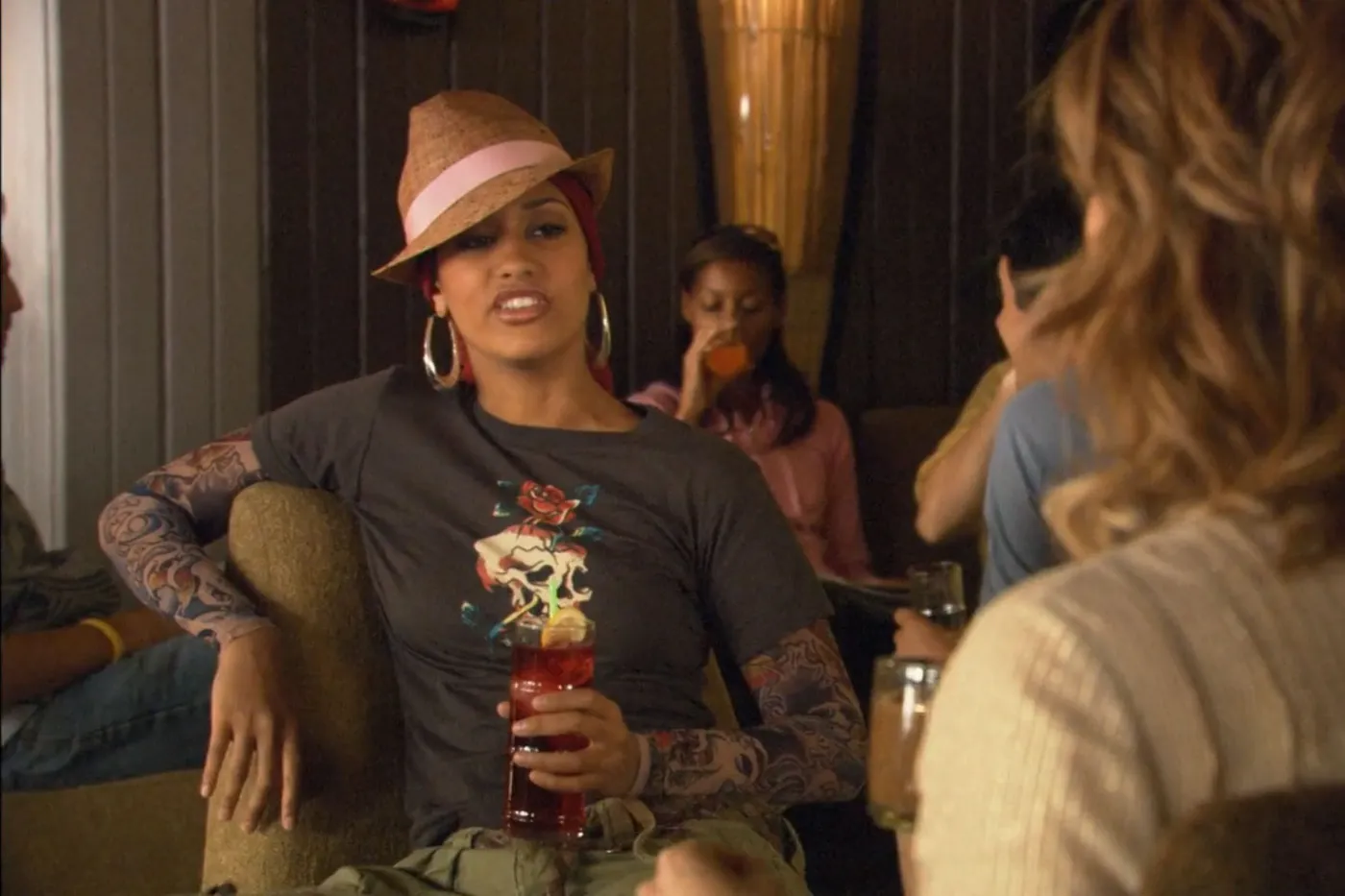
In "Cultural Representations of Lesbianism and the Lesbian Body in the 1990s," by Ann Ciasullo, she explains how the lesbian body had to be coded in order to be palatable to a broadly heterosexual public (609). We can observe this with the character Papi in the 2000s television show "The L Word." The show provided a space for proliferation and away from cliches but was often criticized for playing into the "male gaze" and lacking nuanced representation. When examining Papi's character in The L Word, she serves as an illustration of the intersectionality between her Latina ethnicity and her sexuality, significantly shaping her portrayal on the show. The portrayal of Papi's character not only fails to challenge the male gaze but reinforces its influences because while Papi's characters may appear as a representation of sexual liberation, it falls short of providing a nuanced and empowering portrayal of queer women of color. As a queer woman of color, Papi is often portrayed as promiscuous, hyper sexualized and a "Womanizer," on the show, more than her white counterparts. Papi's narrative focus often revolves around her sexual encounters and pursuits. Her portrayal aligns with Latina tropes and stereotypes, such as the "Spicy Latina," or "Fiery Seductress," which often contribute to more negative representation of latinas while her sexuality is only displayed as a "Womanizer." This intersectionality of lesbian stereotypes as well as Latina stereotypes not only pushes harmful narratives but also shows the sexual agency of white queer characters and the hypersexualization of queer people of color characters, further marginalizing them within mainstream television.
The Cut

The L Word Wiki
Another example of hypersexualization of queer people of color in television is the character Lafayette Reynolds in True Blood (2008). Lafayette is a charismatic gay man, who takes care of his loved ones by working as a cook and occasionally as a prostitute. Lafayette frequently is shown engaging in casual sex that is often depicted in a graphic and explicit manner, emphasizing his sexual prowess. This reinforces stereotypes about black men such as the "Black Buck," which portrays black men as hypersexual, aggressive and physically imposing figures. Further emphasizing this point, Lafayette's storyline often revolves mostly around his romantic and sexual relationships. So it pushes that a large part of his identity is defined by his sexuality. As a gay character, he also falls under the "Sassy Sidekick," or "Gay Best Friend" tropes in which he is positioned to provide emotional support to his friends or loved ones while navigating his own romantic pursuits. These tropes reduce gay men to supportive roles in the lives of heterosexual protagonists, only further marginalizing queer people of color in television even more.

Advocate

The Hollywood Reporter
Not only does the hypersexualization of queer characters of color on TV perpetuate harmful ideologies about queer people in reality but it also diminishes their ability to have a multifaceted identity. It fuels the thought that the behavior and beliefs certain queer identities exhibit in the show is the norm and if they act otherwise, they're strange or going against the grain. An example is how trans characters are constantly portrayed as sex workers living in poverty. While poverty disproportionately affects trans-folks owing to workplace discrimination, as seen in POSE when Angel attempts to find work, many trans folks turn to sex work as a means of making ends meet. There is more to trans life than sex work and the traumas the industry presents. There is family, friendship, success, and joy. The multiplicity of these depictions and lack of more varied representations is limiting, only serves to promote the unfair ideology that trans people are hypersexual, that living as a trans person means a constant surplus of pain without joy. One film example of this is Sean Baker's 2015 Tangerine. The film depicts a day in the life of two black trans women working as sex workers in Hollywood after one of the pairs is released from prison. The latter, Sin-Dee, is a tough, lip smacking and wise cracking tour-de-force clacking down the Hollywood streets. She pulls girls out of hotel rooms by their hair. She picks fights and wins. And near the film's end, we see that she lets her white boyfriend/pimp call her and others the n-word. While the film has been heralded for cinematographic excellence and depiction of trans-folks despite a low budget and resources, these adherences to form with stereotypes of the angry and "ratchet" black woman, coupled with the sexualization of Black trans women, and the usage of the n-word by white characters should be more closely scrutinized — especially being that the presence of Black trans folks on screen was not reflected in the offscreen production staff or methods. While Baker claims to have consulted trans-folks in the Hollywood area, these claims should also be scrutinized as these folks do not receive credit in the actual film nor, again, do any other Black or trans people. Thus, it becomes difficult to parse out how much of Baker's depictions are influenced by his own conceptions of the Black-trans community in Hollywood as opposed to the lived experience of trans-folks.

The Seattle Times

NPR
The hypersexualization of queer people of color in television reflects broader societal issues of racism, homophobia, and sexism, highlighting the need for media producers to prioritize authentic representations and challenge dominant narratives.There is more to the characters than who they sleep with and how frequently. TV is a powerful medium, and with the right writers at the helm of these identity-based narratives, harmful ideologies can be conquered. As Patel states, "When most of one's social knowledge comes from the media, that also becomes the only knowledge they reproduce in their everyday lives." In learning more about this issue, we can uncover the underlying forces at play and advocate for a media that reflects the complexities of the queer experience without the harmful tropes and stereotypes.

Cosmopolitan

Tumblr
Albertson, W. C. (1970, January 1). Sleeping with the enemy: The male gaze and same-sex relationships on broadcast network television. SpringerLink. https://link.springer.com/chapter/10.1007/978-3-319-90838-0_4
Ciasullo, A. M. (2001). Making Her (In)Visible: Cultural Representations of Lesbianism and the Lesbian Body in the 1990s. Feminist Studies, 27(3), 577–608. https://doi.org/10.2307/3178806
Desexualizing queer identities: Methods to validating non- ... (n.d.). https://academicworks.cuny.edu/cgi/viewcontent.cgi?article=4803&context=gc_etds
Martin, A. L. (2021). The generic closet : black gayness and the black-cast sitcom / Alfred L. Martin, Jr. (1st ed.). Indiana University Press.


No comments:
Post a Comment