How Detroit techno is preserving the city’s beating heart in the face of gentrification
Detroit, the birthplace of techno, is facing the pressures of gentrification. Willie Orlando Ford, CC BY Carla Vecchiola, University of Michigan-Dearborn For over two decades, Detroit has celebrated its status as the birthplace of techno with an e…
As an ethnographic researcher of Detroit techno – and a self-confessed "househead" – I have watched as the city and its music have changed as more and more Black Detroiters have been forced out by rising rents. But I have also seen how the city's underground music scene is fighting back by preserving community in the face of spatial injustice – that is, the unfair allocation of resources in a mixed society – and the pressures of systematic racism.
One such space of resistance happens every Thursday during the summer at The Congregation, a cafe built in a former church located one block from the epicenter of Detroit's 1967 rebellion – which saw days of confrontation between police and predominantly Black residents.
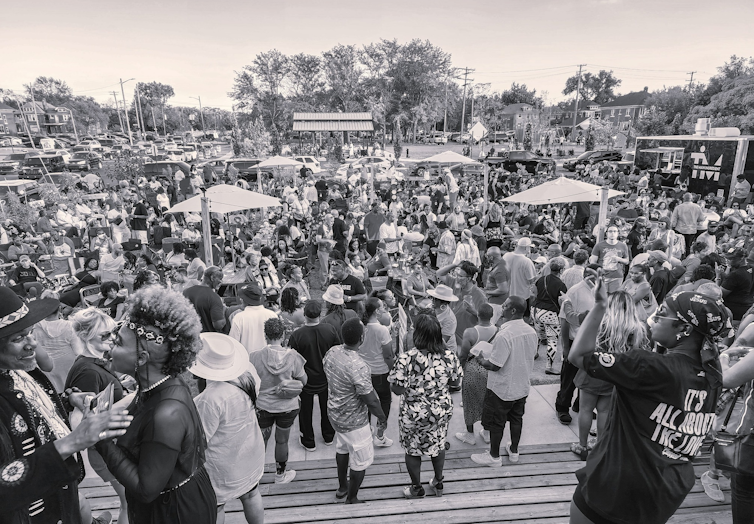
At The Congregation, a grassy dance floor draws an intergenerational and diverse crowd. The event keeps the spirit of old Detroit alive, while offering newcomers a vision of what a truly inclusive city can look like.
The Congregation brings together generations of Detroiters. Marius Bingue, CC BY
Techno is Black music (from Detroit)
Detroit is known universally as the birthplace of techno. The genre emerged in the 1980s, when the Rust Belt city was experiencing white flight, widespread disinvestment and the consequences of postwar government programs, such as urban renewal and highway building, that were destructive to community needs.
As one techno musician from back in those days told me, techno was the soundtrack they heard in their head while walking, and looking over a shoulder, in mostly abandoned downtown streets.
Techno emerged from two interrelated scenes: Black, gay clubs and the Black high school party scene, where people, some too young to drink, organized elaborate events with professional light shows and sound systems.
Meanwhile, inspiration and encouragement also came from the music being played by the Electrifying Mojo, a radio DJ whose nightly show demonstrated Detroit's wide range of musical tastes, from Parliament to Peter Frampton to the B52s, and, later, techno and house.
The diversity of influences and do-it-yourself attitude of techno pioneers such as Juan Atkins, Eddie Fowlkes, Derrick May and Kevin Saunderson resulted in a form of music that is both funky and futuristic, even some 40 years later. The purpose of Detroit techno was, and still is, to make you dance, to make you sweat; it distinguishes itself from other dance music by its characteristic layered rhythms, abstract sounds and Afrofuturistic themes.
Detroit techno was always rooted in strong community bonds – especially within Detroit's Black community – despite the city being ravaged by disinvestment.
Since the 1980s, many of the forms of electronic dance music that were inspired by Detroit and Chicago have gained mainstream popularity in Europe and white America.
In return, the Detroit techno and house scene helps maintain a sense of community and support for Detroiters who have long faced systemic racism in the city, and are now encountering gentrification.
Gentrification's threat to culture
The changes in Detroit over the past 15 years have been disorienting and have had negative consequences for many longtime Black Detroiters.
Seniors have been evicted, sometimes with little notice, from downtown buildings, which are then redeveloped into high-end apartments out of the financial reach of many Detroiters.
Gentrification is a danger to Detroit's underground music community, too. Not only is it making residential and commercial spaces unaffordable for longtime residents, but cultural communities are also threatened.
The high school party scene that incubated techno was possible because there was so much downtown space in 1980s Detroit. That space has been squeezed by gentrification.
'Are you going to The Congregation?'
In response to the squeeze of gentrification, Detroit's underground music scene has kept vibrant by creating spaces for weekly pop-up events.
I attended the very first house night at The Congregation in the summer of 2020. With a large, grassy front yard, it was perfect for social-distanced dancing during the pandemic. The three resident DJs who host the event – Marvin Prather, John Spears and Tony Dennis – are lifelong Detroiters who bring in guest DJs, including Eddie Fowlkes, who helped originate Detroit techno.
Over the four years of its existence, house night at The Congregation has become a gathering place for people who were part of the 1980s techno scene – predominantly Black Detroiters now in their 50s and 60s.
I find it remarkable that the community has maintained these connections over the decades, and that the dancers and DJs who were there from the beginning still draw inspiration from their participation.
Yet it's a welcoming, inclusive community that incorporates newcomers – just as it did when I first moved to Detroit from California in 1998.
It is, simultaneously, a homecoming with a family cookout vibe, a great place for a weekly catch-up or a banger to work up a sweat dancing.
Midway through one such evening last summer, a young Black woman near me on the dance floor shouted with surprise, "Dad! Dad! Dad!" and then walked along the fence to greet a Black man, perhaps a bit older than me. The fact that both attended the event – and were happily surprised to see each other there – demonstrates the way in which Detroit's music scene continues to bring generations together. And The Congregation is just one such venue. On any given night, the regular crowds at the four main dance music venues in Detroit are likely to be diverse in races, ethnicities, sexualities and – in contrast to the norm in electronic music events worldwide – age.
During the final record played on the last Thursday event of summer 2023, one of the DJs, Taz, acted as MC and asked the crowd to take out their phones as another DJ, Mark Duncan, was playing "Flashlight" by Parliament.
Many in the crowd shined their phone flashlights as they danced and sang along.
That sense of community is what makes events such as those that take place at The Congregation something that househeads like myself miss from summer to summer – and fear might be edged out completely in the face of gentrification.
I am counting down the days until it begins this year on June 6. In a gentrifying city, spaces like The Congregation represent both continuity and an honoring of all that have come before: the Black people who created techno and house, the Detroiters who didn't leave a disinvested city, and the fierce creativity that remains one of the city's main draws.




No comments:
Post a Comment