The 2025–2026 John E. Rovensky Fellowships CFA is open through July 30, 2025. The fellowships support doctoral research in business and economic history. Funded by a gift from the late John E. Rovensky and administered by the University of Illinois Foundation, these fellowships offer $11,000 each to outstanding Ph.D. candidates whose dissertations demonstrate excellence in archival research and potential for contributing to the field. There are two fellowship tracks: 🔹 John E. Rovensky Fellowship in U.S. Business or Economic History Open to Ph.D. students at U.S. universities working on dissertations focused on U.S. business or economic history. 🔹 John E. Rovensky Fellowship in International Business or Economic History Designed for students in U.S. doctoral programs conducting research on business or economic history outside the United States. Each application requires a CV, a six-page research statement, and one letter of recommendation. The submission deadline is July 30, 2025, and recipients will be announced in late August. We encourage all eligible doctoral candidates to apply and help carry forward rigorous, archive-based scholarship in business and economic history. You're currently a free subscriber to Organizational History Network. For the full experience, upgrade your subscription.
|
Monday, 30 June 2025
Now Accepting Applications: 2025–2026 John E. Rovensky Fellowships in Business and Economic History


Saturday, 28 June 2025
The Autistic Rhizome: Reclaiming Knowledge, Rewriting Reality
The Autistic Rhizome: Reclaiming Knowledge, Rewriting RealityA tribute to the growth of Autistic community
In the face of a world that has long pathologized, misunderstood, and silenced us, Autistic people are forging new ways of producing and disseminating knowledge. We are building something deeper than a support network or advocacy movement. We are growing a rhizome; a decentralized, perpetually expanding, anti-hierarchical web of community-driven knowledge that refuses to be contained by academic journals, diagnostic manuals, or institutional gatekeeping. The Autistic rhizome is not merely a metaphor. It is a structure of reclamation, reshaping how we understand ourselves, one another, and the world we move through. What Is the Autistic Rhizome?Expanding from Deleuze and Guattari’s (1987) concept of the rhizome, we can understand Autistic knowledge production not as a tree, with a central trunk, fixed branches, and linear growth, but as something decentralised, associative, and interconnected. A rhizome grows in all directions. It has no singular beginning or end. Any point in a rhizome can connect to any other. This is precisely how knowledge flows in Autistic spaces today:
Each of these nodes is valid. None claim universal authority. This is a radical refusal of hierarchy, and a profound reclaiming of how we make and share knowledge. From Medical Diagnosis to Collective DefinitionHistorically, the production of knowledge about autism has been dominated by neurotypical researchers, clinicians, and institutions. Our lived experiences were reduced to symptoms. Our bodies were turned into case studies. Our behaviours were pathologised. Our liberty became a political matter rather than an ethical one. But through the rhizomatic community, we are no longer content to be spoken about. The phrase “nothing about us without us” (Charlton, 1998) becomes more than a resistance to marginalisation, it becomes a reality we drive toward. We are not just offering personal testimony; we are redefining what it means to be Autistic. We are redefining what it means to embody an identity. The Sapir-Whorf Hypothesis and Reclaiming LanguageThe Sapir-Whorf hypothesis (Whorf, 1956), also known as linguistic relativity, suggests that the structure of language shapes how we perceive and understand reality. In reclaiming the language of neurodivergence, we are doing more than self-advocacy. We are rewriting the boundaries of our reality itself. When we reject terms like “low-functioning” or “disorder”, we shift the ontology of autism from deficit to divergence, from pathology to identity. Linguistic relativity posits that by defining our interpretation of reality, language itself serves to control our thoughts. In this sense, the rise of the neurodiversity paradigm and subsequent corporealisation of the Autistic rhizome facilitates the collective neuroqueering (Walker, 2021) of all who interact with the body of knowledge produced and contained within the rhizome itself. When we coin terms and concepts like monotropism (Murray et al., 2005), stimming, and double empathy (Milton, 2012), we are not simply describing experience. We are naming new realities. We are linguistically carving out space for our existence on our own terms. We are shaping the very fabric of neurodivergent consciousness by refusing to let others define it for us. This same linguistic redefinition simultaneously allows and facilitates the growth and interconnection of the Autistic rhizome. Such reclamation is a political act. A cognitive act. A revolution of praxis. Knowledge as Connection, Not CredentialThe Autistic rhizome thrives in digital commons and grassroots collectives, not institutions and hierachical systems. It operates through connection, not credential. Here, academia is not the only entrance to contributing to community discourse. Autistic elders and newly diagnosed teens can share space as equals while keeping space for the wisdom of experience. Knowledge is not owned. It is shared and expanded. It's origins are duly noted while exponential expansion of ideas and concepts takes place within multiple facets of a diverse community. This doesn’t mean rejecting academic contribution, but it does mean refusing to let institutions be the sole gatekeepers of truth. The rhizome is creation in all of it's chaos. Iterations upon iterations that spawn webs of knowledge. It makes room for contradiction and complexity, because that is the texture of neurodivergent life. A Praxis of Rebellion and RebirthTo participate in the Autistic rhizome is to engage in praxis, the synthesis of theory and action. We are not just thinking differently. We are living differently:
This is more than adaptation. It is a reclamation. A rebellion against the systems that tried to fix, cure, or erase us. It is a rebirth. Like any birthing process it is painful and messy, but leads to the potential that new life has to offer. We Are the RhizomeWe are not a tree with a single root. We are not a line on a developmental chart. We are not a case study in a diagnostic manual. We are a rhizome, and we are growing. Through every story, every redefinition, every radical new word, we are synthesising a new world where Autistic lives are not just visible, but viable, where we do not survive, but we thrive. ReferencesCharlton, J. I. (1998). Nothing about us without us: Disability oppression and empowerment. University of California Press. Deleuze, G., & Guattari, F. (1987). A thousand plateaus: Capitalism and schizophrenia (B. Massumi, Trans.). University of Minnesota Press. Milton, D. E. (2012). On the ontological status of autism: The ‘double empathy problem’. Disability & Society, 27(6), 883–887. https://doi.org/10.1080/09687599.2012.710008 Murray, D., Lesser, M., & Lawson, W. (2005). Attention, monotropism and the diagnostic criteria for autism. Autism, 9(2), 139–156. https://doi.org/10.1177/1362361305051398 Walker, N. (2021). Neuroqueer Heresies: Notes on the neurodiversity movement, Autistic empowerment, and post-normal possibilities. Autonomous Press. Whorf, B. L. (1956). Language, thought, and reality: Selected writings of Benjamin Lee Whorf. MIT Press. You're currently a free subscriber to David Gray-Hammond. For the full experience, upgrade your subscription.
|

What to do when the world is collapsing
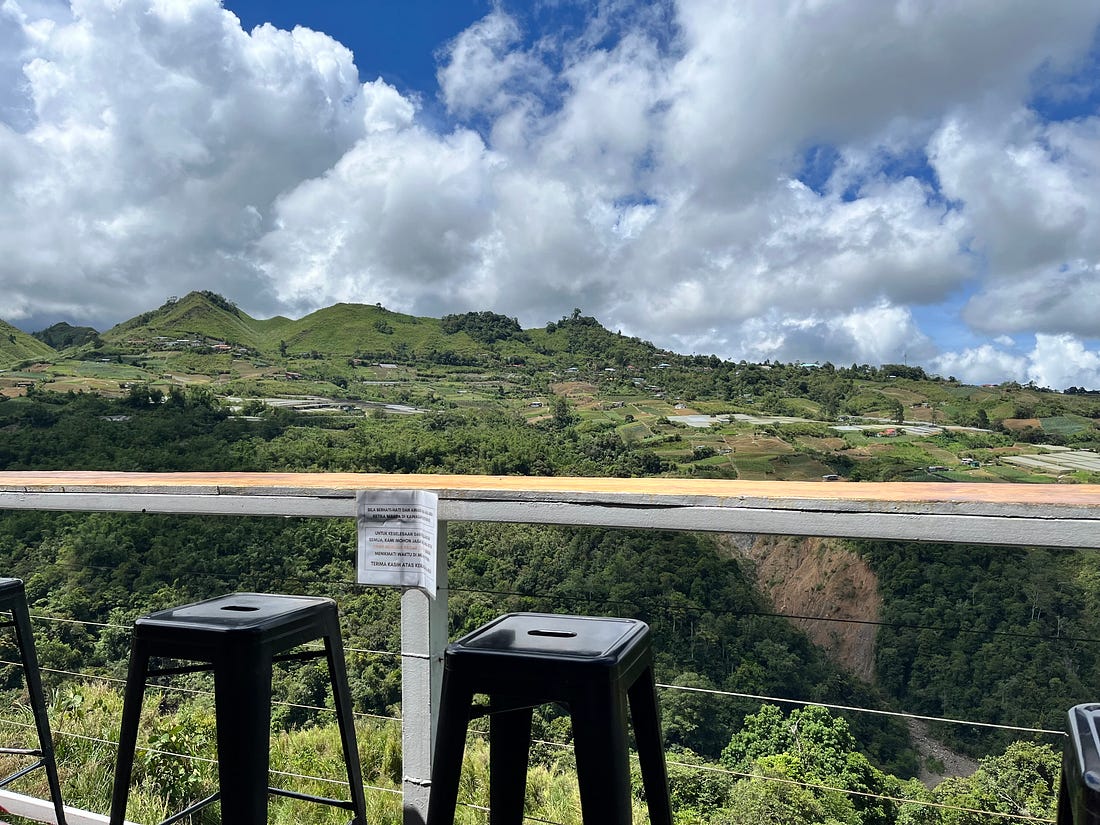
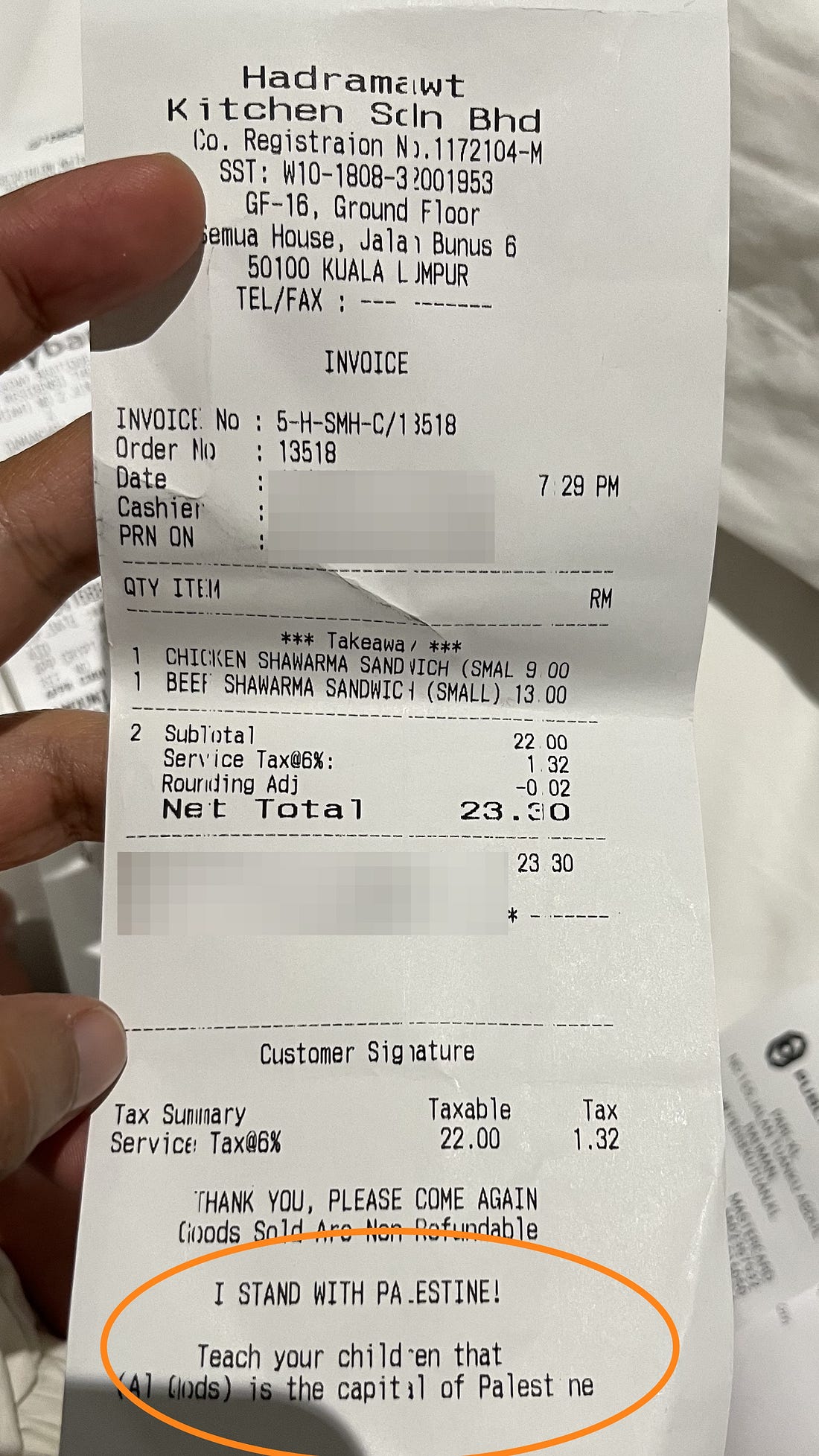
I travelled a bit recently, it feels like a selfish luxury. It is a selfish luxury. I cannot pretend that traveling at this time feels like I’m strolling past a dead starved body and chooses to look ahead at the roses. I don’t know. I cannot help them beyond prayers and donations and raising awareness. I don’t think that is enough, but I also have no ways to help other than those. If I were a sniper, or a trained assassin, or a fighter jet pilot, or a hacker, I would possibly be doing a lot of tangible, immediate-impact things. But I am not. But hey, I will document a bit about what I saw in my travels, tiny bits of things that recover some hope in this dying world. This little receipt with an important reminder
I will teach them more than that, I will teach them what really happened, how it happened, how a bunch of world so-called leaders are so corrupted they would rather beating up and shutting up their citizens protesting against the complicity than actually stopping the arms and the support, I will teach them everything. I will make sure all you genocidal cult followers are named and memorized. I will pray for you to be hunted and haunted. 1-2 people in my circle started to see thingsSo for as long as this genocide happened, I have intentionally removed myself from the life of many people. Not because they are Zionists, but because they are silent (I did share quite a bit in the Oct-Dec 2023). To me it’s just as equally atrocious to stay silent when you see a daily stream of genocide. The silence is what is powering this genocide, I don’t know why it’s so hard for some to grasp. I cannot pretend (that things are fine) for very long when I interact with people, so I start to just isolate myself. Not a very good thing to do - I’m aware, especially when Palestine is often (subhanAllah) the single point of eye-opening experience for many people and teaches them the truth about Islam and generally what is really happening in the world. But alas, I cowered my way out, I’m tired. At this point I just want to focus on being a proper muslim first, I have no desire to fight for anyone’s soul other than mine. Besides, nobody can guide anyone except if Allah swt wills it for them. But, after nearly 2 years, a person reaches out - showing what he saw on his well-oiled algorithmically shielded social platform. My post on LinkedIn (often suppressed), got a few engagements. People are acknowledging what is going on. And only that little act already means something. The bar is so low, it genuinely recovered some hope in me. A part of me craves genuine human connection, the connection with like-minded people who share the same lens and pains, who understands that there is a genocide going on, and chooses to direct their energy for good, no matter how small. I crave for someone to actually talk about it, openly, without fear. But I live in a country that is not really well-versed with the “conflict”, and frankly I have to put on a mask in this world, I have to pretend that it does not consume my soul - whatever it is I’m witnessing and feeling inside, I must hide it, because ‘emotions’ are a taboo, because these things interest nobody. “Nobody cares” has been what I tell myself, to drown the waves of bitterness and redirect my facial muscles to somewhat of a relatable mask. Nobody wants to talk about dead children, or the depth of evil that is happening, everybody talks about AI and other shitty things they think will last forever, thinking this world will continue to grow on the fake rosy path. But I’m aware that it is collapsing, the end is near, and it’s a bit hard to just tell people that without walking them through a bit of ‘red pill blue pill’ demo. When everybody is in the Matrix, it’s not just because they do not know they are in a Matrix, more often than not - they choose to not face the truth. I thought about prophet Noah (pbuh) who had to teach Islam for 900 years and nobody followed him, occasionally. The thought just makes me sink. I cannot imagine what he must have felt. He must have been the most lonely prophet that we know of. But if there is anything that I must remember for myself, as the world is collapsing and as up is down and down is up, as lies persist and falsehood spread, is this single idea:
Keep doing whatever good you can, not because it will change the outcome, but because this is the battle for your soul, and it is a battle you must not let go without a fight. intj wanderer is free today. But if you enjoyed this post, you can tell intj wanderer that their writing is valuable by pledging a future subscription. You won't be charged unless they enable payments.
|

A Quick Update On A Free Way To Support Our Work
Earn NeuroHub Free Donations While You Shop! ͏ ͏ ͏ ͏ ͏ ͏ ͏ ͏ ͏ ͏ ͏ ͏ ͏ ͏ ...
-
Dear Reader, To read this week's post, click here: https://teachingtenets.wordpress.com/2025/07/02/aphorism-24-take-care-of-your-teach...
-
CALL FOR APPLICATIONS: AOM 2025 PDW ͏ ͏ ͏ ͏ ͏ ͏ ͏ ͏ ͏ ͏ ͏ ͏ ͏ ͏ ͏ ...

