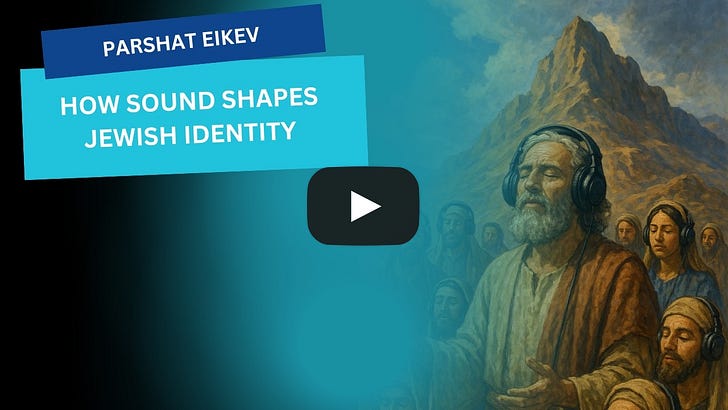
 This week my Torah study and my day job converged. For the last 20 years I have run a business that has designed and produced products which record, reproduce, respond to or play sounds. Our claim to fame is that we have provided over 70 million electronic sounds to Build-A-Bear Workshop where children, of all ages, create custom plush toys. If there is one thing I have learnt during this time, it is the power of sound, whether voice or music to trigger emotions and memories. VoiceGift, the consumer brand that we recently launched offers a family of products that provide the gift-giver, crafter and memory-maker the opportunity to add a personal voice recording, no matter the occasion, season or creative project. Our tagline is The Way Life Sounds™. In conjunction with the introduction of a new device called PLAY, I have been talking to podcasters and journalists and sharing my belief in the potential power of sound, especially in a world of scrolling images and hand-held screens. I recently recorded a podcast called Why Emotional Engagement is your Business’s Hidden Superpower where I share the lessons learnt. PLAY is a hand-held device that empowers the user to add a voice recording like a Post-it note, to any object. It took an extremely powerful insight by Rabbi Jonathan Sacks to make me realize the synergy between my profession and the Torah, specifically Deuteronomy and latter Rabbinic Judaism. Deuteronomy 11: 13 proclaims: “if you hearken, yes, hearken to my commandments that I command you today, to love YHWH your God and to serve him with all your heart and with all your being” אִם־שָׁמֹ֤עַ תִּשְׁמְעוּ֙ Rabbi Sacks writes: Shema is one of the key words of the book of Deuteronomy, where it appears no less than ninety-two times. It is, in fact, one of the key words of Judaism as a whole. It is central to the two passages that form the first two paragraphs of the prayer we call the Shema, one in the previous parasha, the other in this parasha. At the most basic level, Shema represents that aspect of Judaism that was most radical in its day: that God cannot be seen. He can only be heard. Time and again Moses warns against making or worshipping any physical representation of the divine. As he tells the people: It is a theme that runs through the Bible. Moses insistently reminds the people that at Mount Sinai: (Deut. 4:12). ה׳ spoke to you out of the fire; you heard the sound of words but perceived no shape—nothing but a voice. וַיְדַבֵּ֧ר ה׳ אֲלֵיכֶ֖ם מִתּ֣וֹךְ הָאֵ֑שׁ ק֤וֹל דְּבָרִים֙ אַתֶּ֣ם שֹׁמְעִ֔ים וּתְמוּנָ֛ה אֵינְכֶ֥ם רֹאִ֖ים זוּלָתִ֥י קֽוֹל I had never focused on the profundity of this verse before… Sacks has opened Sacks continues: … the Babylonian Talmud consistently uses the metaphor of hearing. So when a proof is brought, it says Ta shema, “Come and hear.” When it speaks of inference it says, Shema mina, “Hear from this.” When someone disagrees with an argument, it says Lo shemiya leih, “He could not hear it.” When it draws a conclusion it says, Mashma, “From this it can be heard.” Maimonides calls the oral tradition, Mipi hashemua, “From the mouth of that which was heard.” In Western culture understanding is a form of seeing. In Judaism it is a form of listening. Rabbi Sacks in his offering for Parshat Eikev in Judaism's Life Changing Ideas; A Weekly Reading of the Jewish Bible focuses the lesson of Hearing into the social realm. He describes how he left an academic conference in Jerusalem were there was much talking and not so much listening to have an encounter with the secular author Amos Oz where he learnt to listen. I highly recommend Rabbi Sacks in general and this article in particular. I chose to dive deeper into the power of sound. Writes one blogger named Rishi: Have you ever heard a song that instantly transported you to a specific moment in your life? Maybe it was a childhood tune that brought back innocent feelings. Music has a profound ability to evoke deep emotions, and there’s some fascinating science behind why this happens. Music is not just a collection of sounds; as you know, it is a complex stimulus that interacts with multiple regions of the brain. The amygdala, which is responsible for processing emotions, and the hippocampus, which is associated with memory, work together when we listen to music. This connection explains why certain songs can trigger strong emotional responses and vivid memories. Music is more than entertainment — it’s a gateway to our deepest emotions and memories. Whether it’s a song that reminds you of the joys of childhood or a melody that comforts you during difficult times, music has an unparalleled ability to touch our souls. By understanding the science behind music and memory, we can harness its power to enrich our lives and emotional well-being. See: Why Certain Songs Trigger Deep Emotions Written by Rishi Anyone familiar with the Talmud and Jewish Liturgy will acknowledge the widespread use of audible techniques used to impact memory and cultural transmission. Mnemonic - Any memory trick that can help somebody remember information. Common types of mnemonics- • Acronyms • Rhymes - • Chunking and Organizing- breaking things down into categories and then memorizing each category Example: colors, the alphabet, numbers • Sound Mnemonics - catchy songs that help us remember something Example: the alphabet In the Haggadah, the Rabbis provide an acronym to encourage the memorization of the 10 plagues. רַבִּי יְהוּדָה הָיָה נוֹתֵן בָּהֶם סִמָּנִים: דְּצַ"ךְ עֲדַ"שׁ בְּאַחַ"ב Rabbi Yehuda grouped these under acronyms – A weird digression, lacking all meaning, except that it celebrates the power of sound to foster memory… The Ashrei prayer recited three times a day is actually Psalm 145, is an alphabetic acrostic of 21 verses, each starting with a different letter of the Hebrew alphabet arranged alphabetically. There is a marketing technique used in the music industry to have us repurchase previously purchased music… Remastered Recordings that are closer to the original. Through the strict parameters of the halacha, natural objects such as a rams horn and palm branch are transformed into a Shofar and Lulav that when blown and shaken exactly duplicate the sounds heard 3,000 years ago. Rabbi Adam commented: “The Mishnah seems to suggest that the sound that you make when you shake the lulav is actually what's most important, their sound and that connects Rosh Hashanah and Sukkot, both of them are connected to sound. One you make through the instrument of the shofar, the other you make through the lulav.” Who knew? Similarly the tune for Kol Nidre that we will hear on Yom Kippur is so wired into the DNA of our people, that the meaning of the words, hardly matter. We forget that the actual meaning of the Rabbinic Torah SheBa’al Pe is the Oral Law. True, it is the transmitted traditions that fill in the blanks left by the Written Law. True, without this non-written tradition we would not know what the Tefillin suggested by placing these words on your arm and as frontlets between you eyes really look like…. but it is also, at the end of the day, an Oral… heard tradition. When Maimonides followed in the footsteps of Rav Yehudah Hanasi, who committed the oral tradition to the written Mishnah, codified Jewish law he understood that he was losing something. I contemplated all these texts and sought to compose [a work which would include the conclusions] derived from all these texts regarding the forbidden and the permitted, the impure and the pure, and the remainder of the Torah's laws, all in clear and concise terms, so that the entire Oral Law could be organized in each person's mouth without questions or objections. Instead of [arguments], this one claiming such and another such, [this text will allow for] clear and correct statements based on the judgments that result from all the texts and explanations mentioned above, from the days of Rabbenu Hakadosh until the present. (Mishneh Torah, Transmission of the Oral Law 40-41) Similar to the pop song “Video killed the Radio Star” we are confronted with a moment when the pure music died and in the 70’s video and screen technology took over from radio and in the case of Maimonides, the pure Kol Torah, the sound of the Torah was eclipsed by the written word. Let us take Rabbi Sack’s insight as an opportunity to celebrate the audible content of Judaism and the corresponding challenge to nurture our ability to hear audible cues in our tradition. My grandfather offered his grandchildren a substantial prize if we could sing the Birkat Hamazon (grace over food) by heart and my grandkids return every summer from Jewish Camp with songs seared into their very being. Let’s rediscover the power or our Oral Tradition. Sefaria Source Sheet: https://www.sefaria.org/sheets/668904 Transcript: Geoffrey Stern: We're raising a generation that can see but not hear. Deuteronomy was written for a world without screens, a world where sight was tempting but dangerous, because images could be idols, distractions, lies. So we're taught something radical: Don't look. Listen. Ninety-two times in one book, it repeats the same word, Shema. Hear, pay attention, tune in. And yet, in our age of infinite images, from the toddler with an iPad to the adult asleep with a glowing phone in hand, we've reversed it. We see everything and hear almost nothing. In that trade, we risk losing what Deuteronomy knew. The deepest truths aren't visible; they're audible. Welcome to Madlik. My name is Geoffrey Stern, and at Madlik, we light a spark or shed some light on a Jewish text or tradition. Along with Rabbi Adam Mintz, we host Madlik Disruptive Torah on your favorite podcast platforms and now on YouTube, so you can see us and not only hear us. How ironic is that? We also publish a source sheet on Sefaria, and a link is included in the show notes. This week's Parsha is Eikev. Rabbi Jonathan Sacks has pointed out the importance of listening as opposed to seeing, especially in Deuteronomy, and as it relates to interpersonal skills. We explore the primal power of sound, speech, and music as emotional triggers essential to Jewish practice. So join us for Listen, Just Listen. Rabbi, I have to say, last Shabbat was Shabbat Nachamu, and I went to my local Chabad in Westport, Connecticut, and Yehuda Kantor, the Chabad Rabbi, pointed out—he didn't quote Rabbi Sacks—but he pointed out the power of hearing as opposed to the challenges of seeing idolatry. Then my wife sent me this Rabbi Sacks article on Shema, and I said, you know what? I guess the gods are saying something I've got to do this week on Shema. Adam Mintz: Listen. Just listen. It's a great thing. I'm happy that it came from the Chabad Rabbi in Westport. Geoffrey Stern: So before we start, we have a little housework or homework or file-keeping to do. You sent me, I guess, a pre-publication of an article in Sapir, a very respected journal that you wrote for the coming edition. I assume it's called the Paradoxes of Conversion, and I read it. We have talked about ger so many times, but you somehow bridged the gap between ger as stranger and ger as convert as I've never seen before. So all I can say to our listeners is I hope you're subscribed to Sapir because in the upcoming edition, there's an amazing article by Adam Mintz. I just loved it. Adam Mintz: Thank you so much, everybody. I think you can go to the Sapir website and access it, or if you would like, you can go to my Facebook page. I actually posted it today, and I look forward to hearing everybody's ideas. I'll just tell you in one second that the word ger, which we probably have talked about over time in Madlik, is a fascinating word because, in the Torah, ger doesn't mean convert; it means stranger. The rabbis use the word that in the Torah means stranger, to mean convert, which is an interesting selection of words. Why would you choose the word that means stranger as convert? Probably on some level, it means that the convert never loses that uniqueness, even after they join the Jewish people. But, anyway, read the article. I look forward to your reactions. And now let's listen. Just listen. Geoffrey Stern: Well, that's a great tease. I have to say, because we are talking about listening, I don't normally share my other hat or my other kippa, but to pay the bills and the rent, I have a company that makes products that have audio chips inside of them and record audio. There was a podcast published also this week called The Business Behind Your Business. I'll put a link in the show notes, but I think, as we move forward in this podcast, that the power of hearing, the power of music, the power of the spoken word is powerful. The potential of a screenless society where you can focus sometimes on just the word kind of unites my two careers. So anyway, here we go. In Deuteronomy 11:13, it says if you hearken. Yes, hearken! It says the word to hear twice to my commandments that I command you today to love God, your God, and serve him with all your heart and with all your being. So if you ever look at the show notes on Sefaria, Sefaria now has all the writings or a large part of the writings of Jonathan Sacks. You can just go there. I mean, it's great to have his books, but this is a brilliant commentator who is so well-versed in the literature and ethos of our day. He's just fascinating. So this is what he writes. Shema is one of the key words of the book of Deuteronomy, where it appears no less than 92 times. It is, in fact, one of the key words of Judaism as a whole. It is central to the two passages that form the first two paragraphs of the prayer we call Shema, one in the previous Parsha, the other in this parsha. And that is what kind of hit me between the eyes. He goes on, and he says at the most basic level, Shema represents that aspect of Judaism that was most radical in its day, that God cannot be seen. I think that's amazing, that you have to listen to him because he can't be seen. He can only be heard. Time and again, Moses warns against making or worshiping any physical representation of the divine. As he tells the people, it is a theme that runs through the Bible. Moses insistently reminds the people that at Mount Sinai, the Lord spoke to you out of the fire. You heard the sound of words but saw no form. There was only a voice. Even when Moses mentions seeing, he is really talking about listening. A classic example occurs in the opening verses of the next Parsha, Re'eh. In Deuteronomy 4:12, it says, "God spoke to you out of the fire. You heard the sound of words but perceived no shape, nothing but a voice." I have never read this passage with more enlightenment than when I read it after this introduction by Rabbi Sacks. It is just brilliant: "God spoke to you out of the fire. You heard the sound of words but perceived no shape, nothing but a voice." It's just absolutely amazing if you think about it, Rabbi. Adam Mintz: einchem ro'im zulati kol You saw nothing except the voice. That's what Sacks is saying. It gives the impression actually that you see the voice. Geoffrey Stern: It just. You talk about an eye opener. You talk about someone who opens your eyes. He goes on. Judaism by contrast is a culture of the ear more than the eye. As Rabbi David Cohen, the disciple of Rav Kook, said, the Talmud constantly uses the metaphor of hearing. So when a proof is brought, it says "tashma, come and hear." When it speaks of inference, it says "shmamina, hear from this." When someone disagrees with an argument, it says "lo shmale, he could not hear it." When it draws a conclusion, it says "mashma, from this it can be heard." Rabbi, we take all of this stuff for granted. Maimonides calls the oral tradition "mishmi," from the mouth of that which was heard. In Western culture, understanding is a form of seeing. In Judaism, it is a form of listening. Adam Mintz: And. Geoffrey Stern: From the mouth of that which was heard. In Western culture, understanding is a form of seeing. In Judaism, it is a form of listening. Adam Mintz: That last sentence is remarkable. Now, I don't know enough about Western culture. I don't know what that means, understanding as a form of seeing. But the idea that Judaism has it different is also fascinating. Geoffrey Stern: So you are welcome. And I invite you to read Rabbi Sacks's full particular article that is quoted in regards to our Parsha. It has him leaving a conference at the Hebrew University because people are talking and not listening. Speaker A: And him going to meet Amos Oz a secular writer and learning what it is to listen. I just want to say he really opens up our eyes. I would argue that there's a place for hearing and there's a place for seeing. I mean, last week's Parsha we read, it has been clearly demonstrated—you have seen it—that God is king, that God is God. We learn when the Mishkan was being built. It says clearly, in architecture, it's important to see a plan once in a while. "Exactly as I show you, the pattern of the tabernacle." And of course, in the Talmud, there's an amazing expression, "ein shmia k'reiyah." It happens to deal with the new moon. But hearing is not quite like seeing. So, I think we need to take Rabbi Sacks with a grain of salt. But alternatively, we need to say, wow, there is something here. And I'm not saying a pun. We have to listen. And where does that take us? In the rest of today's talk, we are going to talk about the power of listening—not necessarily to the exclusion of the other senses, but focusing like a laser on the power of listening and what that means to us. Rabbi, do you hear me? Adam Mintz: I hear you. Let's go. Video Killed the Radio Star, so— Geoffrey Stern: I will argue at the end that there was a moment in our tradition very similar to the moment when the song came out, "Video Killed the Radio Star." I looked it up on Wikipedia, and it really was fascinating because it was the moment where we transitioned from—and I have pictures in the show notes from Norman Rockwell and others of people listening to Roosevelt talking to the nation. They were listening to a radio, and their imagination was alive. There's another picture that I show of a bunch of guys with a beer in their hand listening to... maybe it was sports, maybe it was a horse race, or who knows? The power of sound and that image that we have of just radio. And then all of a sudden, we came into a culture with all of these technologies, whether it's video or screens, that in a sense robbed us of that imagination of just listening and listening with others, and also listening in terms of the imagination that it conveyed. The Wikipedia entry on "Video Killed the Radio Star" ends by saying it was inspired by memories of listening to Radio Luxembourg at night as a child. And if you look at the video—and the irony, of course, is that this was the first video that was produced on MTV, so it was the first music video. But I think it was a seismic moment where we moved to this age of everything being shown to us, and we lost something in the process. So, you know, I want to talk a little bit about what happens in our world when we start looking at screens. One of the things that I learned in my business life from this company, Build-A-Bear, that I provided the sounds to, is what people do with those sounds. They have voices of people that are no longer with us. They take the last message from their answering machine. There's something about having tactile memories that triggers emotions, and there's a lot of research that shows that children, for instance, who get addicted to that iPhone and iPad screen, they lose certain—not only what Rabbi Sacks was talking about the social interactions, but their language development is impacted. You watch a kid watching a video, and their mouth is open. They're just kind of taking it in, but it's not interactive. Adam Mintz: Even my three-year-old grandson is like that when he watches a video. It's crazy. Geoffrey Stern: There are all sorts of studies, and I think this is a wonderful kind of introduction for us to maybe reclaim not only the audible content in our Torah and the power of Shmia, but in our daily life. So music is another. And I couldn't help but get a sense when I was at Chabad of the singing involved. But, Rabbi, I think a Friday night dinner is all you need. You say the Kiddush, you might sing the Birkat Hamazon. When I was a kid, my grandfather paid us—he gave us a prize if we could sing the whole Birkat Hamazon. My kids, my grandkids go to Camp Ramah. It's because they put these tunes to music that they are memorized, and those music pieces are triggers. Have you ever heard a song that instantly transported you to a specific moment in your life? Maybe it was a childhood tune that brought back innocent feelings. Music has a profound ability to evoke deep emotions, and there's some fascinating science behind this. Some of the science I saw was that music is not just a collection of sounds—as you know, it's a complex stimulus that interacts with multiple regions of the brain. I'm going to mispronounce this: the amygdala, which is responsible for processing emotions, and the hippocampus, which is associated with memory. Rabbi, memory and music and sound. In a month's time, a little more, we're going to hear Kol Nidre. And Kol Nidre is sung the same way all over the world, but much more importantly, it's been sung like this forever. You know, they get into music today, and once in a while, you'll hear remastered CDs where they took the original tracks and remastered them. When we hear the leining of the Torah, when we hear Kol Nidre, when we hear a tune, a song, or a melody of words that is part of our tradition, it's as close as we can get back to those original traditions. It's the same human voice chords that are singing or saying the same words. You don't get that with visions; you don't get that with screens. Adam Mintz: Now, I think that there are many studies showing that people with dementia respond not to words; they respond only to music. And I'm sure that it's related to this same thing, right? That there's a piece of memory that only reacts and responds to music. Geoffrey Stern: So I have a very dear friend, Michael Posnick, who sometimes comes on the podcast, and his wife, God bless her, had dementia. And the only thing that triggered her without fail was music. And she was a member of Zimria, and literally what you just said was the fact. And I would suggest one of my products is the Old Fashioned mixtape, where we used to make a music track for a loved one, because this was either our music or their music or our shared music, and we would give it to them. And I think every one of us should have our own mixtape, because God forbid we ever get into a situation where we need those triggers. We're going to need our mixtape. I think it's profound. Adam Mintz: It is absolutely profound. And this is exactly what you read in the previous paragraph, that there's a scientific, biological, or neurological reason for this. Geoffrey Stern: So then we get into memory techniques, because as I said before, it's connected to memory. And there are mnemonic devices. We believe in an oral tradition. We have a word that Rabbi Sacks didn't mention but should have: Torah Sheba'al Peh, the Torah that is by voice. Now, we normally consider it as a complementary Torah, a Torah that fills in the empty spaces. And that's all true, but it's also a Torah of voice. It's a Torah that you hear. Adam Mintz: Yeah, I mean, we say in English, the Oral Torah. So actually, in that case, the English translation is perfect. It is exactly right. Geoffrey Stern: Exactly. And we have these mnemonic devices. We all come across them, for instance, in the Haggadah, where it talks about the ten plagues, which can be minimized to "Datzach V'adash B'achav." The point is, in tech, we have a lot of mnemonic devices and acronyms. DOS is Disk Operating System, but the Torah—and this gets back to Moses. Moses is giving the people something that they can carry with them into the future. And Shmia is one of those things. Hearing is one of those things. And with that comes a whole toolbox of tools, including acronyms, where you take a lot of information and you put it into just a few letters. Speaker A: It's called an algorithm, Rabbi. You make dense data, and it is a trigger. Judaism is full of those triggers. You hear them, and you have a response. There are rhymes, there's organizing by the alphabet. Ashrei, if you look at it, is a famous psalm, but there are many psalms that go through. The first letters are the letters of the alphabet. This concept of hearing is not only a trigger to our emotions but also a direct connection to our memory. It's just so profound. And it all starts with this infatuation of Deuteronomy with hearing. Adam Mintz: It's fantastic. I mean, that's what it is. And that's great. And it's right there. The amazing thing, Geoffrey, is that Rabbi Sacks highlighted it. But it's in the Shema that we say twice a day. We don't think about it that way. If you will listen. But actually, it talks about the importance of listening. Geoffrey Stern: Yeah, it's as everything else that we kind of quote-unquote discover on Madlik. It's there in front of our eyes, or in this case, in front of our ears. But again, this concept that I talked about, about remastering audio, if you really focus, for instance, Rabbi, on the shofar, it is the Halacha guides us into the simplicity of the design of the shofar. And what that does is ensure that our shofar is identical to a shofar that was blown a thousand years ago, 2,000 years ago, 3,000 years ago. Even if you believe in evolution, a thousand years is nothing. The chances of our ram's horn being identical to the ram's horn that was used a thousand, two thousand, or three years ago are very feasible. And then, if it's blown and you close your eyes on Rosh Hashanah or during Elul when you hear it, this is high-fidelity Judaism. You are literally re-experiencing the identical sound. You can't do that with images. We can all pretend we know what the Menorah looks like. The Chabad Menorah is very angular. The Menorah on the Arch of Titus in Rome is not so much. But when it comes to sounds, it has this amazing ability. If we do it right with musical notes, which is what Trop is, to reproduce. Adam Mintz: Yeah. I mean, that's fantastic. I mean, the whole idea doesn't exactly mean music, but of course, it's right. And we also don't know, by the way, the way that they recited the Torah. Right. You talked before about Trop, but how was the Torah transmitted? How did Moses transmit the Torah to Joshua? Did he say it? Did he declare it? Maybe, Geoffrey, he sang it. Maybe it was like poetry. So maybe from the very beginning, the way the Torah was transmitted was through song. Geoffrey Stern: I mean, certainly there's that famous Yiddish song. Unless it was the sound of the kinder studying Torah. Adam Mintz: That, by the way, is an interesting idea. The sing-song. You know that from Yeshiva, when you open a Gemara, you don't read the Gemara. You sing the Gemara. The fancy word is you chant it, but basically, you sing it. There's a way to learn Gemara, and everything goes with a tune. Geoffrey Stern: Called the Kol Torah. I just thought of that. I mean, you can. I used to live on 79th and Riverside. Opposite, there was a cheder there, and you could literally hear. I said to my wife, that's the Kol Torah. That's the sound of Torah learning. It is just the sound. Amazing. These are triggers, and they're triggers that really are so kind of primal that we dare ignore them. I would argue that after listening to Rabbi Sacks' insight, I recommend that when we shake the Lulav. I was once in China, and I saw a Buddhist making sounds with something they were shaking, and it reminded me of the sound that you hear from shaking the Lulav. Adam Mintz: That's so interesting. The Mishnah seems to suggest that the sound you make when you shake the Lulav is actually what's most important. There's sound. And actually, you want to say it better. That connects Rosh Hashanah and Sukkot. Both of them are connected to sound. One, you make through the instrument of the shofar. The other, you make through the Lulav. Geoffrey Stern: Thank you for that. I mean, that just confirms what I was saying. So, you know, if you look at Maimonides, who wrote the first code of Jewish law, in his introduction, I am going to argue he came as close to giving in legalese what the song "Video Killed the Radio Star" did in lyrics. What he does is go through the history of the oral tradition. And of course, he's much more interested in the part of the oral tradition that filled in the blanks, those things that it says, put these words on your arm and on the frontlets between your eyes. The oral tradition told us what tefillin looked like. But I think you can just as easily say that it had to do with also the oral tradition. And there was a time where he says that either it was because the Jews became dispersed, but if you look at the beginning of Pirkei Avot, it's all about how the tradition was translated. It was the oral tradition that was translated. Then came along Rabbi Yehudah HaNasi and the generations. There was persecution, and they had to break the law. They broke the law by writing down the oral traditions. Adam Mintz: Now, explain why they broke the tradition. Because they were afraid that it would have been lost. They would have forgotten it because the Jews were dispersing, and that oral tradition would be lost. The other piece, Geoffrey, about an oral tradition is you need people. A written tradition can be maintained even if there's no community. If there's a break of 100 years, you still have the written tradition. But the oral tradition needs continuity, which also makes your point very strong. Geoffrey Stern: I guess it's like an echo. Sound carries, you know. Meanwhile, Maimonides went ahead, and he codified everything because he said in his generation, it went to the next level. But what he talks about is that I am going to give you clear laws, judgments that result from all the texts. There won't be any arguments anymore. There won't be any discussion anymore. Everybody will have this processed and prepackaged. And similar to "Video Killed the Audio Star," where they both reminisced about it and regretted it and then went on MTV, Maimonides does both. He talks about the power of the oral tradition. He clearly had a love, and his critics believed that he kind of abandoned his love for the discussion, for the discourse, for the argumentation, that Kol Torah. For pragmatic reasons, he put it down into writing, which in today's day would be almost putting it into the video. This is the way it looked. You can only see it this way. I think that we owe Rabbi Sacks a great thank you for focusing us on the power of sound, the power that sound has. It has an ability to bring us together, as Sacks says. It also has this ability to require us to listen to each other. I think also it is this amazing emotional trigger. It is a tradition, whether by music or by other instruments like the shofar or by the transmission of sounds and intonations that we really can't ignore. Adam Mintz: And. Geoffrey Stern: And we have to thank ourselves that on Shabbat, where we hopefully unplug a little bit and get away from our screens, I think if we look at that Friday night table where we have so many sounds of liturgy and music, we really take advantage of this gift that Sacks says is a radical idea of Judaism. I think it's certainly one that's very empowering. Adam Mintz: Amazing. Not only, Geoffrey, are we going to think about this idea on this Shabbat when we read Parashat Eikev, but every single day, when we say "V'haya Im Shamoa" when we recite the Shema, we can think about this idea. You gave new meaning, Rabbi Sacks gave new meaning to something that we all kind of take for granted. So thank you, Geoffrey. Thank you, Rabbi Sacks. Shabbat shalom to everybody. And we look forward to seeing you, everybody, next week. Geoffrey Stern: Shabbat shalom, everybody. Listen to us wherever you can. We hear you; we hope you hear us and look forward to seeing you all next week.
|
Wednesday, 13 August 2025
Listen - Really Listen


Subscribe to:
Post Comments (Atom)
We're Moving Our Marketing
Sign-Up For Info On The Conference And More! ͏ ͏ ͏ ͏ ͏ ͏ ͏ ͏ ͏ ͏ ͏ ͏ ͏ ...

-
Dear Reader, To read this week's post, click here: https://teachingtenets.wordpress.com/2025/07/02/aphorism-24-take-care-of-your-teach...
-
How i recognise psychosis and manage it in myself as an Autistic person ͏ ͏ ͏ ͏ ͏ ͏ ͏ ͏ ͏ ͏ ...


No comments:
Post a Comment