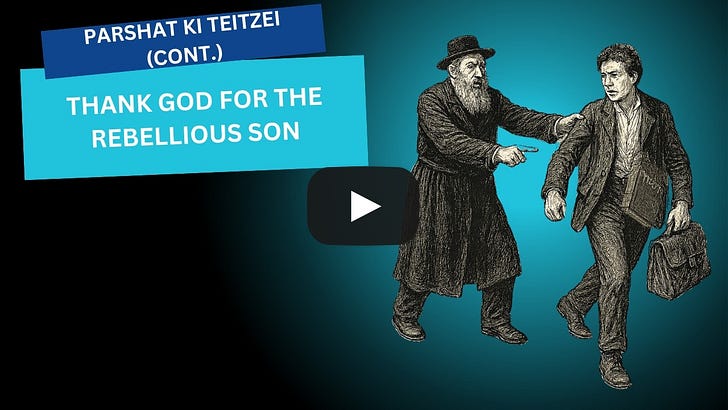
 Last Shabbat, Madlik went live at the brand-new Shtiebel at the JCC Manhattan. Over 100 people joined us for what was, quite honestly, electrifying. Rabbi Adam Mintz and I had so much fun that we decided to recreate the conversation for our listeners and readers here.
The week’s Parasha, Ki Teitzei, opened the door to a larger exploration: what does it mean to treat Halakha not just as law, but as a language? The Rebellious Son That Never WasDeuteronomy 21 introduces the law of the Ben Sorer u’Moreh—the rebellious son who refuses parental discipline and is sentenced to death by stoning.
The Talmud doesn’t mince words. This is a legal fiction. The law exists not to be enforced but to be studied: drosh v’kabel schar — “study and receive reward.” And this is not an isolated case. The rabbis declare the same about the Ir HaNidachat (idolatrous city) and houses afflicted with leprosy. These laws were never meant to be lived, but to be learned. Which raises a disruptive question: Could Halakha itself sometimes be more about hearing than doing? The Reward of StudyTraditionally, we translate schar as “reward.” But maybe it’s better understood as outcome or benefit. The very act of study is transformative—shaping character, sharpening perspective, creating meaning. As I put it during the conversation and quoting the blessing we say every morning after the Shema:
Halakha is not only an instruction manual. It is a language in the fullest sense of the word. It carries artifacts and baggage, offers one of many possible ways of expressing an idea and conveys value and meaning, even when the laws themselves were never intended to be applied. Maimonides’ Math ProblemMaimonides famously codified 613 commandments. But, in Sefer HaMitzvot, at the end of his enumeration, he admits something startling: most Jews, in most lifetimes, will encounter only a fraction of them. He concludes that for the average person, only about 60 positive commandments are definite and universally binding. For women, even fewer. And yet, Rambam doesn’t dismiss the rest. Instead, they remain as texts to be studied, as concepts to be listened to. Halakha here functions less as statute and more as lexicon. Soloveitchik’s ChallengeEnter Rabbi Joseph B. Soloveitchik. In Halakhic Man, he argues that the very essence of Judaism is embedded in Halakha itself:
For Soloveitchik, Halakha is not just law—it is philosophy, worldview, identity. But this leaves us with tension. Heschel, “the Aggadic Man,” stressed narrative, poetry, and story. Soloveitchik insisted that Halakha alone was the foundation. Perhaps the truth is that both are essential—Halakha and Aggadah as two halves of the same whole. Bialik’s Rebellious VoiceWhich brings us to Chaim Nachman Bialik—the great Hebrew poet, educated in the yeshiva of Volozhin and expelled by Rabbi Chaim Soloveitchik the grandfather of Joseph Soloveitchik, and later a patriarch of Jewish Enlightenment and the Poet laureate of Israel. In his remarkable essay Halakha and Aggadah, Bialik writes:
Bialik compares Tractate Shabbat—157 pages of dry, technical Halakha—to the majestic creation of Shabbat HaMalkah, the Sabbath Queen. Out of pedantic details, the sages sculpted one of Judaism’s most poetic and enduring symbols. Halakha, in this telling, is a collective masterpiece of life itself. Here is Bialik in his own words: (2) On these opposite appellations, which contrast halakha and Aggadah, I could add more infinitely, and it is obvious that in each there would be a bit of truth, but is there nothing to learn from this -- the popular position -- that the halakha and the Aggadah are two enemies, one thing and its reverse? (3) Those who say this are confusing fundamental nature with outside appearance -- to whom are these similar? To the one who decides that the river's ice and water are two distinct materials. The halakha and the Aggadah are not in fact anything except two halves of the same whole, two faces of the same creature. The connection between the two of them is like that from speech to thought and feeling, or from action and tangible form to speech. The halakha is the crystallization, the final and inevitable result of the Aggadah; the Aggadah is the core of the halakha. (5) Halakhah, however, is no less a work of art than aggadah. Its art is the greatest in the world – the art of life and the paths of life. Its material is the living person with all the impulses of his heart. Its methods are personal, communal, and national education. And its fruits are a continuum of days of proper deeds and lives, the paving of a way of life through the twists and turns of the individual and the group, a proper way for a person in the world, and a refined path in life. The creations of halakha’s hands are not like the creations of the hands of other arts, such as sculpture, drawing, architecture, song, and poetry, which are concentrated and unified in matter, space, and time. Rather, they join together little by little, point by point, from all of the flow of a man’s life and deeds that, in the end, give over one final product, one form, whether complete or damaged. Halakhah is the guiding art and the teaching art of an entire nation. ... [Likewise,] the Cathedral of Cologne, the Cathedral of Milan, and Notre Dame in Paris were perfected in their beauty and became what they became by the efforts of world-class artists for hundreds of years, each one of whom, in his time, gave his life and the best of his creative powers exclusively to this holy work. (6) The children-of-Israel has its own magnificent creation—a lofty, holy day, “Queen Shabbat”. In the imagination of the nation, it has developed into a living being with a body and the figure of a body, all radiance and beauty. .... Is she not a creature all of aggadah–of legend, of tale? Is she not herself a source of life and sanctity to an entire nation, and a wellspring flowing with divine inspiration for poets and liturgists? And even so, who will say, who will ascertain, by whose hand she was crafted, and who made her into what she is: by the hand of halakhah—law, or by the hand of aggadah–legend? Tractate Shabbat has one hundred fifty-seven double pages, and Tractate Eruvin has one hundred five, and they are almost entirely devoid of aggadah. They mostly comprise examinations and precise legal analyses into the thirty-nine labors and their subcategories and the fixing of domains; with what does one light, with what does an animal go out, how does one communalize a domain—how exhausting to the spirit! How much acuity wasted on every little serif! And when I traverse among those pages and see groups upon groups of sages and scholars at their work, I say: Indeed, artists of life I see before me! Artists of life in the workshop and at the potter’s wheel! Tremendous spiritual work like this, at the same time like an ant and like a giant, work for its own sake and born of love and faith without bounds, is impossible without divine inspiration. Each of those individuals did their part according to their character and their soul’s inclinations, and all of them together were beholden to an exalted will that ruled over them. This is nothing but a single, lofty ideal, a single, elevated image of Shabbat floating before the eyes of these exceptional people, and her spirit is what gathered them here from all the generations and made them into collaborators in her creation and enhancement....And what is the fruit of all this laborious work of halakhah–of law? A day that is all aggadah–all legend. Listening to the CommandmentsWhat emerges from all this—from rebellious sons who never were, to Rambam’s recalculations, to Soloveitchik’s philosophy, to Bialik’s poetry—is a radical insight: Halakha is a language. A language that encodes both the limits and the aspirations of Jewish life. Each commandment, whether practically applicable or not, carries within it profound wisdom and beauty not to mention the ethos of the humans who created it. By adopting this perspective, we open ourselves to a world of insight and meaning that goes far beyond simple observance. We become not just practitioners of Jewish law, but students of a language spoken by saints and rogues, scholars and workers, divinely inspired and rebellious all at the same time. And perhaps, as Bialik suggests, the greatest works of Jewish imagination—like Shabbat—are born when Halakha and Aggadah converge. Shabbat ShalomMadlik listeners, thank you for joining us for this live-recorded conversation from the Shtiebel. You can find the full source sheet on Sefaria https://www.sefaria.org/sheets/672006, and of course, listen to the full episode on your favorite podcast app, YouTube, or right here on Substack. Until next week— Transcript: Geoffrey Stern: Madlik listeners, you are in for a treat. Today we are recreating the recording that we held this Shabbat for your benefit. So sit back, enjoy the show, and if you have a chance, go to the JCC in Manhattan on Shabbat and check out the Shtiebel. It was electrifying. Welcome to Madlik, recorded live at the Shtiebel at the JCC of Manhattan. My name is Geoffrey Stern, and at Madlik, we light a spark and shed some light on a Jewish text or tradition. Along with Rabbi Adam Mintz, we host Madlik Disruptive Torah on your favorite podcast platform and now on YouTube and Substack. We also publish a source sheet on Sefaria, and a link is included in the show notes. The Parasha is Ki Teitzei. In our previous episode, we highlighted three Mitzvot in the Parasha which articulate a message through their actual observance. In this bonus episode of Madlik, we showcase the fact that the Mitzvot are actually a cultural language that we need to listen to as much as observe. So join us for Halakha as a language. Rabbi, we had a real ball this Shabbat. There were over 100 people there. You had moved the shul and this is going to be your new home. Is that correct? Adam Mintz: It is so exciting. It was such a good way to launch and to inaugurate the Shtiebel at the JCC, and it's fun to do it again because you know, Geoffrey, that it is said that the Talmud states that when you study something 101 times, it shouldn't be like you studied it a hundred times. It means every time you have to have a new angle. So this is our chance. This is the second time, and therefore we're going to find something new and interesting here. Geoffrey Stern: Perfect. So we are in Deuteronomy 21, and it contains the iconic law of the Ben Sorer u'Moreh, the rebellious son. It says if a householder has a wayward and defiant son who does not heed his father or mother and does not obey them even after they discipline him, it goes on through a few rituals that have to be held. Ultimately, what happens if he is identified as a rebellious son? In verse 21, it says, "Thereupon his town's council shall stone him to death. Thus you will sweep out evil from your midst. All Israel will hear and be afraid." I mean, Rabbi, there are many laws in the Torah that are a little hard to process, to digest. For a modern person, any law that ends with the death penalty is by nature going to be tough. But here certainly we have the question of a rebellious son. Just reading it, it is an iconic law. Yeah. Adam Mintz: I mean, the rabbis have been struggling to understand this for at least 2000 years. How can it be that you can put a child to death, even a troublemaking child, how can you possibly put him to death? So now we'll see what the Talmud has to say about this. Geoffrey Stern: So rather than mince words, the Talmud cuts right to the chase. In Sanhedrin 71a, it says, "There has never been a stubborn and rebellious son, and there will never be one in the future." Ben Sorer u'Moreh lo hayah v'lo atid l'hiyot. And then it asks, "Therefore you can ask, why do we have the text in the Torah?" And it says, "Lama nichtav? Drosh v'kabel schar." Why was it written? The translation here says, "So that you may expound upon new understandings of the Torah and receive reward for your learning." This being an aspect of the Torah that has only theoretical value. Putting it shortly, Rabbi, it's a legal fiction. That's what it is. And it is the iconic legal fiction. I think if you ask people about the Ben Sorer u'Moreh, we are going to see other instances in the Talmud where they use a similar strategy, but this is the most famous one. Adam Mintz: Yeah. Now, simply, and I know this is what we're going to analyze, but simply, Drosh v'kabel schar means just study it. It's part of the Torah. You know, as we're going to talk about, there are many laws in the Torah that can't be observed. Nevertheless, we study them. Drosh, study them. But this is no different than the laws of the Temple, which we can't relate to, which have no relevance to us. This also is not relevant and never happened. Geoffrey Stern: So I totally agree. I think that in some of the other instances that we are going to see, it's going to be even more difficult to make this case. But here, at least, it says, when it says stone him, it says, "And all of Israel will hear and be afraid." So it is almost baking into it, Rabbi, that it has a pedagogic value to it, that it is a learning moment, so to speak. So you can kind of see how the rabbis were able to make this maneuver, because if it wasn't the actual corporal punishment of the victim that was to be a learning moment, at least hearing and seeing the law itself would have a pedagogic value. So I think they did have kind of a leg to stand on. Adam Mintz: I mean, I think that that's really good. Generally speaking, anytime that you have a death penalty, the whole Yisrael yishma'u vi'yira, that there's a piece of it that is to teach people or to encourage people not to do what will get them the death penalty. But it's absolutely for sure that's right. Geoffrey Stern: I mean, I think even in modern scholarship, when they talk about the death penalty, they question, is it punitive or will this stop people from committing the crime? So that is a deep-seated argument. But I think that, for instance, the Stone Chumash, which they use in your synagogue, it literally correlates it to pedagogy, because after all, it is talking about a rebellious child living at home. So this is exactly the kind of thing. It's kind of like some of those fairy tales that we read that we cringe at. They're so scary. But there was a time where they believed in terms of a pedagogic tool. Scare the bejesus out of somebody and he won't sin. Adam Mintz: I mean, and we know it works. Geoffrey Stern: I guess spare the rod and just scare them. But anyway, I did mention that there were other examples of this same strategy. In Sanhedrin 71, just a few pages from where we have the rebellious son, it talks about an Ir Hanidachat that is an idolatrous city. And it says there has never been an idolatrous city and there never will be in the future. It's virtually impossible to fulfill all the requirements that must be met in order to apply this halacha. This is the translator speaking. And why then was the passage relating to an idolatrous city written in the Torah? So that you may expound upon new understandings of the Torah and receive reward for your learning. So here too, correct me if I'm wrong, Rabbi, we're talking about a city almost like a Sodom, that is so, so evil it should be destroyed. And again, the rabbis are saying it never will happen. But here, of course, the psukim do not say, and therefore this is a teaching moment. So I think they really are taking this concept of Drosh v'kabel schar, that some of the legislation, some of the mitzvot in the Torah, are there not so much to observe, but to learn from. Adam Mintz: Yeah, I mean, that's right. So the fact that it's not just one, but there are several of these laws makes it seem like that was a strategy in the Torah, right? That there are certain laws in the Torah which are only Drosh v'kabel schar. Now, that's kind of surprising in a legal book, that they have laws that are not applicable. But that seems to be a strategy in the Torah. Geoffrey Stern: And of course, three is a charm. In a few paragraphs later in Sanhedrin, it brings another example. We're all familiar in Leviticus about the law of a house that has leprosy, and it says that there has never been a house afflicted with leprosy, and there never will be, Drosh v'kabel schar. So whether these are unique instances or whether they can give us, Rabbi, an insight into other commandments too, that whether they're practiced or not, have an element of Drosh v'kabel schar. That's actually the subject of our talk today. But before we go there, let's talk a second about that word "schar." You don't get a reward for it, or your reward is that you study it. There's a famous Mishnah in Pirkei Avot in Ethics of the Fathers that says, and there, I think we translate it as the reward for a good deed, a mitzvah is a mitzvah. So if you go to the trouble to keep Shabbat, what is your ultimate reward? You have the beauty, the oneg of Shabbat, and the s'char mitzvah. The reward now here, it's more like a payment for doing a sin, is you're a sinner, you're going to have to live with yourself. You don't feel actually very good after doing a sin. So I think even in this iconic piece of Mishnah, you get a sense that it doesn't necessarily mean reward because it doesn't read that well. Adam Mintz: It's causative. If you do one mitzvah, you'll do another mitzvah. If you commit one aveira, that'll lead you to commit other aveirot. Okay, we can argue about the psychology of that. Geoffrey Stern: Yeah. And I think it also means kind of the outcome, as you said, the benefit, the takeaway. I mean, a shomer sachar is someone who watches, is a caretaker, but gets paid for it. So it's really a payment, more of a reward. And I will argue that what the rabbis are really saying when it comes to these three commandments, but maybe to many, many more, is that there is a benefit just in studying the law above and beyond observing the law, so that there are commandments, that there is no observance, and there's still validation for having them on the books. And that's my point, and I think to make it even stronger, there is a beautiful, it sounds like a verse from Tehillim, Rabbi, but I could not find it in Tehillim. Adam Mintz: It is not. It's from the Davening. Geoffrey Stern: It's a piece of our liturgy that we say after reading the Shema every morning. It says, happy is the person who the translation is observes your commandments. But I'm taking it literally. I'm saying happy is the person who has the ability to hear the commandments. Because ultimately, Rabbi, I believe the commandments are a language in and of themselves. And that's the limb I'm going to stand on today. Adam Mintz: Good. I mean, and you know, "Ashrei" is a good word. Praise be the person that's famous. Ashrei yoshvei veitecha. That's one of those words that we use in the davening to express the ultimate praise of that person. Geoffrey Stern: Yep. And it almost makes, they want it to sound biblical. They want it to sound like this was Tehillim, whether it was an innovation or not. So now I want to just expand the horizon of commandments that were written and were never fulfilled. One commandment I didn't put in the source sheet is about a mamzer, a bastard who cannot marry into the people of Israel. The rabbis in the Talmud said, ein Mamzerim ba Yisrael, there are and never will be a mamzer in Israel. Meaning to say, Rabbi, that it's so complicated to comply with all the requirements of being a mamzer. It'll never happen. The rabbis made sure it would never happen. Geoffrey Stern: I think there are certain rabbis around who should hear that, because they certainly hold things like that as a cudgel against people. But no, that's not the case. Another famous one is corporal punishment in the Mishnah. In Makot, it says a Sanhedrin that executes someone once in seven years is characterized as a destructive court. It actually says Chavlanit—it's like a murder. It's. It's a terrible thing. And Rabba Gamliel says this applies to a Sanhedrin that executes once in 70 years. And I think that's the famous takeaway. But I looked at the source and it even goes further. Rabbi Tarfon and Rabbi Akiva said, being members of the Sanhedrin, we would have conducted trials in a manner whereby no person would have ever been executed. Geoffrey Stern: So, Rabbi, all the times in the Torah that we read Moti yamut, you shall die, you shall certainly die. What? According to Tarfon and Akiva, it never happened. Never happened. So this universe of laws that are simply legal fictions is growing by the minute. I want to finish by something that I discovered in my research that I absolutely fell in love with. And this is that Maimonides, as you know, wrote a book and started actually a whole tradition based on the concept that there are 613 commandments, Taryag Mitzvot, of which 365 are negative commandments and the balance are positive commandments. Geoffrey Stern: He went ahead, and he illuminated, elucidated, categorized every commandment. And at the end of his book, he says, and when you now examine all these commandments that were previously mentioned, you will find among them commandments that are an obligation on the community, not on each and every individual, like the building of the temple or the establishment of the king, the cutting off of the seed of Amalek. And he's starting to list things that don't apply to you and me, Rabbi. Just simple Jews who are looking at the commandments and thinking that there are 200 odd positive commandments. Geoffrey Stern: He goes on, there are also among them commandments that are obligatory on an individual if he did a certain act or something happens to him, such as a sacrifice or an inadvertent violation sin, such as the law of a Hebrew slave and a Hebrew manservant, the law of a Canaanite slave, an unpaid guardian, the laws of borrowers. And he says it is possible that an individual will live all of his life and not deal with all of these situations, and so not be obligated in this commandment. Geoffrey Stern: And also among them are commandments that are only practiced when the temple is in existence, such as the festival offering. And among them, there are also those that are only practiced by somebody with property, such as tithes, priests, and things like that. And sometimes one will not have these possessions, so he will not be obligated in these commandments. A man may live his whole life, and he will not become obligated by any of the commandments of this type. But there are some that are obligatory on everybody, and he lists those. And he says, and the commandments that are of this type are called definite commandments, because they are definitely obligated for every Jewish man. Interesting that reaches that age at any time, any place, and whatever the circumstances. Geoffrey Stern: So he says, when you examine the 248 positive commandments, you will find that the definite commandments are 60. Rabbi. He went from 248 to 60 and that this is with the stipulation that his situation is the situation of most people, that is, he lives in a house in a city, eats the foods associated with the human species, meaning to say bread and meat, engages in commerce with people, marries and fathers children. There are 46 commandments that women are also obliged to and 14 that women are not obliged to. Geoffrey Stern: So now, and I didn't say this when we were live, but if you're a woman and you start to look at mitzvot shehaz'man grama, you can come down to only 48 commandments that are positive. And it's absolutely amazing because I think what he's saying is not to say that all the other commandments are irrelevant, Rabbi. What I am arguing today is they remain relevant, but they become something else than touch points of that we have to observe. They are things we need to listen to. Ashrei ishi ishma mitzvotav, right? Adam Mintz: I mean, we're really dividing the laws of the Torah from those laws that are only observed and that you listen and you observe and those laws that you only listen to. But there was never an intention that you should observe that. Geoffrey Stern: And therefore, it becomes of interest, especially if you learn in a yeshiva like you and I did, or you go to shul every Shabbat and you listen to these laws. What do they mean for me? What am I to take away from the Halachot? So, I had recently listened to a podcast by Shai Held on Hadar, and they actually were talking about Rabbi Soloveitchik. So, I picked up this book; it's called Halachic Man, and Soloveitchik in this book and in another makes a radical point. I think it's radical to most of us. He says that there is only a single source from which a Jewish philosophical weltanschauung could emerge—the objective order, the Halakha. What he argues, Rabbi, is if you want to understand what the essence of Judaism is, don't go looking at beautiful Midrashim. Don't go looking at wonderful flowing commentaries and theology, biblical narratives, and story. He is arguing, and it's radical, that you have to look at the halacha. And it is in the halacha that you will find the essence of Judaism. It was, I think, radical when he wrote it. It's a very difficult book to read because it's from its time; it's based on dialectic and German and French philosophy. But in the end, what he argues is that modern Jewish philosophy must be nurtured on the historical religious consciousness that has been projected onto fixed objectives. So, the material actions are the sources of a halacha. A new world awaits this formulation. It was a challenge, I think, Rabbi, to look at halacha differently, and it really was a talking point. Do you remember reading it, discussing it, and coming in contact with it? Adam Mintz: It was always difficult. When I was a yeshiva student, it was difficult, and now it's really difficult. What Rabbi Soloveitchik is really saying is that the building blocks of everything Jewish are the halacha. If you want to understand what makes a Jew tick, you need to look at the halacha. Now, from Rabbi Soloveitchik's perspective, a very Lithuanian perspective, they were anti-Hasidim, and therefore they didn't focus on connection to God in a spiritual way. They thought that the answer to everything was in the formulation of the halacha. You said it's a little dated. I mean, most people don't think that way anymore. I think, Geoffrey, that's a reflection historically about the fact that Hasidism and especially Chabad have really made a tremendous impact, so that nobody thinks of halacha alone anymore. It's always halakha plus something else. Geoffrey Stern: Fascinating, fascinating. I mean, I think the arguments he makes in this lengthy book are very dated, but the argument and the challenge that he puts to us are still a challenge. And I think last week, in the first part of this series, when we talked about those three commandments, for instance, we talked about shichacha, leaving the wheat when you pick up the harvest, and when you pick up the grain. We compared that to shichacha lefnei kisei kavod, that on Yom Kippur, on Rosh Hashanah, we say that God doesn't forget anything. Geoffrey Stern: But we'd really like God to act like us when we're following God's commandments, and we have selective collective memory. I do think that comes through in the halacha itself. And so, what I'm saying is he really did get me thinking. I think there is something there—that the halacha is not only a language, but, according to Soloveitchik, a language that projects and embeds the essence of our traditions. Geoffrey Stern: Now, the example he gives—the first example he gives—is kind of timely. He kind of compares Maimonides of the Moreh Nevuchim, the Guide for the Perplexed, who is busy giving historical anecdotes and reasons for things, to the Maimonides of the Mishneh Torah. And he says in Mishneh Torah, Maimonides says even though sounding of the shofar on Rosh Hashanah is a decree, it is a chok—well, he calls it a gezerat hakatuv—we know it only because it is commanded. Geoffrey Stern: He says it contains an allusion; it contains a remez. And what Soloveitchik learns from this is: Wake up, you sleepy ones, from the sleep you slumber. When I discussed this in your, in the shul, I said it's kind of like a baby's cry. That's a universal sound that no one can hear without perking up, listening, even feeling emotional, that there's something in need. I think what he was saying here is that without commentary and without embellishment, Maimonides is saying there is in this language of halacha something that tells you to wake up, something that tells you to forget the truth of the vanities of the time. Geoffrey Stern: And throughout the year, focus. I do think that Soloveitchik is onto something, and I think it's an approach that is worth listening to. And as I said before, I really do believe it's important to listen to the commandments. I also quoted the fact that Heschel, I called it a hot mic moment. One of the students of Heschel, after Heschel passed away, said that when he heard Heschel once say there never was, there never will be a halachic man. Geoffrey Stern: There are authors that talk about Heschel as the aggadic man because we all know Heschel writes The Sabbath, Heschel writes The Earth Is the Lord's. He talks about the people, he talks about the stories, and the midrashim. And you really have this conflict between aggadic man, the aggadah that we have, and the halacha. I'm saying today, if we're going to look at halacha as a language, why don't we look at a poet? Why don't we look at a sofer, a writer? Geoffrey Stern: And as long as we're on the subject, Rabbi, why don't we look at a rebellious son? So, there was a rebellious son, and his name was Chaim Nachman Bialik. He lost his father at a young age. He was raised by his Orthodox grandfather. He was obviously a very smart, talented young man. He went to the yeshiva in Volozhin, and he studied there. But while he was studying tractates of Talmud, he also was becoming a maskil and a child of the Enlightenment. Geoffrey Stern: And finally, the Enlightenment pulled him too strongly. According to Wikipedia, it says when he was kicked out of the yeshiva or agreed to leave, he was taken by Chaim Soloveitchik, who was the grandfather of Joseph Soloveitchik, who has Ish Halacha. He was taken to the outskirts of the yeshiva. As Rabbi Chaim was escorting him out, Bialik asked why. In response, the Rabbi said he had spent the time convincing Bialik not to use his writing talents against the yeshiva world or Torah. Geoffrey Stern: So we are going to end today's podcast by reading directly from an amazing monograph that Bialik wrote called Halacha and Aggadah. It is in the Sefaria, so I really tell you all to read it in its original form from beginning to end. But this is what he writes, and he's talking about this argument between which is more important—the aggadah or the halacha. On these opposite appellations which contrast halakha and aggadah, I could add more infinitely. Geoffrey Stern: And it is obvious that each of them has a bit of truth. But is there nothing to learn from this? The popular singular position that halakha and the aggadah are enemies, one thing and its reverse—those who say this are confusing fundamental nature with outside appearance. To whom are they similar? To the one who decides that rivers, ice, and water are two distinct materials. He compares halakha to water in ice form or liquid form. They are two of the same. The halacha and the aggadah are not, in fact, anything except two halves of the same whole, two faces of the same creature. The connection between the two of them is like that from speech to thought and feeling, or from action and tangible form to speech. The Halacha is the crystallization, the final and inevitable result of the Agada. The Agada is the core of the Halacha. This is amazing, Rabbi, to hear from Geoffrey Stern: a quote, unquote, secular Jew, a child, I would say a patriarch of the enlightened. And he goes on, by the way. Adam Mintz: I didn't say this on Shabbos, but of course, you know, he started in yeshiva and he became the patriarch of the Enlightenment. He's talking about himself. Without the yeshiva, he never could have done what he did. Geoffrey Stern: I love it. He goes on. Halacha, however, is no less a work of art than Agada. It's art is the greatest in the world. The art of life and the paths of life. Its material is the living person with all the impulses of his heart. Its methods are personal, communal and national education, and its fruits are a continuum of days, of proper deeds and lives, the paving of a way of life through the twists and turns Geoffrey Stern: of the individual and the group, a proper way for a person in the world and a refined path in life. The creations of Halacha's hands are not like the creations of the hands of other arts, such as sculpture, drawing, architecture, song and poetry, which are concentrated and unified in matter, space and time. Rather, they join together little by little, point by point, from all of the flow of a man's life and deeds. In the end, give over the final Geoffrey Stern: product. One form, whether complete or damaged. Halacha is the guiding art and the teaching art of an entire nation. Likewise, the Cathedral of Cologne, the Cathedral of Milan and Notre Dame in Paris were perfect in their beauty and because what they became by the efforts of the world-class artists for hundreds of years, each of whom in this gave his life and the best creative powers exclusively to this holy Geoffrey Stern: work. And here's where he gets into the absolutely boring pedantic pages of the Talmud itself. In a way that blew me away. He says, the Children of Israel has its own magnificent creation, a lofty holy day queen Shabbat, Shabbat Hamalkah. In the imagination of the nation it has developed into a living being with a body and the figure of a body, all radiance and beauty. Is she not a creature Geoffrey Stern: all of Agada, of legend, of tale? Is she not herself a source of life and sanctity to an entire nation, and a wellspring flowing with divine inspirations for poets and liturgists? And even so, who will say, who will ascertain by whose hand she was crafted and who made her into what she is by the hand of Halacha law or by the hand of Agada legend? Tractate Shabbat has 157 double Geoffrey Stern: pages, and Tractate Eravin has 105. And they are almost entirely devoid of aggada they mostly comprise examinations and precise legal analyses into the 39 law labors and their subcategories and the fixing of domains with one. What does one light? With what does an animal go out? How does one communalize a domain? How exhausting to the spirit, how much acuity Geoffrey Stern: wasted on every little serif. And when I traverse among those pages and see groups upon groups of sages and scholars at work, I say, indeed, artists of life. I see before me artists of life in the workshop and at the potter's wheel. Tremendous spiritual work like this, at the same time, like an ant and like a giant, works for its own sake, and born of love and faith without bounds, is impossible without divine Geoffrey Stern: inspiration. Each of these individuals did their part according to their character and their soul's inclinations. And all of them together were beholden to an exalted will that ruled over them. This is nothing but a single lofty ideal, a single elevated image of Shabbat floating before the eyes of these exceptional people. And her spirit is what gathered them here from all the generations and made them into collaborators in Geoffrey Stern: her creation and enhancement. And what is the fruit of all these laborious works of Halacha, of law, a day that is all Agada, all legend. Shabbat Shalom. Adam Mintz: Fantastic. And that is the life of Chaim Nachman Bialik. Thank you, Geoffrey. Shabbat Shalom, everybody. We look forward to seeing you all next week. Geoffrey Stern: See you all next week. Shabbat Shalom.
|
Wednesday, 10 September 2025
Thank God for the Rebellious Child






Subscribe to:
Post Comments (Atom)
Newsround: Free book on academic careers
Also the sub-themes for EGOS 2026 are out, and it is rich pickings for historical researchers. And New Scholars offers new webinars on AI...

-
Dear Reader, To read this week's post, click here: https://teachingtenets.wordpress.com/2025/07/02/aphorism-24-take-care-of-your-teach...
-
A slightly unconventional guide to your first time ͏ ͏ ͏ ͏ ͏ ͏ ͏ ͏ ͏ ͏ ͏ ͏ ͏ ͏ ͏ ...


No comments:
Post a Comment