The Original Sermon on the Mount — Jewish EditionFrom Woodchoppers to Kings: How the Torah's Radical Covenant Redefined Ancient Politics
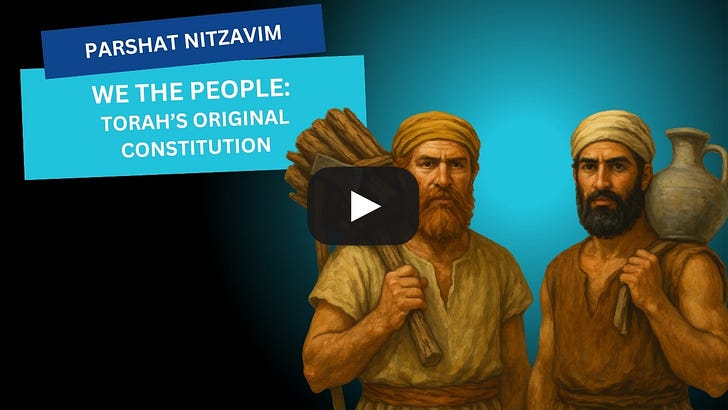 As we approach the end of Deuteronomy, we encounter a pivotal moment in the Torah: the renewal of the covenant between God and the Israelites. This isn't just any covenant - it's a radical reimagining of the relationship between the divine and humanity, one that would reshape political thought for millennia to come. I will argue that this is the original Sermon on the Mount! In Deuteronomy 29, Moses gathers the entire nation - from the highest leaders to the lowliest workers - to enter into this new covenant. But why is this moment so significant? And what can it teach us about our own relationship with power, authority, and community? Key Insights and Takeaways 1. Radical Inclusion "You are stationed today, all of you, before the presence of Adonai, Hashem your God: your heads, your tribes, your elders, and your officials, all the men of Israel, your little ones, your wives, your sojourners who are amid your encampments, from your woodchopper to your water hauler." This isn't just a list - it's a revolutionary statement. In ancient Near Eastern treaties, covenants were typically made between kings or ruling elites. But here, God is making a covenant with everyone, regardless of social status, gender, or even national origin. 2. A Movement, Not Just a Moment The Ibn Ezra, a medieval commentator, emphasizes that this covenant isn't just for those present, but for future generations as well. This isn't a one-time event, but the birth of a movement that would span millennia. 3. The Complexity of Conversion The rabbis, in their interpretations, see in the "woodchoppers and water carriers" a reference to converts - some joining out of genuine conviction, others out of convenience or necessity. This nuanced view of conversion and belonging challenges us to think deeply about what it means to be part of a community. 4. Divine Equality The Midrash Tanchuma teaches that this covenant shows God's equal love for all humanity: "His mercy is upon all his works, upon males and females, upon the righteous and the wicked." In a world of stark hierarchies, this was a radical notion indeed. In fact, the Rabbis are on the same page as modern scholars who identify a major social disruption that occurred parallel to the Israelite Exodus and entry into Canaan. In Deuteronomy 29:11 we read: for you to *cross over into the covenant of YHWH your God, and into his oath-of-fealty that YHWH your God is cutting with you today— Everett Fox comments: *cross over into the covenant: The wording is a bit unusual. There may be a conscious play here on “crossing” in v.15 below. (15) Indeed, you yourselves know how we were settled in the land of Egypt, and how we crossed amid the nations that you crossed; The Hebrew word used for crossed is לְעׇבְרְךָ֗ בִּבְרִ֛ית where the word “Avar” crossed is the same word that Abraham used to identify himself in Genesis 14:13 אַבְרָ֣ם הָעִבְרִ֑י Abraham the Ivri… or the crosser. There are some scholars who have directly linked, or at least linguistically linked the Hebrew to the Apiru. ʿApiru (Ugaritic: 𐎓𐎔𐎗𐎎, romanized: ʿPRM, Ancient Egyptian: 𓂝𓊪𓂋𓅱𓀀𓏥, romanized: ꜥprw), also known in the Akkadian version Ḫabiru (sometimes written Habiru, Ḫapiru or Hapiru; Akkadian: 𒄩𒁉𒊒, ḫa-bi-ru or *ʿaperu) is a term used in 2nd-millennium BCE texts throughout the Fertile Crescent for a social status of people who were variously described as rebels, outlaws, raiders, mercenaries, bowmen, servants, slaves, and laborers. Due to the linguistic similarity between the term 'Apiru and "Hebrew," early scholars equated them with the Israelites. See Wikipedia It seems to me that whether the Hebrews were directly linked with the Apiru disruption or adopted (or were tagged) as Apiru, the association stuck. Ivri may have been used as a verb (kind of like “Jew” me down, but in a good way) in our verses. (10) your little-ones, your wives, your sojourner who is amid your encampments, from your woodchopper to your waterhauler, (11) for you Hebrewed into the covenant of YHWH your God, and into his oath-of-fealty that YHWH your God is cutting with you today— (15) Indeed, you yourselves know how we were settled in the land of Egypt, and how we Hebrewed amid the nations that you Hebrewed. Hebrew and Ivri was a token for this rag tag group of interlopers who had a radical idea, crossed over convention and created a movement using an existing model of a treaty or covenant between an King and suzerain: subordinate ruler. Joshua A Berman an Orthodox rabbi and professor of bible at Bar-Ilan University writes in his book: Created Equal: How the Bible Broke with Ancient Political Thought writes: In light of parallels with Late Bronze Age (fifteenth to thirteenth centuries B.C.E.) suzerainty treaties, the covenant narratives implicitly suggest that the whole of Israel—not its king, not his retinue, not the priests—bears the status of a subordinate king entered into treaty with a sovereign king, God. I maintain that it is in covenant, properly conceived, that we may discern a radically new understanding of the cosmic role of the common man within the thought systems of the ancient Near East, one that constituted the basis of an egalitarian social order. Thus we may posit that to some degree, the subordinate king with whom God forms a political treaty is, in fact, the common man of Israel; that every man in Israel is to view himself as having the status of a king conferred on him—a subordinate king who serves under the protection of, and in gratitude to, a divine sovereign. If much of biblical writing reveals an ambivalent attitude toward the notion of monarchy, I would suggest it is not because of a fear of the Almighty being marginalized. Rather, these texts reflect a fear that a strong monarchy would result in the marginalizing of the common man. What Berman argues is that the radical inclusion of our verses is not simply an expansion of previous trends, but actually a paradigm shift. His approach is based on the findings of earlier scholarship such as George E. Mendenhall who writes in his book: The Tenth Generation - The Origins of Biblical Tradition 1973 The biblical revolution, then, saw, a radical redefinition of what we now term religion. Under the old primitive tribalism, religion consisted mainly of elaborate rituals performed, first, for maintaining the solidarity of the group and its complex of authority structures, and, secondly, for influencing the supernatural world to give the group what it desired, and protect it from evils it could not control. Over against this, the new concept of religion consisted of man's voluntary submission to the will of God defined in ethical terms that were binding beyond any social or territorial boundary. The new religion actually destroyed most of the traditional boundaries over which so many battles had been fought from the time of the Amarna age. If the center of the old paganism was concern for perpetuating the king's control over all his enemies, the new proclaimed that no one but God was, or could be, in control. … Any history of the origins of ancient Israel must start with, or at least account for, the sudden appearance of a large community in Palestine and Transjordan only a generation after the small group escaped from Egypt under the leadership of Moses. At the same time, it must account for the fact that from the earliest period there is a radical contrast between the religious ideology of Israel and those of the preceding periods and neighboring groups. … All of these historical problems are most easily explained by the fact that the religious community was based upon a covenant, which is most strongly emphasized in biblical tradition. The enormous and rapid growth in size can only have been possible through the entry of existing population groups into the religious community through covenant, which is actually the opposite to law, and which functioned in a way entirely analogous to a modern constitution and bylaws. Biblical tradition actually gives narratives or indications of three such historical covenants, in which radically different social contexts are either demonstrable or necessarily inferred. The first, at Sinai, was the instrument by which the “mixed multitude" became vassals, (servants) of Yahweh after the miraculous escape from Egypt. The second covenant, the last significant act of Moses' life, was radically transformed by much later tradition into the second giving of the Law"-Deuteronomy. (Deut. 29:1-31). … The Transjordanian population segments joined the covenant community and were confirmed in their enjoyment of lands and fields, free from the claims of the northern kings, but with the condition that they were bound to serve upon Yahweh's command. … There is nothing surprising about this - it is a constant in tribal organization all over the world and all through history. Erich Fromm points out a fascinating paradox: by making all humans servants of God alone, the Torah actually establishes the basis for human freedom. As he puts it: The idea of serfdom to God was, in the Jewish tradition, transformed into the basis for the freedom of man from man. God’s authority thus guarantees man’s independence from human authority. This is the true meaning and symbolism of declaring God the King on Rosh Hashanah… If God is the King then no man can be the King. אָבִֽינוּ מַלְכֵּֽנוּ אֵין לָֽנוּ מֶֽלֶךְ אֶלָּא אָֽתָּה: Our Father our King! we have no King except You. The covenant at Moab wasn't just a religious ceremony - it was a radical reimagining of human society. By including everyone, from the highest to the lowest, from “your heads” to your wood choppers and water carriers”, it established a new paradigm of equality and shared responsibility before the divine. It was the ultimate Sermon on the Mt. Sefaria Source Sheet: https://www.sefaria.org/sheets/675947 Transcript: Geoffrey Stern: Long before Jefferson wrote "We the People," the Torah declared it on the plains of Moab. Everyone is called: leaders, children, strangers, even woodchoppers and water carriers. As radical as that might sound, the rabbis upped the ante by claiming that those woodchoppers and water carriers weren't even Jewish. They were outsiders, converts of convenience, maybe even forbidden Canaanites. This means the covenant deliberately included the margins and pushed the envelope. A nation standing shoulder to shoulder and saying our worth isn't ranked by titles, tools, or pedigree. Nitzavim rewires politics at its source. God is the only master, which means no human gets to own another. Power flows down to the furthest edges of the camp. Even those not here today are written in. It's the sermon that Moses delivered on the mountains of Moab. And it is the message of this high holiday season. Welcome to Madlik. My name is Geoffrey Stern, and at Madlik, we light a spark or shed some light on a Jewish text or tradition. Along with Rabbi Adam Mintz, we host Madlik Disruptive Torah on your favorite podcast platform. And now on YouTube and Substack, we also publish a source sheet on Sefaria, and a link is included in the show notes. This week's parasha is Nitzavim. As the Israelites renew their covenant, the spectrum of those entering this treaty with God is broadened to include the woodchopper and water carrier. And to those here and those yet to come, we explore the radical significance of this original Sermon on the Mount to the ancient Israelites and to us today. Well, Rabbi, we're back in real-time. Last week, we took a parsha off because we did two on the previous parsha. But here we are. Devarim never ceases to attract us, to make us think afresh anew. And you're in D.C. so why wouldn't we talk about "We the People"? Adam Mintz: This is the perfect topic. You know, we're getting to the end of the Torah, so it's the climax of the entire Torah. It's really interesting. So we have four to go. Let's take it away. Geoffrey Stern: And I have to say I'm seeing connections between what we read in Devarim and this Elul that we're in as we prepare for the High Holidays, as I mentioned in the intro. And we'll see potentially more of that as we proceed. So we are in Deuteronomy 29:9. And it says, you are stationed today, all of you, before the presence of Hashem. Your heads, your tribes, your elders, and your officials. All the men of Israel. Nothing really surprising yet. Your little ones, your wives, your sojourners, who is amid your encampments. And then it goes from your woodchopper to your water hauler. And Everett Fox says, what is a woodchopper? It's equivalent to every man Jack amongst us. It's everybody. This is the complete spectrum, the complete gamut for you to cross over into the covenant of Hashem, your God, and into his oath of fealty that Hashem, your God, is cutting with you today. So really, Rabbi, this is using all the language of cutting a covenant. This is a new covenant above and beyond what was done at Sinai. This is right before the Israelites enter the land of Israel, and they are cutting a new covenant in order that he may establish you today for him as a people, with him being for you as God, as he promised you and as he swore to your fathers, to Abraham, to Isaac, and to Jacob. Not with you alone do I cut this covenant and this oath. But with the one who is here standing with us today before the presence of Hashem, our God, and with the one who is not here with us today, this is our covenant forever. It's a movement, Rabbi. We are really creating a movement here. This isn't just a group of people forming a little union to get through the day. Indeed, you yourselves know how we were settled in the land of Egypt and how we crossed amid the nations that you crossed. So there's a play on words in terms of crossing over into the covenant of God and crossing among the nations. I will be arguing, Rabbi, that this is really a movement, a social movement, a religious movement, a political movement. And as the people of Israel moved out of Egypt and moved into the land of Canaan, they were gathering people; people were joining the movement. And that is why it is so, I think, timely that they should make a new covenant just before they come into Israel. But there is a lot of stuff in these, what, five pesukim. Adam Mintz: I'll just say that the fact that it's a movement is not surprising because they're about to enter the land. You enter the land with more energy if you enter it as part of a movement. So it actually makes perfect sense. Geoffrey Stern: Agreed? Agreed. And I have to say, we talk about different sects within Judaism as movements. Sometimes we forget that they have to move, that there has to be some dynamism to them. But anyway, that's an aside. Rashi says, from the woodcutter. This teaches that some of the Canaanites came in Moses' day to become proselytes. Just as the Gibeonites came in the day of Joshua, we're going to go to that text in Joshua. This is the meaning of what is stated of the Gibeonites. And they also acted cunningly, meaning to say this wasn't the first time, and Moses made them woodcutters and drawers of water. So Rabbi, there is this ongoing tradition that there were people who were joining the movement. Some of them cunningly, some of them maybe not so cunningly, some of them for total buy-in and some of them for other reasons. But this was an amalgam, there's no question about it. And if you had to pick a few verses that really touch upon that, I don't think we could pick better ones. And that's, I think, ultimately what it means when it includes even the woodchoppers and the water carriers. It was everybody. Adam Mintz: I mean, that's where Rashi gets it from. How does Rashi know that some of the Canaanites came in Moses’ day? Because to be a successful movement, you need the outsiders coming. A movement is not just your own group. A movement needs others from the outside to join your group. That's what makes the movement successful. Geoffrey Stern: And I will argue, Rabbi, and I made a little bit of an allusion to this Sermon on the Mount, but I think people and commentators that we are going to see are going to read themselves. It's almost like a Rorschach test. Everybody will see in these woodchoppers and water carriers their own prism of what they want to see in terms of inclusion. The Sforno is a great example. The Sforno says, what are woodchoppers and water carriers? People who normally require the consent of their husbands or fathers to do what they do. So they're talking about people that normally are not 100% free to make their own decisions. But I think the takeaway is, in this particular moment, they did have agency and they could make their own decision. Adam Mintz: Well, they can't make their own decisions on regular things. But in terms of covenant with God, they can make their own decisions. That's what Sforno means. This moment, this moment of covenant, they have agency. Geoffrey Stern: Okay, I like it, I like it. But again, this is a pivotal seminal moment. The Sforno says the leader of the woodchopper to the most lowly of the water carriers. The construction here parallels comparisons in Samuel, infants as well as sucklings. The examples that the Sforno brings is when they totally destroy another nation where they kill them from the kings down to the animals. And I think what's important to say is, this was a reverse. This was a paradigm shift. God was saying, or Moses, the spokesperson was saying, that the covenant, therefore, goes to the highest, to the most low. Whatever your commentary is, you can't get away from the radical inclusion of everybody who was listening to this message. I think that's the main takeaway. Adam Mintz: Right? That's great. Okay, good. I mean, again, the idea of a movement, it's almost as if the medieval commentators are aware of that and trying to enslave each piece here as part of that creation of the movement. Geoffrey Stern: So again, getting into each one, each is reading their own thing. The Ibn Ezra says, and also with him that is not here with us means with him that is not here with us but will come after us. It is not to be interpreted as those who say that the spirits of the covenanting generations were there. So Ibn Ezra is going against the kabbalists, against the ideology that says, you know, we met at Sinai, that every Jewish soul was actually at Mount Sinai. He goes, no, I'm not talking about that. I am literally saying that we are creating a movement here, and these people that are joining this movement are buying into it, and their children will buy into it, and their children's children will buy into it. I just love the practicality that Ibn Ezra brings to it and kind of shoo-shoos away the mystical tradition. Adam Mintz: Right? Geoffrey Stern: So the Ramban says a bunch of things here, but what is interesting is he says he brings in the mixed multitude, the erev rav. Rabbi, we all know that when the Jews left Egypt, the tradition believes that there were those there who joined the movement. They saw that the plagues were happening to the Egyptians, and that the Israelites were unscathed. This sounds like a good bet. Let's leave with them. Many of the terrible things that happen, whether it's the golden calf or whatever, are sometimes blamed on the erev rav. The word "erev" is when you take a string and you put it around a city and you make it all together. It's the ultimate mashup. That's what they are. But here, the Ramban is bringing that tradition of the erev rav into this tradition of the water carriers and the wood choppers. And he is saying that they were all brought in. And he quotes, the rabbis have said, some Canaanites came in Moses' day, just as they came in Joshua's day. And he said, you know, ultimately, they came to make peace. This wasn't necessarily a religious movement. This was joining the movement of the Israelites that was coming in. Ultimately, the argument or the tension amongst the rabbis is, we will read about Joshua in a few minutes, but in Moses' time, the question is, was Moses also fleeced the way Joshua was, or did Moses know what was happening and accept these Canaanites or accept these people that were joining? And I think that's a little bit of a tension here. And then the other thing that comes through, Rabbi, is what did Moses do with that? There's this thing that he made them hewers of stone and drawers of water for the temple. Now, I don't know, in a lot of the commentaries, it appears that's almost like the lowest form of service that you can have. To me, it doesn't sound so bad that these people are the ones who are the janitors who are making sure that the temple worked. There's a lot of mixed messaging going on, right? Adam Mintz: I mean, I think that's also a tension, right? The Ramban is sensitive to that, and he says, "May they be the hewers of wood and drawers of water for the congregation unto the tabernacle of God." But that's not explicit in the Torah. That's a rabbinic interpretation, and, you know, he's clearly taking a position that they're not just everyday Jacks, that they're special people. Actually, there's a disagreement between the Ramban and Everett Fox. Geoffrey Stern: I like that. I like that. I mean, you know, that's quite a compliment to Everett Fox. But in any case, yes, in the Midrash Tanchuma, it talks about other lessons that we can learn from. Here it says, another interpretation: All of you are responsible for each other, kol arevim zeh lezeh. Even though there is only one righteous person amongst you, you all shall survive through the merit, like it says in Proverbs, but a righteous person is the foundation for the world. And also, it shows that there can be an evil person who can bring the whole world down. Rabbi, this comes right out of the kind of Musar that we study before the High Holidays, where we say the whole world is in a balance, and one mitzvah can tip it one way and one aveira can tip it another. Here, too, what the Midrash is trying to learn from this is the importance of every member of the society. It goes on to say that God is not like us. He doesn't have favorites. His mercy is upon all his works, upon males and upon females, upon the righteous and upon the wicked. As it is said, from one who chops your wood to the one who draws your water. So literally, they're all learning the same thing with different variations, that this is a radical statement of God's love for all of humanity. Adam Mintz: Now, my question is, do you think these commentators are disagreeing with one another? No, I think they're just coming at it from a different place. Right. They're all ending up in the same place, which is the creation of this movement. But it's interesting that each one of them has their kind of twist or their own goal on how to create that. Geoffrey Stern: I think. I think. And again, what it shows is that not only do people join a movement for different reasons, but people interpret how people join a movement. Adam Mintz: Right. That's very good. Geoffrey Stern: So, you know, every week I always say, I learned something. This week I really learned something. Cool. So one of the sources. And by the way, of course, there is an article in TheTorah.com that talks about the water carriers and the woodchoppers, and they reference Kings 1, where Solomon had 70,000 porters and 80,000 quarriers in the hills. Kind of similar, a parallel to this. And Rashi says, 70,000 men who carried loads to bring the stones from the mountain to the city, and 50,000 workers. And they were all proselytes who were drawn. Rabbi, I had never heard the expression gerim gururim. I've always heard ger tzedek, converts out of righteousness. Gerim gururim seems to mean proselytes who were drawn. The translation here is that gerurim means they rolled in. They had other reasons for joining. I think the reason that TheTorah.com's article brings this in is, again, to show us that there were different gradations of people who joined this movement. But I had never heard of gerim gururim. And there's an... Adam Mintz: It's a little bit of an alliteration. Right? Gerim, gerurim, they sound similar. Geoffrey Stern: So there is in the source notes, an article from the Hartman Institute in Hebrew. But Google does a nice translation of literally what this gerim gururim means, I think. And maybe we could dedicate another podcast to it. It's really talking about people who joined the people, people who joined the nation for whatever reason. I think today we would call it converts out of convenience. And we always question that, whether they're getting converted only because they're getting married or because their children are Jewish. But it was here. This is the parsha for it. Jeffrey Tigay, who wrote a commentary on Devarim, he says that there is one thing that seems pretty clear, that it cannot be referring to Israelite menial labors. In other words, when it says cut water carriers and wood choppers, it can't be talking about Israelite water carriers and wood choppers because it comes right after the word gerim. Since all categories of Israelite have already been listed, this phrase must refer to aliens that serve as menial laborers. And I think that's a critical mark here that even the classical commentaries are playing with. None of them are saying, no, no, no, it's just repeating itself as the Torah does many times. Adam Mintz: Good. Geoffrey Stern: I mean, that right now if you notice the gerim gerurim, the verse tells us that they're gerim gerurim because they hear about how great King Solomon is. You know, that's an important piece of it. You know they're drawn, but, you know, it's a social consideration. I want to be part of this. People political, social, economic, call it what you may, but they're certainly gerimimum, I think cannot but be taken as in reference to gere Tzedek, those that buy in 100%. So Joshua has been referenced a few times. Let's go to Joshua 9, which obviously happened after Devarim. In Joshua 9, it says, but when the inhabitants of Gibeon learnt how Joshua had treated Jericho and Ai, they for their part also resorted to cunning. So the word "also" is the key here. And that's where it harkens back to Moses. They set out in disguise. So these Canaanites disguised themselves. They took worn-out sacks for their donkeys and worn-out water skins that were cracked and patched, and had worn-out patched sandals on their feet, threadbare clothes on their bodies, and all the bread they took as provision was dry and crumbly. And so they went to Joshua in the camp at Gilgal, and in a conversation said to him, and to the rest of Israel's side, we come from a distant land. We propose that you make a pact with us. Israel's side replied to the Hivites, but perhaps you live among us. How then can we make a pact with you? They said to Joshua, we will be subjects. But Joshua asked them, who are you and where do you come from? So later it says, and the chieftains declared concerning them, they shall live. And they became hewers of wood and drawers of water for the whole community, as the chieftains had decreed concerning them. Joshua summoned them and spoke to them thus, why did you deceive us? So what happened was they went for the ruse. They accepted them. They said they could be hewers of wood and drawers of water. So, similar to the commentaries that we are seeing here. They weren't—I can't say they weren't full members because the covenant was with them as well. But they were certainly on the lower stratum of society. Adam Mintz: Now, clearly this is not what the Ramban means, because he said it's hewers of wood and drawers of water for the tabernacle. That is not what these people want to do. They want to be. That's. They want even be. Wasn't even be lower class. Geoffrey Stern: Yes, but I think what Ramban is saying is that the ones that happened in Moses' day were made for hues. This is the second. This is the second one. And Joshua summoned them and spoke to them thus, why did you deceive us and tell us you lived very far from us when in fact you live among us? Therefore, you be accursed. Never shall your descendants cease to be slave hewers of wood and drawers of water for the house of my God. So, again, a lot of different mixed messages here. Is it a punishment? It's kind of. It reminds me of when Adam is cursed after leaving the Garden of Eden, that he shall work by the toil of his brow. Is that a curse? Or that is his lot. In any case, this is part of the history. That day Joshua made them hewers of wood and drawers of water, as they still are for the community and for God's altar in the place that God will choose. And I just haven't found any of the commentaries that would say, are you kidding me? For the altar? I mean, how bad is that? There must be something holy about them if they were for the altar. But in any case, there is only one commentary, a Sephardic or Mizrachi commentary that thetorah.com brings in that combines the Moses story with the Joshua story. And it says, it teaches that the Holy One, blessed be he, showed Moses at that point that the people of Gibeon were eventually to take refuge under the wings of the Divine Presence and become the wood choppers and water drawers for the whole community. So once they came to Joshua and agreed to be wood choppers and water drawers, Joshua accepted them immediately. And Joshua made them hewers of water and drawers of water for the community. So again, if you're a higher biblical critic, you say that Deuteronomy was simply rehashing and projecting back in time something. Adam Mintz: That happened, meaning that it's the same story. Right? If you're a Critic. It's the same story. Because how can there be woodchoppers and water drawers twice? Obviously, there's one story about them and they reflect backwards and forwards. Geoffrey Stern: But. And if you're a traditional commentary, you say that Moses perceived it in the future. The bottom line, Rabbi, is I don't think there's any way that you can read this where you cannot but say that we, the Jewish people, are an amalgam of others that have joined. We're not a pure race. Probably no one left Egypt, Rabbi, with your blue eyes or my blue eyes or freckles, we are a movement at the end of the day. And what you're involved with with Project Ruth, in terms of bringing people in, is as old as the hills of Moab. And this has been part of our, I guess, magic, but also both part of the mission. The coolest. Before we get into, I think, the bigger message here, we said that this was kind of a litmus test, a Rorschach block for everybody to see in it what they want. I think the award, the Academy Award, goes to Maimonides. Maimonides, in Mishneh Torah, says the greatest sages of Israel included woodchoppers, water drawers and blind men. Despite these difficulties, they were occupied with Torah study day and night and were included among those hands transmitted the Torah's teaching from masters to student. Rabbi Maimonides believes that if you learn Torah, you have to make a living. And he found in the wood choppers and the water drawers examples of our great sages that are quoted in the Talmud, who actually had very menial labor that they earned a living with, and then they went to study. Adam Mintz: So talk about, you see what the Rambam is saying, he says, and nevertheless they study Torah. To the Rambam, being a wood chopper or a water drawer or blind people, that's something that's very time-consuming. And even though they had a time-consuming job, nevertheless they studied Torah. We would say it today, even though you're a lawyer or an investment banker, you still find time to study Torah. Geoffrey Stern: So it really is all inclusive. But now I want to get to the bigger message here. And we have quoted Joshua Berman's book called Created Equal, how the Bible Broke with Ancient Political Thought. And what he writes is that there is no question that in the late Bronze Age, the 15th to 13th centuries BCE, there were these treaties and covenant narratives that were being created. People were making kind of coalitions. A movement was being formed. And what Israel did, the ancient Israelites did, is they took these treaties that were typically made between one king and another, and they made them between God and the woodchopper, God and all the way down to the woodchopper. And that was radical. Not its king, not its retinue, not the priests bears the status of a subordinate king entered into the treaty, but the people. And what Joshua Berman maintains Geoffrey Stern: is that this is the magic of the covenant, the covenant properly conceived, that we may discern a radically new understanding of the cosmic role of the common man within the thought system of the ancient Near East, one that constituted the basis of an egalitarian social order. I mean, Rabbi, you can't read these words that start as we would expect it to start from the princes of Israel and goes to woodchoppers without Geoffrey Stern: saying, this is not a stretch. This is what it is. Thus we may posit that to some degree the subordinate king with whom God forms a political treaty is in fact the common man of Israel. That every man in Israel is to view himself as having the status of a king, conferred on him a subordinate king who serves under the protection of and in gratitude to a divine sovereign. If much of biblical writing reveals an ambivalent attitude toward the notion of monarchy, I would suggest it is not because of a fear of the Almighty being marginalized. Rather, these texts reflect a fear that a strong monarchy would result in the marginalizing of the common man. This concept of a covenant between the common man, as really personified by the wood chopper and the water carrier, and God is right out of our verses. And it is truly, truly radical. And I think, ultimately, Rabbi, that when we pray over the High Holidays and we say that God is king, to many of us moderns, we don't really associate with this concept of king. And we certainly don't find it particularly wonderful to say that someone is king. But you have to understand it from its context, and what it was saying was that God is king and no man is king, that God is making a covenant with us and not with another king. And I think Erich Fromm really characterizes this the best. He writes in a book called "You Shall Be as Gods," a radical interpretation of the Old Testament and its tradition. The principle that man should not be the servant of man is clearly established in the Talmud. In the rabbinical comment to the law that says that a Hebrew slave's ear must be pierced if he refuses to be liberated after seven years, Rabbi Yochanan Ben Zakai explained to his disciples, the ear had heard on Mount Sinai, "For unto me the children of Israel are servants." And yet this man went and acquired another master. Therefore, let his ear be bored through, because he observed not that which his ear had heard. The same reasoning has also been used by the leaders of the Zealots, the most radical nationalistic group in the fight against Rome. The idea of serfdom to God was, in the Jewish tradition, transformed into the basis for the freedom of man from man. God's authority thus guaranteed man's independence from human authority. Rabbi, this is ultimately this message from the Mount of Moab that Moses is delivering: from the highest prince to the lowest water carrier and wood chopper, you make a covenant only with me, and therefore you serve no one else. And ultimately, at the end of Yom Kippur, when we say that "Avinu Malkeinu, ein lanu melech ella atah," we are saying that the only boss that we listen to is God, and that goes from the highest to the lowest. I think it's a beautiful message. And yes, Rabbi Sacks, I took a look at him, and he was the one who gave me the idea of calling this "we the people." He says it's a politics of collective responsibility. The parties to the covenant are, said Moses, your leaders, your tribes, your elders, and officials, all the men of Israel, your children, your wives, the strangers in your camp, from woodcutter to water drawer. This is what is meant in the preamble to the American Constitution by the phrase "we the people." Adam Mintz: Great. What a good way to end and to, you know, to understand the importance of this parasha as we get ready to enter the land of Israel. Shabbat shalom, everybody. I look forward to seeing you all next week. Geoffrey Stern: Shabbat shalom. See you all next week.
|
Wednesday, 17 September 2025
The Original Sermon on the Mount — Jewish Edition



Subscribe to:
Post Comments (Atom)
Six years ago, Tony Abbott ...
Sometimes you can't escape your past! ͏ ͏ ͏ ͏ ͏ ͏ ͏ ͏ ͏ ͏ ͏ ͏ ͏ ͏...

-
Dear Reader, To read this week's post, click here: https://teachingtenets.wordpress.com/2025/07/02/aphorism-24-take-care-of-your-teach...
-
CALL FOR APPLICATIONS: AOM 2025 PDW ͏ ͏ ͏ ͏ ͏ ͏ ͏ ͏ ͏ ͏ ͏ ͏ ͏ ͏ ͏ ...


No comments:
Post a Comment