Pop-Up Booths in the Desert: Really?How “זֵכֶר לִיצִיאַת מִצְרַיִם” — a remembrance of the Exodus from Egypt — became Judaism’s default setting.
I didn’t expect it in the High Holiday prayers.There I was on Rosh Hashanah, and again on Yom Kippur, and the liturgy spoke of the day as Creation of the world (or human kind) and atonement… yet somehow, Egypt? Once I identified this artificial branding with regard to the High Holidays, I noticed it everywhere — on Shavuot, on Shabbat, and even on Passover, where it feels redundant. Shabbat: Blessed are You, Lord our God, King of the Universe, Who sanctified us with His commandments and was pleased with us. And He gave us His holy Sabbath, with love and pleasure, as a heritage, a commemoration of the work of creation, the first of the days of holy convocations commemorating the exodus from Egypt זֵכֶר לִיצִיאַת מִצְרָיִם. Passover: Blessed are You, LORD our God, King of the Universe, who has chosen us from among all peoples, raised us above all tongues, and made us holy through His commandments. It’s as if Judaism stamped one watermark across the entire calendar: Why? And why here? The booths that never quite wereSukkot feels like the “natural” place to connect harvest and history because Leviticus 23:42-43 does something rare — it gives a reason:
But the verse strains against the record. The commentators knew the problemClassical rabbinic voices don’t take Leviticus’ “booths” at face value — or they flag the difficulties:
Each is solving the same puzzle: an agricultural commandment reframed as Exodus memory. From farm festival to liberation lensThat reframing may be the point. It didn’t have to be that way… As Prof. David Frankel notes on TheTorah.com, Exodus wasn’t the only origin story in ancient Israel. see: How and Why Sukkot Was Linked to the Exodus Some strands centered on the wilderness, others the land, the Temple, or kingship. Hence the tag we keep hearing: זֵכֶר לִיצִיאַת מִצְרַיִם.
What Sukkot trains us to noticeIf Sukkot began in the fields, the Torah turns it into a rebranding and launch of a messaging campaign: Isaiah 4:5-6 braids the metaphors: cloud by day, fire by night, חֻפָּה overhead — “and the sukkah shall be a shade by day, a shelter from rain.” ‘Twas in another lifetime, one of toil and blood [Bob Dylan - Shelter from the Storm lyrics © Universal Music Publishing Group]
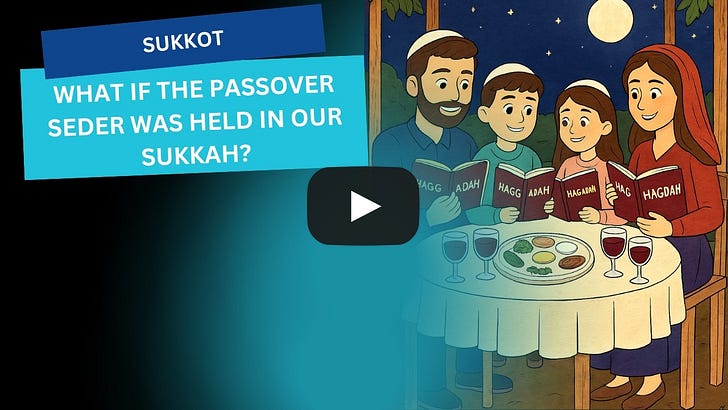
Jonah’s booth: waiting to see what happensAnd then there’s Jonah. וַיֵּצֵ֤א יוֹנָה֙ מִן־הָעִ֔יר וַיֵּ֖שֶׁב מִקֶּ֣דֶם לָעִ֑יר וַיַּ֩עַשׂ֩ ל֨וֹ שָׁ֜ם סֻכָּ֗ה וַיֵּ֤שֶׁב תַּחְתֶּ֙יהָ֙ בַּצֵּ֔ל עַ֚ד אֲשֶׁ֣ר יִרְאֶ֔ה מַה־יִּהְיֶ֖ה בָּעִֽיר That, too, is Sukkot. Maybe that’s the deepest zecher l’yetziat Mitzrayim: Standing on the ThresholdAnd fittingly, this Shabbat Sukkot we also finish the Five Books of Moses. Moses leaves the people just as Jonah leaves the city — And that, perhaps, is where the Torah truly ends: not with closure, but with a question. Chag Sameach — and Shabbat Shalom.May your sukkah be a place of humility, of memory, and of wonder for what happens next. 🎧 Listen to the full conversation with Rabbi Adam Mintz on Madlik Disruptive Torah Transcript: Geoffrey Stern: Picture it in ancient Judea, or up until today, families live and sleep under fabric walls and a roof of cut branches. It looks like a farm holiday because it is. And then the Torah whispers a plot twist: Sit in booths so your children will know I made Israel dwell in booths when I brought them out of Egypt. Except the wilderness generation probably lived in tents, says the Bible, or maybe under clouds of glory, say the sages. So why bolt the Exodus onto a farm festival? Join us as we follow the breadcrumbs from Rashi’s clouds to Rashbam’s simple huts, from Deuteronomy’s tents to Isaiah’s canopy, to ask a bigger question: why does the Exodus seep into almost every Jewish practice? What happens when an event becomes the operating system of a people? Welcome to Madlik. My name is Geoffrey Stern, and at Madlik we light a spark or shed some light on a Jewish text or tradition. Along with Rabbi Adam Mintz, we host Madlik Disruptive Torah on your favorite podcast platform, and now on YouTube and Substack. We also publish a source sheet on Sefaria, and a link is included in the show notes. This week we transition from the High Holidays to the third pilgrimage festival of Sukkot, or booths. Ancient agricultural holidays were repurposed by the Israelite religion to commemorate the Exodus, and Sukkot appears to be the most natural. The Torah itself connects the temporary booths of the fall harvest with the temporary booths of the migrating Israelite tribes. Or not. Join us as we question this common assumption and explore what Sukkot means for us. So, Rabbi, we just finished Yom Kippur. What are you supposed to do after you break the fast? You’re supposed to take a nail and a hammer and start building your Sukkah. It never ends. Adam Mintz: It never, ever ends, from one to the next. Geoffrey Stern: So I actually was kind of thinking about this because there are two different kinds of cycles. There are the pilgrimage holidays, which start with Passover, go to Shavuot, and then to Sukkot, and they’re all linked to different agricultural milestones. And then there are the High Holidays, which have more to do with the New Year. It’s the time the world was created, maybe when man was created. Not that involved with history, but as we’re going to say and as we see today. As I was davening, I was blown away at one point when I was reading the prayers about Rosh Hashanah, and it said zecher l’Yitziyat Mitzrayim. And I go, where did that come from? What does Rosh Hashanah have to do with Yitziyat Mitzrayim? So as I said in the introduction, Yitziyat Mitzrayim, leaving Egypt, actually became the overwhelming motif of the whole Torah. And that’s the real connection, Rabbi, to the fact that we’re finishing the Torah this week too. It’s a wonderful way to look at what’s the bumper sticker message of this whole journey that starts with Creation and ends up with Moses. So we’re gonna make a stab at it. We’re gonna try to understand how Yitziyat Mitzrayim, leaving Egypt, became so seminal. So, first of all, let’s look at Sukkot in Shemot. In Exodus 23, it says: “And the festival, the Feast of the Harvest, of the first fruits of your work, of what you sow in the field, that’s Shavuot. And the Feast of Ingathering, Chag HaAsif, at the end of the year when you gather in the results of your work from the field.” Just a very straightforward rendering of the last two pilgrimage festivals. The same thing goes for Exodus 34. Adam Mintz: Interesting. By the way, the Chag HaAsif B’Tzeit HaShana, at the end of the year, they knew somehow that the cycle started with Rosh Hashanah. So Sukkot is the beginning of the year and the end of the year. Geoffrey Stern: They really are connected. I always thought they were kind of like ships passing in the night. But there is a reason we’re moving from the end-of-the-year or the beginning-of-the-year festival right into this Thanksgiving holiday, gathering the crop that needs to last you through the winter. In Exodus 34, it says: “You shall observe the Feast of Weeks of the first fruits of the wheat harvest,” that is Shavuot, which later became associated with the giving of the Torah. But it never says that in the Torah itself. Adam Mintz: Correct? That’s rabbinic. Geoffrey Stern: Yeah. And the Feast of Ingathering at the turn of the year, again, not so much at the end of the year, KufaT HaShana, the season of the end of the year. In Deuteronomy, it says, “After the ingathering from your threshing floor and your vat, you shall hold the Feast of Booths for seven days. You shall rejoice in your festival with your son and daughter, your male and female slave, the family of the Levite, the stranger, the fatherless, living in your communities.” So, as an aside, Sukkot is a happy, very happy holiday. And the idea was that happiness should permeate for all of the citizens of Israel. Adam Mintz: And again, the happiness is because it’s the end of the agricultural cycle. So it’s a celebration of success. It’s like, you know, you went through a whole year, your investments were successful. Geoffrey Stern: Now you celebrate very naturally. No need for any embellishment or explanation. “You shall hold a festival for your God, seven days, in the place that God will choose for you,” that means where the temple was, which means this is a pilgrimage festival. God will bless all your crops and all your undertakings, and you shall have nothing but joy. V’Hayita ach sameach. A beautiful, beautiful holiday. And now we get to Leviticus 23. And in Leviticus 23, it does something rather radical. “You shall live in booths seven days. All citizens in Israel shall live in the booths.” In 23:43, it says, “in order that future generations may know that I made the Israelite people live in booths when I brought them out of the land of Egypt. I am your God.” L’ma’an yed’u doroteichem ki baSukkot hoshavti et Bene Yisrael b’hotzi otam me’eretz Mitzrayim; ani Hashem Elokeichem. So it’s not that many times in general that the Torah goes out of its way to give, I guess, a commentary, the background, the context. Adam Mintz: It’s the only holiday where there’s an explanation like this. Geoffrey Stern: And in a sense, if we say that the agricultural holidays were, I would say, adopted or morphed into cultural historical holidays like Shavuot for the Torah, here’s an example of the Torah doing it itself. And that makes this rather interesting. So, Rashi on that verse says, this does not mean literally booths but the Ananei haKavod, the clouds of glory. And he quotes a bunch of rabbinic sources, classic rabbinic sources. So we will see. There is one tradition that takes this metaphorically and it refers, or I wouldn’t say metaphorically, it takes it to describe not some four-wall booth with making sure that you had three complete sides and maybe a tefach on the fourth and that you have your s’chach on top. No, no, no, no, no. In the desert, it was the Ananei haKavod, the clouds of glory. And then we, through the halacha, create a commemoration of that. So it’s not metaphorical. It just does not say that the Israelites were in tents. The Rashbam says the plain meaning of the text is in agreement with the view expressed in Sukkah 11, according to which the word sukkah is understood literally. The meaning of the verse then would be constructing for yourselves the festival of huts. When you gather in your grapes, you are to do this at the time you gather the produce of the earth, and your houses are filled with all the things the earth produces, such as grain, wine, and oil. This is to be done in order that you will remember in the desert for a period of 40 years when they neither owned land nor found themselves in a cultivated part of the earth. So, the Rashbam is doing a lot of maneuvers here, right? He’s saying if this is. He’s thinking in the back of his head, we can hear the gears turning. If this is to commemorate the Jews leaving Egypt and being in tabernacles, why don’t we celebrate it at Passover time? Can you imagine what a wonderful seder it would be? We’d be sitting in a sukkah, we’d be having our matzah. It would be wonderful. It would also save us. We’d be able to go to work this week. Adam Mintz: We save a holiday. Correct. Geoffrey Stern: So what he says is, no, the reason why it’s this time of year, and of course, we noted that the verses, two of the verses associated with the end of the year, is because that’s actually when you gather the produce of the earth. The message from this, how does he connect it to agriculture? He says because the people neither owned land nor found themselves in a cultivated part of the earth, and still they were given all the crops. So it’s kind of a soft connection, Rabbi, but a very nice one. This is kind of like a Rorschach test. Everybody is reading something else into this. And he says, you must not fall into the trap of thinking that all this success is due to your own efforts. So at that time of year, Rabbi, that we are most inclined to say, kochi v’otzem yadi, I created my whole. Think back to the Israelites in the desert who didn’t have a harvest and were dependent on God. We need to learn the lesson that our success also comes only by depending on God. Adam Mintz: So let me just make a point, and that is, you know, today we very much connect Sukkot to Rosh Hashanah and Yom Kippur, but the Rashbam is not interested in that. The Rashbam tries to locate Sukkot in the autumn, in the fall, but the fact that it comes right after Rosh Hashanah and Yom Kippur, as far as the Rashbam is concerned, that’s completely by chance. Geoffrey Stern: Yeah, absolutely. I mean, the only connection you could make is the end of the year is the fall, and that’s when you gather the crops. But you’re absolutely correct. There’s a lot of thought that went into this. I will say something that occurred to me that I kind of liked is when he said that they neither owned land nor found themselves in the cultivated part of the earth. All of a sudden, this makes Sukkot something that can resonate and can be a profound lesson to urban dwellers, to people who are no longer involved with farming and agriculture. I kind of love that, that he is saying that the Jews or the Israelites in the desert celebrated a harvest festival without a harvest. Right. I think that’s kind of nice. People are learning lessons from this because they’re given a license by the text of the Torah that says ‘L’maan’ (in order that). In order that what? That you learn the lesson that the Israelites were somehow protected in the desert. Here we are bringing in our bounty. I think it’s a beautiful idea and it does fit in with other Thanksgiving type of holidays. It’s the time that you really have to be thankful when you are kind of gathering the produce. Hazorim Bedima, Barina Yiktzoru. You harvest in joy, you work hard, and now you could very well say, I did this. And this is a beautiful lesson. Adam Mintz: Good. So it’s about humility is really what he says. Geoffrey Stern: And Hakarat Hatov, recognizing the good God. Adam Mintz: Gratitude to God and humility are really flip sides of the same coin. Geoffrey Stern: I would go out even further, and I would say, because again, I am just infatuated with the comment that he made—that they neither owned land nor found themselves in a cultivated part of the earth—that this gives license to us today that we are not part of the supply chain, that we eat meat, we eat eggs, we eat crops, so we get them at the grocery store. And there is no connection to the growing of it. We still need to learn the lessons of the farmer. I love that. And I love the fact that he said the first people to do this were the Israelites, because guess what? They weren’t farming for 40 years in the desert, but they celebrated a harvest festival. So the Ibn Ezra says the Israelites made booths after they crossed the Sea of Reeds. This is going to be an important statement when we come to what modern academics have to say about this. But then he goes on, they certainly did so in the wilderness of Sinai. In other words, whether they created booths after they crossed the Sea of Reeds is one question, but they certainly did in the wilderness of Sinai, where they dwelt close to a year. This is the manner of all camps. This festival too, like Passover, is thus in memory of the Exodus, even though it is not observed in the month of Nisan. So Ibn Ezra again is struggling with the same question that the Rashbam was having. If this is truly recognizing or remembering, commemorating, leaving Egypt, should someone ask why is this commandment to be observed in the month of Tishrei, not the month Israel left Egypt? They can answer: God’s cloud was over the camp during the day and the sun did not strike them. However, they started to make Sukkot from the days of Tishrei onward because of the cold. So we have to look up where Ibn Ezra lived, right? Adam Mintz: He lived in Toledo, in Spain. Geoffrey Stern: It was never cold. Okay, but what he’s saying is this has more to do with the weather changing. And he is almost a hybrid approach. He is saying that whether they were protected by the clouds of Glory or actual huts depends on the time of year it was. But clearly, we can celebrate and commemorate those booths because they would make them in the fall, and that occurred in Tishrei. I said a second ago that the first line of Ibn Ezra is kind of interesting. It says the Israelite made booths after they crossed the Sea of Reeds. He breaks it up, if you recall, Rabbi, and this is based on a wonderful article in TheTorah.com but it’s really based on a commentary that was in Moses Mendelssohn’s translation of the Bible, the Torah, into German. The rabbi is named Naftali Herz Wessely, and he says he connects the Sukkot to a place called Sukkot. In Exodus 12:37 it says the Israelites journeyed from Ramses to Sukkot, about 600,000 fighting men on foot, aside from the non-combatants. In Exodus 13, it says they set out from Sukkot and encamped in Etam at the edge of the wilderness. And then finally in Numbers 33, it says the Israelites set out from Ramses and encamped at or in Sukkot. I added ‘or in’ because the Yachanu b’Sukkot literally means they, they dwelt in Sukkot. Right. So the argument that some of the academics are giving is, and by the way, Mendelssohn’s famous translation was called the Biur, which consisted of a German translation plus a Hebrew commentary. Rabbi Wessely suggests that the place was called Sukkot because God miraculously covered the Israelites with booths on the way out of Egypt. We’ve seen that many times before. Rabbi Be’er Sheva is called Beer Sheva because they made oaths there. The name is given to it because of what was done there. And so he takes this to be a more logical explanation for doing this. I don’t think that anyone will argue how the tradition took it. I think it’s pretty safe to say when our kids and grandkids go to Hebrew school and they are taught why we go into booths, they are probably told because the Israelites dwelled in booths. Absolutely. In the desert. Adam Mintz: Exactly. Geoffrey Stern: Right. But this is simply trying to understand where this all comes from. If you’re interested in exploring this further, I suggest you look at the Sefaria notes and the link to TheTorah.com. But there is another practical issue that comes up. Where did they get the supplies? And remember, Rabbi, these rabbinic scholars are looking at this. When they talk about a sukkah, they’re talking about specifications. Geoffrey Stern: It has to have four corners. It has to have live crops on the top, right? Adam Mintz: Yeah. Geoffrey Stern: So Rabbeinu Bechaya says one must suppose that they had regular commercial contact with traders from far off who brought to them the various necessities of life, including plants. So now not only are they disconnected from agriculture, but they actually are going to Whole Foods and picking up their S’Chach. Adam Mintz: You know, these comments are more a reflection of the fact that Rabbeinu Bechaya comes from Spain and he probably didn’t have access to all these things. Geoffrey Stern: Interesting. I like that context. The point is, when I post these podcasts on YouTube, I have to come up with images for the thumbnail. I go to ChatGPT and say, ChatGPT, make me an image. This week I have an image of Moses constructing a prefab sukkah. There’s a box on the side, and it says, “Family Sukkah.” And he’s looking at the instructions. It’s not that far from what Rabbeinu Bechaya and Vayechulu U’re’einu, which our grandmothers and great-grandmothers read. Their explanation is that merchants from foreign lands bought the Israelites everything they needed. Geoffrey Stern: So there really was this. We do project backward, Rabbi, into our text and imagine it’s not only the Hasidim that I assume must imagine that Moshe Rabbeinu was wearing a long black kapote and a fur hat, but we imagined if we’re building a sukkah. They must have built a sukkah too. Where’d they get it from? They must have ordered it from the local merchants who were stopping by. It is fascinating how pop-up sukkah brings these commandments and laws to life. I think it’s fascinating and a little bit humorous. Geoffrey Stern: I think what it does is it touches upon the process that is not so humorous, identifying what is important in the texts, what is important to us in our day, and how do we make it relevant now? The same academics who are saying it can’t be actual Sukkot or huts in the Bible have a very easy case to make. In Numbers 11, Moses heard the people weeping, every clan apart, at the entrance of each tent. When the miraglim, when the spies came back, everybody at the entrance of their tent. Rabbi, not at the entrance of their hut, of their sukkah. Geoffrey Stern: And when Balaam looked out at the children of Israel, he said, it’s clear that they were in tents, and they weren’t saying, we need some branches to put on the top so that we can see more. Less sun and more sky or whatever the halacha is. So I think we’re talking about the lessons that we learn. There’s no question that the sukkah itself, this kind of protective quality of it, is almost a magnet for us looking for meaning. Geoffrey Stern: If you look at Isaiah, Isaiah 4:5-6 says, God will create over the whole shrine and meeting place on Mount Zion a cloud by day and smoke with a glow of flaming fire by night. Indeed, over all the glory, a canopy shall serve as a pavilion for shade from heat by day and as a shelter for protection against drenching rain. So here we have Isaiah himself conflating the two concepts. The anane ha’kavod, these clouds of glory that protected the Israelites, and the sukkah itself. Here he mentions both. Adam Mintz: Very interesting rain, right? Geoffrey Stern: And it was the rainy season, so things are coming together, there’s no question. But he, of course, does not bring anything to talk about leaving Egypt. So I’d like to read a little bit about what this thetorah.com Rabbi Professor David Frankel writes. What he is going to say is that it didn’t have to be this way, that everything related back to Yitziyat Mitzrayim. He says the Exodus tradition was not always the central story or myth of ancient Israel concerning the formation of the nation that it eventually became. This centrality was achieved gradually as some traditions were silenced or marginalized and others became interpreted in relation to the Exodus. Geoffrey Stern: So in this verse about Sukkot, that it says, and therefore you should remember that you left Egypt, he finds the kernel of this whole strategy that we will see goes to Rosh Hashanah and Yom Kippur. Everything is Zecher L’tziyat Mitzrayim. Geoffrey Stern: He talks about other types of narratives, and I will even say that we even find them in our own obvious texts. If you think of the Haggadah, Rabbi. And if you think of the Bikurim, when we hold up the crops and say that our ancestors were traveling Arameans, we don’t mention leaving Egypt at that point. There’s no question there were traditions where we were not simply coming out of Egypt, but we were people that were just stragglers, foreigners coming all together. Adam Mintz: We didn’t have a victory story necessarily. Geoffrey Stern: Absolutely, absolutely. So what I want to do is start looking at how widespread this sense of Yetziat Mitzrayim ultimately became. What started with this verse in the Torah itself proliferated into every aspect of Judaism. And I said before, I’m reading the Machzor and looking at the Kiddush, and it says, blessed are you, God, King of the universe, who chose us from among all the people, exalted us amongst all tongues. And then on Shabbos, you add: a remembrance day with love, day of holy assembly, commemorating the exodus from Egypt. Geoffrey Stern: So here we are, we say it is a day of remembrance, a sounding of the shofar. And then it says, commemorating the exodus from Mitzrayim. Rabbi, I will argue that it is no more strange than saying that the Israelites lived in Sukkot that they magically created. We are connecting everything to leaving Egypt. Even on Yom Kippur, it says, Mikra Kodesh Zecher L’tziyat Mitzrayim. And there is no connection that you or I can think of between the New Year festival and leaving Egypt. Adam Mintz: In Rosh Hashanah, the Talmud says, on Rosh Hashanah, our forefathers slavery in Egypt ceased. In Nisan, the Jewish people were redeemed from Egypt. And in Tishrei, in the future, the Jewish people will be redeemed in the final redemption from the coming of the Messiah. So the rabbis were also challenged by this. What they argued was that somehow, magically, Rosh Hashanah was the day that slavery in Egypt ceased. They had to try to connect it. As the scholar said before, they were trying to make this the preeminent tradition, the origin myth of our people. Geoffrey Stern: And we have also on Shabbat. This is kind of interesting. Every Shabbos, we say, after we make the blessing over the wine, we say that Shabbos is holy, that it is a commemoration of the creation of the world. Tehila le Mikrei Kodesh, the first of our holidays. We say that every Friday night. We breathe. Adam Mintz: I just want to say, when it comes to Shabbat, the commandment of Shabbat is mentioned twice. It’s mentioned many times in the Torah, but it’s in both of the Luchot, right? It’s on both of the tablets. The tablets that are described in Exodus and the tablets that are described in Deuteronomy. In Exodus, the reason for Shabbat is because God created the world in six days and rested on the seventh. In Deuteronomy, the reason for Shabbat is that God took us out of Egypt so that we could worship God. So actually, when it comes to Shabbat, Zecher L’tziyat Mitzrayim is actually explicit. Geoffrey Stern: I totally agree. And I think we can find it’s not as though they created this connection to the Exodus from Egypt out of nothing. There is a connection. It is the primal moment in our lives. But this concept that it is a commemoration for leaving Egypt is something that struck me. And I might be totally off here, but even on Passover, when we say “at Yom Chag HaMatzot Hazeh,” on this day of the Matzos, “Z’man Cheruteinu,” the day of our freedom, “Mikra Kodesh,” a holy convocation. We even say about Pesach, that it’s not the holiday of leaving Egypt, Mitzrayim. I think it became a tag phrase. And it was almost stamped on pretty much everything. Adam Mintz: Everything, right? Geoffrey Stern: The Gemara in Bava Metzia says, Rabba says, why do I need the mention of the Exodus from Egypt that the Merciful wrote in the context of the Halachot, of the prohibition against interest and the mention of the Exodus from Egypt with regard to the mitzvah of wearing the Tzitziot, the fringes, and the mention of the Exodus from Egypt in the context of the prohibition concerning weights. So this is not an original question from Madlik. This is a valid question. Why are we always focused on Yetziat Mitzrayim? And I want to end by saying that it became this orienting event which sets in motion and guides the Jewish way toward a promised land. You can draw any conclusion that you want. But basically, when we finish the Torah today, if from this lens, if you were to ask Moses, what is the narrative that goes all the way from the first page of Bereshit until the end, you would almost have to say Z. It was a narrative that started. It has exile in it, it has return in it. It defines redemption. And I think this is key as being redeemed from a place as a community, and that became very Israelite. I think all of those lessons one cannot ignore. And we see it right here in this verse that ties the Sukkot to the booths when they left Egypt. I want to end by saying that one of the things that really surprised me this year when I went to the Yom Kippur service at Mincha and we read Jonah, I had never noticed before. We all know the story of the whale. Jonah didn’t want to save the people of Nineveh. He went on a boat from Jaffa. It got stormy. He was thrown into the water. The whale swallowed him, spit him out. At Nineveh, he had to go. He told them, do teshuvah. They did better teshuvah than Israelites have ever done. They put sackcloth on their animals. Their animals couldn’t eat for the whole day. This was a Yom Kippur to speak of. And then it says, now Jonah had left the city and found a place east of the city. He made a booth there. It says “Vayas Lo Sham Sukka.” And he sat under it in the shade until he should see what happened to the city. I love this concept of him leaving the city and going into this booth and just saying, what’s going to happen? What’s going to be the end of this story? Adam Mintz: Of course, it’s temporary. That’s where you look at the city. This identifies temporary. It’s out of the city, it’s outside, it’s in our backyard. It’s temporary. That’s a great connection between Yom Kippur and Sukkot. You know, the Torah doesn’t make that connection, but clearly that connection is there to be made. Geoffrey Stern: To me, what it means is that the Sukkah, on the most organic level, when we either leave our house or we leave our non-agricultural existence, or when we finish the Torah of Moses, we go outside, outside of the base Midrash, outside of the synagogue, outside of everything. And we see how is this all going to turn out. I think it’s a wonderful picture. I’m hoping that by the time this podcast publishes, the hostages are out of Egypt just like our forebearers, and that we can all watch how this all turns out. But that is, I think, the secret sauce that was created in these five books of Moses. This idea of being able to go out and watch how it happens as an outsider but also as an insider to understand that you are not dependent only on yourself. All of the beautiful messages that we went through that the commentary saw, it’s a wonderful thing that when you sit in that sukkah, you feel them all. Adam Mintz: It’s fantastic. What a great lesson and what a great verse from Yonah to wrap it all up. Chag Sameach everybody. Enjoy and don’t miss it. Next week we’re starting from the beginning. The book of B’reishit, the book of Genesis. Chag Sameach everybody. Geoffrey Stern: Chag Sameach. See you all next week,
|
Wednesday, 8 October 2025
Pop-Up Booths in the Desert: Really?



Subscribe to:
Post Comments (Atom)
GOOD TROUBLE - ON SALE NOW
Abolish ICE & More from Blessed Bee by HP ͏ ͏ ͏ ͏ ͏ ͏ ͏ ͏ ͏ ͏ ...
-
Online & In-Person ͏ ͏ ͏ ͏ ͏ ͏ ͏ ͏ ͏ ͏ ͏ ͏ ͏ ͏ ͏ ͏ ͏ ...
-
Dear Reader, To read this week's post, click here: https://teachingtenets.wordpress.com/2025/07/02/aphorism-24-take-care-of-your-teach...


No comments:
Post a Comment