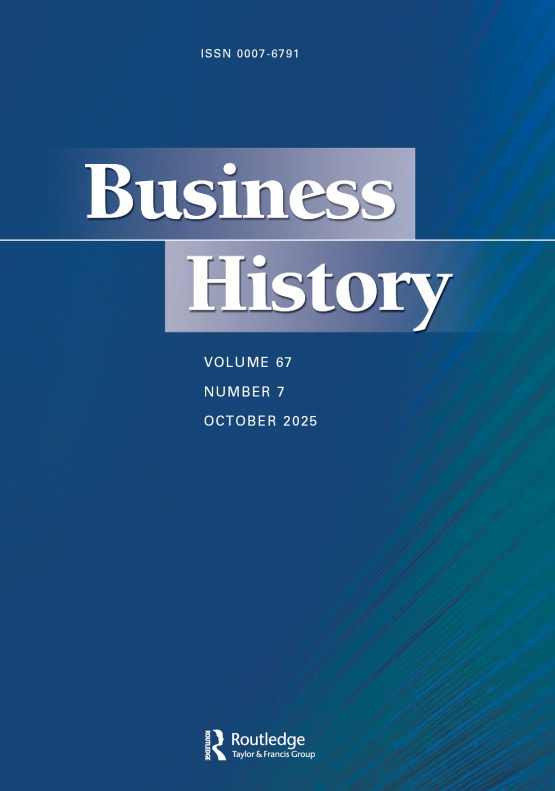
William R. Kelson Beyond the Stock Market: Unpacking China’s 1880s Economic Crash Historians often focus on the stock market when discussing China’s 1880s financial crisis. But what if that’s only half the story? My article, “Manias, Panics, and Land: The Property Bubbles of the Great Chinese Crash of the 1880s,” reveals a crucial missing piece: massive housing market crashes in Hong Kong (1881) and Shanghai (1883). These overlooked property bubbles were not isolated events; they were deeply endogenous to the late-Qing economy and fundamentally linked to China’s integration into global capitalism. This research offers valuable lessons for today’s globalized markets, reminding us to look beyond just one asset class when assessing economic stability. Read the full article in the latest issue of Business History: https://www.tandfonline.com/toc/fbsh20/67/7 #EconomicHistory #China #RealEstate #FinancialCrisis #History #HongKong #Shanghai #BusinessHistory Doi: https://doi.org/10.1080/00076791.2025.2525148 Carles Brasó Broggi The Untold Story of Hong Kong’s Post-War Textile Boom How did Hong Kong transform from a small weaving hub to a global textile giant after WWII? My article uncovers the hidden role of the Hong Kong Spinners Association and Shanghai entrepreneurs. In the mid-1970s, Hong Kong became a leading global textile exporter, a remarkable feat for a city competing against industrial giants. My research explores how strategic entrepreneurship, intensive capital and labor use, innovation, and the unique conditions of post-war Hong Kong as a Cold War frontier economy fueled this incredible rise. It highlights the critical, yet under-researched, role of the spinning industry and the business migrants from Shanghai. Discover the fascinating history behind this economic miracle. Read the full article in the latest issue of Business History: https://www.tandfonline.com/toc/fbsh20/67/7 #HongKong #TextileIndustry #EconomicHistory #PostWar #Entrepreneurship #Shanghai #BusinessHistory Doi: https://doi.org/10.1080/00076791.2024.2346535 Jian Ren Mao-Era China in Latin America: A Surprising Commercial History Think China’s market entry into Latin America is a new phenomenon? My article, “Beyond Revolutions: Mao-era China’s Market Entry Strategies in Latin America,” reveals how Mao-era China, defying the Cold War, laid the groundwork for today’s booming trade. This research uncovers how Chinese and Latin American governments, Latin American businesspeople, and Chinese immigrants collaborated to navigate Cold War political currents. They developed diverse and pragmatic marketing strategies, creating an impressive image of China and Chinese products for Latin American consumers long before the Reform and Opening-up era. It’s a fascinating story of early commercial interconnections that challenges conventional narratives. Read the full article in the latest issue of Business History: https://www.tandfonline.com/toc/fbsh20/67/7 #China #LatinAmerica #ColdWar #EconomicHistory #Trade #BusinessStrategy #MaoEra #BusinessHistory Doi: https://doi.org/10.1080/00076791.2024.2348013 Anshan Ironmaking Anshan’s early ironmaking history reveals the awkward “in-between” status of both Japan and China in the early 20th-century global economy. My article explores the history of ironmaking in Anshan, Manchuria (1909-1931), prior to Japanese military occupation. It argues that this industrial site captures the complex interplay between Japan’s unique position as a non-Western imperial power still catching up to the West, and China’s pursuit of industrialization while resisting foreign economic intrusion. The result was a continual renegotiation of informal empire, leading to various forms of collaboration and resistance within industrial sites like Anshan. Discover this intriguing story of imperial ambition, industrial catch-up, and constant negotiation. Read the full article in the latest issue of Business History: https://www.tandfonline.com/toc/fbsh20/67/7 #Anshan #Manchuria #China #Japan #EconomicHistory #Industrialization #Imperialism #BusinessHistory Doi: https://doi.org/10.1080/00076791.2024.2340629 Meng Wu The Invisible Network: How Shanxi Banks Revolutionized 19th-Century Chinese Finance How did 19th-century China move vast amounts of silver, its principal currency, across the country without state support? My research reveals how Shanxi piaohao banks built a national remittance network using ingenious private rules. These Shanxi banks were China’s first and largest private domestic remittance firms, transferring hundreds of millions of taels of silver for governments, businesses, and ordinary households. Drawing on extensive archival sources and insights from applied microeconomics, my study shows how these merchant-financiers employed sophisticated private rules to manage complex agency problems between shareholders, general managers, and distant employees. It’s a fascinating story of financial innovation and entrepreneurial ingenuity. Read the full article in the latest issue of Business History: https://www.tandfonline.com/toc/fbsh20/67/7 #China #FinancialHistory #Banking #Shanxi #EconomicHistory #Remittance #Entrepreneurship #BusinessHistory Doi: https://doi.org/10.1080/00076791.2024.2409436 Peter Hamilton Beyond Taylorism: Re-interpreting Management in 1920s China While “scientific management” swept the globe, China uniquely re-interpreted Taylorism in the 1920s. My article explores this overlooked history of management in China. Introduced by American-returned students, “scientific management” rapidly gained traction among Chinese elites as a tool for both national industrialization and social change in the May Fourth spirit. My research shows how Chinese discourse re-interpreted Taylorism as a capacious, progressive tool to encourage a ‘scientific spirit’ among ordinary people. More Chinese industrialists experimented with these ideas than previously thought, often interpreting them loosely. Crucially, I argue their motivations were a layered set of commercial, political, and intellectual factors, not primarily an anti-labor agenda. Discover this nuanced and fascinating chapter in global management history. Read the full article in the latest issue of Business History: https://www.tandfonline.com/toc/fbsh20/67/7 #China #ManagementHistory #ScientificManagement #Taylorism #EconomicHistory #MayFourth #Industrialization #BusinessHistory Doi: https://doi.org/10.1080/00076791.2024.2326170 Special Issue - “The Global Economy and the Origins of Modern Chinese Business” Unpacking the Roots of China’s Global Business Prominence: A New Special Issue Today, Chinese businesses are global powerhouses, but how did they get there? Our new special issue, “The Global Economy and the Origins of Modern Chinese Business,” explores this crucial question. Co-edited by Ghassan Moazzin, Jin-A Kang, and John D. Wong, this collection delves into the historical processes that laid the foundation for the current global prominence of Chinese business. Spanning from the early 19th century to the Mao era, the articles reveal three common themes:
This special issue builds on existing scholarship to illuminate how Chinese enterprises evolved and modernized against the backdrop of their deep integration with the global economy over time. It’s an essential read for anyone interested in Chinese business history, global economic history, and the origins of modern China’s economic might. Explore all the articles in the latest issue of Business History: https://www.tandfonline.com/toc/fbsh20/67/7 #ChineseBusiness #GlobalEconomy #EconomicHistory #China #BusinessHistory #SpecialIssue #Research #History #ModernChina Doi: https://doi.org/10.1080/00076791.2025.2525148
You're currently a free subscriber to Organizational History Network. For the full experience, upgrade your subscription.
|
Monday, 15 December 2025
New Special Issue on Chinese Business History




Subscribe to:
Post Comments (Atom)
Intersecting Identities: The Double Rainbow
Watch now (60 mins) | NeuroHub Live! Recording (14th June 2026) ͏ ͏ ͏ ͏ ͏ ͏ ͏ ͏ ͏ ͏ ...

-
Dear Reader, To read this week's post, click here: https://teachingtenets.wordpress.com/2025/07/02/aphorism-24-take-care-of-your-teach...
-
How i recognise psychosis and manage it in myself as an Autistic person ͏ ͏ ͏ ͏ ͏ ͏ ͏ ͏ ͏ ͏ ...


No comments:
Post a Comment