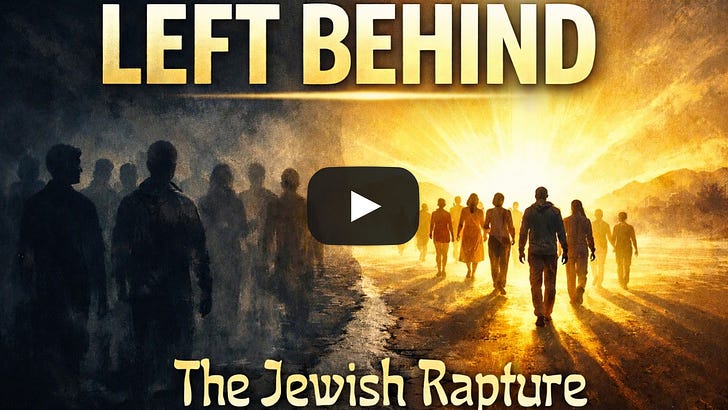
 Last week, the Torah seemed unambiguous. And then—almost casually—the Torah introduces a single, ambiguous word.
Ḥamushim—armed? fivefold? something else entirely? Maybe not everyone deserved redemption. What begins as a question of translation quickly becomes something else entirely. When Redemption Turns SelectiveRashi famously brings two interpretations of ḥamushim. On the surface, it means the Israelites left Egypt prepared, capable of defending themselves. A practical reading. A reassuring one. But Rashi adds another explanation, citing the Mekhilta:
Why? Because, Rashi explains elsewhere:
Their deaths, we are told, occurred in darkness so the Egyptians would not see—and would not say that Israel suffered just like they did. Suddenly, the Exodus is no longer only a story of liberation. The Wicked Son and the Logic of ExclusionThis logic should sound familiar. At the Seder, the Wicked Son asks: “What does this service mean to you?” The Haggadah replies sharply:
This is not merely pedagogy. Again and again, the tradition flirts with the idea that redemption has prerequisites—that belonging is conditional, that some Jews fail the test. From Egypt to Babylon: When the Polemic Takes ShapeThe first sustained version of this argument does not emerge in the Biblical (as in Five Books of Moses) account of the Exodus at all, but in the later Prophets, specifically Babylonia based prophets. The prophet Ezekiel, addressing Jews already living comfortably in exile, radically rewrites the Exodus story:
Israel is redeemed not because it deserves redemption—but because God cannot afford the embarrassment of abandoning them in public. Why tell the story this way? Because Ezekiel is no longer talking about Egypt. And a generation later, when Ezra and Nehemiah lead a return to Zion, the numbers speak volumes:
Out of no where we have Ezra referring to those left behind
Repurposing the original story, he instructs those who are left behind to act like the Egyptians in the Biblical account
And who does he contrast the left-behinders to?
Most Jews stayed behind. A Story About Leaving Becomes an Excuse for Not Moving at AllHere is the irony that repeats across Jewish history. When Jews chose to remain in Babylon, the “left behind” story could be wielded against them. Again and again, the story is repurposed to delegitimize Jews whose choices unsettled those trying to control the narrative. In Eastern Europe, a story about leaving becomes an excuse for not moving at all. When “Tradition” Keeps Changing Its MindThis is where the argument finally gives itself away—and where Rabbi Dr. Ari Zivotofsky’s scholarship becomes decisive. The oft-repeated claim that Israel was redeemed because it preserved its names, language, and dress feels ancient and authoritative. But it isn’t. As Zivotofsky demonstrates, this triad appears late, inconsistently, and only gains real traction in the 19th century, precisely during the battle against Reform and the Haskalah. What masquerades as timeless tradition turns out to be a reactive weapon. And then comes the most revealing twist. Zivotofsky notes that Rabbi Yekutiel Yehudah Halberstam, the Sanz-Klausenburg Rebbe, writing in New Jersey in 1977, invoked this very midrash to insist that Jews must speak Yiddish—not the local language, and certainly not Ben Yehuda’s Hebrew. Yiddish, he argued, was the “true” Jewish language: a deliberate corruption of the surrounding culture, sanctified by exile. Hebrew—the language of the Bible, prayer, and Jewish national revival—was suddenly recast as the threat. As Zivotofsky dryly observes, some even suggested that in Egypt, the language Israel “did not change” was not Hebrew at all—but a Jewish-corrupted form of Egyptian. The conclusion is unavoidable: Tradition is not being defended. Redemption, ReclaimedAnd then, quietly, another voice enters the conversation. Rabbi Yosef Zvi Salant, in Be’er Yosef, asks a simple, devastating question: If four-fifths of Israel died in Egypt… His answer reframes everything. Those who left Egypt, he suggests, took the orphans with them. That was their righteousness. Redemption was not about worthiness. This reading aligns perfectly with the Jerusalem Targum, which renders our verse:
Not armed with weapons—but armed with kindness. The Fifth ChildRabbi Jonathan Sacks, of blessed memory, brings this arc to its most humane conclusion. Reflecting on the tradition that only a fifth left Egypt, he asks: Was there a fifth child at the Seder? His answer:
The Exodus, Rabbi Sacks reminds us, is not a story about who failed the test. And in a very disruptive spirit, I want to extend that table even further. I suggest we leave a chair open not only for those who drifted away, but also for those who stayed behind—those who never left the diaspora, in body or in mind; those who repurposed tradition to resist change; even those who refuse shared responsibility, including military service and sacrifice. Let’s leave a seat open for them too. Not to excuse. Not to endorse. For the full discussion and complete source sheet, listen to this episode of Madlik: Disruptive Torah and explore the sources on Sefaria (links below).
|
Wednesday, 28 January 2026
Left Behind: The Polemics of Redemption



Subscribe to:
Post Comments (Atom)
Three Newspapers and a Broken Water Fountain
One paper stopped arriving. Another outgrew the list that started it, then learned how to say goodbye. ͏ ͏ ͏ ͏ ͏ ...

-
Dear Reader, To read this week's post, click here: https://teachingtenets.wordpress.com/2025/07/02/aphorism-24-take-care-of-your-teach...
-
A slightly unconventional guide to your first time ͏ ͏ ͏ ͏ ͏ ͏ ͏ ͏ ͏ ͏ ͏ ͏ ͏ ͏ ͏ ...


No comments:
Post a Comment