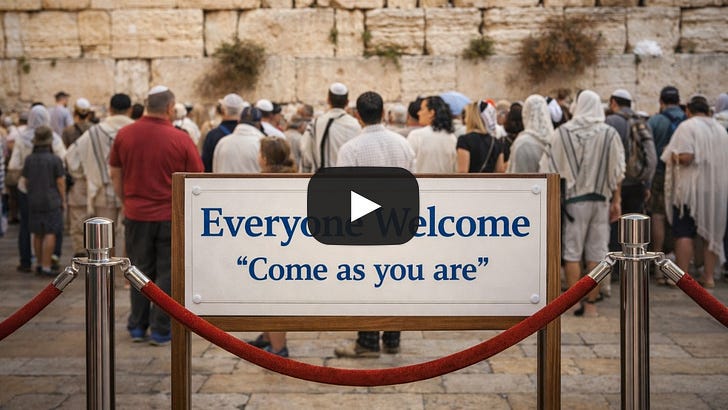
 Pharaoh asks a simple question. Not a theological question.
At first glance, it sounds reasonable. Moses has asked to take the people out to celebrate God. Pharaoh is willing—at least partially—to comply. But he wants clarity. Who exactly is going? Moses’ answer is brief, but it is explosive.
Everyone. Not a delegation. Everyone. Pharaoh’s AssumptionPharaoh immediately pushes back.
On the surface, Pharaoh seems to be posturing, possibly making a gendered claim: worship is for men, not women and children. But the commentators hear something more precise. The Torah uses the word גְּבָרִים (gevarim)—a term that is rare in the Torah and distinct from the more common אנשים (anashim). As one commentary notes:
In other words, Pharaoh is not simply saying “men.” He is saying: the important ones. Or maybe he’s just saying: “You don’t need women or children for a minyan” Religion (and politics), in Pharaoh’s view, belongs to a narrow class. Moses’ RefusalMoses refuses the premise entirely. He does not argue for expanding the list. He rejects the idea that worship and social value can be selective at all. The JPS translation makes this explicit:
And The Torah: A Women’s Commentary clarifies what is at stake:
Moses is not merely insisting that children attend. He is insisting that status itself is irrelevant. Ramban: A Festival Is Not PrivateRamban sharpens the contrast. Pharaoh, he explains, wanted named figures—the leaders, elders, and officials.
Moses answers that this is impossible. Why? Because what he is asking for is not a private rite, but a festival.
A festival cannot be restricted to the few. If this is true worship, it must belong to everyone. Not an Isolated MomentWhat is striking is how consistently the Torah returns to this position. The commandment of Hakhel requires gathering:
The covenant in Moab:
Even (or especially) the obligation to rejoice on a festival is defined expansively:
Participation is not optional. Inclusion Creates ObligationOne modern scholar puts it starkly:
But inclusion, he notes, is not sentimental.
If everyone belongs, then leaders bear responsibility to make room—for women, for children, for those on the margins—within the framework of halakhah. From Sinai to the Baal Shem Tov: Radical Inclusion RebornThis logic of inclusion did not remain confined to the Torah’s early narrative. It re-emerged powerfully in one of the great spiritual revolutions of Jewish history: Hasidism. Eighteenth-century Eastern European Jewish life was rigidly hierarchical. Torah learning, spiritual authority, and religious prestige were concentrated among elite scholars. For the unlettered peasant, the laborer, the illiterate villager, religious life often consisted of mechanical observance and quiet marginalization. Into this world stepped Rabbi Israel ben Eliezer, the Baal Shem Tov. The Baal Shem Tov insisted on a simple but radical proposition: Not only to scholars. But to the simple Jew — especially to the simple Jew. Martin Buber captures this revolution in The Legend of the Baal-Shem:
Buber then recounts, as an example and in his introduction, the now-famous story of a young boy who, unable to pray properly on Yom Kippur, blows a simple whistle in the synagogue at the height of Ne’ilah:
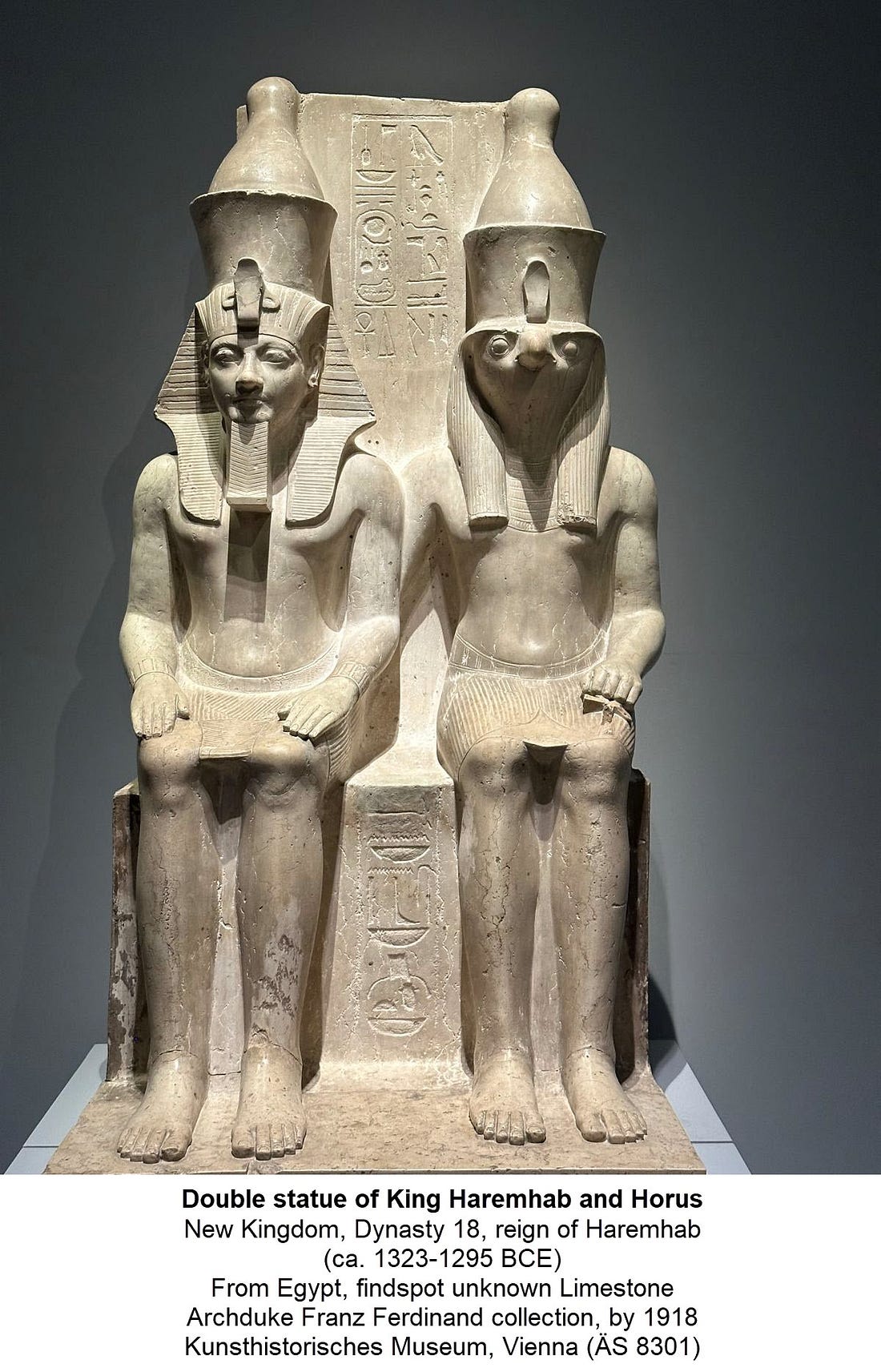
Here, Hasidism gives flesh and blood to Moses’ answer. Not elite prayer. But human presence, raw and sincere. The Baal Shem Tov did not dismantle halakhah. He did something more daring: he dismantled the assumption that spiritual worth belongs to hierarchy. In doing so, Hasidism became the emotional and spiritual continuation of Moses’ original refusal to produce Pharaoh’s guest list. Everyone goes. The Divine Image: One or ManyWhile preparing this episode, I visited the Metropolitan Museum of Art in New York to see the exhibition Divine Image. The show opens with a statue that greets every visitor: Haremhab seated beside the god Horus.
They are nearly indistinguishable. They share the same posture, the same crown, the same body. Haremhab does not worship Horus—he mirrors him. The message is unmistakable: divinity flows sideways, embodied in a single human ruler. If you want to know what a god looks like, look at Pharaoh. Standing there, I was struck by how powerfully this image illuminated the Torah’s quiet revolution. At the very beginning of this year, on Madlik, we explored tzelem Elohim—the claim in Genesis that every human being is created in the image of God. Not kings alone. Not priests. Not elites. Every person. Now, here in Exodus, we hear that idea again—this time not in the voice of God, but in the mouth of Moses. When Pharaoh asks, “Mi va-mi ha-holchim?”—who exactly is going?—he is speaking the logic of Haremhab. Divinity is rare. Access is restricted. Representation is singular. Moses answers with an entirely different theology. Everyone goes. Not because everyone is equal in power. For Pharaohs like Haremhab, godliness was concentrated—reflected in one body, one throne, one crown. For Moses, godliness is distributed—reflected across generations, genders, classes, and voices. The statue at the Met helped me see what was always there in the text. Moses’ answer stands as one of the most radical claims Judaism ever made: The image of God is not guarded at the gate. The Other Story We Tell — and Why It MattersAnd yet, this is not the only story Judaism tells about the Exodus. Alongside the inclusive narrative we have traced — one deeply embedded in Torah, halakhah, and covenant — there exists another strand, far more restrictive, often quoted with great confidence. One midrash claims that only one-fifth of the Israelites left Egypt, while the rest perished in the darkness. These teachings are not fabrications. They exist. They are part of our tradition. But they are isolated — midrashic fragments, not architectural pillars. They do not appear in the Torah text itself. Most importantly, they point in a different direction. These midrashim imagine redemption as a reward for cultural preservation and boundary maintenance. Salvation comes from sameness, continuity, insulation. Identity is protected by refusing to change. There is truth here. Continuity matters. Language matters. Memory matters. But when these teachings are elevated into the dominant story of Exodus, something profound is lost. Because the Torah’s own narrative insists on something else entirely: At the sea — everyone crosses… not a percentile. Redemption, in the Torah’s telling, is not selective survival. The midrash of exclusion explains who deserved redemption. And Moses — standing before Pharaoh — chooses which story will define the future. The Cost of Saying “Everyone”Inclusion is not sentimental. If everyone goes, then everyone matters. Moses’ model does not only grant rights. Pharaoh wanted religion to be efficient, hierarchical, controlled. The question Pharaoh asked never disappears. Who’s in? Judaism’s most unsettling answer remains unchanged. Everyone goes. And the real test is whether we still have the courage to say it. Where the Argument ContinuesThis essay traces the arc of a single question—Mi va-mi ha-holchim?—from Pharaoh’s palace to our own religious debates. But the full conversation unfolds in the sources themselves. If you want to see how this moment in Exodus is developed by classical commentators like Ramban, refracted through modern scholars, and even invoked by contemporary legal and halakhic thinkers wrestling with questions of inclusion and exclusion, I invite you to explore the accompanying Sefaria source sheet or listen to the full Madlik podcast episode. There, the texts speak back—sometimes in harmony, sometimes in tension—but always circling the same enduring challenge: When power asks who belongs, will we answer with lists and hierarchies—or, like Moses, with everyone? Sefaria Source Sheet: https://voices.sefaria.org/sheets/702597 Podcast on Spotify
|
Wednesday, 21 January 2026
Who’s In — Who’s Out





Subscribe to:
Post Comments (Atom)

-
Dear Reader, To read this week's post, click here: https://teachingtenets.wordpress.com/2025/07/02/aphorism-24-take-care-of-your-teach...
-
How i recognise psychosis and manage it in myself as an Autistic person ͏ ͏ ͏ ͏ ͏ ͏ ͏ ͏ ͏ ͏ ...


No comments:
Post a Comment