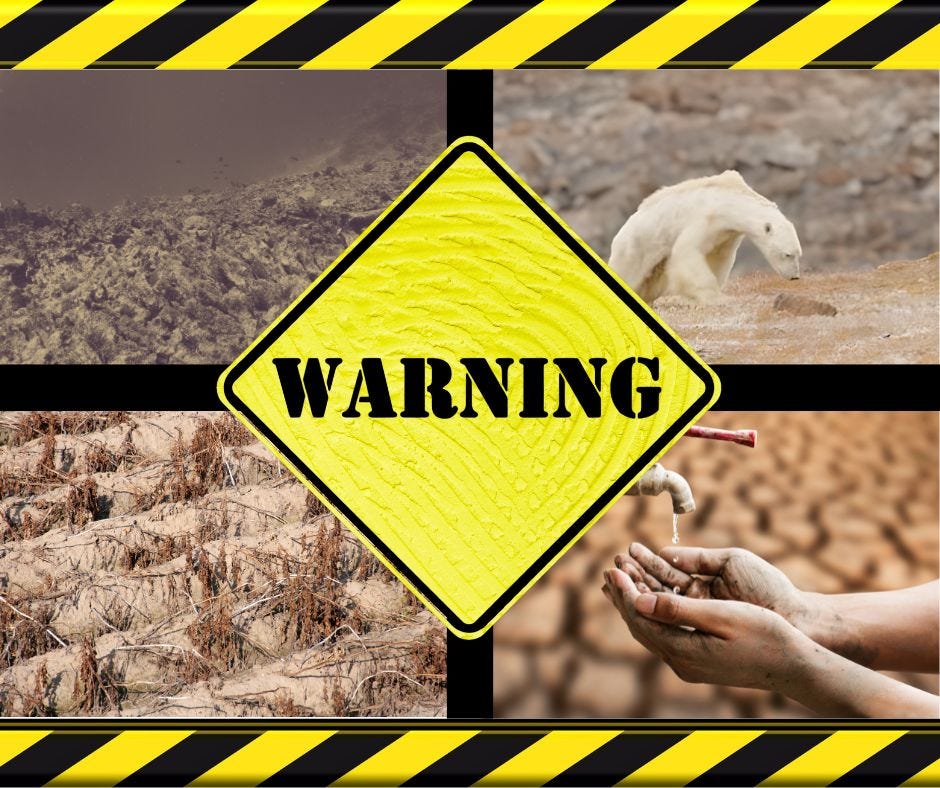
Welcome to the PolycrisisEarth’s Life-Support Systems Are Failing as We Cross Planetary Boundaries and Approach Climate Tipping Points
Crossing Critical Environmental Thresholds
Climate Warnings are Escalating
Rising CO₂ Emissions and the Failure of Climate Targets
Approaching Tipping PointsThe 425 parts per million (ppm) of carbon in the atmosphere in 2025 is an all-time high, and this is way above the safe upper limit of 350 ppm. This puts the world on track for 2.6°C warming. According to Bill Hare, CEO of Climate Analytics, this is a “global disaster” that will trigger major tipping points from which we may not be able to recover. Runaway changes known as climate tipping points are among at least 16 critical thresholds that could exceed our capacity to respond or recover. The “Breaching Planetary Boundaries” study concluded that surpassing these tipping points jeopardizes the planet’s ability to sustain life. Earth Systems at Risk of Irreversible CollapseThe 2025 Global Tipping Points report concludes that 5 of Earth’s vital systems are close to a point of irreversible change. The report assessed 25 Earth systems that humans depend on. Different studies suggest coral reefs, Amazonian forests, and Antarctic ice sheets are all at risk with temperatures above the 1.5°C threshold. “We are rapidly approaching multiple Earth system tipping points that could transform our world, with devastating consequences for people and nature,” said Tim Lenton, a professor at the Global Systems Institute at the University of Exeter and an author of the report. Biodiversity Loss and Global DeforestationYear after year, more species of plants and animals are going extinct. We are losing many of these species before we have a chance to identify and understand them. Ecosystems are composed of interdependent webs of flora and fauna. The loss of individual species can contribute to the collapse of entire ecosystems, putting millions of species at risk. If the Amazon were to collapse, roughly 10 percent of global biodiversity would be affected. More than 3 million species of plants and animals would die, including 40,000 plants, 3,000 fish, 1,300 birds, 427 mammals, 400 amphibians, and over 370 reptiles, as well as millions of insects. Insect Decline, Bird Population Loss, and Food Web BreakdownThere has been a precipitous decline in life forms at the bottom of the food chain, and this could prove catastrophic. In Germany, insect populations have declined by 75 percent in less than 30 years; in the US, beetle numbers have decreased by 83 percent in 45 years. As a staple food source, declining insect populations have a direct impact on other species like lizards and birds. The reduction in insect biomass is contributing to the decline of 61 percent of the world’s bird species. Birds are also a critical part of the food web. Research shows that birds can spread up to 12,700 large seeds a day in a square kilometre. The main driver of declining bird populations is deforestation. According to the State of Climate Action and other reports, we are falling far short of stopping deforestation. We are losing between 8 and 10 million hectares of forest annually. According to the Forest Declaration Assessment 2025, the health of the world’s forests is in a “dismal” state, and this constitutes a threat to global biodiversity. Warming Oceans, Acidification, Collapsing Coral ReefsIn 2025, the Earth crossed another critical ocean threshold as the world’s seas absorbed record-breaking amounts of heat. High levels of atmospheric carbon are also wreaking havoc on our oceans in other ways. Oceans absorb 25 percent of global CO₂, forming carbonic acid, and in 2025, this caused the breach of the 7th planetary boundary: ocean acidification. The 2025 global coral bleaching event became the largest such event on record. Almost 85 percent of coral reef ecosystems are being harmed by increasing ocean temperatures and acidification. This damages shell-forming species. The combination of acidification and heat stress is driving the collapse of half of the planet’s coral reefs. The decline of these reefs directly impacts marine biodiversity that millions of people rely on for food and tourism. How Ocean Heat Drives Extreme WeatherAs oceans warm, they inject heat and moisture into the atmosphere, destabilizing weather systems and driving increasingly extreme global weather. Ocean heat either causes or exacerbates extreme weather events. In 2025, warmer oceans contributed to tropical cyclones, drought in the Middle East, and flooding in parts of Southeast Asia, Mexico, and the Pacific Northwest. Rising ocean heat also contributes to sea-level rise through thermal expansion and increases ecosystem stress. Global Water Scarcity and Freshwater DepletionBillions of people live in areas where water is increasingly scarce. In 2025, this was evident in the Middle East, North Africa, and the US Southwest. More than half of the world’s big cities suffer from “high water stress,” and more than a third are experiencing “extremely high water stress”. A UN report announced that the world had entered a state of water bankruptcy, which is worse than a crisis because the effects are irreversible. According to this report, nearly 4 billion people face water scarcity for at least one month every year. Rivers, lakes, wetlands, and aquifers are drying up, and snowfalls are diminishing. Remaining potable water sources are increasingly polluted. The World Bank Group estimates the planet is losing about 324bn cubic metres of freshwater every year. Diminished Soil Resilience and Agricultural VulnerabilitySoil supports 95 percent of food production, and a third of these soils are already known to be degraded by intensive agriculture. Modern farming methods decrease biodiversity and soil resilience. This means soil has diminished capacity to resist damage and recover its structural and functional integrity (e.g., nutrient cycling, water regulation) following disturbances. According to a 2025 study, soil stability is being undermined by plowing, watering, fertilizing, and spraying. The largest threat to soil resistance is erosion due to inappropriate tillage, slash-and-burn agriculture, and overgrazing. Irrigation is vital to modern agriculture, but it can also contaminate the soil with salt. Approximately 20 percent of irrigated cropland is salt-affected. The use of plastic can also reduce soil resilience, and pesticides leave residues that can harm soil biodiversity. Earth at a Breaking Point: The Convergence of Environmental CrisesEcological breakdown and ecosystem stress are driving systemic dangers. We are at risk from the convergence of climate change, biodiversity loss, deforestation, and warming oceans. Biophysical breakdown is converging with intensifying water scarcity and declining soil resilience. Large-scale environmental degradation is pushing us past critical thresholds and stretching the Earth’s carrying capacity to the breaking point. “The collective evidence from the past tells us that we’ve still got a safety margin. Science tells us that if we act quickly, if we act dramatically, we can avoid warming that will bring far worse consequences. That’s the fragility of this moment: we have a little bit of a safety margin, but it’s not a large safety margin,” Mann said. While the Global Climate Change (GCC) report suggests we have three years’ worth of emissions in our carbon budget, to have a chance of keeping temperatures within prescribed limits. Others, like venerable biologist David Suzuki, think that it is already too late. Climate scientist James Hansen agrees, saying, “the RCP 2.6 scenario, which was designed to keep warming under two degrees, is now impossible.” Even the GCC report concedes that significant climate impacts are unavoidable. There may still be time to avoid the worst impacts, but there is no room for complacency. Time to avert disaster is running out. Every delay pushes us closer to catastrophe.
|
Tuesday, 10 February 2026
Welcome to the Polycrisis





Subscribe to:
Post Comments (Atom)
Intersecting Identities: The Double Rainbow
Watch now (60 mins) | NeuroHub Live! Recording (14th June 2026) ͏ ͏ ͏ ͏ ͏ ͏ ͏ ͏ ͏ ͏ ...

-
Dear Reader, To read this week's post, click here: https://teachingtenets.wordpress.com/2025/07/02/aphorism-24-take-care-of-your-teach...
-
How i recognise psychosis and manage it in myself as an Autistic person ͏ ͏ ͏ ͏ ͏ ͏ ͏ ͏ ͏ ͏ ...


No comments:
Post a Comment