Natural landscapes are continually transformed to make room for agricultural and urban developments – often at the expense of important habitats and species.
That's why, to avoid unnecessary species extinctions, it's crucial to know which habitats to protect. In a recent paper we studied how changes to the landscape affected butterflies in a grassland area of South Africa's KwaZulu-Natal province.
The sheer speed at which landscapes are being transformed by human activity means that conservationists simply don't have the time to gather detailed information on all the species in a particular region. That slows down conservation responses. It's also not always possible to conserve entire landscapes and doing so is not always economically feasible.
Butterflies are icons in the sky. On warm summer days we can watch them dance elegantly from flower to flower. But they aren't just beautiful to look at. They are important pollinators, and are important in natural food chains. For scientists, they are sentinel species. By identifying how they interact with landscapes we gain a better understanding of how other insect species do, too.
Our research offers a closer look at how butterflies interact with the landscapes they roam. This, in turn, allows us to delve into how conservation measures can be adopted to better protect butterfly communities against the effects of people changing natural habitats.
We found that a variety of different grassland types, in addition to flower diversity, is important for butterflies. When it's not possible to conserve whole grassland areas, a variety of smaller grassland patches can help protect butterflies and other insects against environmental transformation. This means that effective insect conservation is possible in areas earmarked for large-scale transformation – without sacrificing economic gain.
The landscape
Timber estates occupy a large proportion of the grassland landscape in the KwaZulu-Natal province, where we conducted our study. This leaves little habitat for grassland butterflies in some areas.
To ensure that the biological impact of plantation forestry is minimised, forestry practitioners have moved towards leaving at least a third of natural grasslands untouched among timber plantations. This provides butterflies and other insects with enough habitat to roam the landscape while timber production continues in other sections.
But this approach raises an important question: does it matter which grasslands are set aside for conservation? Or is one grassland much the same as another?
The butterflies
Many butterfly species roam in high elevation habitats, like the Mistbelt Grasslands of KwaZulu-Natal province. The area also forms part of one of the world's biodiversity hotspots.
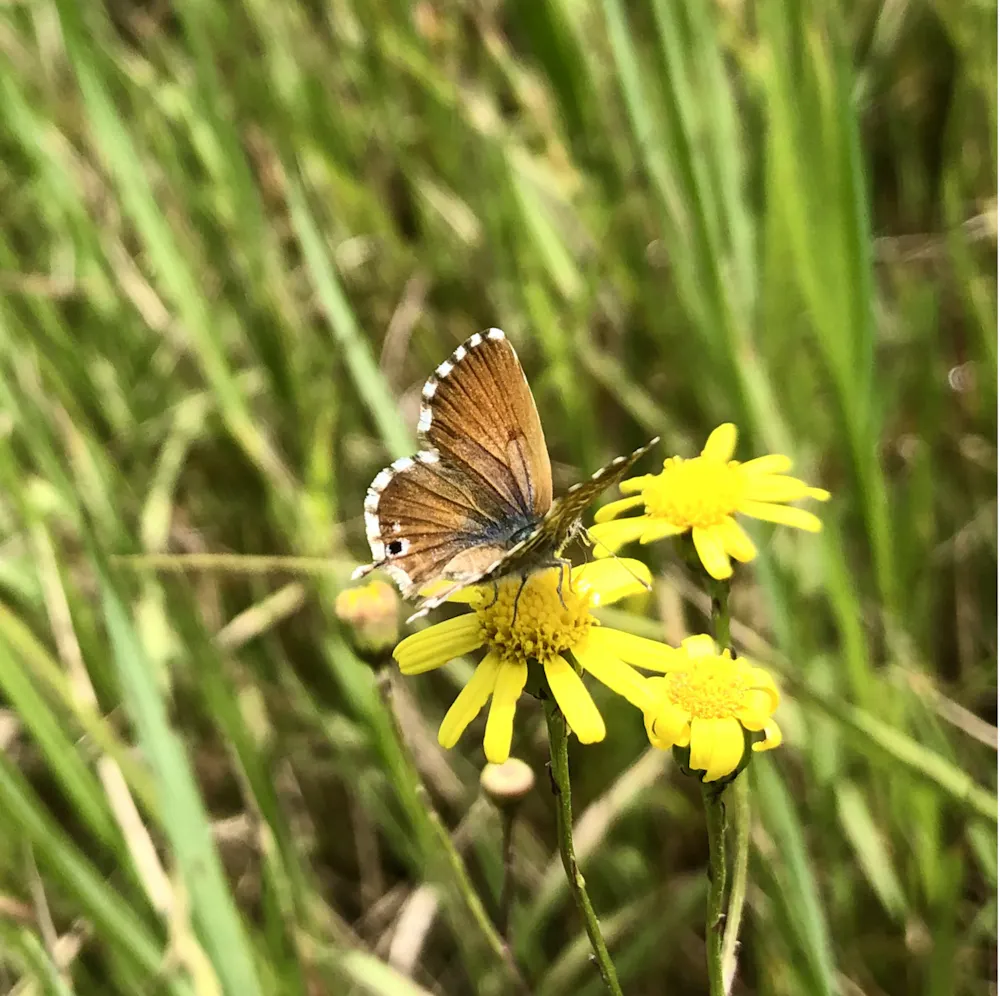
A Geranium bronze butterfly settles on some flowers in the study area.
Inconspicuous species such as the Natal spotted blue (Azanus natalensis) and the Meadow blue (Cupidopsis cissus cissus), along with large and showy species such as the Mountain pride (Aeropetes tulbaghia), frequent grasslands in the region. A keen eye might even spot some magisterial species briefly darting over, like the Flying handkerchief (Papilio dardanus cenea). Strikingly, these species and their counterparts rarely enter timber plantation compartments; they rely on grassland habitats.
We recorded and counted as many butterfly species as we could, allowing us to determine just how important natural grassland habitats are among plantation compartments. The results were clear – butterflies need grassland habitats to outlive human transformation.
Not that simple
There is a catch. Conserving only one or a few feature grassland types won't protect all butterfly species.
Our results show that grasslands of similar types vary considerably. Each grassland has a set of characteristics that defines them such as availability of sunlight during the day, resistance to fire outbreaks and richness of flowering plants. These characteristics are important for attracting particular butterfly species that would avoid another type of grassland.
Butterflies are highly mobile insects. Many species rely on small elevation variations to complete their day-to-day tasks. In particular, butterflies move up and down the elevation gradient to avoid, or catch, more sun. This means it's important for butterflies to have access to habitats at various elevations throughout the day.
Butterfly population levels are also highly variable between seasons and from one year to the next. During times when feeding and breeding resources are scarce, butterfly populations may be more concentrated in areas where resources are more reliable. Resources are often more reliable in nature reserves, meaning that butterflies need to access them.
When grassland patches among plantations are connected to nature reserves at the landscape level, they are more accessible to moving butterflies. This means that butterfly diversity is higher in grasslands that are close to, and connected to, neighbouring protected areas.
All of this is important information because it can help in guiding decisions about where to focus grassland conservation efforts in the region.
Next steps
Our study shows that landscape variety is best and that taking this landscape-scale variety into consideration in conservation practices can greatly counteract human impact on natural systems.
In viewing butterflies as sentinels in conservation, we can use this information to decide which grasslands to conserve, or restore, to better protect all their insect residents.
Charl Deacon is a post-doctoral researcher affiliated with the Department of Conservation Ecology and Entomology, Stellenbosch University. His research is funded by the Foundational Biodiversity Information Programme (FBIP) and Mondi Group International.


No comments:
Post a Comment