The Nippon Budokan or Budokan, as it is simply known, is a 14,000 seat venue that exists on land belonging to the former Imperial palace that sits in northeast Tokyo, Japan. Because Budokan sits in a parklike setting, there is a feeling of tranquility that surrounds the building proper. If you have ever been there or have watched events that are held there, you can attest to the peaceful nature of the exterior of this building. But the peaceful exterior of Budokan masks the true nature of what goes on within its walls. For Budokan is not known all throughout Japan as a place of quiet contemplation and meditation; it is known as an arena of combat. Budokan is unlike almost all other venues that have or will appear in this series because it was not built with it becoming a music venue in mind. Budokan was built in the early 1960s as an Olympic venue for Judo and other martial arts in the 1964 Tokyo Summer Games. Since then, Budokan has been known as the main sports venue in Tokyo for all things related to martial arts, boxing and wrestling. The building itself was modeled after a famous Buddhist temple that has become known as The Temple of Dreams. That temple is purported to have been a place where Buddha appeared in a prince's private palace in order to meditate. Thus, the ideas of quiet strength and mental toughness have been brought over into Budokan and help to create an appropriately charged atmosphere inside whenever two combatants enter the main floor area to do battle. The Budokan is topped with pagoda-style roofing, which is typical of grand buildings in Asia. The main portion of the building is cylindrical. The interior seating rises up steeply on all sides, with a fixed combat floor in the middle of the lowest level. The primary material used to construct the actual auditorium area was concrete. Because sound bounces off of concrete, and because the combat floor is surrounded on all sides by spectators, the noise of their roars and cheers tends to bounce off the walls in all directions, enveloping any participants on the floor below. Thus, the Budokan has become known for its acoustical properties, as well as its role as the centre of martial arts in Japan. The story of the Budokan would have ended there for the purposes of this series of posts if not for the arrival in Japan of an English band that you may have heard of called the Beatles. Their performance at Budokan changed the nature of how this venue could be used and helped set the stage for one of rock music's most defining and uplifting moments. But first, let's talk about the Fab Four.

Martial arts inside of the Budokan.
As you know, Beatlemania swept North America in the mid-1960s as John, Paul, George and Ringo burst onto the music scene, dominated the music charts and changed rock n' roll history in the process. The band toured extensively in 1964 and '65. Everywhere they went, they were met by screaming mobs of fans, mostly young girls, who were completely and totally enthralled with the band and the music they were making. However, if you know your Beatles history, you will know that the band stopped touring for good in 1966 after a disastrous US tour that included John Lennon's famously misconstrued quote about the Beatles being "more popular than Jesus". By the time the 1966 world tour began, manager Brian Epstein had died, and the lads in the band were discovering how difficult life as a band could be when they were forced to deal with business matters, as well as remain creative and productive as a group. Up until 1966, life had been overwhelmingly positive for the Beatles. But in 1966, that began to change. One of their first tastes of dissatisfaction and public negativity arose over plans that were made to have the biggest band in the world perform at Tokyo's shiny new venue known as Budokan. The news that a foreign rock n' roll band was going to perform at Budokan was met with a fair degree of outrage and some actual protests. The reason for this had nothing really to do with the band itself. Instead, it is a testament to how important martial arts are to the cultural fabric of Japan. It is not an exaggeration to say that martial arts are viewed with almost a religious-like zeal. The cultural history of Japan is filled with stories of warriors known as Samurai. Martial arts, both the combat aspect along with the mental training involved, are held in high regard. Thus, when it was announced that the Beatles were to perform at Budokan, it was akin to inviting foreigners to play the devil's music in a holy shrine. Into this charged atmosphere strode the Beatles. In the links below, you can watch this entire concert unfold. There are several local acts that perform as openers for the band, and then, as if by magic, the Beatles appear on the tiny Budokan stage, slightly elevated but still near the bottom of the cylindrical bowl and all heck breaks loose! The power of Beatlemania overcame the resistance to change held by martial arts purists and Budokan transformed into a music venue right before our eyes. It is one of the more interesting concerts I have ever seen. One thing that became known right from the opening notes of the opening song was that the acoustical properties of Budokan help to amplify the voices of fans as much as they do the artists performing on stage. At times it is almost impossible to even hear John and Paul trying to sing. The Beatles' performance showed the people of Tokyo that their venerated martial arts venue could also host music concerts without taking anything away from the lustre of the building as the home of combat sports in Japan. Because of that performance by the Beatles, future opportunities opened up for other artists and bands to appear there. One of those appearances proved to be the reason why Budokan ended up becoming equally famous as a concert venue in the eyes of the music world. That concert was held in 1976. The band in question was America's Cheap Trick. The live album recorded there is universally regarded as one of the best live albums of all time. It was a concert that saved a band's career. This is Cheap Trick at Budokan.
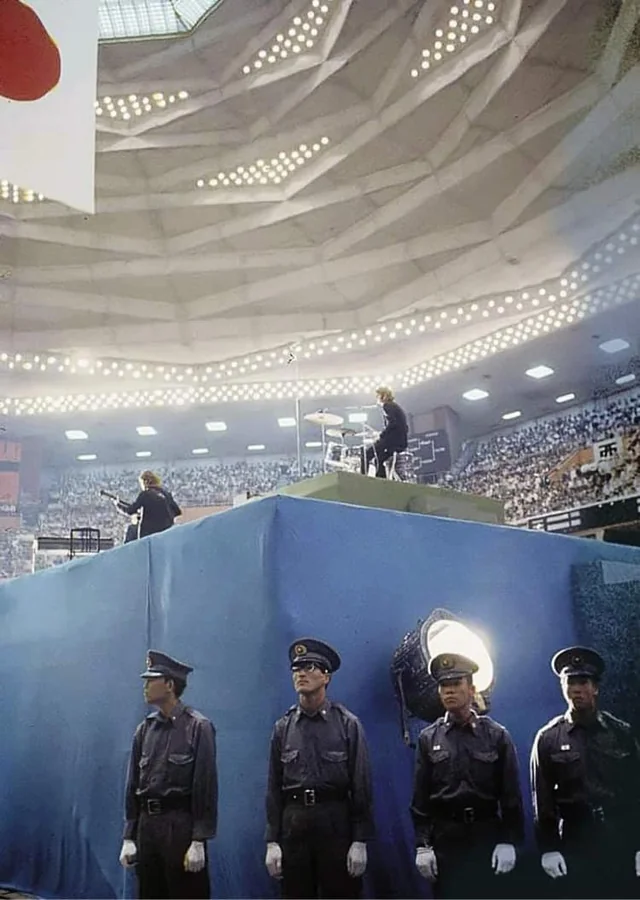
The Beatles breaking down barriers at Budokan in 1966.
The story of Cheap Trick at Budokan is one that I have told before in a previous post that you can read here. However, the short strokes of the story are as follows: Cheap Trick was essentially the anti-Beatles of their day. The Beatles were hitmakers right from the beginning and only soured toward the end of the decade, as internal pressures mounted and the first bits of negative press began to emerge. Their ascendency to the top of the charts was watched by millions. Their every move was filmed and chronicled. As very young men and musicians, they learned and grew in the public eye until it all became too much and the band broke up. Cheap Trick formed in the decade following the death of the Beatles. However, their musical journey was, in many ways, the complete opposite of that of the Fab Four. The band toiled in relative anonymity for several years. They opened for bands such as Styx and ZZ Top but never made much headway on the charts with their own music. Touring is a necessary step for new bands. Playing everywhere, all of the time helps to hone their skills as individual musicians; it tightens their playing as a group, and it helps audiences get to know who they are. Unfortunately, it costs money to tour. Many new bands such as Cheap Trick know that there is a limit to how long they can afford to tour before debts become too great and begin to overwhelm the small revenue streams that may open up from gate receipts and the sales of band merch. Cheap Trick was reaching the point where they had released several albums, and they had a few minor US hits such as "Surrender", but they just weren't able to get over the financial hump in America. The end seemed near for the band. They were going to have to call it quits, strictly because of the high cost of making music in the US. Then a funny thing happened. For reasons that even the band cannot quite explain, they managed to earn a gold record from sales in Japan, of all places! Being the clever boys that they were, the members of Cheap Trick stopped touring in America and took flight for Japan. To their great surprise and relief, they were greeted at the airport in Japan by thousands of screaming Japanese fans. It was Beatlemania all over again, except it was for a relatively unknown American band called Cheap Trick. As the band is quoted as saying, they arrived in economy class seats on the airplane from the States and have flown First Class ever since. From the moment Cheap Trick arrived in Japan, they were mobbed by fans everywhere they went. The band was forced to hole up in hotels. They couldn't leave without running the risk of being swarmed by fans who wanted a piece of the band…any piece…hair, shirts…anything would do. At the time, Cheap Trick's record label came up with the idea of recording a series of live concerts at Budokan by the band and other label mates. Thus, the idea for recording Cheap Trick at Budokan came to fruition even though the band had a new album in the can and ready to go called The Dream Police. No one expected the live Budokan album to be anything special, so there was no worry about the launch of The Dream Police album being affected or delayed in any way. The thinking was that the band was going to be performing anyway, so recording the concert and making any money from the recording was seen as being bonus money for a band that needed extra cash. The concert went ahead. The frenzied atmosphere that had enveloped the band at the airport and their hotel and on the streets of the city followed them to the inside of the Budokan. The live recording captured the excitement of Cheap Trick's live show in a way that their studio albums had never really been able to do. As it turned out, Cheap Trick was a great live band. The album recorded there captured that great performance in combination with the overly enthusiastic response from the audience. When the album was released and American audiences began hearing the mania that accompanied "I Want You to Want Me", for example, the band was suddenly seen in a whole new light. As mentioned earlier, from that point on, they never traveled in economy class again. Also, the album Cheap Trick at Budokan was so well received that the phrase "Live at Budokan" has become synonymous with great live music recordings.
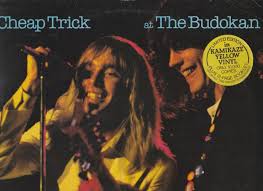
One of the best live albums of all time for a reason!
In the links below I have a gift for you, should you care to accept it. For most of the posts in this series, it is my intention to always provide you with a series of videos that show actual performances from whichever venue I happen to be profiling. So far, whenever I have looked for such videos to share, I have had to be content with linking to videos that show only one song at a time. That is fine. It is standard fare for services such as YouTube. However, when it came time to do likewise for the Budokan, I discovered that almost all music-related videos that appear when I type in "Live at Budokan" are actual full length concerts!!! Thus, in the links below, you can watch the whole Beatles concert in 1966. There are concerts by Eric Clapton, Ozzy Osbourne, Alanis Morissette, Avril Lavigne and many, many more. *You can watch Cheap Trick at Budokan in its entirety but on YouTube the concert is broken down into individual song videos, played one after the other, which is a bit of a drag. I will link to those "full concert" videos to whet your appetite. I have linked to "Surrender" and "I Want You To Want Me" in the paragraph above. Feel free to take the rest of the day off. Enjoy the shows. If you wish to see what else is available, simply go to YouTube and type "Live at Budokan" into the search bar and have fun! I thank whoever it was that saw fit to release so many complete Budokan concerts for free. It is a very kind and generous act, for sure. That's it for now. If you have ever been lucky enough to have traveled to Japan and have been to Budokan, I would love to hear your thoughts about it all in the comments below. Thanks for reading my words. I will see you all again next time from somewhere in the world where great music is played. Take care, bye for now.

The link to the official website for Nippon Budokan (shown to the right) can be found here.
The link to the live concerts from Budokan for the Beatles, Eric Clapton, Ozzy Osbourne, Alanis Morissette and Avril Lavigne can be found by clicking on their names.
The link to the official website for the city of Tokyo can be found here.
***As always, all original content contained within this post remains the sole property of the author. No portion of this post shall be reblogged, copied or shared in any manner without the express written consent of the author. ©2024 http://www.tommacinneswriter.com


No comments:
Post a Comment