French Polynesia Scaling ConservationFrench Polynesia demonstrates that you do not need to be a major power to champion biodiversity and support human wellbeing.
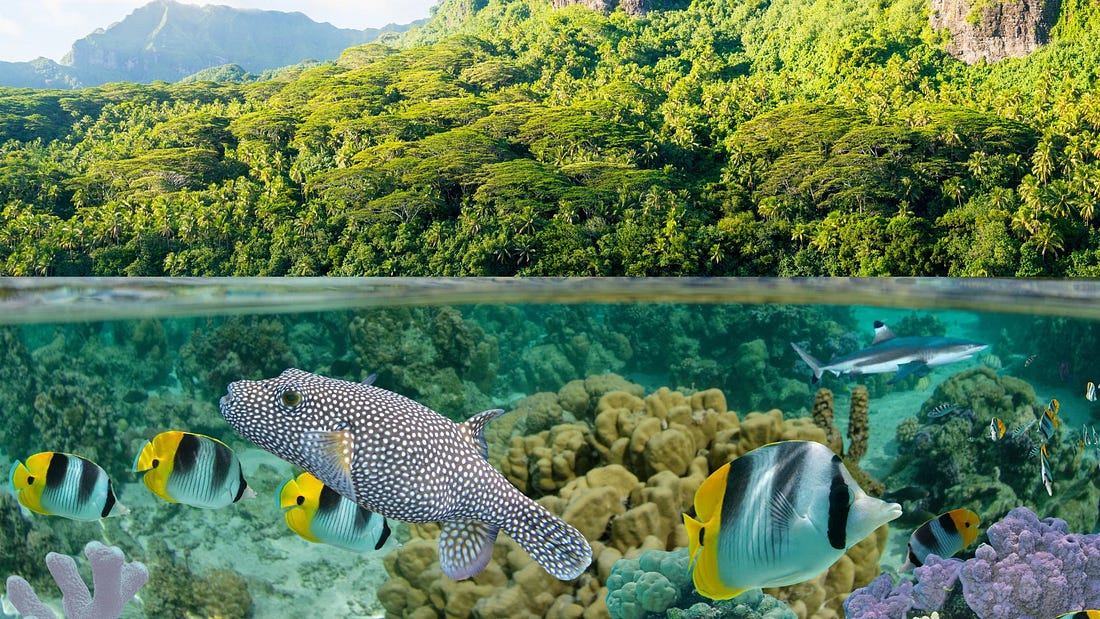
French Polynesia is creating the world’s largest marine protected area (MPA) safeguarding 1.1 million km² of ocean. This is a tremendous feat and a model for the world. The territory is an overseas collectivity of France that comprises 121 islands scattered over more than 2,000 kilometres in the South Pacific Ocean. This newly created MPA is 312 times greater than French Polynesia’s landmass. Grassroots PowerFrench Polynesia’s MPA is a community led initiative that gained the support of more than 90 percent of the 280,000 people that live there. That is in large part because MPA’s are seamlessly consistent with Polynesian culture, and the deep spiritual ties these people have to the land and sea. This includes traditional stewardship (like rāhui). Polynesian cultural values prioritize regeneration and safeguarding natural resources for future generations. Local support for marine protections is widespread, and deeply integrated, reflecting the ocean’s central role in traditional beliefs and as a source of sustenance. It is as much about practical necessity, as cultural identity. French Polynesians understand that the health of the seas are synonymous with community well-being. Boosting Biodiversity: From Shark Sanctuaries to Coral ResilienceThe MPA in French Polynesia provides a host of benefits starting with the protection of exceptionally rich and unique marine biodiversity and ecosystems. This includes protecting critical habitats and life forms including dozens of shark species, hundreds of different kinds of coral, and over a thousand species of fish. By prohibiting industrial fishing, deep-sea mining, and other extractive activities in core zones, it creates safe havens where marine species can feed, reproduce, and recover without human pressure. Large, fully protected marine areas help maintain ecosystem integrity and biological productivity, important for coral reef health and larger food webs. The biomass inside MNAs is on average 670 percent greater than in similar unprotected areas. MPAs can also benefit adjacent waters, as evidenced by research which shows a “spillover” of biomass. Sustainable Livelihoods: Securing Food Systems through ConservationCatch rates in no catch adjacent fishing grounds also benefit from a spillover effect. MPAs have been shown to strengthen fish stocks and contribute to more sustainable harvests. A California study found that sustainable catch rates in no catch adjacent fishing grounds increased by 245 percent. A 2024 meta-analysis showed that areas adjacent to MPAs had a catch rate that was 40 times higher, compared to unprotected areas that were not adjacent to MPAs. Fishers in French Polynesia actively support conservation efforts, and they recognize the dangers of threats like overfishing and pollution. They understand that MPAs protect people’s livelihoods and contribute to food security. While commercial fishing is banned, zones have been created for traditional artisanal fishers. Contrary to industrial fishing, these small-scale fishing methods are sustainable which is good for local food systems and biodiversity. In addition to sustainable fisheries, healthier oceans also supports ecotourism, and related economic activities, which provide income for local communities. Resilience to Climate Change and Supporting ScienceMPAs enhance resilience to climate change by preserving carbon-rich habitats like reefs and seabeds which act as natural buffers against warming and acidification. According to research out of the University of Exeter, protected coral reefs are far more likely to recover from climate impacts. MPA’s are massive natural laboratories that provide a panoply of opportunities for scientific investigation. Such areas provide the opportunity to conduct long-term ecosystem monitoring which contributes to better understanding of ocean health and climate impacts. A Global Model for the “30 × 30” Conservation TargetBy establishing one of the world’s largest MPAs, French Polynesia has positioned itself as a global leader in ocean conservation, offering a model for other nations and territories, especially small island states. The 1.1 million km² MPA is a bold step towards the global “30 × 30” target of protecting 30 percent of Earth’s marine and terrestrial ecosystems by 2030. French Polynesia is helping to restore marine biodiversity, enhance ecosystem resilience, safeguard cultural and economic wellbeing, and advance global conservation goals — all of which ultimately support both planetary health and human prosperity. Despite a history defined by the brutality of French colonial rule, and more recent economic hardships, these sparsely populated islands have emerged as a global ecological champion of ocean conservation. French Polynesia demonstrates that you do not need to be a major power to champion biodiversity and support human wellbeing.
|
Wednesday, 28 January 2026
French Polynesia Scaling Conservation





Subscribe to:
Post Comments (Atom)
Three Newspapers and a Broken Water Fountain
One paper stopped arriving. Another outgrew the list that started it, then learned how to say goodbye. ͏ ͏ ͏ ͏ ͏ ...

-
Dear Reader, To read this week's post, click here: https://teachingtenets.wordpress.com/2025/07/02/aphorism-24-take-care-of-your-teach...
-
A slightly unconventional guide to your first time ͏ ͏ ͏ ͏ ͏ ͏ ͏ ͏ ͏ ͏ ͏ ͏ ͏ ͏ ͏ ...


No comments:
Post a Comment