Today's post is going to be a little different. For starters, I am going to include my copyright disclaimer here for once.
***As always, all original content contained within this post remains the sole property of the author. No portion of this post shall be reblogged, copied or shared in any manner without the express written consent of the author. ©2024 http://www.tommacinneswriter.com
There we go. You'll see why I did this at the end of the post. As for today, sixty-one consecutive times so far I have taken music from the soundtrack to a movie or from the original cast recording of a staged musical and explored the significance of that music to the story being told. Well, for the first time since I started writing about how music is used to augment the storytelling found in Hollywood films or in Broadway musicals, I am stymied. Specifically, I am stymied by the legendary Coen Brothers who have directed a film called No Country for Old Men in which there are only sixteen minutes of actual music used throughout the entire film. Of those sixteen minutes, none are dedicated to songs with lyrical content, and half of those sixteen minutes of music happen over the opening and closing credits. For all intents and purposes, No Country for Old Men is a movie that is devoid of music entirely. And yet…the absence of music plays a fundamental role in enabling the Coen Brothers to achieve the suspenseful feel they were striving for in this film. So, essentially, today's post is going to explore how the use of music in movies, musicals and on TV has helped to train our brain to automatically add meaning and/or context to the visuals we are seeing on screen and how the absence of said context clues affects how we interpret what we are watching and feeling. NOTE: As per usual in posts such as this, I will leave a link for the trailer for No Country for Old Men here. If you haven't watched the movie and want to get a sense of what it is about, then take a moment and view the trailer. If you do not want any spoilers, then stop reading now, go and watch the movie (which for me was on Amazon Prime) and come back to this post later. However, if you have watched the film and/or don't feel that you will anytime soon, then keep on reading because figuring out how the Coen Brothers used the void created by the absence of music is a large part of what this post will be about. In any case, thanks for reading so far. I hope to see you on the other side of the trailer. Off you go!
Alrighty then! Let's get on with things, shall we?
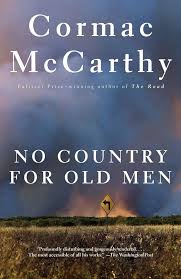
No Country for Old Men won four Academy awards in 2008, including Best Picture of the Year, Best Supporting Actor for Javier Bardem (who plays a sociopathic hitman named Anton Chigurh), Best Director (for the Coen Brothers) and Best Adapted Screenplay. The film is a faithful reproduction of a novel of the same name written by Cormac McCarthy. It is a film that takes our notion of time and place and turns that world upside down. It is a movie that is populated by characters that symbolize heroes and villains, goodness and evil, and yet are none of those things. No Country for Old Men is a movie that has a plot that drives the action forward while really being nothing more than a meaningless diversion from the bigger issues of destiny vs. fate, being in control versus being victims of random chance and, rising above it all, who gets to decide how it all unfolds. And it does all of this without the use of soundtrack cues to help the audience figure it all out. I have stated many times throughout the course of this series that I like films that have a different take on the act of storytelling. No Country for Old Men certainly qualifies as having enough unique quirks and twists for my sensibilities. Since it won the Best Picture Oscar, I have to assume that many share my thoughts on this matter. So what is it about this film that makes it one of the most suspenseful and unpredictable films I have ever watched? Let's explore that by examining the characters and the storyline a bit. Afterwards, I will talk about how the lack of a soundtrack made this action all the more creepy and spine tingling. Here we go.
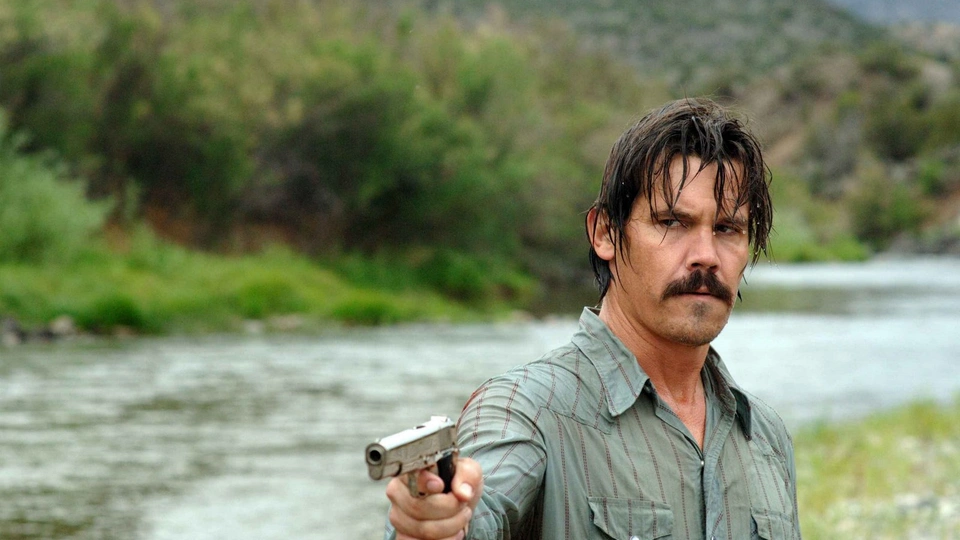
Josh Brolin as Llewelyn Moss.
The plotline of No Country for Old Men is relatively simple and straightforward. The story takes place in the Texas desert near the border with Mexico. The action begins when a man named Llewelyn Moss (played by Josh Brolin) goes hunting in the desert one night and stumbles upon a crime scene involving a drug deal that has gone wrong. Dead bodies litter the ground. Blood is everywhere. One pickup truck remains filled with kilos of pure drugs. Off to the side, under a lone tree, is a man who was shot and has later died from his wounds. Beside him is a briefcase filled with two million dollars. Moss, a welder by trade, decides to steal the money for himself even though it is clear that the money and drugs involved the much larger and more dangerous forces of Mexican drug cartels. This single decision sets the wheels in motion for everything else that happens in this film. It also sets the stage for a seemingly endless series of confrontations between various minor and major characters in which there exists an obvious imbalance of power. However obvious this imbalance of power may seem to the viewer as we watch Moss take the drug cartel's money, he firmly believes he is in control of the situation and can handle whatever is about to come his way. Thus, we have another of the film's major themes on display, and that is to what extent we are in control of the events of our lives and how much are we at the mercy of fate. And this is just one scene. There are numerous scenes throughout the rest of the movie in which these themes are constantly on display for us to consider and examine. So on a certain level, No Country for Old Men is about the chase that ensues over ownership of this briefcase filled with money. But, overall, the stolen money is merely a plot device aimed at allowing the Coen Brothers to tell a story about life and how much influence we have over what happens to each of us.
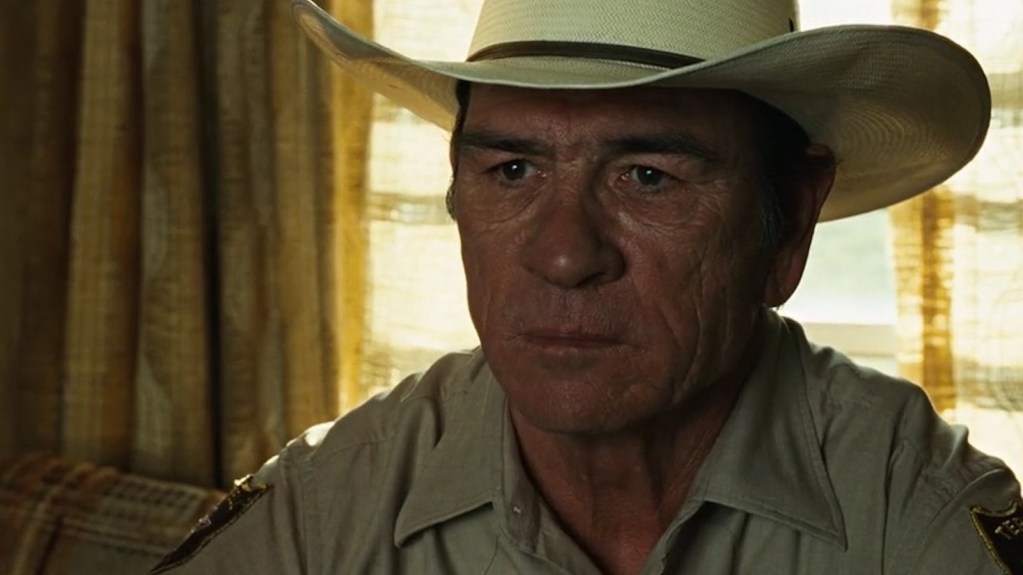
Tommy Lee Jones as Sheriff Ed Tom Bell.
Tommy Lee Jones should have won an Oscar for his portrayal of Sheriff Ed Tom Bell. Sheriff Bell is the traditional hero figure of a movie that looks, on the surface, to be a western. In reality, however, Sheriff Bell is no hero. In fact, he is overwhelmed by the violence that is happening around him, mainly because of the drug cartels. He is the "old man" being referenced in the film's title. Sheriff Bell longs for the simpler times of days gone by when crimes were straightforward and convicting the perpetrators put an end to the crime. However, in the times in which the movie takes place, there is violence around every corner. The criminals are nameless Mexicans from across the border and so are many of the victims. No progress appears to be made by investigating any of these crimes. Thus, there is a sense of helplessness that permeates Sheriff Bell's character all throughout this film. Tommy Lee Jones does an excellent job of conveying the world weariness that he possesses. In the end, he retires as Sheriff and gives up trying to make a difference. In the film world, the hero usually triumphs in the end, but in No Country for Old Men the hero abandons the fight and leaves the citizens to their fate. Sheriff Bell knows that he is derelict in his sworn duties by quitting and putting himself first, but he feels that to continue with his investigation will only end in his own murder. He fears death so he retires instead. At the end of the film, he is plagued by dreams of the old days when sheriffs were able to make a difference. He appears sooooooo sad and defeated. His monologues about his life as a younger, more vital man are told without any soundtrack or orchestration in the background. It is only his voice and the ambient sounds of the Texas desert wind or the ticking of a clock. It is all so effective and packed with emotion!

Javier Bardem as Anton Chigurh .
The third main character in this movie is Javier Bardem's sociopathic killer, Anton Chigurh. While being clearly deranged, in many ways, Chigurh is the character with the clearest moral compass. He is a killer. He is judge, jury and executioner for anyone whose path he happens to cross. In almost every scene he is in with any other character, there exists a massive power imbalance. As an audience, we know the utter ruthlessness that Chigurh possesses, and so we watch a majority of his scenes in anticipation of him acting as executioner. However, we are also given the opportunity to watch his mind at work in some scenes where we get to see this game play out on an unsuspecting foe, in much the same way that a cat toys with a mouse before deciding to eat it or let it go. In order to demonstrate what I mean, I want you to take a moment to watch a clip of a famous scene that has simply come to be known as "The Coin Toss". Go and watch the clip here. Then come back and we will continue.
"The Coin Toss" happens at a point in the movie where we have already watched Chigurh kill at least two other people in cold blooded fashion. So we know what power and evil this man possesses before the scene even starts. The actual scene opens with an exterior shot of a Texaco gas station in the middle of nowhere. The only sounds we hear are the wind blowing across the empty land and the creaking of a rusty Texaco sign. Thus, before the scene begins to unfold, we are armed with information that states that the gas station owner is alone and that help is nowhere to be found. The scene shifts to inside of the gas station; Chigurh has stopped to buy gas and has come inside to pay. The gas station owner is a kindly, gentle older man. Right away, without anything happening, we all understand that he will be no physical match for Chigurh should something start to go down. Thus, Chigurh is immediately granted the role of the cat and the old man becomes the mouse. This interaction may have passed by in an uneventful manner except for an unfortunate bit of small talk by the owner toward Chigurh. Because of the direction from which Chigurh was driving, the gas station owner knew instinctively that he was coming from Dallas (simply because the road his station sits on is the road between Dallas and El Paso). So, when the man harmlessly asks about the weather up in Dallas, he inadvertently gives Chigurh the impression that he possesses information on him. For a man like Chigurh who is moving stealthily, having someone in possession of his whereabouts makes the gas station owner a threat. By now, we, as an audience, know far too well what Chigurh does to those he perceives as a threat. What ensues is a game of chance in which the gas station owner is playing for his very life, even though at no time is he aware of this. He just thinks that Chigurh is kind of weird and wants him out of his station. This is also one of the very few times that music appears in this movie. Watch the clip again. Can you hear the violins? If not, there is a reason for that. The Coen Brothers played the violins at a frequency that is identical to that of refrigerators. Thus, the music hums in the background like a fridge.
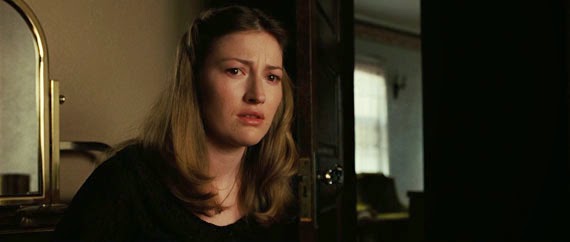
Carla Jean refuses to "call it".
The tossing of the coin is symbolic of the main theme in this film of chance versus pre-determination and being in control of what happens to us in life. There is a second coin toss scene in the movie. This time it happens when Chigurh finally meets Llewelyn Moss' wife, Carla Jean. By this time, Chigurh has spoken with Moss and promised him that he was going to kill his wife in retaliation for Moss having stolen the briefcase. As Chigurh quietly sits in a chair in Carla Jean's bedroom and offers her the chance to "call it", she stands her ground and calls his bluff, placing the responsibility for his actions squarely on him. To Carla Jean, there is no "chance" involved in this transaction. Chigurh can clearly allow her to live as surely as he can decide to take her life. But in the end, it is all on him. She refuses to let him wriggle off of the moral hook he has placed himself on. In the end, he decides her fate as he has for so many others. But at least she has forced him to admit that chance only plays so much of a role in what fate has in store for us all. You can watch that clip here.
No Country for Old Men is one of those films that does not have a defined ending. There is no hero walking off into the sunset. Because the movie has the trappings of a classic western, we are predisposed to expect the hero to ride in on horseback and save the day. That does not happen. Life, as described by Sheriff Bell in his haunted dreams, just continues on. Consequently, the ending seems unsettling. Part of the reason for this is that we have not had the help of a musical soundtrack to give us hints as to what to think and feel as the movie has unfolded. There is no rising crescendo of violins to indicate romance or emotion. There is no quickening of the beat to indicate danger or suspense. There are no songs with lyrics playing on a radio that shed any light on what the characters on screen are thinking or feeling. As audiences, we tend to rely on these types of intellectual crutches as we watch a movie. The classic theme of the movie Jaws is a great example of a soundtrack helping to create a mood. In the movie Poor Things starring Emma Stone, she plays an adult woman whose life was saved by having a brain transplant with a newborn child. In this film, as crazy as that premise sounds, the musical score that accompanies each scene becomes less strident and more complex and rhythmic as her cognitive skills become more highly developed. Again, the music helps us to understand and appreciate what the on-screen character is going through by guiding us along. However, in No Country for Old Men, we have no such guidance. We are placed alone in the same world as the characters, and we are left to figure things out on our own. Thus, the movie seems very suspenseful for most of the film because we legitimately don't know what to expect. We experience the action almost in real time and have to process it as it is unfolding. The absence of music is a neat physiological trick by the Coen Brothers. One that keeps us on the edge of our seat throughout the film. [I'm not sure whether this is the word you meant.]
I thoroughly enjoyed watching this movie. I think that No Country for Old Men is fully deserving of the many accolades that have come its way. Anton Chigurh is certainly one of the most interesting characters to have appeared on screen in a long, long time. He is the epitome of evil and coldbloodedness. But for me, the character I most identify with is that of Sheriff Bell. Like him, I worry that our world is becoming more divided and dangerous and is on the verge of spinning out of control to the point where we are no longer capable of making enough of a difference to rein in the violence on our own. Today's myriad of issues seems larger and impervious to simple solutions. Today's enemies seem larger and more faceless and highly organized. Do we even know who to rise up against anymore? I am not yet ready to resign myself to my fate by giving up, but, as Sheriff Bell says at one point, I am feeling overmatched. All that I know how to do is to be a good person and to act accordingly toward those I meet in life. I have no coins in my pocket that are in need of tossing. You are always safe with me. On that you can rely. But one indication that things are different can be seen in the fact that for sixty-one consecutive posts I have ended off by leaving you with a song to check out. Today, like the Coen Brothers, I leave you with nothing but silence.


No comments:
Post a Comment