The writer A.R. Moxon once said the following (I'm paraphrasing): If you are driving a car and someone grabs the wheel to make the car go into a ditch for no reason, that person is being radical. But if there's a gas tanker exploding in front of you …
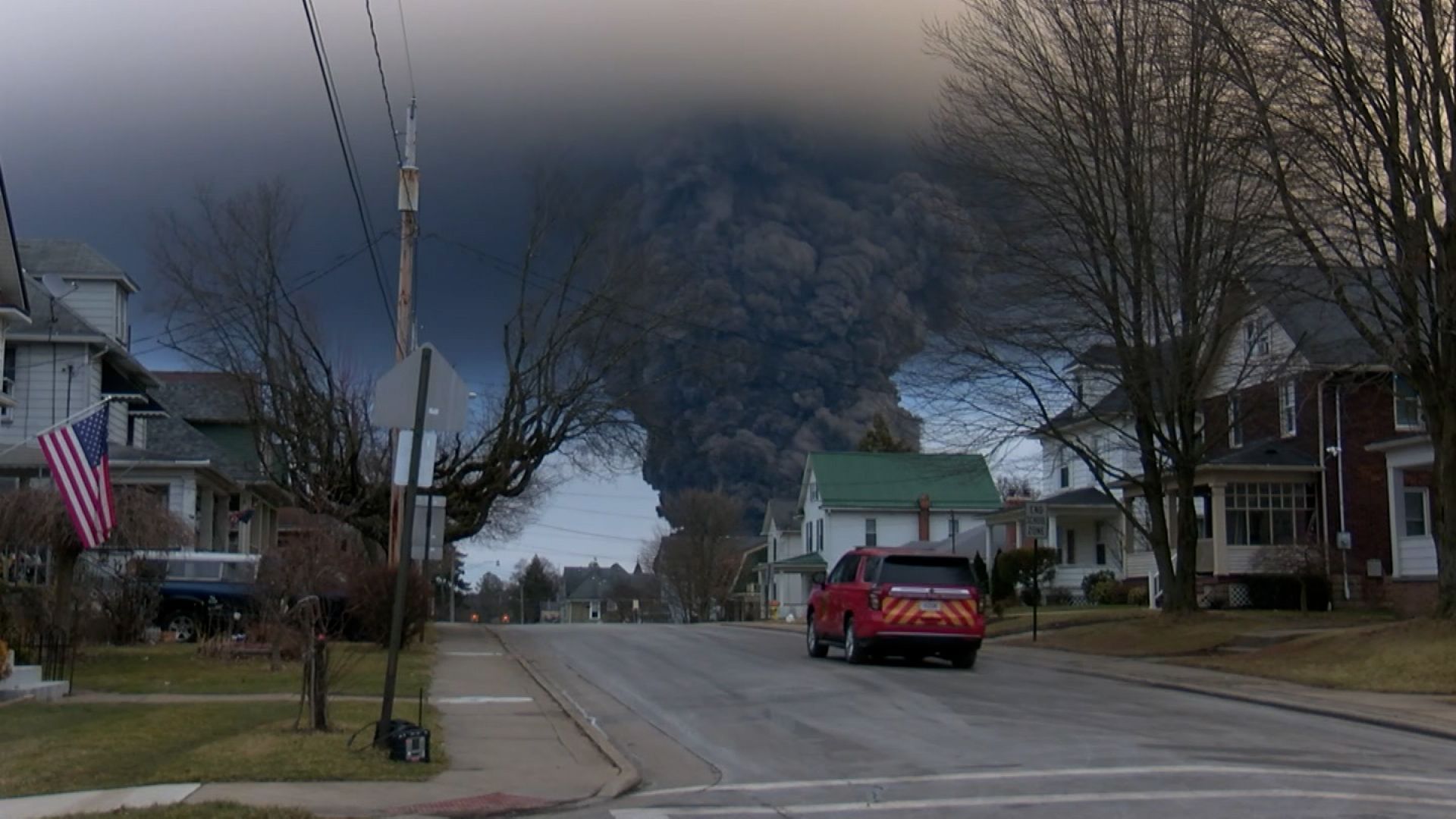
Last year's derailment of a train carrying toxic chemicals in East Palestine, Ohio.
The writer A.R. Moxon once said the following (I'm paraphrasing): If you are driving a car and someone grabs the wheel to make the car go into a ditch for no reason, that person is being radical. But if there's a gas tanker exploding in front of you and you refuse to swerve into a ditch and keep on driving, then you become the radical.
Over the past week, we've had a Supreme Court that made it easier to criminalize homelessness, basically legalized political bribery, and more or less made it near impossible to enforce many federal regulations, including environmental and safety rules. Oh, you also may have heard about the immunity ruling, which basically makes the president a king.
Many many kudos to our blog leader, who was not feeling well today, for soldiering on and writing about something that made him, you, me, and a lot of other people feel a lot worse today. I suggest going there for his take on the immunity decision.
The only things I can add about it is the stuff on "official" vs. "unofficial" acts, with no guidelines on what constitutes official vs. unofficial, opens the door for a president to do what they want and then there are months and years of court fu fighting over whether the acts are "official" or "unofficial." I sort of feel like perhaps this was a way for the less insane people on the court, like Roberts and Coney Barrett and to a lesser extent Beer Guy Brett, to feel better about declaring Trump a king-in-waiting. Hey, we said he's not immune from unofficial acts and oh-by-the-way not our call what is the definition of that is.
Beyond today, there's also the Chevron decision. There's a very odd trend in American society where expertise is ridiculed, treated with suspicion, and held in contempt. It often does not turn out well for the people holding these views - just ask hundreds of thousands who died during COVID due to "doing their own research" although you would need to hold a seance to reach them.
One would think that in a More Perfect Union, such thinking would be limited to the crazier parts of Facebook and your nutty uncle at Thanksgiving, but SCOTUS went 6-3 that indeed, non-expert judges should make decisions on regulations and not experts. Because what do experts know?
My day job involves translating complicated materials research papers into articles that are shared with the media for further coverage and are posted at the university I work at's news website. They have to be "dumbed down," so to speak, so the average person can read and understand them. I also did this at my previous job, writing about biomedical engineering and chemical engineering. It can be exceedingly difficult to do.
The point of all this is science and engineering are difficult subjects to parse and a lot of federal regulations involve science and engineering. Tom Sullivan over at Digby's Hullabaloo, who happens to be a retired engineer, has more on this. The best way to make a factory safer, what level of particulates in the air is acceptable, how clean should your favorite restaurant be, how to design a safe railway system to transport dangerous chemicals (see this post's feature photo), etc. are all regulations that are determined largely by people who know what they are doing. Courts are now no longer required to defer to agencies and their expertise, so judges can make decisions on cases that they are not even close to being equipped to navigate.
Incredibly, Roberts said in his opinion that allowing qualified people to interpret the very regulations they are tasked with administering is "fundamentally misguided." He also lied when he stated that any prior case settled under Chevron is "good law," because today with the Corner Post 6-3 decision the conservatives on the court said that anyone can challenge administrative regulations with no statute of limitations. Say it with me: The war on expertise is part of the war on democracy.
I guess Harlen Crow really is getting his money's worth.
What to do about all this? See my opening paragraph. Business as usual is no longer tenable, Dick Durban's stern letters to the chief justice are not working, and Democrats need to take serious action. First things first, even if the Dem candidate is a moldy loaf of bread, we need to vote them in. Throw out the voters' guide, and assume ANY Republican is an authoritarian.
If there is any good news in all of this, while the Chevron decision goes over people's heads, the idea that a president can do what they want has a greater chance to wake people up. I am sure my fellow First Draft bloggers will touch on this, but the immunity decision has a strong chance to do for Democrats in 2024 what the Dobbs decision did in 2022 - motivate people to vote against the fascism.
Then, after a successful election, we need Democrats not to get cold feet, but to work to get this under control and explore any and all options. Again, business as usual is no longer tenable. With today's decision, we see once again that even people sold to us as reasoned "conservatives" are radical right-wing operatives. All is not yet lost. Allow yourself the understandable despair of the moment, but then we all have to get back to work.
The last word goes to Des'ree. I know, clichéd and all but it's what I got right now, people.




No comments:
Post a Comment