Organizational History Network New article on how researchers use digital archivesAnd how tools and models can better support a diversity of researchers.
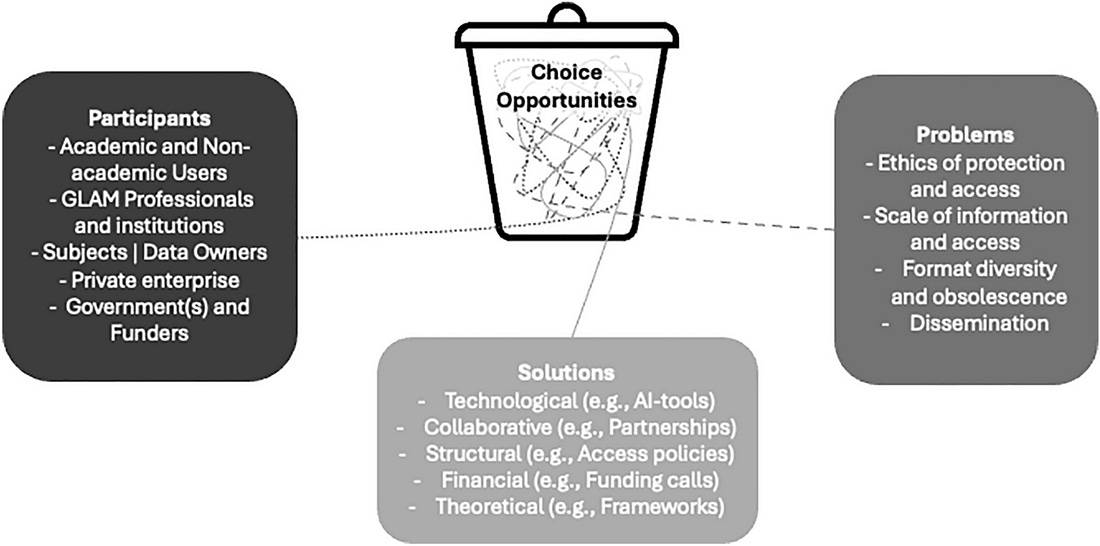
We are delighted to announce that our new article “Conceptualising methodological diversity among born-digital users: insights from the garbage can model”, by Adam Nix, Stephanie Decker and David Kirsch, has just been published by AI & Society as part of a special issue on When data turns into archives: making digital records more accessible with AI, edited by Lise Jaillant and Lingjia Zhao. In our new paper, we explore how different researchers use born-digital archives. We've identified four distinct user types: aggregators looking for statistical patterns, synthesizers seeking thematic connections, fact finders hunting specific information, and narrators reconstructing historical stories. The development of AI tools to help these users often happens randomly—like the Garbage Can Model suggests—rather than through careful planning. We argue that we need more opportunities for users, archivists and tech developers to collaborate, so tools can address everyone's needs, not just focus on preservation or on the needs of large-scale data users crunching numbers.
Here is the abstract - you can read the full article open access here. The benefits of AI technologies in archival preservation are well recognised, though questions remain about their integration into existing processes. AI also shows promise for enhancing user experience and discovery in accessing born-digital materials. However, a limited understanding of the diverse methodological needs surrounding born-digital access risks the creation of one-size-fits-all solutions that suit certain approaches and research questions better than others. This article reviews current efforts in born-digital access and applies the Garbage Can Model from organisation theory to conceptualise the challenge of developing AI-based tools for multiple user types, highlighting the iterative and often decentralised nature of multi-stakeholder decision-making. We address this challenge by creating four born-digital archival user types—the aggregator, the synthesiser, the fact finder, and the narrator—each with distinct motivations and research approaches. Finally, we identify some new opportunities for stakeholders to inform how AI-based tools can be developed to better meet the variety of methodological needs that exist in relation to born-digital archives. Organizational History Network is free today. But if you enjoyed this post, you can tell Organizational History Network that their writing is valuable by pledging a future subscription. You won't be charged unless they enable payments.
|
Monday, 10 March 2025
New article on how researchers use digital archives





Subscribe to:
Post Comments (Atom)
Embracing Our Autistic Selves
3-part audio course for a positive sense of Self ...
-
Dear Reader, To read this week's post, click here: https://teachingtenets.wordpress.com/2025/07/02/aphorism-24-take-care-of-your-teach...
-
A slightly unconventional guide to your first time ͏ ͏ ͏ ͏ ͏ ͏ ͏ ͏ ͏ ͏ ͏ ͏ ͏ ͏ ͏ ...


No comments:
Post a Comment