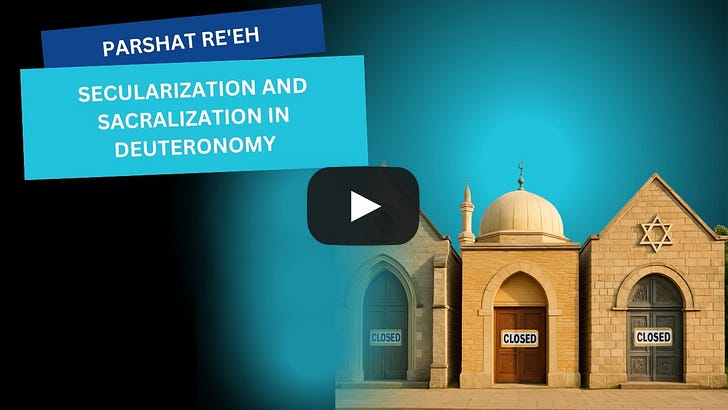
 In reading this week’s parsha (Re’eh) I was struck by a surprising phenomena regarding the Israelite migration into Canaan. The text claims a decisive military conquest. But rather than expand the Israelite cult throughout the land, the Deuteronomist demands that all outlying shrines and holy places be shuttered and the cult be relegated to one chosen location. Rather than colonize and expand, by way of patriation of every existing holy hilltop, the Torah puts the cult into the proverbial box. (13) Take care not to sacrifice your burnt offerings in any place you like, (14) but only in the place that ה׳ will choose in one of your tribal territories. There you shall sacrifice your burnt offerings and there you shall observe all that I enjoin upon you. (Deuteronomy 12: 13-14) (יג) הִשָּׁ֣מֶר לְךָ֔ פֶּֽן־תַּעֲלֶ֖ה עֹלֹתֶ֑יךָ בְּכׇל־מָק֖וֹם אֲשֶׁ֥ר תִּרְאֶֽה׃ (יד) כִּ֣י אִם־בַּמָּק֞וֹם אֲשֶׁר־יִבְחַ֤ר ה׳ בְּאַחַ֣ד שְׁבָטֶ֔יךָ שָׁ֖ם תַּעֲלֶ֣ה עֹלֹתֶ֑יךָ וְשָׁ֣ם תַּעֲשֶׂ֔ה כֹּ֛ל אֲשֶׁ֥ר אָנֹכִ֖י מְצַוֶּֽךָּ׃ The other surprising provision prohibited the absorption and acculturation of the indigenous Canaanite cult and culture. While the prohibition against idol worship and pagan practice is widespread throughout the Torah, the way the prohibition is formulated here, is clearly and specifically with regard to the conquest of, or migration into Canaan. beware of being lured into their ways after they have been wiped out before you! Do not inquire about their gods, saying, “How did those nations worship their gods? I too will follow those practice (Deuteronomy 12:30) The Israelites are commanded to contract their cult and at the same time… prohibited from filling this cultural void with the commonly accepted practices. Not surprisingly, this irony lets some biblical scholars to suggest that Deuteronomy espoused secularism where the cult and religion were to be removed from society. For more than two centuries, most biblical scholars have understood cult centralization, i.e., the requirement that all sacrifices be offered from one central Temple, as a prominent theme in Deuteronomy, one that drives much of its agenda. The late Israeli scholar Moshe Weinfeld (1925-2009), .. argued that the central cult is not the focus of the book’s religious program, which is, rather, observance of divine commandments. What is the significance of this marginalization? Weinfeld sees this as “secularization,” as it emphasizes aspects of everyday life, which is fundamentally secular, at the expense of the sacred Temple. See: The Torah.com Deuteronomy: Religious Centralization or Decentralization? by Dr. Baruch Alster Clearly, Weinfeld opened himself up to the obvious crime of anachronism; projecting a modern idea that doesn't fit the historical context of its setting. A slightly less anachronistic and more pious suggestion is made by German Catholic theologian and Bible scholar Norbert Lohfink, who argues that this phenomenon is better understood as a process of sacralization of everyday life. By emphasizing law over cult, average Israelites find themselves governed by the commandments in their day to day existence. Instead of just the Temple being sacred and only the Levite priests serving God, the entire God-given land becomes sacred and all of Israel serves God. These processes of sacralization and laicization highlight two important aspects of Deuteronomic thought. As an aside, not only is the Temple minimized, so are the Levites who in Deuteronomy appear more like Buddhist monks begging for food then the top of a clerical hierarchy. When you finish tithing all the tithe of your produce in the third year, the year of the tithe, you are to give [it] to the Levite, to the sojourner, to the orphan and to the widow; that they may eat [it] within your gates, and be satisfied. (Deuteronomy 26:12) [The Deuteronomists] push forward the individual Israelites’ enhanced status, at the expense of the priests. God’s covenant is with the nation as a whole, not only with its leaders. Israeli scholar Joshua Berman has shown this convincingly regarding the book’s political view, but this is true, as we have seen, regarding religion as well. Second, these processes highlight the significance of obedience to God and observance of commandments as opposed to ritual or cultic practices. Since, according to Deuteronomy, performance of mitzvot is primary, then the sacred space in which God will be served is the holy land as a whole. In short, rather than strengthening the Temple cult, Deuteronomy actually weakens it, while strengthening the religious value of the nation of Israel and its covenant with God, and observance of God’s mitzvot, which takes place throughout the entire land, not just in the Temple. ibid: B. Alster But what fascinated me, and was not, to my knowledge, picked up by classical commentators or academic scholars is the strange formulation of the prohibition to synchrenize the existing culture. beware of being lured into their ways after they have been wiped out before you! Why, for heaven’s sake, would the dominant and conquering culture be attracted to the culture of the vanquished? The obvious solution is of the ilk “my lady protests too much”, namely that the Israelites never fully or successfully vanquished the Canaanites. It would follow that the Canaanite gods and religion actually remained in the land and continued to attract the Israelites. The reference to “after they have been wiped out before you” simply plays lip service to the fake news of the successful conquest. Similarly, the distributed network of Canaanite holy places continued to exist after the so called “conquest” and the Deuteronomist put a positive spin on the Israelite cults inability to spread throughout the land…. Let’s only have one central Temple…. Afterall, in academic circles, the biblical narrative of the Israelite conquest of Canaan is not supported by historical or archaeological evidence. The standard Rabbinic explanation is that while the pagan gods were defeated maybe (don’t ask why) you might want to repurpose their worship practices to serve the one and only God. (2) Lest you are drawn after them, or lest you emulate them, or lest you do as they do, and they become a stumbling block to you. (3) "after their being destroyed before you": Why do I destroy them before you? Because of their deeds. That you not do as they do and they come after you and destroy you. (4) "and lest you inquire after their gods, saying, etc.": that you not say: Since they go out in a toga, I will go out in a toga, too; since they go out in purple, I will go out in purple too; since they go out in fancy headdress, so will I. Sifrei Devarim 81: 2-4) פן תנקש אחריהם, שמא תמשך אחריהם או שמא תדמה להם שמא תעשה כמעשיהם ויהיו לך למוקש. Whether this is a variation of the Stockholm Syndrome where, in this case, the victor develops an attraction to the vanquished, or is an expression of intellectual, cultural and religious curiosity or… just an appreciation of the aesthetics, music and cultural achievements of our fellow man in their pursuit of the spirit, as a student of comparative religion, it resonates with me. The Abarbanel (Deuteronomy 12:29:1) quotes Maimonides from the Guide for the Perplexed and puts this into the category of: do not add to it and do not take away from it (Deuteronomy 13:1)." Meaning to say, it is enough for you with what the Torah commanded you, that you should take care to do all of the commandments that I commanded you; and you should not add to them. For 'anyone who adds is taking away.' כל המוסיף גורע What a wonderful variation on “less is more”! כל המוסיף גורע Which of course, get’s us back to centralizing (minimizing) the temple and the temple cult. Of interest, another instance of the Deuteronomist addressing a problem, after the fact, it the monarchy. Similar to our verse where the Israelites are warned not to copy the local pagan culture… after they have destroyed it, so too the Israelites are presumed to have asked for a king, only after they have successfully conquered the land. Strange, given the fact that the most basic function of the king was to lead his people in battle. (14) If, after you have entered the land that your God ה׳ has assigned to you, and taken possession of it and settled in it, you decide, “I will set a king over me, as do all the nations about me,” (Deuteronomy 17: 14) Notes scholar Joshua Berman: “Not only does the king play no role in the conquest of the land; a king may be requested only after the conquest has been completed! Berman in his fascinating book Created Equal: How the Bible Broke with Ancient Political Thought, concludes: In light of parallels with Late Bronze Age (fifteenth to thirteenth centuries B.C.E.) suzerainty treaties, the covenant narratives implicitly suggest that the whole of Israel—not its king, not his retinue, not the priests—bears the status of a subordinate king entered into treaty with a sovereign king, God. As we approach the month of Elul and the Jewish New Year where God is declared king to the exclusion of wordly kings, and as we consider a world where social institutions like the rule of law, social contracts and rules of decency break down, it is worthwhile to consider this tipping point of the Israelite migration into Canaan. The critical question following the minimalization of both the Israelite cult and the normative culture is “what now?”. The Torah filled the void with commandments to and between individual people on every hilltop, valley, field and kitchen. Call it secularization or sacralization the challenge is how we respond as a coalition of disparate tribes and individuals. Good luck to us! Sefaria source sheet: https://www.sefaria.org/sheets/670026 Transcript: Geoffrey Stern: We assume religions grow like empires. You win a war, conquer a land. You repurpose existing temples.. You borrow a few local rituals so the neighbors feel at home, and you go from there. Deuteronomy flips that script. It enters Canaan and makes its own cult smaller. Only one altar, one address, and bans acculturation entirely. No franchising the desert tabernacle across hilltops, no tasteful imports from the grove down the road. And then something odd happens. By narrowing the ritual, it widens the reach. God is no longer a resident deity with a mailing address. Holiness migrates from cultic temples into kitchens and markets and fields. It's the religious equivalent of moving from hardware to software. The sacred isn't where you go; it's what you do and everywhere. So begins the challenge. In a world built on colonizing and blending, Deuteronomy proposes a third path, a covenant that refuses both and, in doing so, invents transcendence. Welcome to Madlik. My name is Geoffrey Stern, and at Madlik, we light a spark or shed some light on a Jewish text or tradition. Along with Rabbi Adam Mintz, we host Madlik Disruptive Torah on your favorite podcast platform and now on YouTube. We also publish a source sheet on Sefaria, and a link is included in the show notes. This week's Parasha is Re'eh. The Deuteronomist approach to Israelite religion is radical. It restricts the temple cult to a single location and forbids the importation of local practices. It creates a way of life and belief system that is borderless with a God who is not local. It creates something that transcends the local cult and raises the question, now what? So, Rabbi, I gotta say, I had always been aware of what happens in this week's Parsha, which is the centralization of the tabernacle. It comes at a period where it either already exists, with many different tabernacles around the country, or it envisions that. But in any way, everything is brought to the centrality of Jerusalem. And in a sense, that's a contraction. But what I had never combined that with is on the one hand contracting our religion and on the other hand saying, you can't import anything from outside, which creates kind of a vacuum. It's kind of fascinating. It's like nothing from inside, no growth. Instead, we reverse trends of expansion, and we can't import from anything from outside. And that's the premise of my kind of exploration, our exploration today. Had you ever thought in those terms? Adam Mintz: It's a great topic. No, the answer is, I never thought in those terms, but obviously, that's the issue. You say, what are the issues of the book of Deuteronomy? And that is one of the issues, the idea of centralized worship and how we feel about centralized worship. Now, the truth of the matter is, Geoffrey, we don't have centralized worship today. We have synagogues in Westport. I don't think there's a synagogue in Newtown, but there are plenty of synagogues in the area here; every community has their own synagogue. We don't have centralized worship, even though the Torah basically tells you that you're going to get in trouble unless you have centralized worship. So isn't that interesting, just the way that's evolved over the centuries? Geoffrey Stern: We went into a diversified virtual model, if you will, where even every home—forget about synagogues—every home was considered a mikdash m'at, a small tabernacle. So we went into a distributed model. But here's where it gets interesting. In Deuteronomy 12:30, it says, "Beware of being lured into their ways after they have been wiped out. Before you do not inquire about their gods, saying, how did these nations worship their gods? I will follow those practices." What struck me between the eyes, Rabbi, is it would be one thing if you kind of reached a rapprochement, the kind of deal we hope that Russia and Ukraine have. But here it says after you've destroyed, wiped them out, before you don't go after them. I mean, that would be—isn't that kind of crazy? After you've broken their model, don't follow their model. Adam Mintz: Right, right. That is crazy. And I think that's an interesting question generally about how we, what we do with their model. Do we wipe it out, or do we actually ultimately follow it just with our God? Geoffrey Stern: So most of the classic commentaries come in and they say as follows: You have destroyed their gods. Now don't pick up the ways they gave honor to their gods and import it into Judaism. And I guess sometimes I'm kind of guilty of that. I look around at other religions; I see how maybe they use body movements, and I say, why don't we do that in Judaism? So it's not looking at their gods. Most of the classical commentaries kind of answer this blatant question of why would you ever want to import practices of a culture that you've just destroyed? But the answer is, no, no, no. You might look around and you say, we've destroyed Canaanites and their gods are no longer potent. But we want to import some of the wonderful ways that they worshiped. I think another approach could be, you know, maybe we didn't actually destroy them the way we said. You know, sometimes you declare victory, and the Canaanites are still there. That would be another approach—that actually they look down the street, and they did see a Canaanite temple still standing. And they go, I like the way they're shaking those palms or they're bowing or they're prostrating. But I think, nonetheless, I was surprised that the standard classical commentaries were not struck the way I was with the most basic question: Why, for heaven's sake, would you want to copy a culture, a tradition, a military that you've just destroyed? In the Sifrei, it says, lest you are drawn after them, or lest you emulate them, or lest you do as they do and they become a stumbling block before you. So the next focus is in our verse. It uses an interesting verb. It says, "pen tinakesh," I think, is related to the serpent a little bit. I mean, it’s this kind of primal attraction. Don't be attracted to them. And the Sifrei uses two words: It says, "tis'mach achereihem," kind of like be drawn to them, "suma tid'ma lehem." Maybe you're gonna want to copy, to emulate. So it's talking about, again, I think it's aware of my issue, which is why, for heaven's sake, would you ever want to copy somebody you destroyed? But it does have a little bit of acculturation. You might have destroyed Rome or you might have destroyed Greece, but you look around and you go, I like those frescoes, right? Adam Mintz: Now, of course, the Talmud says that in those days, there was a tremendous Yetzar Hara. There was a tremendous evil inclination to want to worship idols. The Talmud says that that doesn't exist anymore. But that was very much a part of the issue, was the fact that people were drawn to worship idols. Geoffrey Stern: You know, and the Sifrei goes on, and it says, even without getting to the magic that you imply from the Talmud, which is as, guess what? You guys don't understand this, but in the day, Avodah Zarah was something that attracted people like nothing else. The Sifrei goes and says, lest you inquire about their gods, saying, since they go out in a toga, I will go out in a toga. Since they go out in purple, I will go out in purple too. I think, Rabbi, what the Sifrei interprets this to mean is, sure, you did destroy them, but you might look at them. There might be this natural inquisitiveness. But I think it also starts you thinking in terms of what happens, the mentality of what happens if you're kidnapped, the Stockholm syndrome. There is this relationship always between the victor and the vanquished, and I think that plays out here. So my question, I still believe, is very strong, but nonetheless, there are other things going on here that the traditional sources kind of understand. And, of course, there's always this thing of taking trophies. You know, you want to constantly remind yourself that we've stolen their trophy. We've stolen this column that you see here in our temple. We took that from their temple. So there's a little bit of triumphalism too. There are a lot of things going on here. But I think the question still becomes a little bit of, it's kind of the cart in front of the horse. It would make a lot more sense before you vanquish them, to say, don't copy them after. It raises as many questions as it answers, right? Adam Mintz: There's no question. That's true. That's such an interesting word, Tina‘keh, right in the way that Midrash. Because Tina‘keh is a... it's not a familiar word. What it means is you want to, you know, replicate them; you want to imitate them. Such an interesting idea. Very good. Geoffrey Stern: And the Ibn Ezra again, along with the lines of myself, many times with comparative religion, he says, look, you will want to do likewise in the service of the Lord. They did these rituals, these beautiful dramatic moments to their gods. You destroyed their gods. But maybe you will want to take some of the best. It's like you and I talk about when we go to Europe, and we go into churches, and we see the beauty of the music, we see the beauty of the imagery, and we cannot not be inspired. So, again, that's what I feel they are coming with here and they're saying, you still can't do it. There's another commentary, the Reggio, on the Torah. He says, after they have been wiped out, and when you see the judgment that has been pronounced upon them, you will know without a doubt that their gods are false and their faith is false, and therefore they were destroyed. So he really does acknowledge my question. Therefore, I do not warn you not to worship their God, for I have warned about this elsewhere. But perhaps you will think their way of worship is correct. So, that seems to be the consensus in the classical commentaries. The Abarbanel quotes Maimonides from the Guide for the Perplexed. And what he talks about is more of this issue of adding to the commandments: when God, may He be blessed, cut off those nations from before you in the name of idolatry, will be forgotten from earth. Do not think in your heart that God, may He be blessed, cut off the worshipers of other gods, not account of the worship being evil. And so what he continues to say, and this kind of fits into Maimonides' whole approach to ritual, which is less is more. He's saying, don't add to the rituals that you have. We already built the temple with sacrifices, because that's kind of what you were used to. Therefore, he ends beautifully where he says, everything that I'm commanding you, be careful to fulfill it, do not add to it, do not take away from it. Meaning to say, it is enough with you what the Torah commanded; you should take care to do all the commandments that I commanded you, and you should not add to them. For anyone who adds is taking away. That's just a beautiful variation on less is more. But again, now already it starts to complement the other trend in our parsha, which is contracting Judaism. So the idea is if less is more if anyone who adds is taking away, that's another reason not to start importing more rituals. We are trying to contract the cult, so to speak, not to expand upon it. Adam Mintz: So, and it's very important to say here that they're about to enter the land. So in terms of territory, they're expanding. So the reason they want to contract Judaism is because they're afraid that people are spreading out and they're going to lose the Judaism unless they contract it. That, of course, Geoffrey, is the story from the end of the Book of Numbers where the tribe of Reuben and Gad want to go on the east side of the Jordan and Moses is against it. Because when you expand, when you broaden or expand the territory, there's a huge risk that you're going to lose everything. Geoffrey Stern: There's definitely, as everything else in Deuteronomy, it's all about coming into the land. And now I want to provide another example that I found in a book called Created Equal by Joshua Berman. And he says also when it comes to appointing kings, in Deuteronomy 17, it says, if after you have entered the land that your God has assigned to you and taken possession of it and settled in it, you decide, I will set a king... Geoffrey Stern: ...over me, as do all the other nations; you shall be free. And we all know that there's a bias against taking kings. But what this author says is, this is fascinating. The highly ritualized prelude to battle is performed with no mention of the king. Notice what it said, Rabbi. It says, after you've conquered the land, if you want to appoint a king again, it's the same type of question that I about if you were going to copy the non... Geoffrey Stern: ...Jews, you would do it before you destroy them. So he says none of these depictions before the war mentions the king. Most striking, however, is the section that addresses the appointment of the king and the occasion at which such an appointment will be made when you arrive in the land. He makes the same point that I made. A king may be requested only after the conquest has been completed. And so, Rabbi, what I'm trying to see is a trend that I... Geoffrey Stern: ...started by contrasting on the one hand, contracting the temple rites to just one place, and on the other hand, not filling that void with rituals, idol worship. And here the monarchy that surrounded you, it really becomes a fascinating tipping point in the Israelite experiment, so to speak. You have a movement, you come into the land and all of a sudden I say, not something that's... Geoffrey Stern: ...obvious, contract our cult. And then I say something that's also not obvious, and don't fill it with institutions, whether the monarchy, whether the priesthood, whether the idolatrous practices of the non-Jews. So that's why I said, what now? What happens now? We've kind of. There was that movie that we referred to in the past called Filling the Void. You are really making a void here. It becomes seems very radical. What this particular author, Joshua Berman... Geoffrey Stern: ...suggests is in biblical scholarship, the amalgamation of the tribes into a federated whole is usually addressed with reference to the formation of the monarchy. On Saul, he says what they were doing even in Deuteronomy was that each citizen is called to recognize a socio-religious identity that transcends kinship, underlies the laws of Deuteronomy. What he's saying is the radical nature of what we are watching right now is where the local cult, where a... Geoffrey Stern: ...God who was localized, where religion and institutions like the monarchy were replaced by something so radical you can't even put your finger on it. It was this confederation of tribes, all held together by both belief in God and Mitzvot, commandments, things that you do one with the other. Fascinating. Adam Mintz: Absolutely fascinating. He's a great scholar, Josh Berman. So that's great. Geoffrey Stern: Okay, so getting back to what you were saying before about what happens when they come into the land in the beginning of our Parasha, it says, these are the laws and the commandments that you shall observe Ba' Aretz in the land that God of your ancestors is giving you to possess as long as you live on the land of call. Hayyamim, Asheratem, Chayim, al ha Adama. It doesn't say al Haaretz. And what the rabbis, some rabbis, try to learn from here is that... And the one in particular that I'm going to quote is that the Bechor Shor says, whether in the land or abroad, according to what I said above, in the land which the Lord gave you to possess. I could think that he would not practice except in therefore we learn all the days that you live. What he is saying, Rabbi, is part of the revolution that I described before, which is that in the old days, every god was a local god, every cult was a local cult. So you could understand the Israelites coming in and actually saying, what are the indigenous traditions here? We're now part of Canaan. Let's see what their traditions are. And what this pasuk in the hands of the Bechor Shor is saying is that you might think that the whole religion of the Israelites was only to be practiced in the land of Israel. Like other religions. If you're a Babylonian, you worship the Babylonian gods in Babylon, when you go somewhere else, as the New Testament said, do unto Caesar as Caesar, you know, you change your rules because Zeus becomes called by a different name. So what he is saying is that there is a revolution here. That what, what is coming in to fill that void transcends the boundaries of the land itself. Adam Mintz: By the way, that's not so clear. Ramban Nachmanides, another one of the medieval biblical commentators, here in the book of Devarim in several places says that actually the law outside the land is just practice because the law, it's only in the land that the law reaches its fulfillment. But what you're pointing out for Bechor Shor, is that that itself is a tension. And that's also part of this contracting versus expansion. How do we look at it? Once they move into the land, what's the role of diaspora? And it's funny. It's funny or it's not so funny that today we still argue about the same thing. What role did Diaspora Jews have? Are they allowed an opinion on what's going on in Israel? Right. It's not all that far from what we discussed here in Deuteronomy. Geoffrey Stern: Yeah, I love it that, that Ramban quotes. I think it's the Sifre who says that the mitzvot are tziunim. They're just signs outside. You watch it, it's just brilliant. But I think what they're saying is whether the laws are only actually practiced in the land, they nonetheless transcend the land. This is not a God of just the land of Israel. No one, even those most radical ones who would say that practicing the laws outside Geoffrey Stern: of Israel were literally practiced, would not say, and it was because God didn't serve. God didn't rule outside of the land of Israel. There is no question that there is. The third leg that we're standing on after we say, contract the Judaism into the cult into one place, don't emulate and copy the non-Jews. That which kind of begins to fill the void is that this is a God of this land, Geoffrey Stern: but he is the God of adama, of everywhere. And I think that becomes fascinating. And so what I'd like to do as we finish up is talk about how biblical scholars had looked at this move. And there's a wonderful article that I quote from thetorah.com, and it talks about Moshe Weinfeld and others, these early biblical scholars at the Hebrew University, and what they saw, Rabbi, when they looked at this Geoffrey Stern: contraction of the cult to only one place and not taking the new cults and the new traditions and rituals of the pagans around you was secularization. That's what secularization is. You put God into a box in Jerusalem and you say, and don't fill it with anything else. And what they do is to his credit, now that the central cult is not the focus of the book's religious program, meaning my Deuteronomy, which Geoffrey Stern: is rather observance of the divine commandments. So what he does say in line with rabbinic tradition is you fill the void not with other things, pagan things, but with mitzvot. And we become then a people of the law, that the law guides everything. And I think that's kind of fascinating. There are others. And he quotes a German Catholic theologian named Norbert Lohfink, who says it's not secularization, Geoffrey Stern: it's sacralization. In other words, what used to be in the temple, only that holiness is now b'tochem, is now everywhere, amongst every person, in every town, in every village. And I love the fact that it could be either secularization or sacralization. They both work the same way. It's just fascinating how he could go either way here. Adam Mintz: Fantastic. That is a great phrase, sacralization. Okay, let's hear it for Professor Lohfink. Geoffrey Stern: So what he says is again, if you look at the book of Deuteronomy, all of a sudden the Levites, not only the temple cult, but also the Levites are kind of minimized. They are now put. We all think of the famous statement that you make when you bring the bikurim and you say, and this shall go for the priests and for the strangers. All of a sudden the priests start to look a lot more like Tibetan monks who go around begging for leftovers. Adam Mintz: Which is much more the reality than the description of the Levites in the earlier books of the Torah. That's also important. Deuteronomy tends to be more realistic because for the first time they're actually living the law. Geoffrey Stern: Yeah, yeah, yeah. And again there it's really the tipping point here is you have this kind of movement form coming in a crucible. 40 years, everything is controlled, it's a petri dish. And now they come into the land of Israel and all of a sudden they have all these new moving parts. And what the argument is about the sacralization of everyday life is by emphasizing law over cult, average Israelites find themselves governed by the commandments in their day-to-day existence. Instead of just the temple being sacred and only the Levite priest serving God, the entire God-given land becomes sacred and all of Israel serves God. This process of sacralization and laicization, that's a nice word. The laity becomes now the pashat, the simple Jew. Highlight two important aspects of Deuteronomic thought. The push forward the individual Israelites enhanced status at the expense of the priests. God's covenant is with the nation as a whole, not only with its leaders. And then Israeli scholar Joshua. Adam Mintz: And then they go back to Josh Berman. Yeah. Geoffrey Stern: Yes. Who I quoted before, has shown this convincingly regarding the book's political view. But this is true as we have seen regarding religion as well. And he says second, this process highlights the significance of obedience to God and observance of commandment as opposed to ritual or cultic practices. Since according to Deuteronomy, performance of mitzvot is primary, then the sacred space in which God will be served is the Holy Land as a whole. He really combines all of these different things that are in our parasha. It talks about the Holy Land, the whole land. It really becomes very fascinating. And I think it really focuses a little bit up into the present. You know, we are living now at a time where everything is falling apart, everything is falling down, institutions are being kind of destroyed and there's going to be, please God, a moment after the judicial, whether it's in Israel or in the US or some of these other guardrails are destroyed, that we are going to have to fill the void. And especially in Israel that never has had a constitution. It's almost the moment where they come into the promised land. And I don't think that religious leadership has served them so well. I don't think there's a lot of voids cross created. And they're going to have to figure out how in every village and town, how every mitzvah or commandment between interpersonal, between each other, ourselves. We're going to have to pick up the pieces. And I think I was having a coffee yesterday with an academic, and I said, "What is your specialty?" He's an anthropologist of migration. I said, "Well, that must be a hot button." Adam Mintz: That's pretty fancy. Geoffrey Stern: Yeah, I mean, well, colonization is a subtext of migration. And what he said is, you know, when I told him about this strange kind of reflex that we discovered of conquering a people and then taking over their institutions, he goes, "Well, that's what the Romans did to a large degree; it's what the Greeks tried to do. There's one place it didn't work out—was in Palestine." But the point is, we are really in the mix of things. This was a migration with everything that is included in the migration. And I think what we do if we read this week's parsha carefully is we find a new model for how migrants come to a place and try to create a new model. They're not colonizing—that would be looking through a very flat lens. They are not necessarily mixing into what was there. But in this particular case, they're creating a constitutional congress or a society between the tribes, whatever model you want to fit. There are enigmas that need to be addressed, and I just think that it becomes a fascinating part of the discussion that is very timely today. Adam Mintz: Amazing topic. Wowee. Okay, Shabbat Shalom, everybody. Enjoy this week's parsha and some of these really important ideas. I will look forward to seeing you next week, everybody. Geoffrey Stern: Shabbat Shalom. See you all next week.
|
Wednesday, 20 August 2025
What Now?



Subscribe to:
Post Comments (Atom)
Beyond The Bodymind Battlefield
Disability Pride And The Future We Have To Build ͏ ͏ ͏ ͏ ͏ ͏ ͏ ͏ ͏ ͏ ͏ ͏ ͏...

-
Dear Reader, To read this week's post, click here: https://teachingtenets.wordpress.com/2025/07/02/aphorism-24-take-care-of-your-teach...
-
How i recognise psychosis and manage it in myself as an Autistic person ͏ ͏ ͏ ͏ ͏ ͏ ͏ ͏ ͏ ͏ ...


No comments:
Post a Comment