 Madlik Disruptive Torah PodcastOn the holiest days of the year, we plead with God: “Do not cast us away in our old age.” Yet our tradition rarely speaks directly about aging. This week we ask: what does Judaism teach us about the elderly — and what does it mean to grow old together as a community? The Bible’s Blind Spot
Why does the Bible’s famous quartet of the vulnerable—the widow, the orphan, the stranger, and the poor—not include the elderly? Did ancient Jewish society simply assume the old would be cared for in ways we’ve forgotten? This week on Madlik, we explore how the High Holidays themselves become a radical communal ritual for confronting aging and mortality. Introducing Yossi HeymannWe are privileged to be joined by Yossi Heymann, Director of JDC-Eshel and the visionary behind Muni100, an ambitious program working with municipalities across Israel to promote optimal aging — ensuring older adults remain present and active in public life throughout their “100 years of living.” What Is “Optimal Aging”?
Muni100 focuses on three key indicators:
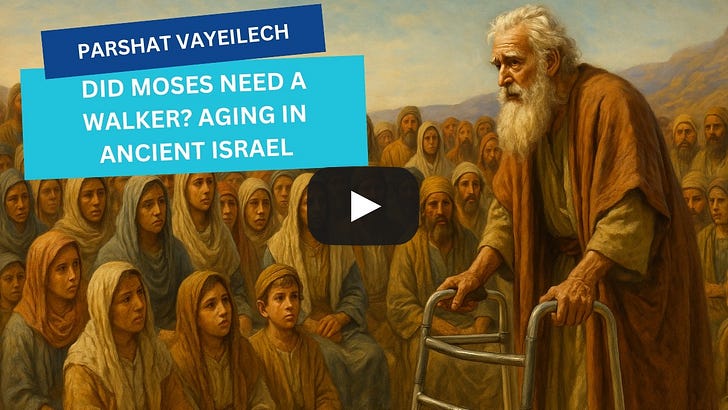
If municipalities make their cities accessible — physically, socially, and financially — they can extend the years of healthy, independent living. Moses and the Limits of AgeIn Parshat Vayelech, Moses declares:
Yet Deuteronomy later insists:
Rashi cannot accept that Moses lost his strength. He explains instead that when Moses admitted he lacked mobility, he meant he was no longer permitted to lead, or that the wellsprings of wisdom had been stopped up. As Rabbi Adam Mintz pointed out:
Sickness and Mortality in the BibleUnlike today, sickness rarely appears in the Torah. Jacob is the first to be described as ill. Isaac goes blind. But most of the time, once you were sick, the end was near. Chronic illness was unknown. This makes the psalms and the High Holiday prayers all the more poignant:
Aging, Community, and the High HolidaysIn synagogue on Rosh Hashanah and Yom Kippur, generations stand together. Mortality is not abstract — it is embodied. As we pray for life and quality of life, we also see life’s cycles in our families and communities. As a celebration of a new year, the High Holidays are unique in the Jewish calendrical cycle as not marking or reliving history or an agricultural season. Their sole purpose is to mark time. Those of us who have attended these services all of our life, cannot but conjure up memories of being a child, a young parent and the child of an aging parent. There is a custom for those who still have living parents to leave the sanctuary for the Yizkor service. As my father entered his 90’s I remember looking around the group of people gathered outside and noticing that I was the oldest. My days and that of my dad were numbered. Rabbi Adam Mintz reminded us that Psalm 71 is in the singular (“do not cast me off”), but the High Holiday liturgy changes it to the plural (“do not cast us off”).
Why Aren’t the Elderly in the Quartet?The Torah consistently calls us to protect the widow, orphan, stranger, and poor. But not the elderly. Perhaps, as I reflected, this is because the elderly had strong social institutions — synagogue, family, community life. Aging was integrated. Homes were multi-generation with the elderly living with their children and grandchildren. Houses of worship served as community centers Batei knesset and the elderly regularly left their homes to congregate and interact. Today, as lifespans lengthen and family structures shift, that assumption no longer holds. One of the most striking revelations from our conversation with Yossi was learning about Israel’s approach to eldercare. Despite being a relatively young country, Israel boasts some impressive statistics:
This cultural emphasis on family care, shared holidays, and Friday night family dinners transcends religion and also aligns beautifully with Jewish traditions of honoring the elderly. But the challenges of longer lifespans and a modern society cannot be ignored. Israel’s Experiment: Muni100Today, Muni100 operates in 20 municipalities across Israel, including Jerusalem, Ashdod, Beersheba, Netanya, Holon, Ramat Gan, and Tel Aviv, as well as Arab towns like Sakhnin, Rahat, and Shefa-‘Amr. Each city designs its own plan, based on surveys of older adults. The goal: prevent isolation, fight ageism, and ensure cities are livable for 100 years of life. Rather than focusing solely on individual care, Muni100 takes a broader approach, working with municipalities to create environments that promote “optimal aging.” The Face of Society
That is why honoring parents (kibbud av va-em) is linked in the Torah to the promise of long life. TakeawayAs modern lifespans expand, we face a choice: will old age mean withering away (kashish as straw), or will it mean strengthening (kashish as hardened resilience)? The High Holidays remind us that aging is not just personal — it is communal. To honor our elders is to honor ourselves. Unlike many secular “awareness” days or months, these High Holidays bring entire communities together to confront the passage of time and our own mortality. I will argue that if you take away God and repentance, the Jewish High Holiday period may be the oldest and possibly only established Holiday dedicated to communal reflection on aging and mortality. Sefaria Source Sheet: https://www.sefaria.org/sheets/678049 Transcript: Geoffrey Stern: The Bible has a blind spot. It almost never talks about the elderly as vulnerable. On the holiest day of the year, we plead with God, do not cast us away in our old age. Yet our tradition rarely speaks directly about aging. At the end of his life, Moses says, I am 120 years old today, and I can no longer go out and come in. But just a few verses later, the Torah insists his eyes had not dimmed, his vigor had not fled. So which is it? Is aging weakness or hidden strength? Why does the Bible’s famous quartet of the vulnerable—the widow, the orphan, the stranger, and the poor—not include the elderly? Did ancient Jewish society simply assume the old would be cared for in ways we’ve forgotten? This week on Madlik, we explore how the high holidays themselves become a radical communal ritual for confronting aging and mortality. Together, we are privileged to be joined by Yossi Heimann, Director of JDC Eshel and the visionary behind Muni100, an ambitious program working with municipalities throughout Israel to promote optimal aging and to increase the presence and participation of older adults in the public space for 100 years of life. Welcome to Madlik. My name is Geoffrey Stern, and at Madlik, we light a spark or shed some light on a Jewish text or tradition. Along with Rabbi Adam Mintz, we host Madlik Disruptive Torah on your favorite podcast platform. Now on YouTube and Substack, we also publish a source sheet on Sefaria, and a link is included in the show notes. This week’s parsha is Vayelech. Moshe describes the debilitating infirmities of old age, and we explore care for the elderly in the Rabbinic texts and modern Israel, and even in our high holiday liturgy. Well, welcome, Adam. And welcome, Yossi. This is the last podcast of the year, very special to have you. As I said, I was reading the Parasha I was preparing, and when it said that Moshe could not get up and go outside, I thought of you. Because what you’re doing, working with municipalities is changing the architecture and the structure of cities around Israel to get people out. I’m wondering if you can tell a little bit about yourself and a little bit about Muni100 before we dive into details. Yossi Heymann: Hello and thank you very much for having me here. My name is Yossi Heimann. I served in the IDF in the military for 28 years, from simple soldier in the infantry to division commander. In my last duty, I was the head of the Strategic Division. I retired 15 years ago from the military and became the CEO of Jerusalem Municipality. Yossi Heymann: For the last 11 years, I’ve been the director of JDC Eshel. JDC Eshel deals with promoting optimal aging in Israel. We help the government. JDC is a very special organization. On the one hand, we are an NGO, but on the other hand, we work with the government. We help them—the government, the ministries, the municipalities, and most of the organizations in Israel—to promote optimal aging. Yossi Heymann: What does optimal aging mean? One thing we can be sure we all know is that at the end of the day, we are going to die when we are 80, 90, 100, or 120. The big question is how we are going to live during our last 20, 15, 10, or 5 years. We try to help the older adults in Israel improve the way they live their lives—not just to add years to life, but even to add life to years. Yossi Heymann: We know from researchers all over the world that if the ministries, municipalities, and individuals themselves do the right thing, we can add many better years to life in good health versus moderate or bad health. This is the idea we try to achieve—to postpone the dependency of a person on others. When a person becomes dependent, in a nursing situation, on their family, caregivers, or others, their life is less and less good. Yossi Heymann: The ambiguity all over the world is that life expectancy has increased during the last 50 years by, let’s say, 20 or 25 years. But the age of 65 to retire, 65 or 67, when people usually retire from the workplace, doesn’t change. This is ambiguous because when a person still has 20 or 25 years of living after 65 and becomes more dependent on others, it goes against the idea of optimal aging. Geoffrey Stern: So you can imagine how I was reading the Psukim, and lately, I haven’t been getting very far into the parsha before the bells start to go off. It says that Moses went and spoke these words. The first thing I notice is it says we’re going to say in a second that Moses can’t go, and he can’t come back. But it says vayelech. He went and spoke these words to all of Israel. He says, I’m 120 years old, which of course is the iconic age of living a full life. He says I am no longer able to go out and come in. You know, being able to dictate one’s own ability to move, mobility is such a key item in aging, Rabbi, that I said we have to just touch upon this. As I said in the intro, later on in Devarim, it actually gives a different picture. It says in Deuteronomy 34, now, Moses was 120 years old at his death. His eye had not grown dim, his vigor had not fled him. So I was curious how we, how the rabbis round that square. And Rashi says one might think that this was because his physical strength failed him. Scripture, however, states his eye was not dim, nor his natural force abated. Rabbi, I think it was almost embarrassing to think that Moses could not have his mobility. And so he starts to bring in midrashim about what this means. Adam Mintz: Moshe needing a walker is not something he could imagine, right? Geoffrey Stern: Absolutely. But again, we’re diving right into the weeds here about perceptions and biases. So Rashi says, what then is the meaning of I cannot? Rashi says, I am not permitted because the power of leadership has been taken from me and given to Joshua. So again, the bias against Moses, as you say, being in a walker was so strong that he says, no, we’re talking, we’re taking it metaphorically. Another explanation Rashi gives: I am no more able to take the lead in the matter of the law. This teaches us that the traditions and the wellsprings of wisdom were stopped up from him. Adam Mintz: Let me just say one second. You know, people in Chumash don’t get sick. The only person we know who’s sick is Jacob. At the end of his life, it says, your father is sick. It’s interesting to notice that the idea of being sick or getting old doesn’t happen much. Yitzchak goes blind. But we don’t see it very often, which is interesting. Geoffrey Stern: And I wonder if, and we’ve discussed this kind of before, what you once said, I believe, that when you got sick, you didn’t last long, that most sickness was critical, chronic (terminal), whatever the term is. Maybe that’s the reason, I don’t know. Adam Mintz: I mean, that’s the pre-Penicillin Dvar Torah—you know, the idea that you’re sick for a long time that we have today didn’t exist before there was medicine. So if you got old or you got sick, that was the end. Geoffrey Stern: But I do think there are enough psalms, for instance, where we cry out to God to heal us. Adam Mintz: On Yom Kippur, we say, don’t throw us to old age. So there has to be an idea like that. Geoffrey Stern: But it is interesting that as we think about it, we have to pull straws. It’s not so obvious. And I think that’s part of the issue that partially we’re dealing with in modern society. Things have changed. Maybe it was Rabbi, especially with regard to the elderly, that we took better care of our elderly. Maybe we had multi-generational living under the same roof. Who knows? But let’s explore the texts. In the Talmud in Sotah, the word that he says is, I cannot go out and in. But he says, I am 120 today. So, the Talmud in Sotah focuses on that. He says, on this day, my days and years have been completed to be precisely 120. This is to teach you that the Holy One, blessed be He, completes the years of the righteous from day to day, from month to month, as it is written, the number of your days I will fill. This gets into the Rosh Hashanah and Yom Kippur liturgy because what we’re asking for is God, give us the allotted days and let us live our allotted days. There’s almost this sense of destiny that we live each day to the fullest. Here, this sense of our mortality, the fact that we start to decline, is mixed into the liturgy of Rosh Hashanah and Yom Kippur. It’s a new year, and the whole congregation, young and old, is together. I must say, when I go to synagogue, I think back to whe people (whose parents are still living) used to go out for Yizkor. I started to realize as my father got older that I was one of the oldest guys still going outside. It just meant that being part of Rosh Hashanah, you see the generational cycle. Besides beseeching God and praying, we come into direct contact with our mortality, but also the frailty of aging. Yossi, you were telling us that you went from the army to working with the elderly. Tell us a little bit about what Muni100 is and what you’re trying to achieve. Yossi Heymann: So what is Muni100? Muni100 is a program with the municipality that tries to promote optimal aging. It means how the municipality can influence a person’s life in their old age to be better, and at the end of the day, transfer years from moderate and bad health to good health of a person in his 20, 15 years at the end of his life. We study from many researches that the municipality can affect the older adult by two main things. Muni100 has two goals. The first is at the individual level. We want to increase the presence and participation. Yossi Heymann: Of the older adult in the public space, physically, socially, and financially. This is one goal. The second goal is that professionals in the municipality prepare the municipality for 100 years of living with advanced optimal aging. I can tell you that from my experience in Jerusalem municipality, but I can say about other municipalities, this is not in the high priority of the municipality to promote optimal aging, because municipalities think about families, young children, education, sports, and other things, but not about optimal aging. Yossi Heymann: Today, when life expectancy increases so much, the municipality should prepare itself for 100 years of living. You have to understand that today every third child who is born is going to live 100 years. This is something I think is happening all over the world, but specifically in Israel. The government of Israel is not prepared for that, and the municipalities are not prepared for that. What are the main indicators that we think can influence the individual and the municipality as an organization? In Muni100, we Yossi Heymann: want to promote three individual indicators. The first one is mobility. We want the person to get out of his home, with a goal of doing so at least once a day. The second indicator we want to promote at the individual level is walking outside. Walking is the easiest way to promote optimal aging. This is known from many researchers. The goal for walking outside is 150 minutes a week. This is something recommended by the World Health Organization, the WHO—150 minutes a week of physical fitness at medium or high intensity. Yossi Heymann: The third and last individual indicator is participation. We want the person to take part in social activities with others, not through the internet or via Zoom, but by meeting each other and doing things together. The goal for this indicator is two to four times a week. If we want the person to go out from his home, walk outside, and participate in social activities, the municipality should improve its physical accessibility, financial accessibility, access to information, and inclusiveness. This means that the older adult would feel better and be part of the environment, preventing ageism at the level of the municipality, and so on. So, this is Muni100. Yossi Heymann: Anka said that Muni100 is happening today in 20 municipalities and clusters all over Israel. This includes seven of the large cities in Israel, with more than 150,000 people, which are Jerusalem, Ashdod, Beersheba, Netanyah, Holon, Ramat Gan, and Tel Aviv. In three medium cities, Bat Yam, Beit Shemesh, and Lod. In four small cities: Ofakim, Kiryat Malachi, Kiryat Bialik, and Ramat HaSharon. In three Arab cities, Sakhnin, Rahat, and Shefa-’Amr, and in three regional councils and clusters: Negev Ma’aravi around Gaza, Soreq, and Upper Galilee. This means that today, almost 40% of all adults in Israel are part of the municipality. Muni100 is taking part in their municipality. Yossi Heymann: One last thing before maybe you ask questions. I want to mention that part of the program is the policy that the older adults would be part of the leaders who decide what would happen in the city, in the municipality. From that reason, we initiated a leadership of older adults, and we trained in all those 20 municipalities and clusters a group of leaders in each municipality who are partners in advancing optimal aging. Geoffrey Stern: Rabbi, it’s like eerie that when it describes Moses’ infirmity, it says he can’t go out. The first indicator Yossi mentioned was to go out of the house. “La vo” means to have activities outside. I just loved it. Then, of course, there’s this social aspect. You know, I’ve heard that McDonald’s, for instance, has an issue with the elderly coming in, sitting at a table, and staying there for three or four hours. People need that social ability. I’ll argue that maybe one of the reasons, and I’d love to know your input on this, that the elderly are not included in the typical at-risk populations that the Torah always addresses—which are the orphan, the widow, the poor, and the stranger—is because the elderly had those social institutions. I think back to my grandfather, who would go to shul on a regular basis. There’s a joke that goes, you know, Shimon goes to talk to Ruven and Ruven goes to talk to God. The social element of congregating is so important. Even in secular society, you can get rid of the talking to God part, but you can never, God forbid, give up that social part. That’s why we call them a Beit Knesset, a house of gathering. Adam Mintz: I like the word camaraderie. We go to shul for camaraderie. We see the same people, and that’s our community, for sure. So, what you’re pointing out is important. Let’s just review what we have here since we listened to Yossi for a minute. The problem is that there seems to be a contradiction at the end of the Torah. On one hand, it says that Moses couldn’t go out and come in, but in the next chapter, it says that Moses remained vigorous. How can you remain vigorous but not be able to go in and go out? So, Rashi, like you said, gives a drash that he wasn’t allowed to go in and go out. But what we’re suggesting is that with old age, you have trouble going in and going out, even if you’re vigorous. That’s what Yossi said. You can go, you can walk for 150 hours, but you have trouble. You have to be encouraged to do it. It’s hard to go in and to go out. Geoffrey Stern: And it’s fascinating that, you know, you and I, a knee-jerk reaction would be, if you want to help the elderly, create a one-to-one relationship, call on Mrs. Shapiro once a week, make sure that she has everything she needs. But what he’s working on is the larger picture, the way our towns, our villages, and our cities enable them. Just the simplest thing is to get outside, to spend X amount of hours outside. It’s really kind of interesting that the solutions can be so material and that embedded into them, where you have, I know in my town here in Connecticut, they’re building sidewalks like crazy because you get to the suburbs, and you assume everybody is outside, but the truth is everybody’s in their car, and you don’t get outside enough. You know, I was looking really hard, scratching my head about does our society really honor the elderly? And of course, the first thing that I thought about is what it says in the Torah, that for “mipnei seivah takum,” in front of the elderly, you should get up. And the fascinating thing, Rabbi, is that there’s a real disagreement between our sages. Some of them say, yes, it is the elderly, and others say it’s in front of the wise, in front of... We revere old sages and wisdom so much that sometimes we forget about the infirmity part of it. In Mishnah Torah, Positive Commandment 209 is to honor the sages. Where does it get that? So, I do think that we, you know, Yossi is fighting, or I’d say, working with municipalities. I think we have to be a little more focused in our society, whether we’re secular or whether we’re religious and understand whether, as Yossi said, we’re living to a much larger age. What did he give? The statistics are that if you’re being born today, the chances are you’ll live to 100. Adam Mintz: This is a big problem, isn’t it? Geoffrey Stern: Yes, it absolutely is. Adam Mintz: Let me just say one thing about honoring the smart people. You know, of course, the sages. Of course, the idea in Jewish tradition is that you get smarter as you get older. And so therefore honoring the sages means honoring the sages who are going to be older. Because the sages, to get so smart, you need to be older. They didn’t know about child prodigies. Geoffrey Stern: They didn’t. But what I found kind of fascinating in all of these rabbis trying to understand the verses that we talked about is, for instance, I mentioned Ramban, but he says this was a miraculous event in order that Moses should not be troubled. In other words, that God took away some of his clarity so that he did not recognize what was happening around him. He did not recognize that the torch was being passed on. I mean, they are addressing the issues that all of us face. And as you and I get older, we’re facing them every Rosh Hashanah. It’s not them, it’s starting to be us. I just find this fascinating that we don’t spend enough time talking about aging and that in fact a lot of the crumbs are being sprinkled right in front of us that can elicit these kinds of conversations. The other thing that I was thinking about is yes, we do talk about in Tehillim, it says, “Do not forsake me when I get old.” That is a key part of the Yom Kippur liturgy. And I really do think it’s a key part. I mean, it’s the kind of thing that when you say it, you get a little choked up. You start thinking about the elderly in your life and you do think about yourself as you’re getting older and you look to your children. It is a moment. Yossi is back. But what I’d like to discuss a little bit is what is the communal response to initiatives to help the elderly. I was saying, Yossi, that in our traditional society, my guess is a hundred years ago, the elderly lived with the family. There was multi-generational living. And it’s only in the so-called modern era that we have the issues of the elderly being alone, unattached, and we have to address this. I think in Israel, you have something fascinating also. The original chalutzim, the survivors of the Holocaust, they came without parents. And so there’s a learning curve as well in Israeli society to how we deal with this. We have all of this coming at the same time. So, Yossi, if you could talk about how difficult it is in Israel to get the governments, the municipalities, and people in general to focus on the issue of aging. Yossi Heymann: First of all, to say that this is something that we have to give a compliment to the State of Israel for two reasons. First of all, Israel is a small country and is very family-oriented, meaning that most of the time when older adults and most of them are not neglected by their family, the situation is good. And most of the families in Israel take care of the older adult during the holidays and Shabbatot and weekends. Second, in Israel, much better than all the other Western countries, the percentage of people who are 65 and above who live in an institution, and when I say institution, it means a geriatric center or nursing home, is the lowest in the OECD. Just 2% of the people are living in an institution. And why I think it’s good is because we know from all the researchers that all the idea of “Al tashlicheni l’zikna,” and the fact that the family and the society have to take responsibility for the old adult during his last few years when he needs others to take care of him. It’s always better to live at home. What the world understood during the ‘60s, the terminology of aging in place means as much as you can, live at home and stay in your community and so on. That’s why in Israel, just 2% of the older adults live in an institution. This is something that we can say that in Israel, the situation is in good order, still there are 7% who are neglected by their family. That we know from research in Israel. And we try to focus part of our program to identify those people and to try to take care of them. But I think that if we compare it to other nations in the OECD, the situation in Israel is not bad. Geoffrey Stern: You know, I was thinking culturally and I mentioned this before, that when we talk about the at-risk populations in the Bible, we talk about the Almana, the Yatom, the Ger, and the Ani. We don’t normally include the Zaken. And I think maybe one you kind of touched upon it and you said that Israel and I always love the fact that Israel is really a Jewish state and has kind of baked into itself the deeply DNA of taking care of their elderly whether it’s living at home. Whether it’s, as you say, Shabbat and the Hagim. You know, there is a secular organization called Yisrael Chofsheet and they want bus service on Friday night and Saturday so that kids can visit their parents and their grandparents. It’s that important in our structural dynamics. So I do think that the answer to the question of why the elderly are not included in what we would call the at-risk community in the Bible is they probably were taken care of. But as you said, society is changing, modernity is changing, the length of our years is changing. And we can’t take this for granted. We have to be proactive. And I think that’s what I love about what Muni 100 is doing, it’s trying to ensure that. And I love the very variables that are important. Getting outside, spending time with each other, and activity, that’s more important than anything. What sort of results are you getting? I know you’re doing pilots right now. What is the status? Yossi Heymann: First of all, we made the research when we started the Muni 100 a year and a half ago, we made a research in all the 20 municipalities. And we asked more than 12,000 people about those indicators: how many times you get out from your home on a weekly basis, how much you walk outside, how many times every week you meet with others and participate in social activities. We know exactly, first of all, what the average at the national level of those indicators is. Second, in each of those municipalities, which I mentioned before, we assess the situation and how far they are from the national average. Each municipality has its own data and should set a goal for where they want to be in three years from now. During the program, they have to prepare a specific program tailored for each municipality. You cannot compare one municipality to the other in how they promote those indicators. At the beginning of 2026, in four to five months from now, we are going to measure again. We will conduct another research, what we call T1. The previous one was T0. We are going to conduct the T1 research, which will provide perspective to them. For each of those municipalities, do Muni 100 promote their goals that they want to achieve? By the way, this is the only thing that we haven’t decided for the municipality. Every municipality decided on each of those indicators what their goal for the next three years is. And by the way, we asked the older adults in this survey what should happen so that they get out more from their homes, walk more, and participate more in social activity. This forms the basis for those municipalities to plan their three-year plan to promote optimal aging in Muni 100. Geoffrey Stern: So it’s not a cookie cutter. Every community has to decide for themselves. What I was struck by is that we live in a world where every month, every day is Grandpa’s Day, is Hispanic Month, Afro-American Women’s Month. I think, in terms of elderly, you can really look at Rosh Hashanah and Yom Kippur as the only holidays in a religion where people confront aging. In a sense, if you take away all the God and all the Teshuvah and all of that stuff, ultimately having people confront, as Leonard Cohen said, “who by fire and who by water,” how, where we stand today, look back at our predecessors, how they lived their lives, look to our children - it becomes kind of a fascinating rite of passage every year that our religion has created for addressing the birthday of the world, yet another year under the bridge. Rabbi, what do you think of that perspective? I think it becomes natural when you start looking at the liturgy a little bit. Adam Mintz: I think that’s absolutely right. And, you know, that verse, I just wanted to say it’s interesting. Yossi and Geoffrey, that verse in Psalms is in the singular, “don’t throw me to old age.” In the liturgy, we change it to the plural. And I think, Geoffrey, that’s exactly your point. It’s not just worrying about me; I’m worried about everybody. I realize that aging is an issue that needs to be dealt with on a communal, national level. And therefore, it’s “altashlikhenu.” That’s the jump. Tehillim Aleph says “altashlikheni,” but what we do is we say “altashlikhenu” in the plural. That, I think, really summarizes exactly, Geoffrey, what you’re talking about and all the amazing initiatives of Yossi. I’m going to let you guys continue this conversation. I’m going to wish everybody a Shanah Tovah. Happy New Year. Looking forward to 5786. Geoffrey, it’s going to be a good year. Shanah Tovah, everybody. Geoffrey Stern: But I do love what the rabbi just said, we have to do this as a community. And that’s what you were saying about the municipalities, that every community has to determine what’s necessary for it in order to address its needs. Yossi Heymann: I totally agree with the rabbi, and I think that the face of any society is the way they treat the older adults. You know, poor people, you have 10%, 20% of the population; people with disabilities, you have 15% of the population. Each of us is going to be an older adult one day, and that’s why it’s so important. Because 100% of the population, or those who reach 65, are going to live many years as older adults. And the way that society and family, of course, treat them, this is the face of the society. That’s why I think that “kabed et avicha ve’et imecha” (honoring your parents) is one of the important mitzvot in the Torah. And it’s even said “lema’an ya’arichun yamecha” (for a longer life). The “lema’an ya’arichun yamecha” is just written on two mitzvot: “kabed et avicha ve’et imecha” and “shiluach haken.” (sending away the mother bird) But this is another story. Geoffrey Stern: I love that. But maybe “shiluach haken” has to do also with intergenerational respect for the intergenerational. Yossi, your background in Talmud comes through. You can’t hide from it. Once you and I studied in the yeshiva once, it never goes away. Yossi Heymann: Yeah, I don’t try to hide it. I’m proud of it. And really, really, really. Yeah. So, Shanah Tovah, dear Geoffrey, Yossi, thank you so much. Geoffrey Stern: Shanah Tovah.
|
Wednesday, 24 September 2025
Yom Kippur - Aging as a Community



Subscribe to:
Post Comments (Atom)
Intersecting Identities: The Double Rainbow
Watch now (60 mins) | NeuroHub Live! Recording (14th June 2026) ͏ ͏ ͏ ͏ ͏ ͏ ͏ ͏ ͏ ͏ ...

-
Dear Reader, To read this week's post, click here: https://teachingtenets.wordpress.com/2025/07/02/aphorism-24-take-care-of-your-teach...
-
How i recognise psychosis and manage it in myself as an Autistic person ͏ ͏ ͏ ͏ ͏ ͏ ͏ ͏ ͏ ͏ ...


No comments:
Post a Comment