Leonard Cohen, Our Modern Paytan — And His Forgotten PrayerJudaism teaches that prayer requires permission. Leonard Cohen turned that dilemma into song.
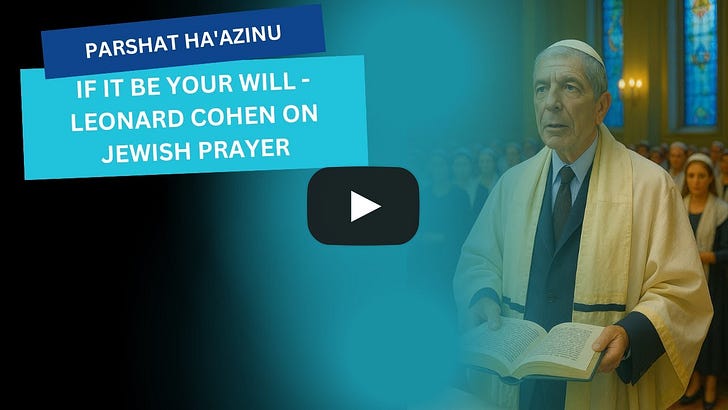 This week, Ynet published a beautiful piece describing Leonard Cohen as the paytan — the liturgical poet — of our generation. It highlighted three songs: Mi Ba’esh (Who By Fire), Cohen’s riff on the High Holiday Unetaneh Tokef; Hallelujah, his ode to a “broken hallelujah” in the spirit of King David; and Come Healing, newly translated into Hebrew as ובא מרפא, a haunting meditation on gathering shattered fragments and seeking wholeness. But reading that article, I couldn’t help but think of the song it only briefly touched: If It Be Your Will. Permission to PrayOur tradition begins prayer with hesitation. Moses opens his final song in this week’s parasha, Ha’azinu, by asking permission to speak:
The Talmud teaches that before the Amidah, which is written in the third person, we open with a personal request: “Hashem, open my lips, that my mouth may declare Your praise” (Psalm 51:17). Afterward we conclude: “May the words of my mouth and the meditations of my heart be acceptable before You” יִהְיוּ לְרָצוֹן אִמְרֵי פִי וְהֶגְיוֹן לִבִּי לְפָנֶיךָ ה׳ צוּרִי וְגוֹאֲלִי (Psalm 19:15). Rebbi Yudan used to say both of them before his prayer. Prayer is not a right; it is a privilege. The Audacity of PraiseThe Talmud in Berakhot 33b tells of a prayer leader who added a cascade of adjectives to describe God:
Rabbi Ḥanina stopped him: Had Moses not written “great, mighty, and awesome” (הָאֵל הַגָּדוֹל הַגִּבּוֹר וְהַנּוֹרָא) in the Torah, and had the Great Assembly not canonized them, we would not be permitted to say even that much. Maimonides cherished this story. In the Guide for the Perplexed (Part 1 59: 6-7), he argued that reason alone would forbid us from praising God at all. The best prayer, he wrote, is silence: “To You, silence is praise” (Psalm 65:2). On Yom Kippur we pray endlessly, five services instead of three. But perhaps the most authentic prayer is the hesitation before we speak—or the silence after. Even better… Maimonides adds “Commune with your own heart upon your bed, and be still” (Ps. 4:4) Leonard Cohen’s MidrashThis is where Leonard Cohen enters.
Cohen channels Yihyu l’ratzon imrei fi — May the words of my mouth be acceptable before You — and Maimonides’ radical teaching that silence itself may be more appropriate then praise. And like the Amidah, Cohen’s song shifts from the singular to the communal:
A Prayer for Our TimeYnet is right to call Cohen our generation’s paytan. His Who By Fire sits alongside Unetaneh Tokef. His Hallelujah is already a modern psalm. Come Healing gathers the fragments of Yom Kippur. But If It Be Your Will may be his purest prayer. It dares to do what Moses, Hannah, the Rabbis, and Maimonides all taught: to stand before God, admit our words fail, and hope that even our silence might be heard. Cohen himself called it a prayer:  The song was translated into Hebrew by Gavriel Belhassen as follows: אם יהא זה רצונךָ Wth all due respect, and based on the strong parallels we have identified, I would suggest: יהיו לרצון Listen to this week’s Madlik Disruptive Torah episode, The Words of My Mouth, where we uncover how Leonard Cohen’s haunting song carries forward a 3,000-year-old Jewish wrestling match with the meaning of prayer. Sefaria Source Sheet: https://www.sefaria.org/sheets/679254 Transcript: Geoffrey Stern: Picture it. Yom Kippur afternoon. Your lips are dry, the pages are endless, and you wonder, does God even want all these words? Judaism’s answer might surprise you. We’ve just come through the High Holidays, the most prayer rich days in the Jewish calendar. But what if prayer isn’t really about the words we say at all? What if it’s about the words we can’t? What if it’s about just asking permission to pray? From Moses calling on heaven and earth to Chana’s silent lips, to Leonard Cohen’s haunting line, if it be your will that I speak no more, my Judaism suggests that the deepest prayers begin where our voices fail. Welcome to Madlik. My name is Geoffrey Stern, and at Madlik we light a spark, shed some light on a Jewish text or traditional. Along with Rabbi Adam Mintz, we host Madlik Disruptive Torah on your favorite podcast platform. And now on YouTube and Substack, we also publish a source sheet on Sefaria and a link is included in the show Notes. This week’s parasha is Ha’azinu. If they are anything. The High Holidays are days of prayer and liturgy. We are struck that the introduction to Moses Penultimate Swan Song begin with terms and verses that have been adopted to introduce our prayer. And so we explore the dilemma of prayer. Rabbi I must have the High Holidays on my mind. I’m reading these last four or five parshiot and there always seems to be a tie in. But this week when I got to the words Imre Pi. I just said this is part of what we talk about when we ask God permission to pray. And then when it gets down to kashem hashem, ekro havu gedola elokenu, also used in either the introduction to the Amidah or after. So I decided we have to keep at it. We’re going to talk about our prayer. Adam Mintz: The holidays are everywhere, you know that. Geoffrey Stern: Absolutely. So we are in Deuteronomy 32, and it says, Ha’azinu hashem v’ adebra Give ear O heavens, that I may speak. So this is God, or this is Moses, I guess, actually asking permission to speak. And it says, hear, O earth, the utterance of my mouth. Imre Pi, let my teaching drip like rain. Let my words flow like dew, like droplets on new growth, like showers on grass. For the name of God I proclaim, give greatness to our God. And as I said in it, as we will explore today, are certain taglines that are used either at the beginning or at the end of the penultimate prayer. The shmona esreich, otherwise known as the silent meditation. So let’s just cut to the chase. In the Jerusalem Talmud, in Brachot it says, Rabbi Yosi from Sidon, in the name of Rabbi Yohanan, before one’s prayer, one says, quoting Psalms, master, open my lips, that my mouth may proclaim your praise. Hashem shifothai tiftach upi yagid tehilatecha. After one’s prayer, one says, again, quoting Psalms, may the sayings of my mouth be agreeable and the thoughts of my heart before you, my God and my redeemer. It says, ye’hu l’ratzon imrei PI. That’s that word that I saw at the beginning. Adam Mintz: So you have both pi and libi. You have your mouth and your heart. The prayer is connected to both the mouth and the heart. Geoffrey Stern: Absolutely. And we’re going to. As we explore today, we’re going to find some prayers that should be said quietly, almost to your heart, and others that need to be enunciated and said out loud. It’s an important part of prayer. Prayer kind of goes between cycles, between lips moving and talking out loud. And just thought in your heart. Again, you find in Tehillim, in Psalms, an amazing background for this. The word that I said before was hashem shifatai tiftach, God, let my lips be opened and my mouth shall say your praise. It’s actually from Psalm 51, which is a Psalm of David, when Nathan the prophet came to him after he had sinned with Batsheba. So it’s part of this amazing story. But the point is that when we go to the prayer book, we start. There are some that say a little bit more of a kind of a personal meditation, I would say more a personal request. We start by saying, kishem hashem ekro ha vu gadoleinu, that I will. This is coming from the verse that we just said. And then it says, God, open up my lips that I may sing your praise. And then you go right into the first paragraph of the Shmona esrei, where you bless God of our fathers, the God of Abraham, the God of Isaac, the God of Jacob, the God who is great One Big and Gibor hael hagadol hagibor v hanua, and off you go. So you have this kind of personal request that uses terminology from the beginning of Moses today. Adam Mintz: By the way, it’s interesting, there are two verses there, right? Yeshaya b’ shem ekra and then hashem svatai tiftach, right? They both more or less Say the same thing. One’s from Deuteronomy and one’s from Psalms. Geoffrey Stern: And both of them, though, are in the singular. And I think last week you were profound when you said the difference between saying to God, don’t reject me when I am old, and what we do in the liturgy, don’t reject us when you are. You really have to be sensitive to this change in number (person). So Judith Hauptman, a great scholar in the Talmud, in my People’s Prayer Book, which is a wonderful series for any of you trying to understand our prayers, it says all the supplements to the Amida, and that’s what we’re talking about here, are written in the first person singular and not the first person plural, the mode of most paragraphs in the amida itself. They thus add a personal dimension to the Amida, allowing the practitioner to feel more immediately involved in prayer. But you do go to this transition, and it kind of parallels to the Ha’Azinu, where we start by Moses talking about who he’s talking to, requesting permission, talking to the forces of nature. The interesting thing is the verse that comes literally from our Parasha that says that for the name of God I proclaim, give greatness to our God. In the interpretation that is in the machzor that I read, it says as follows. It says, the verse is taken from Moses, final speech to the children of Israel. It was probably originally inserted as an instructional phrase to be recited by the leader asking the congregation to respond by answering amen to the barakot that follow. Thus, this is how you would read the verse. Rabbi, when I proclaim God’s name, Adonai, you should respond by acknowledging God as well. We took the verse from Ha’azinu and we made it into instructional. Adam Mintz: That’s what’s great. Instead of writing instructions in English, they write instructions using a verse. Geoffrey Stern: Yes, absolutely. But again, it just struck me that we are using the verses from Ha’azinu and we’re going right to these kind of personal introductions, supplements you could call them, or permissions that go before the penultimate prayer, the Amidah. And what’s interesting is if you look into Tehilim (Psalms) and it uses the word imre pi, it kind of uses it in conjunction with the tephila (prayer). So I wasn’t off the mark when it resonated with me In Psalms 54, it says, O God, hear my prayer. Give ear to the words of my mouth. Elokim, shemat, philati, haazina, le, imre PI. And the Radak says, there are two ways to interpret this. Either it’s just repeating itself. In other words, imre pi and tephila are synonyms, one for the other, or in line with what you were saying a second ago. Rabbi Prayer is in the heart and the words of my mouth are in speech. So it’s kind of identifying these two elements that we have in. In prayer. Of course, all of us who were paying attention to the Haftarah on, I believe, the first day of Rosh Hashanah, that it has Chana’s prayer, we are already sensitized to this concept that one of maybe the innovations of Chana and of Jewish prayer was to prayer silently. So if you recall, it says in Samuel 1 now, Chana was praying in her heart. Only her lips moved, but her voice could not be heard. So Eli thought she was drunk. So it seems like it was an innovation. Rabbi it certainly was a. Well, we almost have three different ways of looking at prayer. One is praying in your heart to yourself. The other is praying out loud. And I guess the in between is how most people pray today when they do the Shmona esrei. You can see their lips moving, but the sound is not coming out. Adam Mintz: Well, that’s what Eli says to Chana Rak Sephate. Her lips were moving, but her voice could not be heard, and therefore he thought she was drunk. Geoffrey Stern: And of course, the Talmud in Barakot says, I might have thought that one may make his voice heard in his Amida prayer. It has already been articulated by Chana in her prayer as it is stated, and Chana spoke in her heart. So the rabbis truly learn from Chana that that is the reason why we say the Amidah, the shmona esre, the 18 blessings silently. It’s interesting that it also has another explanation. And the other explanation is if, especially on Yom Kippur, you are admitting to your shortcomings, you want to say it quietly, that you say it in a whisper so as not to embarrass transgressors who can confess their transgressions during their prayer. So, Rabbi I think what this adds to is the intimacy of silent prayer. And it kind of, if we bundle all of these kinds of feelings and kind of interjections that we’re dealing with, there’s this sense before coming to prayer that one, it’s very intimate. You almost ask personal permission that your prayers will be accepted, or that maybe I’ll radically say that you’re permitted to pray. And then it’s intimate. It’s in the first person. It’s in the personal. Even though our prayers are in the plural. I think that the different explanations don’t conflict with each other. They give us a kind of a very nuanced and a multidimensional sense of prayer. Adam Mintz: Right. These different opinions are all true. They’re different aspects of prayer. Geoffrey Stern: And, you know. And again, there is this sense of hesitation also. And coming to it personally, it just becomes rather fascinating now to say that all prayer is quiet. I think we should mention the Shema. The Shema is typically said out loud. And I actually find it interesting. In most synagogues that I go to, they might chant the first paragraph, and then everybody goes silent. It’s almost as though the chana and the rabbis were so successful in making prayer prayers of the heart and prayers of silence that we’ve lost that ability. To say it out loud? The Gemara asks, but according to Rabbi Yehudah Hanasi as well, isn’t the word here in this Shema written? The Gemara answers, he requires that for the Halakha that you must have your ears hear that which comes out of your mouth. So there’s a discussion as to whether when you say the Shema, it has to be audible enough that you can hear it. Adam Mintz: Right. I mean, I wonder what that’s about. That’s that unless you say the words, it’s not considered speaking. And Shema needs to be spoken. That’s the one prayer that’s spoken. The Amida does not like that. The Amidah is private. But Shema seems to be a statement of belief that needs to be said out loud. Geoffrey Stern: And I’ve probably told you before, but in my youth I was very influenced by a Rav Shmuel Dishon, who. Who was a Stulinar Karliner Hasid. And when you. One thing that has never happened in a stolener Kaliner Stiebel is for the rabbi to say quiet. I can’t hear myself praying. Because what they do is they scream all the prayers. They actually hold their hand up to their ear. They cup their hand over their ear so that they can hear themselves praying, because the guy next to them is screaming as loud as they are. And I have to say that there’s a silence in everybody screaming. This cacophony of sounds. It’s just this kind of noise or cold Torah, call it what you will, There is something beautiful of it, and I think we’re lacking it in many of our synagogues today. Adam Mintz: That’s funny. That’s still your yeshiva background. You enjoy that. Geoffrey Stern: I enjoy it because it really. Because everybody is screaming at the time. Let’s forget about the screaming, people are saying the prayers out loud. The guy next to you does, doesn’t in any way distract you. And I do think that there are different volumes that our rabbis intended our prayers to be set out. But again, I think there is a concept that maybe of us, some of us are not aware of, and those of us who are aware of it might not take it to the same I think conclusion that I do. And that is this question. Rabbi of Abraham, in other words, you are not allowed to say a blessing on something that doesn’t require a blessing. So the go to explanation is, Rabbi, when my potential son in law comes into the room, I put out different foods in front of him and I want to see whether he makes hamotsi first because then he can’t say borei pri hagefen or borei pri ha’adama. You have to go from the particular to the general. You can’t start with the general. And if you do, since you’ve said hamotzi lechem, which covers everything you’re making a bracha l’vatala But I think what lies behind the bracha l’vatala comes out in the following discussion. Again, in the Talmud, Yerushalmi, it says if one was praying and remembered that he had already prayed, Rav says he cuts short, he stops and Shmuel says he does not cut short. Shimon bab haben, the name of Rabbi Yochanan said, if only one would pray the day long. What’s so bad, Rabbi, if you said mincha and then you’re walking along and you went into another shteibel and you said mincha all over again, wouldn’t it be great if we could pray all day? Adam Mintz: By the way, that’s not so clear that that’s good. I don’t think we believe you should pray all day. We might believe you should study Torah all day, but I don’t know that we believe you should pray all day. Geoffrey Stern: And I think that is the argument between these rabbis and the Talmud, whether sתְּפִילָּה מַפְסֶדֶת or in other words, they are literally arguing not about simply making a blessing in vain, but whether it is a good thing to pray all day. Or to put it in another way of looking, whether we even have permission, Rabbi, to pray all day. I am going to make the argument today, Rabbi, that you can take these introductory prayers or some supplemental prayers more as a request for permission to pray. More of a way of framing prayer as not a right, but a privilege, not something that we can just do. We can just pick up the phone and talk to God anytime we want. But something that we actually have to be thoughtful about and wonder whether we have the right to pray. Adam Mintz: Yeah, I think that’s good, right? I mean, that’s the idea. Do we have the right? Rabbi Joseph Soloveitchik used to like that idea that we don’t necessarily have the right to pray. Who gives us the right to pray? That’s actually, Geoffrey, a Yom Kippur idea. What right do we have to say to God, forgive us. Who do we think we are? It’s like, go to our parent and say, forgive us. We can beg for forgiveness, but there are paragraphs on Yom Kippur in which we actually demand forgiveness. Rabbi Soloveitchik always said, yom Kippur gives us the permission to do that. Only on Yom Kippur can we demand forgiveness. Geoffrey Stern: And I’ll go even further. It’s one thing to demand something, but who are we to praise God? We are gonna find sages in the Talmud who say, like, who are you to say God is great. So let’s start slow. We’re still in these supplemental prrayers Here is how one of the rabbis took this request for prayer. It says, when Mar, son of Ravina would conclude his prayer, he said the following. My God, guard my tongue from evil and my lips from speaking deceit. So again, we’re talking about using the lips, not so much for prayer, but what you say to those who curse me, let my soul, soul be silent, and may my soul be like dust to all. Open my heart to your Torah, and may my soul pursue your mitzvot and save me from a bad mishap, from the evil inclination, from all the evils that suddenly come upon the world. And all who plan evil against me swiftly thwart their counsel and frustrate their plans. And then he says, may the words of my mouth and the meditation of my heart find favor before you. Yehilu ratzon imrei PI vehegyonli bilifanecha hashem tsuri vagoalim. So he kind of mashes this, requesting God that the words that I’m about to say, or in this case, that I have said, he mashes that with other times where we are affected by words said about us, said against us, maybe words that we would say. I think the takeaway from Mar son of Ravina is if prayer teaches us anything, it’s that words matter. That would be his takeaway, that words engaging in prayer is the ultimate buy in that words actually matter. Adam Mintz: Yeah. I mean, it’s interesting that this is the prayer that we choose to say at the conclusion of our Amidah. So obviously your point, Geoffrey, is something that they want us to say every single day at the end of our amita. Geoffrey Stern: Yeah. But it ties into, again, these verses that are either before or after. But it’s this Yehirat liratzon, may it be your will that these words are accepted. And I love the fact that he kind of takes it in a very expansive way and just talks about words in general. But ultimately, prayer. Prayer is a statement about the power of words. So now we’re going to read a piece of Talmud that I think is just absolutely radical. And it gets to what we were saying before, when you were saying almost the audacity of prayer in Yom Kippur, when we almost demand forgiveness. And I said, the audacity that we even praise who God is. So here is the story in Brachot 33 be with regard to additions to prayers formulated by the sages. The Gemara relates that a particular individual descended before the ark. As prayer leader, he was the Shliach Tzibor. In the presence of Rabbi Chanina, he extended his prayer, and he said, God, the great, the mighty, the awesome God, haggad al hakiba vahanoah. And then he went on the power powerful, the mighty, the awe inspiring, the strong, the fearless, the steadfast, the honored. Rabbi Chaninna waited for him until he completed his prayer. When he finished, Rabbi Chanin asked him, have you concluded all the praises of your master? Why do I need all of this superfluous praise? Even those three words that we recite, Hael, hagadal, hagiba vahanoah. Had Moses, our teacher, not said them in the Torah, and had the members of the great assembly not come and incorporated them into the Amida prayer, we would not be permitted to recite them. And he went on and he recited all of these, Are you meshuga? Are you crazy? So I love the fact that he says, had the words themselves not been found in our texts, and had the Sanhedrin in the great assembly not so chosen to use that we would not have been permitted to say these things about God. Adam Mintz: That’s exactly the same idea. The idea of the permission to pray prayer is Chutzpedik. We need permission to pray. Geoffrey Stern: So Maimonides in the Guide for the Perplexed says as follows, about this piece of Talmud, you must surely know the following celebrated passage in the Talmud, referring to what we just Read, read. Would that all passages in the Talmud were like that. That’s pretty astounding in and in itself. For Maimonides, he says, consider first how repulsive and annoying the accumulation of all these positive attributes was to him. Next, how he showed, if we had only to follow our reason, we should never have composed these prayers and we should not have uttered any of them. Maimonides saying, not only would it not be permitted pray, but if you and I were sitting around the table, Rabbi, thinking, what are we going to tell people to do on Yom Kippur? We would not have composed any prayers. Who are we to write these prayers? We should rather not do anything. And he goes on. He says, it has, however, become necessary to address men in words that should leave some idea in their minds and accordance with the saying of our sages, lo diba Torah, Ela balashem b’ ne Adam, the Torah speak in the language of men. And he says, and this is common to Maimonides, he talks about how we had to give people something that they need. But what he ends up saying to me is the most important. He quotes the verse in Psalm that says, silence is praise to you, O God, in Zion, and to you a vow is painful paid. And he says, the idea is best expressed in the book of Psalms. Silence is praise to thee. Maimonides is saying the best prayer would be to zip it, to not say anything. And he says, it is therefore more becoming to be silent. And he quotes another piece of Psalms that says, so tremble and sin no more. Ponder it on your bed and be still. He says, says it would be better to be silent and to be still. It’s really a radical notion. And I started by saying, Rabbi, that we’re on Yom Kippur, we have five services instead of the normal three. We are praying. We’re listening to the repetition of our praise. There has to be a sense of rebellion in us, or at least a questioning. And I think what Maimonides he’s saying is that’s valid. And we really do have to understand the dilemma of prayer. Adam Mintz: Good. I mean, this is fantastic. We have today the dilemma of prayer, the chutzpah of prayer, which you translate in English as being the audacity of prayer. This is not usually the way we think about prayer, but I think as we prepare for Yom Kippur, these are all ideas that are really central to Yom Yom Kippur. Geoffrey Stern: Absolutely. So around this time of year, Rabbi, there are a few songs by Leonard Cohen that everybody thinks of I quoted one last week, and it was who by fire, who by water. And that obviously goes back to his youth in the synagogue on Rosh Hashanah. And then his most famous song is Hallelujah. And that relates to the psalm we talked about a little bit bit before today, which is about David sinning with Batshebaa. But there is a song that I believe, and literally I’ve googled everywhere on the Internet and no one has made this connection. But I think after the introduction that we just had, you will see that Leonard Cohen literally was referring to Yehu l’ratzon imrei pi. May it be your will that the words of my mouth are accepted in his song. And it’s called if it be your will. And if you Google it, some people say, yeah, that’s from Ken Yehirazon. It’s not from Ken Yehi ratzon. It’s from יִהְיוּ לְרָצוֹן. It says, if it be your will that I speak no more. He literally is coming right out of Maimonides. And my voice, voice, be still as it was before. What will I do? I will speak no more. I shall abide until I am spoken for. If it be your will if it be your will. And then he goes on, and what he you will notice. And I draw all of you to listen to the song. He starts moving from the personal, from the individual to the plural. And he says, let your mercy spill on all these burning hearts in hell if it be your will to make us well and to draw us near and bind us tight all your children here in their rags of light in our rags of light all dressed to kill and end this night if it be your will if it be your will. There’s a little bit of the last song that he wrote, which is, if you like it darker, where he was literally saying it’s not only be quiet but also almost to die, to disappear. But the one commentary that I read about where Leonard Cohen actually introduced this song, it says that he was in front of an audience in England, and he said that the song was a sort of a prayer written a while ago when he was facing some obstacles. And this commentary says Cohen asks God if he is supposed to be silent, to stop singing. If so, Cohen will comply. But as the song proceeds, Cohen’s prayer stops being personal. It is almost as if he senses that his prayer is gaining him divine favor and his words are being accepted. Instead of focusing on his own issues, he ends up by praying for healing for the whole of humanity. And this was a guy just talking about the song, Rabbi? Nothing to do with Judaism. Adam Mintz: That’s correct. Geoffrey Stern: But there really is. I think it’s amazing when you can look at a song like this and understand it totally differently. And he really, if I’m correct and I think it comes right from the words he’s talking about the prayers we discussed today. And he’s drawing some of the same conclusions. Mainly that, number one, we have to ask permission to pray in his case, to sing in any way, to talk about out things that transcend us. And on the other hand, if we do get permission, it’s because we come together as that community that we were describing last week and we do it amongst ourselves. I just love it. Adam Mintz: That’s great. That little paragraph is great. Okay, thank you. Geoffrey Stern: Okay, so I’m sure by the time you listen to that, you will have Yom Kippur under your belt. You can listen to the podcast and then you have to go out and put the first nails into your Sukkah. And we will be back next week, I believe. Are we operating on Sukkot? Adam Mintz: We will Sukkot and everything. Fantastic. Everybody have an easy, meaningful Yom Kippur where our prayers should be answered, should be listened to and answered by God and we should listen to one another’s prayers and pray together and enjoy Yom Kippur together. Shanah Tovah, Gemarchatima Tovah, and we will see you all next week. Be well. Geoffrey Stern: See you all next week.
|
Wednesday, 1 October 2025
Leonard Cohen, Our Modern Paytan — And His Forgotten Prayer



Subscribe to:
Post Comments (Atom)
Get the inside track; plus a countdown to the conference
A Relatively Urgent Reminder ͏ ͏ ͏ ͏ ͏ ͏ ͏ ͏ ͏ ͏ ͏ ͏ ͏ ͏ ͏ ...

-
Dear Reader, To read this week's post, click here: https://teachingtenets.wordpress.com/2025/07/02/aphorism-24-take-care-of-your-teach...
-
How i recognise psychosis and manage it in myself as an Autistic person ͏ ͏ ͏ ͏ ͏ ͏ ͏ ͏ ͏ ͏ ...


No comments:
Post a Comment