One Big Beautiful Bill or One Big Beautiful Betrayal?Why the OBBBBA is Devastating for Working and Middle Class Americans
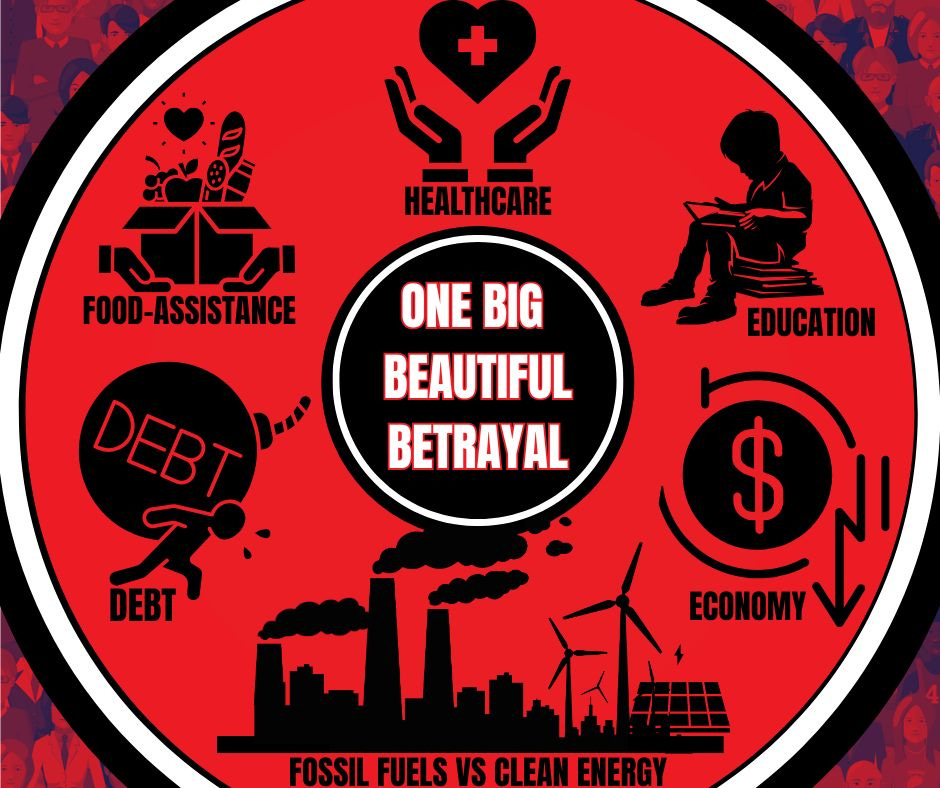
Trump’s “One Big Beautiful Bill Act” may promise prosperity, but independent analyses show that it hurts average Americans. The 1,100-page mega-bill signed into law on July 4th, 2025, adversely impacts 80 percent of the population. This includes the 28 percent of people in low-income groups, and the 52 percent of people in families with moderate income. Only the wealthiest 20 percent of Americans benefit from the bill. The legislation includes the biggest cuts to the social safety net in American history. The bill deprives people of vital services that are fundamentally important to their well-being. This includes everything from homeless shelters to hospital transport for the chronically ill. The OBBBA hits average Americans across multiple fronts: it weakens food security, restricts access to healthcare, hands tax breaks to the wealthy, drives up national debt, worsens air quality, and accelerates climate change through rising greenhouse gas emissions. Weakened food securityOBBBA substantially reduces food assistance through its deep cuts to the Supplemental Nutrition Assistance Program (SNAP, food stamps). Expanded work requirements and altered benefit calculations significantly reduce the number of people eligible for aid. The nonpartisan Congressional Budget Office (CBO), staffed by some 275 economists, analysts, and other employees, estimated that nearly 4 million would lose access to SNAP due to the legislation. Proposed cuts to SNAP are $200–$300 billion over a decade, making it the largest cut to the program in history. Reductions in SNAP funding will increase food insecurity for families who rely on benefits. Diminished access to healthcareOBBBA will deprive millions of healthcare and shift costs onto states. According to the CBO, the bill cuts Medicaid funding by $700 billion. These cuts will have a major impact on the 100 million Americans who rely on Medicaid. Under the OBBBA, many people will not qualify for Medicaid coverage due to new work requirements and stringent eligibility redeterminations. The CBO estimates that 11.8 million Americans will lose their health insurance coverage. If we include marketplace impacts of the Affordable Care Act (ACA), the Center for American Progress (CAP) estimates 15 million Americans could lose health insurance coverage. The legislation will strain healthcare infrastructure as cuts to Medicaid funding will increase uncompensated care and make healthcare more expensive, and increase the burden on hospitals. More expensive healthcare will raise premiums and increase local tax burdens. CAP anticipates this will result in decreased services and closure of some hospitals located in rural settings that rely on Medicaid. These cuts could also lead to a deterioration in health outcomes and an increase in preventable deaths. Declining access to quality educationOBBBA has important implications for the funding of public education and student loans. The legislation supports private schools and siphons funding away from public schools through an uncapped federal tax credit and the 529 education savings plans. That is because such tax credits and savings plans are more likely to benefit wealthier families. The bill imposes caps on student loans and makes repayment options less flexible. It eliminates several Repayment Assistance Plans (RAP) and reduces payments to between 1–10 percent of income for the remaining plan. The lowered borrowing capacity for graduate and professional students may further restrict access to advanced degrees, especially expensive ones like medicine and law. This limits the ability of low- and moderate-income families to finance advanced degrees. According to a CNBC survey of college students, many feel the changes make graduate school or professional school “impossible”. Some students say the changes have forced them to cancel plans for further education. OBBBA also allows Pell eligibility for short-term (8–15 week) training programs approved by governors. However, students may be ineligible for Pell if they receive non-federal aid that exceeds the cost of attendance. Tax cuts for the wealthyOBBBA extends the tax cuts from Trump’s signature first-term legislation. While most Americans get a tax cut, only the wealthiest Americans benefit. Everyone else will end up with less when the spending cuts are factored into the equation. According to the Yale Budget Lab, lower-income households will end up worse off when the bill’s broader economic effects are considered. At a Congressional Hearing, Rep. Jimmy Gomez confirmed that under the OBBBA, in 2031, the taxes of those earning between $15,000 – $30,000 will go up by 21%, and anyone making less than $15,000 per year will see their taxes increase by almost 75%. Low-income earners ($35,000 or less) get an average tax cut of about $160, representing an after-tax income increase of 0.8%. Middle income earners ($67,000 – $119,000 annually) get roughly $1,840 on average, increasing their after-tax income by 2.4%. Most of the benefits ($235 billion) in the OBBBA go to higher earners. A Tax Policy Center analysis indicates the top 20% (those with annual incomes of at least $217,000) get 60% of the $3.75 trillion worth of tax cuts starting in 2026. These earners will see an average annual tax cut of $12,660, which will increase their after-tax income by 3.4%. More than 33% of the tax cut goes to the top 5% (those earning $460,000 or more per year), and the top 0.1% of earners will increase their net income by $290,000 each year. Corporations also benefit from tax incentives in the resurrected 2017 legislation that includes provisions for the permanent reinstatement of 100% bonus depreciation for capital investments and immediate expensing for domestic research and experimental (R&E) expenditures, Growing national debtIndependent analysts project OBBBA will add trillions to the national debt. The bill has more tax cuts than spending cuts, which is why it adds to the deficit.The CBO estimates that the bill adds $7 trillion a year in spending and generates about $5 trillion in revenue. Tax cuts and increases in defense and border security spending will grow the national debt even if we exclude inflation and include $1.5 trillion in cost savings from spending cuts and revenues from tariffs. Estimates of the amount of debt caused by the bill range between $1.7 – $4.1 trillion over 10 years. While Trump and the Republicans are banking on increasing growth to pay for his tax cuts, many economists think this is very unlikely. The bill will grow the economy between 0.4% and 0.8% over about three decades. Even if we take the higher estimate (0.8%), the Increased revenue from economic growth represents less than a quarter (22%) of the lost revenue from OBBBA tax cuts. While the bill’s tax and spending provisions could result in an additional $124 billion in revenue from economic growth, higher interest rates could also increase interest costs by $441 billion. Debt is increasing at a faster rate than income, and the debt-to-GDP ratio is growing at an accelerated pace. We are running a deficit that is 6.5% of GDP, and the ratio is expected to increase under OBBBA. According to a CAP analysis, the increase in the debt since 2000 is due to tax cuts. They estimate that 57% of the debt is due to the Trump tax cuts and the Bush tax cuts, which mostly benefited the wealthy. If you remove Covid spending and spending associated with the recession of 2008 and 2009, 90% of the increases to the debt are due to these tax cuts. The billionaire hedge fund manager Ray Dalio, who researches the rise and fall of economies, warns that OBBBA will cause people to stop buying government debt, and this could cause Treasury debt defaults or restructuring. According to Dalio, OBBBA will increase the debt from an average of about $230,000 per American family to about $425,000 per family over the next decade. Interest and principal payments on the debt will increase from about $10 trillion ($1 trillion in interest, $9 trillion in principle) to about $18 trillion (of which $2 trillion is interest payments). The bill adds to the national debt and does not address the funding issues associated with aging baby boomers. Failing to address the debt sets the stage for economic instability, a collapsing bond market, and much more austere spending cuts that will further exacerbate existing inequality. The end of government support for cleantechOBBBA codifies Republican efforts to kill green projects. The head of Trump’s EPA, Lee Zeldin, called the legislation a “dagger through the heart of climate-change religion”. BloombergNEF called the bill a “nightmare scenario” for clean energy proponents. OBBBA passed in large part because of a Senate amendment that accelerates the phase-out of the Production Tax Credit (PTC) and Investment Tax Credit (ITC) for wind and solar, provided by the Inflation Reduction Act, which was passed by Congress in 2022. Phasing out incentives for solar and wind projects ignores the lawful spending authority appropriated by Congress. Stricter “Foreign Entity of Concern” (FEOC) rules restrict or disqualify green projects with more cost-effective foreign supply chains. These rules undermine the financial viability of such projects and make it likely that they will be canceled. The bill eliminates incentives to build clean energy on “disturbed” or contaminated lands. The White House also said it would slow the permitting process for renewables and introduce new tariffs on parts for wind turbines. The net result is a massive decline in the build-out of new clean power capacity. According to CAP, the reduction of new clean energy projects attributed to the OBBBA could be more than 72%. Modeling from the Council on Foreign Relations (CFR) suggests clean electricity generation in 2035 could be reduced by more than 820 terawatt-hours compared to a scenario without the bill. An Energy Innovation analysis estimates that in 2025, policy uncertainty prompted the cancellation of $14 billion in projects and 10,000 job losses in the clean energy sector. CAP estimates 840,000 jobs will be lost by the end of the decade due to reduced investment in renewables. OBBBA will increase energy costs for consumers and businesses. It will also drive up GHG emissions. As the deployment of renewables slows, household electricity costs are expected to rise. CAP estimates an average increase of $110 in 2026, and by 2035, some states could see much larger increases. A research paper by Jenkins et al concludes American households will pay an average of up to $415 more per year for energy in the next decade, while the annual U.S. GHGs are projected to increase by 1 billion tons by 2035. In addition to eliminating support for clean energy, OBBBA also repeals support for home efficiency improvements such as heating and cooling, efficient windows, and energy audits. Under the legislation, homeowners no longer have access to tax credits for installing solar panels and batteries. The bill not only repeals tax credits for electric cars, trucks, and chargers, but it also imposes an annual federal registration fee on electric vehicles (EVs), on top of fees that some states already charge EV owners. The withdrawal of support for electric vehicles will slow their uptake and increase the number of fossil-fuel-powered vehicles, which will drive up both emissions and consumer costs. The bill would also end tax credits for hydrogen production. The freezing of funds and the cancellation of contracts contained in the OBBBA effectively end the U.S. government’s support for green technologies. This raises consumer costs and eliminates jobs. It is antithetical to efforts to address climate impacts like wildfires, storms, and floods. It also deprives the next generation of the vital technological base required to build a sustainable future. Embrace of fossil fuelsThe combination of the legislation’s elimination of support for renewable energy and increasing support for fossil fuels inflates costs and increases pollution. The burning of fossil fuels has devastating consequences for human health, and the bill effectively negates the pollution-reducing and life-saving impacts of the Clean Air Act. This means more airborne pollutants (eg; mercury, lead, and fine particulate matter). Rigorous research conducted by AP concludes that increased fossil fuel use under OBBBA, would contribute to at least 30,000 additional deaths annually and add $275 billion worth of costs each year. IRENA and others have demonstrated that renewables are cheaper than fossil fuels, so as clean energy capacity declines and fossil fuel use increases, costs will go up. According to Energy Innovation, the increased use of fossil fuels under OBBBA could spike wholesale energy prices by 50% in the next decade. The legislation offers stronger enhanced oil recovery (EOR) incentives in the form of the 45Q tax credit. EOR is a method of injecting CO₂ into oil wells to extract more oil, but it does not permanently sequester carbon. More oil extraction means more emissions and more pollution-related health impacts. OBBBA effectively locks in fossil fuel infrastructure that costs more and makes people sick. It also raises GHG emissions and risks triggering climate tipping points from which we may not be able to recover. Synergistic negative effectsDifferent provisions in the OBBBA interact to create adverse compound effects. For example, the cuts in the bill will result in job losses and lower state tax receipts. Backfilling slashed services will also inflate state budgets. The OBBBA’s healthcare cuts could trigger a cascade of problems, making it harder for many to access necessary hospital care. Reduced funding for Medicaid-supported rehabilitation facilities means some patients can’t be discharged on time, leaving fewer hospital beds available for those who urgently need them. Paradoxically, the legislation may decrease the number of hours worked, and this could in turn reduce government revenue and increase the deficit. Penn Wharton estimates that OBBBA could inadvertently incentivize some lower-income households to reduce their work hours to qualify for Medicaid coverage, and higher-income people may work less to benefit from the bill’s tax breaks. Here are 4 additional examples of adverse interactive effects of OBBBA.
Cuts to SNAP increase food insecurity, and according to the Center for Budget and Policy, this will adversely impact both healthcare and education. Cuts to SNAP and Medicaid combine to impact local economies, leading the Commonwealth Fund to project local job losses and lower state tax revenues, especially in states with large Medicaid/SNAP rolls.
Cuts to food assistance programs have a deleterious impact on health, and they combine to exacerbate the impact of education cuts. Tighter SNAP eligibility requirements under OBBBA mean fewer students will qualify for automatic free school meals. This could put additional financial pressure on public school budgets for nutrition programs.
Healthcare cuts combine with education cuts, putting additional strains on school-based healthcare. Medicaid cuts in the legislation will adversely impact school-based health services (nurses, therapists, psychologists). Pre-K education could be disrupted as many early educators rely on Medicaid. If they lose health coverage due to the more stringent eligibility requirements, this could detract from workforce stability in early childhood education.
New Social Security requirements in the bill mean that an estimated 4.5 million children will not benefit from the increased Child Tax Credit (CTC). According to New America, this has downstream impacts on health and education. Net impactsWhen all the provisions in the OBBBA are factored together, 80 percent of Americans will be negatively affected by the bill. Small average tax cuts ($150) and cuts to both SNAP and Medicaid combine to make this bill harmful to everyone but the wealthiest 20 percent of Americans. Taken together, tax cuts and service cuts provide substantial benefits to the richest Americans, while lower-income earners pay more or get virtually nothing. The first decile (bottom 10%) may lose $1,000–$1,200 annually. The Penn Wharton Budget Model found that in 2026, these people will see their incomes drop by an average of 14.6%. Those earning $17,000 or less will see their incomes fall by $820, on average. Those with incomes between $17,000 and $51,000 would lose $430 in income, or 1.1%. The second quintile (bottom 20–40%) will see a small net loss or near-zero, and this will be exacerbated by reduced access to safety-net supports. The third quintile (40-60%) will see a small net gain on paper. Middle-income households (incomes between $51,000 and $93,000) will receive a tax break of $840, or a 1.1% gain in income, on average. However, weakening economic and employment dynamics alongside diminished healthcare access will reduce the net well-being of these individuals. The fourth quintile (top 60-80%) will see a moderate net gain from larger tax benefits, and those with little direct reliance on Medicaid or SNAP will benefit. The fifth quintile (top 20%) will enjoy the largest absolute gains with windfalls for top earners. The highest earners, those making more than $174,000, would enjoy big average income boosts of just over $12,000, or 2.6%. For the majority of those who see some tax relief, the net effect is regressive when the large cuts to Medicaid, SNAP, and other programs are included. The clear takeaway is that lower-income households will lose, while higher-income households will gain. Those who can afford it least are the ones who will experience the most pain due to the passage of the OBBBA. The most vulnerable members of society—children, seniors, and people with disabilities—will be hit the hardest. Empowering the powerfulThe bill gives the Trump administration broad enforcement authority, and according to CAP, this could further reduce oversight. Trump has been accused of sowing chaos to consolidate his power, and these accusations include his handling of immigration. The tens of billions of dollars allocated by OBBBA for border security, detention, and ICE will create what the CAP described as “social and economic instability in affected communities”. The bill serves what Stephen Collinson described as Trump’s “aggressive claims of executive authority,” and it exemplifies “the growing power of a president dominating and disrupting this era in the US and abroad.” “Trump uses executive power more broadly and questionably than any modern president,” Collinson wrote, leading him to conclude that OBBBA is yet another way that Trump is working to ‘cement’ his authority and “tighten his power grip on the country”. Conclusion: Winners and losersThe most substantial tax benefits of the OBBBA are concentrated among the wealthiest individuals and corporations. The almost $1 trillion government services spending reductions are financing the tax cuts for the rich while decreasing the standard of living for average Americans. The bill’s support for the fossil fuel industry alongside the abandonment of renewable energy will result in rising emissions, lost jobs, and an increase in suffering from the effects of air pollution. The individual impacts of OBBBA on food security, health care, education, as well as the national debt and energy, interact to produce synergistic negative effects. The legislation exacerbates inequality by reducing taxes on the rich and increasing them on the poor. The passage of the bill also deprives many Americans of access to quality education and healthcare, both of which are primary drivers of inequality. As Democratic Sen. Chris Murphy said on NBC’s Meet the Press, this legislation represents “the biggest transfer of wealth and money from the poor and the middle class to the rich in the history of the country”. The trillions of dollars of additional debt created by the bill pose long-term fiscal risks. The economically destabilizing cost of servicing a growing debt could result in more cuts, less public investment, and future tax increases. Republicans are hoping most won’t notice the harm they are wreaking on average Americans. They are trying to conceal their malfeasance by careful timing, like ensuring that nobody is kicked off Medicaid until after the November 2026 midterm elections. Similarly, many provisions in the bill that benefit low- and middle-income Americans will expire in December 2028, after the presidential election. This includes tax-free tips, the increased standard deduction for seniors, and car loan interest deductions. OBBBA’s cuts to the safety net, alongside tax cuts for the rich, combine to create a net negative impact for 80 percent of Americans. These hardships are further compounded by the burgeoning national debt, increasing energy costs, pollution, and climate impacts. Under the OBBBA, the real winners are those in the highest-income brackets, while working- and middle-class Americans are the clear losers. Beyond slashing vital services and transferring wealth to the rich, the bill also threatens America’s democratic foundations by expanding Trump’s already sweeping executive power.
|
Wednesday, 26 November 2025
One Big Beautiful Bill or One Big Beautiful Betrayal?





Subscribe to:
Post Comments (Atom)
Neurodivergence & Humanity
Listen now (7 mins) | Autistic Storytime With David ͏ ͏ ͏ ͏ ͏ ͏ ͏ ͏ ͏ ͏ ͏ ͏ ...

-
Dear Reader, To read this week's post, click here: https://teachingtenets.wordpress.com/2025/07/02/aphorism-24-take-care-of-your-teach...
-
How i recognise psychosis and manage it in myself as an Autistic person ͏ ͏ ͏ ͏ ͏ ͏ ͏ ͏ ͏ ͏ ...


No comments:
Post a Comment