Reframing the past: microhistory’s analytical promise for management and organizational historyForthcoming Special Issue in Management & Organizational History
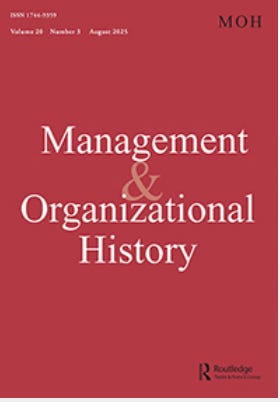
I was really excited to hear that the Microhistory Special Issue in Management & Organizational History is due to come out in this month’s issue. You can read all the articles, and now also the introduction to the special issue: https://doi.org/10.1080/17449359.2025.2576169
Here is the summary of the special issue contributions from the introductory article by Liv Egholm, Michael Heller and Michael Rowlinson: “Dawson Scott’s article introduces the concept of a ‘back bearing’ as a novel methodological device that broadens the benefit of microhistory across non-contiguous time periods. By tracing a line from contemporary concerns in Scottish banking – such as institutional trust and reputational risk – back to the diary of John Campbell, head cashier of the Royal Bank of Scotland during the 1745 Jacobite Rebellion, the article challenges the norm that microhistorical analysis must remain confined within a narrow temporal context. Instead, the back bearing enables a dynamic linkage between present-day analytical priorities and historical episodes that may otherwise remain marginal to mainstream narratives. Through this lens, Campbell’s meticulous recordkeeping and decision to honor Royal Bank notes while Edinburgh was under siege during the 1745 Jacobite Rebellion become more than anecdotes of individual integrity – they become insight-rich data points for understanding the historical foundations of financial trust, discretion, and institutional autonomy. By leveraging the performative quality of ego-documents and the interpretive demands of microhistorical reading, Dawson Scott demonstrates how distant episodes can become clear and theoretically generative for current organizational and management concerns, without reducing historical specificity to presentist utility. Popp’s article offers a distinctive methodological intervention into the microhistorical repertoire by focusing on oral sources – specifically, a decades-long friendship and dialogue with the artisan wheelwright ‘Pete’ – as the primary foundation for historical inquiry. In doing so, the article opens new avenues for microhistory within management and organization studies, showing how oral narratives, personal memories, and shared experiences can be employed not just as supplementary materials but as central historical sources that generate rich, interpretive insights. Through a dialogic and reflexive engagement, Popp investigates how Pete’s entrepreneurial practice – shaped by craft traditions, countercultural movements, and a lived rejection of market logics – is deeply historicized and situated within alternative temporalities and values. Rather than conforming to Thatcherite ideals of the ‘enterprising self,’ Pete’s relationship with work, money, and time demonstrates how agency and subjectivity emerge through everyday negotiations with and reconfigurations of dominant ideological frameworks. In this way, the article reimagines microhistory not only as a method for reconceptualizing the interplay of structure and agency, the particular and the general, but also as a collaborative, co-constructed approach that brings oral testimony, affect, and lived temporal experience into the heart of historical theorization. Decker, Giovannoni, and Plakoyiannaki’s article introduces a novel methodological synthesis of microhistory, historical imagination, and organizational aesthetics, using the Bauhaus School as an evocative case study. Their contribution illustrates how a microhistorical sensitivity to context, detail, and experience can be extended through the lens of materiality and the interpretive power of historical imagination. Working with an eclectic mix of visual and textual ego-documents, as well as what they term ‘alter-documents,’ the authors reconstruct the sensory, emotional, and social experiences of architectural space as lived and contested by Bauhaus members and observers. They show how architecture – traditionally understood through its physical permanence – can be studied as an affective and organizational phenomenon by tracing how design aesthetics were interpreted, resisted, and embodied through personal practice and social discourse. The article advances methodological rigor by explicating how imagination, interpolation, and empathetic understanding function as legitimate scholarly tools in the face of sensory and experiential gaps in the archive. In doing so, it not only enhances our capacity to engage with historical materiality but also opens new analytical pathways for studying how design, emotion, and symbolic form shape the practices of organizing across time. Tennent and Gillett’s contribution offers a methodologically rich exploration of archival ethnography through a microhistorical engagement with an unusual ego-document: a scrapbook compiled by FIFA Secretary General Helmut Käser during a business trip in 1967. Their article exemplifies how ephemeral materials – such as travel tickets, menus, correspondence, and packaging – can serve as powerful traces of organizational life, making visible the tacit routines, aesthetic judgments, and affective dimensions of institutional actors that are otherwise absent from formal archival records. By reading Käser’s curated assemblage as both a personal archive and an institutional artifact, the authors recover the contingencies and lived textures of mid-century football governance at a formative moment in the sport’s global institutionalization. The study underscores how the idiosyncrasies of individual experience intersect with the longue durée of institutional change, illuminating the informal social practices, performative rituals, and networks of influence that sustain and reshape organizational structures. In doing so, Tennent and Gillett not only expand the methodological toolkit of microhistory but also demonstrate how archival ethnography can unsettle received macro-narratives by foregrounding the subtle, cumulative ways in which institutions are shaped through the everyday experiences of their members. Grandi’s article offers a microhistorical reconstruction of the World Bank’s formative missions in Colombia, providing a compelling illustration of how institutional development is shaped not only by top-down models but also through locally contingent negotiations and actor-driven adaptations. Drawing on a rich body of archival correspondence and ego-documents exchanged among World Bank officials, local advisors, and Colombian political and economic elites, Grandi demonstrates how institutional practices and policy models emerged not from standardized protocols but from a dense web of situated interactions, conflicting strategies, and evolving alliances. Her analysis foregrounds the multiplicity of actors – from transnational coffee magnates to regional industrial associations – who navigated and sometimes reoriented World Bank agendas to align with local development visions. Through this approach, the article delivers a textured account of how international institutions take shape through contingent processes of mediation, contestation, and pragmatic adjustment. Grandi’s work exemplifies the power of microhistory to illuminate the generative interplay between structure and agency, revealing the uncertain, negotiated nature of institutional evolution within global economic governance. Gibbs, Mackenzie, McKinlay, McNulty, Phillips, and Procter make a compelling methodological case for the relevance of microhistory in analyzing the evolution of managerial governance, particularly through their focus on discrete, seemingly marginal events in a single factory across several decades. Drawing on a rich combination of archival fragments, union records, and oral testimonies through an in-case comparison, the article reconstructs two moments – the carnivalesque inversion of shop floor hierarchy at a 1953 New Year’s Eve celebration and the 1995 dismissal of a shop steward for violating emerging norms of entrepreneurial self-governance. These cases are not presented as anomalies but as revelatory events that render visible the shifting moral and organizational orders underpinning workplace discipline. By treating such episodes as portals into broader structures of meaning and authority, the authors demonstrate how microhistory can unsettle conventional chronologies of change and foreground the contingent, negotiated nature of institutional transformations. Their work underscores how management practices are made and unmade not solely through formal policy, but through symbolic acts, resistances, and ruptures – thus enriching our understanding of how new regimes of work are experienced, contested, and embedded. Cordina, Dey, Fordyce, and Power offer a fine-grained microhistorical account of how accounting gained disciplinary status at the University of Dundee, shedding light on how institutional, professional, and financial contingencies converged to shape the emergence of academic accounting in Scotland. Rather than adhering to a linear or inevitable narrative of professionalization, the article reconstructs the fragile negotiations, contested alliances, and pragmatic adaptations that surrounded the establishment of Dundee’s Department of Accountancy in the 1970s. Drawing on archival sources and oral histories, the authors illustrate how financial considerations, evolving professional entry requirements, and the symbolic authority of individual figures – both academic and practitioner – intersected with broader changes in higher education policy. The study situates the local within a national context, demonstrating how the University of Edinburgh’s decision to withdraw from Chartered Accountants (CA) teaching created an institutional space for others, such as Dundee, to redefine their academic identity in response. In doing so, the article contributes to broader debates on how disciplines evolve not only through scholarly coherence or institutional design but also through contingent and localized efforts to gain legitimacy, navigate inter-professional boundaries, and establish epistemic authority within a university setting. Deal’s article investigates how microhistory, when attuned to the productive tension between archival absence and empirical serendipity, can reveal institutional change through seemingly marginal events. Focusing on the renaming of Trans Canada Airlines to Air Canada in 1964, Deal engages with what he calls ‘minor knowledge’ – the fragmentary, easily overlooked traces in the archive that, when read against the grain, disclose the contingencies and socio-political tensions underlying a pivotal moment in Canadian corporate and national identity. Anchored in an encounter with archival silence, Deal reconstructs the understated yet consequential role played by then-little-known political actor Jean Chrétien in translating aspirations for bilingualism and national unity into legislative and symbolic form. Through this approach, he illustrates how microhistorical inquiry can unsettle dominant narratives of branding and institutional development, tracing instead how organizations and their identities are shaped by localized, affective, and often accidental alignments of people, ideas, and political imaginaries. In doing so, the article not only broadens the methodological horizons of microhistory – particularly through its dialogue with amodern historiography – but also makes a strong case for the analytical power of connecting local episodes to broader processes of cultural and institutional transformation.” You're currently a free subscriber to Organizational History Network. For the full experience, upgrade your subscription.
|
Monday, 24 November 2025
Reframing the past: microhistory’s analytical promise for management and organizational history






Subscribe to:
Post Comments (Atom)
, mindfulness made more accessible
Follow David on Insight Timer for affirming mindfulness shaped by lived experience and real support. ...
-
Dear Reader, To read this week's post, click here: https://teachingtenets.wordpress.com/2025/07/02/aphorism-24-take-care-of-your-teach...
-
How i recognise psychosis and manage it in myself as an Autistic person ͏ ͏ ͏ ͏ ͏ ͏ ͏ ͏ ͏ ͏ ...


No comments:
Post a Comment