Sarah's Separation from Abraham | With Prof. Rabbi Wendy ZierlerWhat happens when women finally enter the conversation that's been about them all along?
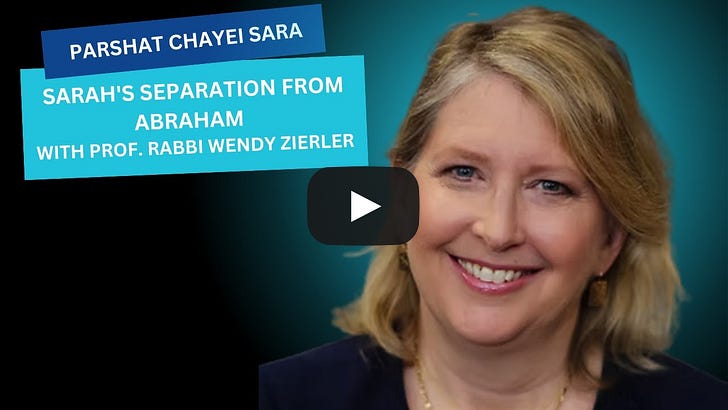 Last week, when we explored Sarah’s laugh, we celebrated the gift of living in a golden age when women’s voices are reshaping our oldest questions. This week we go further. We are joined by Professor Rabbi Wendy Zierler, Sigmund Falk Professor of Modern Jewish Literature and Feminist Studies at HUC-JIR in New York, ordained by Yeshivat Maharat and author of Going Out with Knots: My Two Kaddish Years with Hebrew Poetry. Together, we look at Parashat Chayei Sarah not as a eulogy, but as an act of recovery—a chance to listen for Sarah’s voice between the lines. The Torah’s Silence
Wendy Zierler opens with a simple but seismic question: The Torah places Abraham in Be’er Sheva at the end of the Akedah—and Sarah’s death in Hebron. Forty-three kilometers apart. The classical commentators can’t stand it. Rashi suggests Abraham was only passing through. Ramban insists he had gone to Be’er Sheva “for the day.” Toledot Yitzchak wonders what moved Sarah to Hebron in the first place. It’s almost painful to watch the commentators bend logic to keep Abraham and Sarah under the same roof. Because the idea that Sarah could have lived—and died—independently from her husband simply didn’t fit their world. But what if the Torah’s geography isn’t a problem to be solved, but a truth to be faced? Love Lost at the AkedahWendy reminds us that the Akedah begins with the word love—the first time the Torah ever uses the verb ahavah:
And after the Akedah, that word “whom you love” disappears. As the angel says: “because you have done this thing, have not withheld your son, your only one, indeed I will bless you…” Something changes. Something breaks.
Chayei Sarah becomes not a story about death, but about distance—the emotional aftermath of absolute obedience. Sarah’s Alternative TestIf Abraham’s trial was fear, Sarah’s may have been love. Wendy’s midrash imagines Sarah learning of Abraham’s plan to sacrifice their son and her returning to Elonei Mamre, the place where she first laughed when told she would bear a child. There, she waits for the angels to come again—this time, to tell her that they have interceded and convinced Abraham to prove his fidelity for God in another way. She imagines one of the angels racing toward Mount Moriah to stop Abraham’s hand.
In this alternative midrash ends and she knows Isaac is safe, her story ends. Not in shock, but in peace. This is Sarah’s act of faith—an act not of silence or submission, but of agency and compassion. The First MatriarchToledot Yitzchak raises another question: why didn’t Abraham buy a burial plot earlier, in anticipation of death? His answer: Sarah herself wanted to die in the Land of Canaan, “for the Land of Israel atones for sin.” But Wendy and I go further: maybe it was Sarah who chose Hebron—who anchored the geography of the Jewish story. She made sure by orchestrating her death in Kiryat Arba (the city of four) that our sacred lineage would be matriarchal as well as patriarchal; that the three Avot would always mean the four Imahot too. Sarah’s death secures the resting place not only for Abraham, but for Isaac, Jacob, Rebecca, and Leah. It is her final act of spiritual architecture. Names, Covenants, and ContinuityWendy points out that Sarah’s name change—Sarai to Sarah—is more than cosmetic. She is the only matriarch given a new name by God, and the next person to receive one is Jacob, renamed Yisrael.
Through Sarah’s insistence, love reenters the story—not at Moriah, but when Isaac takes Rebecca into his mother’s tent and “loves her.” “Isaac brought her into the tent of Sara his mother; he took Rebecca and she became his wife, and he loved her. Thus was Isaac comforted after his mother.” The matriarch’s absence makes space for love to return. Modern Midrash: The Poetic LensThe conversation then turned to Wendy’s new book, Going Out with Knots: My Two Kaddish Years with Hebrew Poetry, and how modern Hebrew poetry itself becomes a form of midrash. Wendy brings in Lea Goldberg’s “By Three Things,” written as the State of Israel was finding its footing. Goldberg rewrites the famous line from Pirkei Avot—“On three things the world stands”—and gives it a modern, human twist.
When Leah Goldberg published “By Three Things” in 1949, she wasn’t just writing a modern poem; she was taking her seat at the rabbinic table. In Pirkei Avot, the sages had already modeled what it means to revise a foundational teaching as the world changes. First, Shimon haTzadik declared that the world stands on Torah, Avodah, and Gemilut Hasadim — a worldview grounded in Temple worship and covenantal community. A few generations later, Shimon ben Gamliel reformulated it: the world now stands on Justice, Truth, and Peace. The Temple had fallen, the center had shifted, and so too did the moral architecture of Judaism. Wendy reminds us that Goldberg stands squarely in this rabbinic lineage of reinterpretation-as-renewal. Writing on the threshold of Israel’s independence, Goldberg sensed that a new epoch demanded new foundations. Her fisherman, farmer, and artist echo the rabbis’ triads — but their labors, not their rituals, uphold the world. The fisherman’s sea, the farmer’s field, and the artist’s imagination become Goldberg’s sacred pillars — work, creation, and wonder. And then she breaks the rule of three. She introduces a fourth voice: the human being, ha’adam, open-eyed and awake. In doing so, she dissolves the boundary between divine and human, sacred and secular. The world, she suggests, no longer stands on heaven’s law but on human attentiveness — on the heart that sees, feels, and creates. Goldberg’s poem isn’t a rebellion against tradition; it’s the next chapter of it. Just as the rabbis rewrote Pirkei Avot for their moment, Goldberg rewrites it for hers — and, as Zierler argues, she gives us permission, even a mandate, to do the same. Each generation must ask: on what does our world now stand? By Three Things — עַל שְׁלֹשָׁה דְבָרִים Leah Goldberg (1911–1970) Said the fisherman going down to the sea: Said the farmer pushing the plow: Said the artist in his solitary space: Said the human being, open-eyed: It occurred to me that although Goldberg expanded the masculine three to a feminine four, she ultimately transcended gender foreshadowing in 1949 a post-gender vocabulary and including the whole rainbow palette. וּוְכָל קֶשֶׁת הַצְּבָעִים Men, Women, and Children — Belonging and the First Woman PoetIf Leah Goldberg reclaimed the Mishnah as a living conversation, Yehuda Amichai turned that conversation inward — toward the aching modern question of belonging. In “Men, Women, and Children,” Amichai speaks as the ultimate outsider. Men, Women and children אֲנָשִׁים נָשִׁים וָטַף — yearning to belong to any group, even one defined by loss or limitation. “I want to belong to something,” he says again and again, his refrain both longing and irony. Amichai’s world is no longer sustained by Torah, Avodah, or even Goldberg’s artful adam ha-pokeach einav — the human being who opens his eyes. His world is one of categories, of endless affiliations that promise meaning but don’t deliver, at least not for him. And yet, amid the lists and labels, there’s an unmistakable echo of Goldberg. Until Amichai, no major Hebrew male poet had ever acknowledged a woman as a creative predecessor. Goldberg, who mentored Amichai in Jerusalem, became the first woman to be cited — not in a footnote, but in a poem. Through that gesture, Amichai’s own yearning for belonging acquires a second layer — not only the personal, existential desire to “be part of some stable triangular order,” but the literary and cultural desire to expand the order itself. Goldberg reimagined what the world stands on. And Wendy Zierler helps us see both — the matriarch and the modern poet — as part of one long conversation: Sarah, Leah Goldberg, and Yehuda Amichai, each opening the text a little wider, each teaching us that Torah — like poetry — only lives when it is rewritten. Why It MattersIn the end, Wendy captures what Madlik always seeks to illuminate: that modern voices don’t diminish Torah—they deepen it.
Through this lens, Sarah’s story—and Hebrew poetry—become two sides of the same project: recovering voices, rebalancing love and fear, keeping the conversation alive and finding a place for ourselves. Here’s a link to Wendy’s Book: Going Out with Knots: My Two Kaddish Years with Hebrew Poetry Sefaria Source Sheet: https://www.sefaria.org/sheets/688219 Transcript: Geoffrey Stern [00:00:01]: Last week, when we explored Sarah’s laugh, we celebrated the gift of living in a golden age where women’s voices are reshaping our oldest questions. This week, we go further. We’re joined by Professor Rabbi Wendy Zierler Sigmund Falk, professor of Modern Jewish Literature and Feminist Studies at HUC- JIR, ordained by Yeshivat Maharat, and author of Going out with Knots, My Two Kaddish Years with Hebrew Poetry, which was just published. Together, we’ll read the gaps in Genesis as invitations. Why does the life of Sarah tell us about her burial rather than her living? Is Abraham coming to mourn because he wasn’t there when she died? What happens when Rashi Ramban and Tolot Yitzchak meet? A modern midrash that imagines Sarah charting her own course. We’ll weave classical commentary with Hebrew poetry, Leah Goldberg’s Threefold World, Yehuda Amichai’s Men, Women and Children, and Muhamma Weiss, the chapters of Our Mothers to ask how a feminist midrash doesn’t replace tradition so much as complete it. Illuminating the questions the text itself provokes but never answers. Welcome to Madlik. My name is Geoffrey Stern, and on Madlik, we light a spark and shed some light on a Jewish text or tradition. Along with Rabbi Adam Mintz, we host Madlik Disruptive Torah on your favorite podcast platform. And now on YouTube and Substack. We also publish a sort sheet on Sefaria, and a link is included in the show Notes. This week we read Parashat Chayei Sara. Join us for a conversation with Professor Rabbi Wendy Zierler, a scholar dedicated to the enterprise of feminist midrash, who has recently published a book on Hebrew poetry. We’re excited to explore a feminist midrashic approach to Sarah and to get a taste of what Hebrew poetry has to teach us about our matriarchs. Wendy, thank you so much for joining us. We’re real excited. Wendy Zierler [00:02:10]: Such a pleasure. Geoffrey Stern [00:02:12]: And as I said in the intro last week, we were talking about Sarah’s laugh and how God or somebody accused her. Did you laugh? And she said no. And we looked at The Torah Commentary of Women in Sefaria, and we were blown away by a totally new approach. So we’re excited to start looking at the Torah all over again through the eyes of our women who have so much to add and have been kind of behind that veil, standing by the doorway, ready to laugh, incite, and contribute. So I want to start because I kind of discovered you in a TheTorah.com article. At Madlik, we love TheTorah.com and it talks literally about our Parasha, and it asks some interesting questions. But let’s start with the parsha itself. It says, now Sarah’s life was 100 years old and 20 years and 7 years, thus years of Sarah’s life. So the interesting thing is that it talks about her death, even though the parsha itself is called Chaye Sarah (The Life of Sarah). And in your article, you says it gives us very little insight into Sarah’s internal religious life. Isn’t it kind of ironic and maybe representative of how women are represented in the Torah that we have a Parasha called Chayei Sarah and we talk about her death? Wendy Zierler [00:03:46]: Certainly this opening to the Parasha is a real provocation to try and tease out from whatever we do have of Sarah’s life, whatever detail we do have in the text, to find out something about her and to imagine, to fill in the gaps of her text. I will say, apropos of your teaser, where you talked about discovering Sarah’s laughter, I mean, we know that Abraham laughed and then she laughs, and she sort of gets slammed for it by God. But later, it’s as though her laugh gets approved and endorsed. She gets the last word on laughing because when Yitzchak is born, she names him and basically creates a liturgy for his birth, a celebratory liturgy. God made laughter for me. Anyone who hears will laugh along with me and then recite the poem herself. So we know that there’s a lot there to Sarah. We know there has to be more than what this kind of dismissing her off stage in Parashat Chayei Sara seems to imply. We know that there has to be more because God insists that she has to be the progenitor of the next generation. Moreover, we’ve got this loud pronouncement by God in Genesis 21. Kol asher Tomar, Elecha, Sara, shema, bekola. “Anything that Sarah says to you, listen to her”, be obedient to her. So my question is, of course, what is it about Sarah’s life that we want to emulate? Why is it that she is held out as this matriarch? And so I try to both call attention to what’s there in the biblical text, but then imagine the empty spots in different ways. Geoffrey Stern [00:05:34]: I mean, there’s so much. Like in the Akedah last week we were kind of reading between the lines. There’s, you know, the midrash that says the Torah was written in balck ink and on white parchment. And I think the endeavor that you’re involved with, with your peers is to coax out what’s in between the lines. Sarah is the only matriarch who tells us how long she lived. Everett Fox points out. And then the next mystery that comes up is in the next verse. And Sarah died in Kiriat Abba, that is Hebron in the land of Canaan. And Abraham CAME to mourn for Sarah and to weep for her. Talk to us about what is the question that all the commentaries are asking here. Wendy Zierler [00:06:22]: Okay, so what is glaring and calls out for comment here is the idea that at the end of the Akedah in Genesis 22, Avraham is described as going to Beersheva. And then we find out later that Sarah dies in Kiryat Arba. So it seems that at her death they’re not living together. And this is something that the commentaries can’t suffer, that idea. Whereas I actually believe, and here I think that the text is telling us something very directly that the Torah is very honest to us about what the Akedah exercise, what kind of effect it has on the family. I don’t think that it’s an accident that Genesis 22 begins with under the sign of love. And it’s the first time that the verb ahavah (love) appears in the Bible, Ahavta et Yitzhak (loved Isaac), the first time we ever hear that verb. And that by the end of that parak, at the end of that chapter, love disappears out of the text. When God says, you’ve done this thing, I now know you’re a God fearer. Kilo chasachta et bin cha et Yechibcha, that you didn’t withhold your son, your only son. And it doesn’t say Asher ahafda (that you loved). And my reading, I mean, what lurks behind my torah.com article is a kind of pre existent reading that asks the question where the rabbis ask, where was Sarah and Akeidah, why is she absent? And they supply different answers. My understanding is she’s there to represent another alternative. If Avraham shows and succeeds in a test of God, awe of God, fear, then Sarah is reserved. Her absence reserves another option, which is the option of love. And that’s why theverb Ahahve (love) . The second time the verb ahavah appears is at the end of Genesis 24, where we hear that Yitzhak took Rivkah into his mother’s tent and loved her. I see the Torah being very honest about what it means that Avram was willing so utterly to. To obey God and detach from all earthly commitments. That’s why at the end of the Akedah when it says the word yachdav (together) is not used in relation to Yitzchak and Avraham, but it’s Avraham and N’arav (the youths), that’s a very loud rhyme. So my argument is that there’s a breakdown in the relationship between Avraham and Yitzhak at the end of the Akedah. There’s a breakdown in the relationship between Avraham and Sarah at the end of the Akedah. And dare I say there’s a breakdown in the relationship between Avraham and God at the end of the Akedah, because never does God speak to Avraham directly again. In fact, at the end of Genesis 22, he only speaks to him through an angel. And in order to the next thing we know is Avraham needs to get a match for his son, and he’s doing it through the agency of somebody else, not himself. There’s a lack of that. That attachment is broke down and so broken down. And so attachment has to be reconstituted elsewhere through Sarah. And so she represents that model. Her absence is actually a very loud presence in my view. Adam Mintz [00:09:42]: And is that why at the end of this week’s Parusha that Rivka replaces Sara, that that’s an important piece? Wendy Zierler [00:09:50]: Yes, that Rebecca comes. Rebecca and Sarah are identified with one another. Now, on the one hand, Rebecca continues Abraham’s model in that she’s someone who left Haran, she is a leave taker, and yet she’s right away signaled as an object of love. And so she, in my view, marks the reinsertion of Ahava (love) into the text and in fact, the possibility of family continuity. Because if you’re going to kill your son on a mountaintop, that son is not going to be available to be your successor and your descendant on the most basic level. And so what I wrote in TheTorah.com is kind of a sequel to that, or it’s the backstory. How is it that Sarah was able to exercise some agency even though she wasn’t there on that mountaintop? Geoffrey Stern [00:10:42]: What I want to kind of focus on is in the rabbinical commentaries that you cite Rashi, Ramban and others, it’s almost painful to watch them try to figure out why Abraham was not with Sarah. It is so beyond them to believe that Sarah could be independently living on her own, not like Hagar, that she was exiled, she didn’t go back to her father’s house, she’s an independent woman, living by herself. Rashi says, you know what, Abraham was doing chores or something, and it was on his way home, and he got caught away from home when he got that call. Ramban. It’s a very, very long. Ramban talks about also that it must be that he was just doing some errands while he was in Hebron. It seems to me that because they couldn’t imagine that Sarah was by living by herself, it affected their commentary. And I think that the most basic, I guess, trivial level, the fact that you, a woman is willing to look at it and say they were separated, opens up, first of all to throw out a lot of kind of splitting hairs and going in the wrong direction, but also enables us to focus on why they were living alone and why Isaac was not with his father either, and why he (Abraham) was by himself. But I want to focus on Sarah and not on Abraham so much. And you spoke a little bit about this concept that love was missing, and I love that as well. But then why don’t you talk about the Midrash that we now are kind of given license to write now that we say that no, they were separated, they were living alone. What then can you understand and fill in the blanks about Sarah that we now have license to imagine? Wendy Zierler [00:12:50]: Yeah, yeah. So look, I think that the rabbis in the Middle Ages also, they elevated the Akedah spiritual exercise in ways that I don’t think I share that same conviction. And maybe because they were living in a world of common martyrdoms. But getting to your question, I mean, once you imagine the possibility that there was a real rift or that there was a difference of opinion, different spiritual directions, instead of imagining that Sarah got wind of the Akedah and dropped dead on the spot out of the shock of it, or instead of imagining, as the Midrash and Tanchuma does, that Abraham resorts to all kinds of stratagems to deceive her. You know, he says there’s no way that she’s ever going to agree to this Akedah exercise. I better pretend that I’m taking Yitzhak out to like an Outward Bound trip, that I’m taking him, like off to Cheder or so on, because otherwise if she hears about this, she’ll kill herself. I’m imagining that she heard about this and knowing that the initial news that she would give birth, that she would have a child, happened in Elonay Mamre, which is just a few paces away from Kiriat Arba, she went back to the place of that original prophecy, that original visitation from the three angels and waited for them to come again, because she couldn’t imagine theologically that this God who had directed their lives and brought her this beneficence, this great, like embodied laughter known as Yitzhak, that would ever ask for that, for that joy to be destroyed just for the sake of some kind of test. And that she would wait for these angels to show. She would laugh when, you know, in gratitude when they showed up. And then she would say, please do me a favor, go one of you to Har Moriah and tell him whatever you need to tell him to get him to feel that he’s still okay even if he doesn’t do this thing. In other words, that’s why we have one malach (angel). We have two. Then it repeated, stop, stop him from his sense, his conviction that unless he does this thing, he’s fallen short. And once she does that, once she knows that Yitzhak is safe and that he’s going to survive, given how old she is, she is able to meet, you know, to meet her end. And that’s why she lives in Kiryat Arba, because she’s returning to that original scene. In my Torah.com article, I talk about how Avram is perennially restless. He goes from place to place to place to place to place. And that most of the time we see Sara just being taken with, as if a passive agent. And I wanted to suggest that there has to be something more than that passivity to justify her being such a linchpin in the history of this first stage of our founding family. Geoffrey Stern [00:16:05]: You know, it’s interesting, one of the commentaries you bring told Toldot Yitzchak actually asked two questions. The first question is why they’re not living together. But the second question is, and this kind of relates to the book that you wrote, and we’ll get to in a second. Why did Abraham not do any long term planning? Why didn’t he buy a plot? Asks the Toldot Yitzchak. And what he answers is that Sarah knew that she had to be buried in Canaan. And when she felt that she was losing her health, she went there. But I think that’s another way of saying that Sarah determined where the Ma’arat HaMachpelah (Cave of the Patriarchs) was. Sarah determined that they were not only going to be patriarchs, they were going to be matriarchs. And in a sense, it was Sarah who determined that this was going to be the anchor of the Jewish people, that in this place, she was coming back to that place where the three angels came she was waiting for angels that never came to tell her about the Akedah. But in a sense, it wasn’t a foreseen conclusion that we were going to have three Avot and Arba Imahot, that we were going to have strong Matriarchs. And here she really determined the architecture and the geography of the Jewish people. And that’s how profound she was, both in life and in death. I mean, I just wonder. You say that, you know, she determines it. You know, Wendy, from the fact that God changes her name, also that she’s a player, that she’s part of the covenant. You know, it would have been very easy for God to change Abraham’s name, and Sarah would have remained Sarai. And the covenant is through Abraham, it’s through Isaac and through Jacob. And the wives are the wives. But the Torah from the very beginning goes out of its way to say that Sarah’s part of the covenant. I wonder how that plays out in the Chayei Sara story. Wendy Zierler [00:18:12]: Well, I’ll tell you how I think it plays out. I think it’s extremely important to note that Sarah has her name changed because she’s the only matriarch that we have who experiences a name change. And the next person to experience a name change is Yaakov, who goes from Yaakov to Yisrael. And I make an argument in my article and elsewhere that in effect, what that means is that Yaakov is named after Sarah because it says Kisarita em im Elohim va Adam (I struggled with God and Man). That word Sarita, is an evocation of Sarah. Right? So Yisrael has that root. And so we’re seeing in that naming that, you know, he becomes the eponymous hero of the whole of Genesis in being Yisrael. For us, that is bringing Sarah back into the center of the action. And that her struggles, whatever it is that she went through, in having to assert her position, both vis a vis Hagar, but also with Avraham, that that is something that gets echoed and developed in the personality of Yaakov turned Yisrael. Geoffrey Stern [00:19:29]: I love that. I mean, last week we read into her laughter. Exactly that. Arguing, struggling with God, wrestling with God that you just brought out, that was a very strong laugh. But I want to segue now into your book, which I read cover to cover in the last 24 hours. I absolutely love. You might not know this, but on Madlik, we love to go back to the Yahadut Yisraelite, the Israeli Judaism, in the kibbutzim and we look at kibbutzim, haggadot, and we just love going back because they look at Judaism totally differently. You have done the same thing with Hebrew poetry. And this book is so many things. One of it, as I alluded to before it occurred, because you lost your parents, your father tragically, then your mother, then your mother in law. You were in multiple years of mourning and teaching this Hebrew poetry was what kind of enabled you to move from the different moments and tragedies that you were. But what I’d like to do is to now go into that poetry. And what I’ve done, with your permission, is pick three poems. I don’t know whether we’ll have a chance to get to all three of them, but the first one deals with Al Shelosha Dvarim (On Three Things), and it is written by Leah Goldberg. And it’s a kind of rumination on three things. The world stands al haTorah v’al’ha’avoda v’al gemilot Hasidim. But it puts a new twist on it. Give us a sense of what Leah Goldberg is doing in this poem. Teach it like you would on a Tuesday morning. Wendy Zierler [00:21:20]: Oh, I probably need a little bit more time, but I’ll say it over as quickly as I can. So what we know from Pirkei Avot is that there were two versions of the three cardinal things that the world stands on. There’s the Mishnah that comes in the second Mishnah. In the first perak of Pirkei Avot, which comes in the name of Simon Hazadik, one of the last elders of the Knesset, hagedola, he says the world stands on Torah avudah u’gemilut hasadim (Torah, Service and Good Deeds). Before that, that first chapter of Pirkei Avot ends. We’ve got another rendition of that in the 18th Mishnah, where Shimon Ben Gamliel rewrites it and says that the world stands on Din Emet and Shalom (Justice, Truth and Peace). Between the time of Shimon Ha Tzadik and Shimon Ben Gamliel, the Temple had been destroyed. The possibility of a kind of more parochial or particularistic list of cardinal threes was no longer possible. And so the list had to become more universalistic. And what Leah Goldberg is registering in writing her poem in 1949 as part of a series of children’s poems is the need in 1949 to recognize the epoch making event of the establishment of the State of Israel and the need to establish a new set of three. And that in every major Edan, every major epoch, we’re going to have to go through this exercise. And the rabbis have taught us it’s a traditional thing to negotiate a new list. Now, what Leah Goldberg does in the poem, it’s called Al Shalosha Devarim, and she has three different versions of workers of a sort, who assert their three important things. I will note that all of their things are work. So, like, if we were to sing the song, it would be “al HaAvoadah, Al HaAvodah, AlHaovodah” because that’s what mattered in the beginning of the state of Israel, to assert productive labor. But Leah Goldberg, as a person who understood the legacy of the spirit, first of all, she includes the artist among her workers. She has a fisherman, a farmer, and an artist. So you need the sea, the land, and also the mind, the heart, the spirit. And then she goes to the fourth principle. So she busts up the rule of three, which we can say is, you know, shalosh Avot, she says, arba imahot. She gives us the human being, the Adam, and we know from Breshit Aleph (Genesis 1) that the Adam is created. So the human being ha Adam is an egalitarian construction, and that Ha’Adam is not limited by three things, nor is that Adam limited to one sphere of activity. The Adam is interconnected and makes allusions and references to what matters to the farmer and what matters to the fisherman and what matters to the artist, and also alludes to other matters of the spirit and Jewish culture, hagim and Hulin, holidays and weekdays. That human being is Ha’pokeah Eaynav (opens the eyes), which makes us think of the brachot in the Birkota HaShahar. Now, what of course she’s noting, and we can’t ignore it, is she’s offering a secular list that is nevertheless informed and inspired by Judaism, by Jewish culture. Geoffrey Stern [00:24:58]: And what I love, and you say this later in the book, is, as you correctly say, man was created male and female, androgynous, possibly. She almost transcends gender by being a woman. She not only can take us to look at things as a woman, but can also say, just get rid of the whole gender thing. Look at the “rainbow palette”, this is how you translate, opens it up. And I think what I think about when I think of On Three is a tripod. And there’s nothing sturdier and more set than a tripod. And we’re just giving you a taste, dear listener, of Madlik, of what’s in this book. Because every one of these poems is a gem. I read it in Kindle. And in the subnotes, there’s a hyperlink to songs where Arik Einstein is singing a poem. It just makes you so proud of our culture that we have pop singers singing poetry. But the next thing you go to is Yehuda Amichai. And he talks about men, women and children. And he talks about this tripod and how he wants to be a part of this tripod. He’s almost jealous that he’s not included with. On the one hand, he goes Jews, Christians and Muslims. But he also talks about blood, sweat and tears. He talks about. Does he say; Heresh Shotah v’Katan ( a deaf person a dumb person and a minor). He says widows, orphans and bereaved parents. There are so many threesomes there that are packed that he almost wants to be a part of this rowdy crew. But it’s kind of. There’s a tension there because he’s acknowledging that some of them are at the bottom of the pile. Wendy Zierler [00:26:42]: Yeah. This is a poem written from the point of view of someone who feels like such a super outsider. If only he could have belonged to some trio. And we think about triangles, this stability of the triangle. It’s the geometric metric form that has the least number of lines, yet still closed. Right. It’s that stable form. And he wishes that he could be part of some sort of stable form, even if it would mean being part of that category of the disenfranchised or the bereaved, those who actually are not considered halachically responsible or to be disabled in some manner, just to be part of something. And yet I note in my analysis of this poem that he keeps on saying ani rotze l’hiot, you know, I want to belong to something. And when you say “I” so many times, then you’re asserting that individuality, the very same idiosyncratic outsider, you know, not quite fitting into, like the square peg in a round hole sensibility that gets him into this situation to begin with, where he doesn’t feel like he belongs to anything. And, you know, and he makes clear what he’s looking for in this three is something permanent. In the same way that Al shelosha dvarim haolam omed is a sense of permanence. I note in my book that I read this as an explicit allusion to Leah Goldberg, who of course is explicitly alluding to the sages, because we know that Leah Goldberg was a major mentor for Yehuda Amichai, which is an extraordinary historical fact, because until then we do not have an example of a single woman poet who was a mentor or a model for an important male writer. It just didn’t exist in the Hebrew language. Geoffrey Stern [00:28:34]: That’s fascinating. Wendy Zierler [00:28:36]: Well, look, my whole career has been dedicated to exploring this one big question, which is what happens when women enter into a Hebrew literary tradition that’s been going on since the Bible, where women have been absent since the Bible, with the exception of a few, a handful of poems, there is nothing, there is no book, full book written in the Hebrew language by a woman since the closing of the biblical canon. It isn’t until the 19th century, the end, the very end of the 19th century, that women enter into the Hebrew literary tradition. And so it has to be different if after all this time, women finally can actually represent their own lives and represent their own experiences. And this idea of a woman being the dedication page is an earth shattering, like a seismic shift. I wrote a book about the first Hebrew woman, short story writer Chava Shapiro, and she dedicated her book in 1908 to her mother, Mukdash l’‘imi. It’s the first time that we have a dedication by a woman to a woman of that sort. And so these are just among the many, many incredible historical shifts that we’ve been experiencing over the past century. Geoffrey Stern [00:29:55]: I love the way you weave Yehuda Amichai and the woman that he was inspired by in that narrative. And then the book itself weaves the narrative of those two, three years you went through during Covid together with your congregation every Tuesday morning reading of these poems and making it kind of talk to our situation, your situation. I just love that what your book shows, number one. And I totally recommend it if you’re interested in Hebrew poetry. The book is just full of both the Hebrew and the English with the links to the song sung by pop stars in Israel. And then there’s the backstory. One of the earliest women who actually was writing poetry was a niece of Shmuel David Lezzatto. The Shadal commentary that we love that comes through weaving the stories behind it. We’re not going to get a chance to get to the third poem, but I think that’s totally in line with where we need to go from here. This is the first chapter, not the last chapter in looking at these new voices and the way that these poems who are writing in Hebrew. And I’ll finish with this. It’s the language itself that has within it the ability to carry thoughts that started 2,000 years ago and went through commentaries and through seder tables and through family histories and land here with all that baggage and all that nuance and give us totally new sense of what it is our tradition is and makes it sure that it’s going to stay alive and have the dynamism that it had at the very beginning. It’s a wonderful contribution. I hope you’ll come back. Wendy Zierler [00:31:51]: WENDY well, I’ll just say that part of my goal, my whole career has been to argue that modern Jewish literature can serve as an important layer of commentary on our traditional sources, that just because it doesn’t come delivered to us in that conventional form of the hardback burgundy or navy cover with the gold lettering and the marbleized leaf, that it doesn’t mean that it isn’t part of unfolding canon and a very important layer of parshanut. And in the same way that the rabbis often felt the need to fill in gaps and they used their creativity and their subjectivity to try to bridge the gap between their time and the time of the Tanakh, they taught us, they teach us how we can, through creative interpretation and through creativity, do that in our own day to day. Adam Mintz [00:32:43]: Fantastic. Thank you so much, Wendy . Wendy Zierler [00:32:46]: Thank you so much for inviting me. Geoffrey Stern [00:32:48]: So run out and get Going out with Knots My Two Kaddish Years with Hebrew Poetry by Wendy Zierla. And truly, I hope we’ll have you back again. But thank you so much for joining us. Shabbat Shalom to everyone and enjoy Chayei Sarah
|
Wednesday, 12 November 2025
Sarah's Separation from Abraham | With Prof. Rabbi Wendy Zierler



Subscribe to:
Post Comments (Atom)
An Autistic Addicts Journey Through Recovery
Watch now (40 mins) | NeuroHub Webinars Live Recording (22nd July 2026) ͏ ͏ ͏ ͏ ͏ ͏ ͏ ͏ ͏ ...

-
Dear Reader, To read this week's post, click here: https://teachingtenets.wordpress.com/2025/07/02/aphorism-24-take-care-of-your-teach...
-
How i recognise psychosis and manage it in myself as an Autistic person ͏ ͏ ͏ ͏ ͏ ͏ ͏ ͏ ͏ ͏ ...


No comments:
Post a Comment