Trickery or Evolution? Rethinking Jacob’s Stolen BlessingHow Jacob’s deception, its consequences, and a Maimonidean “divine ruse” reveal the Torah’s deepest lessons about growth.
 The story of Jacob becoming the third patriarch turns on a moment that has always made readers uncomfortable. Jacob walks into his father’s tent disguised as his brother, speaks words that aren’t true, and walks out with a blessing that isn’t his. It’s a scene we instinctively try to explain away — by blaming Esau, shifting responsibility to Rebekah, or insisting that “this is what God wanted anyway.” But what if the Torah doesn’t want us to explain this away at all? What if the discomfort is the point — or more provocatively, what if the Torah doesn’t share our discomfort? In this week’s episode of Madlik Disruptive Torah, Rabbi Adam Mintz and I explore why the Torah insists on portraying Jacob through deception, consequences, zigzags, and growth. And we ask what the story is trying to teach us when we stop trying to rescue Jacob and start paying attention to how the text actually behaves. Isaac’s Suspicion: The Opening TensionWhen Jacob enters the tent, his father Isaac greets him with a striking question:
Rabbi Mintz noted how odd this is. Isaac asked Esau to go hunt food. Someone now returns with food. Shouldn’t Isaac assume it’s Esau? This small hesitation opens a door: The narrative is filled with these charged pauses — “Father.” “Yes.” “Which of my sons are you?” — reminiscent of the Akedah, with its understated emotional freight. Two Brothers, Two Stories, One PatternThe story of the stolen blessing is not the first time Jacob outmaneuvers his brother. Earlier in the parsha, Esau comes home famished. Jacob demands the birthright in exchange for a bowl of stew. The rabbis often read this as Esau being simple, earthy, impulsive — the prust brother concerned only with his appetite. Yet even here, the Torah’s framing is more nuanced than we tend to remember. And in Esau’s own retelling, the two events — the stew and the blessing — form a single narrative of betrayal:
Esau becomes the first commentator on Jacob’s name: But interestingly, Esau himself grows. The text tells us he realized his parents disapproved of his Canaanite wives — and he adjusts, choosing a different wife. Even the so-called villain evolves. At the beginning of the narrative: [When] Esav was forty years old, he took to wife Yehudit daughter of B’eri the Hittite and Ba’semat daughter of Elon the Hittite. And they were a bitterness of spirit to Yitzhak and Rivka. (Genesis 26: 34-35) and at the end of the narrative: Now Esav saw So according to our text… Esav evolves. Two Stories, Two Names: Be’er Sheva and the Double BlessingOne of the most revealing clues to how the Torah works comes from a detail elsewhere in the parsha: the naming of Be’er Sheva. The Torah gives us two different explanations for why the place is called Be’er Sheva:
Both stories end with the same refrain:
Two origins. Same name. Why preserve both? Because the biblical audience already knew the name Be’er Sheva. This is exactly what happens with Jacob and Esau. The Torah gives us two separate episodes through which Jacob acquires what belonged to his brother:
Two different dynamics. Just like Be’er Sheva, the Torah refuses to erase either one. Both the place-name and the patriarch are formed through multiple traditions, layered memories, and stories that do not line up neatly but instead deepen each other. Be’er Sheva becomes Be’er Sheva “until this day” through two tales. Why Doesn’t the Torah Protect Jacob?A modern reader might expect the Torah to shield Jacob, clean up his image, or at least mitigate his actions. But the Bible has no such agenda. The scholar Yair Zakovitch argues that Jacob’s trickster reputation long predated the biblical text. In ancient oral tradition, Jacob was a folk figure — the clever hero who wins through cunning. The Torah couldn’t erase that image without alienating its audience. These stories were read publicly, to people who already knew the characters. The Torah had to work with their expectations, not against them. Too often we forget that the Torah was a text that was read (performed) publicly every Sabbath and market day. We need to put ourselves in the modality of the public reading of the Book of Esther on Purim. Expectations are his and audience participation is welcomed. When the villain Haman’s name is read there are boos and cheers for Esther and Mordechai our hero’s. The crowd identified with Jacob and his moral challenges and twists and turns. The writers and editors of the text had to work with the expectations of their audience. More importantly, the Bible of the First Temple period had no interest in flawless heroes. Perfect characters don’t teach us anything. Real learning comes from:
We identify with flawed figures because their journeys look like ours. And Jacob’s journey is a long one. Measure for Measure: Jacob Gets Tricked in ReturnIf Jacob steals a blessing through deception, he pays for it many times over. Zakovitch and the rabbinic tradition point out that Jacob’s life becomes a morality play:
Jacob’s life is one long confrontation with the consequences of his own methods. Rabbi Mintz noted that Jacob is the first biblical figure whose life is fully exposed to the difficulties of life — nothing comes easy, nothing is linear. Jacob’s path is an extended zigzag. A Tradition Not of Whitewashing but of WrestlingThe Torah gives power to its women — Sarah, Rebekah, Rachel, Leah — to shape events behind the curtain. Rebekah drives the deception. She tells Jacob, “Let the sin fall on me.” She orchestrates, pushes, manipulates, and ultimately pays a price. But the Torah also refuses to flatten any of the characters:
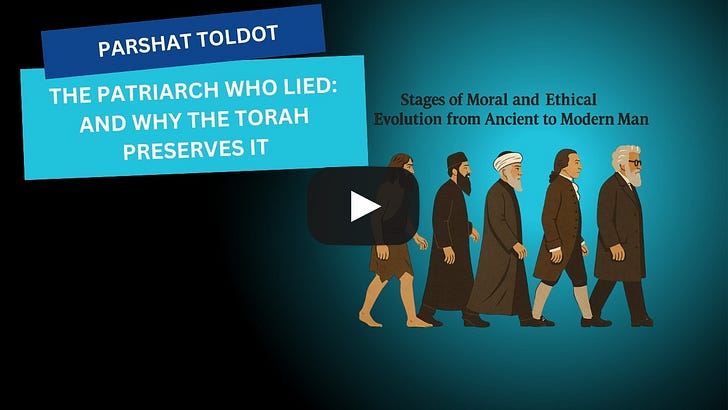
This is not a story that tidies itself. Maimonides: The Divine RuseAt the end of the episode, we turned to Maimonides and a surprising concept in the Guide for the Perplexed: Maimonides argues that God leads human beings gradually — biologically, psychologically, and spiritually. Muscles harden slowly. Children wean slowly. Idolatrous slaves become monotheists slowly. Even mitzvot and the Temple service serve as transitional tools. God guides humanity through a series of holy tricks — not deception but evolution, nudges, and scaffolding. What I had never realized is that Maimonides uses biology of all things to make his point for the ….. evolution of morals! ON considering the Divine acts, or the processes of Nature, we get an insight into the “deity’s willy graciousness” ערמת הא-לוה as displayed in the creation of animals, with the gradual development of the movements of their limbs and the relative positions of the latter, and we perceive also His “willy graciousness”(תחבולתו = His subterfuge) in the successive and gradual development of the whole condition of each individual. The gradual development of the animals’ movements and the relative position of the limbs may be illustrated by the brain… I quote this one instance because it is the most evident of the wonders described in the book On the use of the limbs; [Galen De usu partium humani corporis i.17; ii.3] but the use of the limbs is clearly perceived by all who examine them with a sharp eye. In a similar manner did God provide for each individual animal of the class of mammalia. When such an animal is born it is extremely tender, and cannot be fed with dry food. Therefore breasts were provided which yield milk, and the young can be fed with moist food which corresponds to the condition of the limbs of the animal, until the latter have gradually become dry and hard. [weaning as an example of gradual transition and planned obsolescence] The Guide for the Perplexed Part III 32:1 Seen through this lens, Jacob’s (and Esav’s) life is not a moral failure. It is a growth curve. He starts soft and crooked. Not perfect. Myth, Morality, and the Symbolic JacobThere is a long tradition — both academic and rabbinic — of reading certain biblical narratives not as strict historical reportage but as morality tales, stories whose primary purpose is to reveal truths rather than facts. Job is the most obvious example. Esther and Mordechai live in a similar grey zone. These readings do not diminish the texts. And Jacob pressures us into this terrain more than almost any patriarch. His name itself is symbolic: His new name is symbolic as well: The Torah is telling us something through the names alone: Jacob is not just a person, he is a pattern. A template. A mythic structure. Which brings us to the famous Talmudic principle:
Traditionally, this means that what happens to the patriarchs foreshadows Jewish history. But it also suggests something deeper: The patriarchal stories function as myths in the best sense of the word — narratives that shape identity, encode wisdom, and describe the inner landscape of a people. Under this lens, Jacob’s story is not merely a family drama or a contested inheritance. It is an archetype of the human condition:
Jacob’s life reads like a myth of moral evolution — not because it is fictional, but because its meanings transcend the literal. The Torah itself seems to invite this reading by giving Jacob two symbolically charged names, by allowing his story to operate on multiple narrative layers, and by embedding his life in the moral topology of Israel “until this day.” To see Jacob through the lens of myth is not to deny his existence. Jacob becomes the story we return to because he mirrors the story we live: Sefaria source sheet: https://www.sefaria.org/sheets/689945 Transcript: Geoffrey Stern: The account of Jacob becoming the third patriarch turns on a troubling moment. He walks into his father’s tent, pretends to be someone else, and walks out with a stolen blessing. It’s a scene we usually rush to explain away by blaming Esau, shifting the blame to Rebekah, ultimately trying to reshape the story to fit our moral sense. But what if the Torah wanted us to sit with the discomfort, or worse yet, did not share our discomfort? What if Jacob’s flaw isn’t a problem to fix, but a clue to something deeper? This week on Madlik Disruptive Torah, we explore why the Bible insists on portraying the third patriarch through deception, consequences, and growth. Along the way, we’ll trace ancient oral traditions, the Bible’s preference for imperfect heroes, and a surprising Maimonidean idea about how real change actually happens. Welcome to Matlik. My name is Geoffrey Stern, and at Madlik, we light a spark or shed some light on a Jewish text or tradition. Along with Rabbi Adam Mintz, we host Madlik Disruptive Torah on your favorite podcast platform, and now on YouTube and Substack. We also publish a source sheet on Sefaria, and a link is included in the show notes. If you like the podcast and listen regularly, why don’t you give us a few stars and write a comment or ask a question? This week we read Parashat Toledot. Rather than excuse or explain away the troubling aspects of Jacob stealing the birthright, we ask why the Torah chose to portray the third patriarch in this manner, and what are the takeaways? Rabbi, you know, sometimes we just have to ask how much are we projecting our modern morality onto it? And also, it occurred to me, if we were reading a novel, and I’m not suggesting that the Torah is a novel, but there are plenty of pieces of art we view, listen to music, read books. There are troubling things in it. It’s called a plot. And we don’t always have to explain the dark side of some of our characters, even if there are heroes. What says you? Adam Mintz: I couldn’t agree more. I mean, as we’ll see, part of this discussion is how the commentaries explain these verses. So we have to kind of see the way the verses have traveled through history. Jacob is seen in a certain way. But I think you’re right. We need to take a modern view and to see what do we think about this trickery. Geoffrey Stern: So I’m not bringing all the verses because I think most of us are pretty aware of the storyline. It starts one day with, well, I should go back. It starts with Yaakov’s name. Yaakov means heel. He was born holding onto the heel of his brother. You could call him a heel holder. Ekev means crooked. So baked into his name was already a sense that this guy did not go straight. Maybe when his name was ultimately changed to Yisra’El, that was a change to Yashar (straight). But at this point in time, there’s definitely a kind of a cloud in the horizon that this guy is going to weave and go zigzag, as they say in the (movie) In Laws. And then we get to one day he’s cooking at home, and his brother comes in and he sells his brother’s birthright for the red porridge. And then we fast forward to this week’s part of the parsha that we’re talking about. And that is where his father, Yitzhak, is contemplating his end. And he asks for his eldest son, biologically eldest son, Esau, to go out and catch him some game. And Rivkah, his wife and Yaakov’s mother, overhears what’s going on, and she tells Yaakov, he’s giving out the blessing. You’ve gotta go and steal the blessing. And maybe Yaakov protests a little. I said in the intro that we can put some blame on Rivka herself because she is the schemer behind this. But in any case, we get to Genesis 27:18, and Yaakov, went to his father and said, father? And he said, yes. Kind of reminds you of the Akeda, doesn’t it? And he says, which of my sons are you? Jacob said to his father, I am Esau, your firstborn. I have done as you have told me. Pray, sit up and eat of my game, that you may give me your innermost blessing. So there are times in the psukim where Esau even acknowledges the fact that he’s been wronged twice in his mind. He was taken advantage of at that breakfast deal, the power breakfast, where he gave up his birthright from 60,000ft. Rabbi, what’s your sense for the story? Adam Mintz: Well, let me start like this. And he went to his father and said, father? And he said, yes, which of my sons are you? What a crazy question. You know, he sent Esau to get the food, and now the son brings the food. Obviously, it’s Esau. Why is he suspicious? And you wonder about what he’s thinking, Isaac, does he not trust his wife? Does he not Trust his sons. But that’s a very strange question. Since the son has fulfilled his request, it’s obviously Esau. Geoffrey Stern: So I would go out on a limb here and say we have four characters. We have Esau, we have Yaakov, we have Rivka, and we have Yitzhak. And what you are just saying is that Yitzhak himself might have been eyeing on this. Because if he’s asking which of the sons are you, in a sense he’s saying to himself, you know, I started this little charade maybe, and which of my sons took the bait? Which of them is coming? So it seems like the story is very open ended. I compared it to the Akedah. I think that, yes, there’s these pregnant pauses throughout out where he says father. And he said, yes. And they go, which of my sons are you? And of course the Akeda, we had your son, your favorite son, the son that you love. And the other thing in Esau’s favor, because you could clearly argue that this is all about money. We all watch Sucession. There are hundreds of stories of children fighting over the patrimony and fighting over the inheritance. Here he says, your innermost blessing is the way it’s translated. But again, it is a very rich story and there are multiple ways that you could look at each character. You said, let’s see how the commentaries see it. I would think, if thinking back to the commentaries, definitely the first, I would say straw dummy is a Esav. The second, he walks in famished, they pounce on him. They say he was a glutton. He spent all of his time outside hunting. He was in Yiddish, we call it Prust. He was a bal basar. He was a grubba. He was the antithesis of Yaakov, who maybe spent his time in tents, according to the rabbis in the Yeshiva of Shame and Aver. But let’s talk about these two charact. They are definitely characterized, I think more by the rabbi. Very few of the rabbinic texts come down on Yaakov for stealing the blessing, to my knowledge, I mean, for sure. Adam Mintz: You know, you get the sense that the chapter ends like this is what was supposed to happen, you know. And you said Yaakov is zig. You use the phrase zigzag. He’s a zigzag man. In next week’s power show with Laban, he’s also a zigzag man. Right. It doesn’t go straight. You know, he wants to marry Rachel and he marries Leah. But in the end it kind of works out, I think that’s the same sense you get here, that it’s zigzag. It’s not about who’s right and who’s wrong. It’s that Jacob’s life is a zigzag. By the way, when he deals with his son Joseph, it’s also a zigzag. You know, he makes a mistake, he favors him, but in the end, it all works out. Geoffrey Stern: You know, funnily enough, if you look at the text itself, the only I would say moral or character I would say read is in the beginning and the end. In the beginning, it says that Esau married two Canaanite wives. And it says that, interestingly, that Yitzchak and Rivkah did not approve. Correct. So here it has. We’re seeing that Yitzchak did not approve. Adam Mintz: Of him, even though at the beginning it says that Yitzchak favors Esau. Geoffrey Stern: Yeah, yeah, yeah. So. So again, it just shows you you can disapprove of a favored son. And that’s, I think, part of the challenge that we have where we’re trying to read the Torah as black and white. And it is pushing back, finishing up the story about the kind of ethical commentary that the Bible itself gives. At the end, it says Esau recognized that his parents didn’t like his choice of wives. And it said he married, I believe it was a Hittite, someone who was not part of the Canaanite people that are not thought well of in the text. So I think we can say that in the text itself, it does kind of lean on Esav a little bit. But again, even there, and this is kind of a direction that we’re going to pursue a little more. He evolves. He got the message. You could easily say he was spurned. He didn’t get the blessing. He walked away. He didn’t walk away. He went back to the beginning in the parsha, scratching his head is, what did I do wrong? My marriage choice is there in Pasuk 18 or whatever. And he picked another wife. But I think, again, getting back to Yaakov, I didn’t see in any of the commentaries anything that was potentially really disparaging about what he did, and especially disparaging in terms of either tricking Esav at the power breakfast to sell his birthright, or in the latter vignette, to trick his father to give him the blessing. Adam Mintz: There’s no question about that. You know, the rabbis and that here they’re led by Rashi. There’s this idea that in the end, Jacob is right. So When Jacob says, I am, you know, you know, he says to him, who are you? And he says in verse 18 on the top, I am Asav, your firstborn. And Rashi, of course, says that you put the comma after the word I am, I am. He says, who are you? I am. And a sub is your firstborn. Now, that’s crazy, but that’s how far Rashi goes to justify what Jacob says. Geoffrey Stern: And of course, one thing that you do get is the whole kind of anti Semitic trope that the Jews are crafty, that they are Talmudic, that they’ll split a hair just the way you just did, where he says hineni, and then he says, I am, and then he says, esau is your firstborn. This kind of hair splitting, in a sense, back in the days of the Torah itself, whether it was sensitive to the potential of what others would say or not, it didn’t have any reservations about telling it like it is. So I found a scholarly study. It’s written by Yair Djokovic, who’s a professor emeritus of Bible at the Hebrew University and professor of Jewish peoplehood at IDC Herzliya. And he asks, why was this included? So he’s not asking the most basic question, which is, how could this be? He’s asking what the text of the Bible or the Torah wanted us to learn from it. And he starts by saying, and this is kind of interesting, and I think the best modality to put ourselves in, Rabbi, is the modality of Megillat Esther. We always forget that the Torah is a written work that was read publicly on a regular basis. And the crowd came in every Shabbat or during market days to hear this text read. And they knew certain history and legends. They knew that Haman was bad and you move the grager (noise maker) and they knew that Esther was in Mordechai was good. So he says the tales of Jacob’s trickery and fraud were already well known. Biblical stories were not created ex nilo from the imagination of writers. Most biblical stories represented adaptations of oral traditions, traditions that were modified in order to suit the interests of the writers. So I love the fact that he says there were expectations here. People knew who Yaakov the trickster was. So you couldn’t whitewash this story. You had to present the story that people knew from their Tzena Urena and from the past. But nonetheless, you had the authorship to position it and to place it in a way that you wanted. I hadn’t really thought of that, but I do think that we don’t think enough about this text as a text that was written and read in public and had that interaction with the audience. Adam Mintz: Well, adaptions of oral traditions, we don’t usually think of the Torah that way, but it’s so interesting because that’s the way we do it on Madlik. Geoffrey, It’s an oral tradition. Discuss it. And what he’s saying is that’s been true for 3,000 years, that they discussed the text, and there were certain expectations. People came to the text with certain expectations. Geoffrey Stern: You know, earlier, in this week’s Parsha, it has the story of Beer Sheba about the seven wells. And in this week’s Parsha, there’s a back and forth. The local people are filling up Isaac’s Wells, and he’s having them redug. And at the end of the day, it says they call the place Beer Sheva because of the seven wells. And it’s called Beer Sheva Ad Hayom Hazeh. Those of you who remember earlier parshiot, we have Abraham in a story of wells as well. And there he makes a covenant and a peace treaty. And it says, and it’s called Beersheba because of the Shavuah of the oath that was written there, Ad Hayom Haze. And I think that’s a perfect example, Rabbi, where the listener knew that it was called Beer Seva. The listener is the Ad Hayom Haze-nick. He’s the one who knows what it’s called. And the text is filling in the blanks. And interestingly enough, it parallels this story also in the sense there are two versions. Just like Beersheva, there are two versions here. You could make the case that stealing the blessing, it was stole twice. It was stolen once over breakfast. And by that I mean that he took advantage of his famished brother. He took advantage of maybe his adolescent young brother, where he grew up faster, he was more mature, and then later on, he obviously fleeced him and took advantage of him a second time. But you don’t have to consider the two stories as part of the same narrative. You could consider them as different versions, just like the of Beer Sheva’s name of the same story. Adam Mintz: That’s fantastic. I mean, that’s also not the way you usually think of it. But you raise an important question, Geoffrey, and that is, what’s the connection? The Torah doesn’t connect the two stories. The question is, are they the same story, what you call two versions? Are they two parts of the story? Do they just tell you about the relationship between Jacob and Esau? That basically we would say Jacob has his number, right? Jacob knows how to outsmart Esau. Geoffrey Stern: And I think, as you always say, the version that we heard in Cheder would be that they’re part of the same story and that the first story justifies the second. It was a legal sale and therefore. But in the words of the text itself, Esav says, you have tricked me twice in his mind, and this is the narrative putting words into his mouth. They are also part of the same narrative, but they are duplicity to the power of two. Adam Mintz: Right? Now, you know, technically it can’t be that the second story follows on the first story, because if it was true that Jacob deserved the blessing because he bought the right of the firstborn, then Rebekah should have gone to Isaac and said that Jacob deserves the blessing. Because the fact, you see, Rebecca took a huge chance. Let’s just talk about it in terms of a movie. Rebecca takes a huge chance when she tries to fool Isaac because if Isaac somehow finds out, the one he’s angry at is Rebecca. So, you know, so obviously she had no choice. So you see that the fact that he bought the first born-ship doesn’t give him the right to steal the blood blessings. Geoffrey Stern: Although maybe if Wendy was here, she would say it’s a proof that this couple didn’t talk to each other, just like Sarah didn’t talk to Abraham. Adam Mintz: Right? That’s the old story, that she was only three years old and there was no equality there. Because you would say, in today’s world, you’re talking about how we look at it today. In today’s world, it’s ridiculous if the wife thinks the husband is making a mistake, so she goes to the husband. The idea of a wife tricking the husband this way, you would say that in the 21st century, that is a recipe for disaster. Geoffrey Stern: Although, again, and we’re gonna move on, it is pretty clear that as an ancient text, this text definitely gives a lot of power to women behind the veil. It’s like shadow theater where both Sarah last week, I will go back all the way to Eve, who controls how we live, whether we’re in paradise or in Paradise, Lost. And here we have also Rebecca controlling the narrative. So the second reason that this Professor Jackovic gives, and this is kind of fascinating, and he says the second reason for admitting Jacob’s misdeeds has to do with the character of biblical literature from the first Temple period. The literature we find avoids providing readers with perfect heroes. Adam Mintz: What. Geoffrey Stern: What can we mortals learn from heroes who exhibit no speck of wrongdoing? On the contrary, only characters that have made mistakes, atoned for them and changed their behavior can provide models for us. Only from the experiences of such imperfect human heroes can we comprehend the moral fallibility of humans and mysterious workings of God in human affairs. This again reminds me back of reading Magillat Esther in public. It’s a passion play. The audience is on the edge of its seats. It’s seeing the different plot turns. But they’re not only plot terms, they’re changes in character. They’re challenges that the protagonists are going through. I kind of like this. Adam Mintz: Yeah, this is fantastic. This is a great article. Geoffrey Stern: And so he says, not only do characters that transgress, make amends and learn from their sins provide more depth and interest than those who tread only the virtuous path, but flawed, complex figures give us someone to identify and emphasize with. And here’s where he goes a little bit further. And he says that while Jacob’s deceitful deed also presents his punishment. Rabbi, this is the prequel for the next two parshiot and the next two parshiot. We’re gonna see how Jacob has to flee his home because he’s done something wrong, because he’s not made a friend in his brother. His mother says, go away for a few days. Come back. When it simmers down. Guess what, Rabbi? He never sees his mother again. The father who is on his deathbed will see Jacob again, but Rebecca, who was pulling the strings of the puppets, will never see him again. He gets tricked multiple times. I’ll say he gets fleeced multiple times. He gets fleeced in marrying Rachel and he ends up with Leah. And then he has to work another seven years for Rachel. He gets fleeced by his father in law multiple times. You can talk it about Mida k’neged mida that he is punished in kind. And therefore it does become a kind of morality play. And we don’t need the rabbinic commentaries to comment on the initial story, but they definitely do comment on the aftermath. Adam Mintz: Math, for sure. I mean, and that’s right. And again, in the end, it works out for Jacob. But you’re right, he’s fleeced. He has a very difficult time. And we always say that Jacob is the first, you know, is the first figure in the Torah who has to deal with the difficulties of life. Geoffrey Stern: And again, as long as we are looking at, as I said before, the different characters and I mentioned this, Esau is the one who’s craving meat. He’s the prosta bal habasar. He’s discredited at the beginning for his Marriage choices. And then we get to Rebecca. The blame is deflected onto Rebecca, who initiates the whole deception. And as I said before, she says, let the sin be on me. She actually actively participates in that deflection. And then, as I said before, she does get punished because of her scheming these few days that she sends away her. Her son becomes a lifetime. She never gets to see him again. Adam Mintz: Right. It’s interesting that the Torah tells us in a couple of weeks that the maidservant that it seems to be that Rivkah remained interested in Jacob, and she sent kind of an emissary with Jacob on his travels to protect Jacob. So the special relationship between mother and son continues even when Jacob is sent away from his home. Geoffrey Stern: Yeah, and, you know, we talked a little bit before about his name. And I think, you know, if someone was to say to us, rabbi, that the story of Job or the megillah of Esther, did it really happen in that way, or was it a morality tale that was to bring in the audience? We would all say, yes. But there is also a very strong tradition that maasei avot siman lebanim, that the stories of the patriarchs and matriarchs are a Siman. They’re symbolic, if you will. And so, yes, we can get back to the fact that his name was called Yaakov, which is a heel sneak. And so in chapter 27, verse 36, we hear it from Esav himself. He becomes the commentator, he becomes the myth reader. He says, is that why his name was called Yaakov, the heel sneak? He says, for now he has sneaked against me or cheated me twice. My firstborn, right? He took, and now he has taken my blessing. So in the text itself of the Torah, Esau does a little commentary and he goes. His name provided space for this in the later prophets. Rabbi, Jeremiah actually does the same thing. In Jeremiah 9, it says עָק֣וֹב יַעְקֹ֔ב Yaakove Ekev each of you, beware of your friend. He’s giving moral advice. Trust not even your kinsfolk. For every sibling takes advantage, every friend deals basely. In the Hebrew, it says. He uses the name of the heel guy as watch out for your brother. They use this as a morality tale in the later prophets. Let’s go back to other sneak or stories in the Bible where our patriarchs are using trickery. We have multiple stories of Abraham going down to Egypt, and in this week’s Parasha, Isaac going down to Gerar, where he lies about his wife, and she is my sister. So again, getting back to the professor’s point of not whitewashing our characters. In a sense, even Yaakov, or Isaac, I should say, opened him up to being tricked because he tricked Avimelech. It’s all that goes around, comes around. And you could make a case, Rabbi, that what we are learning is Avera Goreret Avera, that once you go down the slippery slope of playing with the truth, it never stops. Adam Mintz: Well, there is a problem here though, because his father also used this trick. So here he’s following his father. Interestingly, his father got away with it, but he gets in trouble. The king sees him fondling his wife and he gets in trouble. So in a way, Isaac, Isaac is not as good as his father in all of this. And then he gets tricked by his son, not quite as sly as his father was or as astute as his father was. Geoffrey Stern: Although at the end Isaac sowed in that land and reaped a hundredfold the same year. He does get material benefits from his manipulations. Adam Mintz: Right? Okay. Geoffrey Stern: But as you say, he was tricked himself. And maybe we need to go back and read the Akeda and other stories about Abraham and see if he also wasn’t on the wrong end of the stick at a certain point because he had manipulated the truth. Now the truth was being manipulated about him. So I want to end with something that has always fascinated me about The Guide for the Perplexed. And normally I bring it up when the Jews left Israel and they went the long route, instead of going directly into the Promised Land, they have a 40 year adventure. And Maimonides has a famous theory and he calls it the ruse, the Divine Ruse where God has to take them from one place to another place, from being lowly slaves in an idolatrous society to followers of the one God. And to do that he needs some time. And he has to build a temple as he institute mitzvot and stuff like that. The goal is very far away. And so what Maimonides brings is a theory of he has to trick them. Small little tricks along way. But what I had not noticed is he begins talking about that in a biological fashion. And he says in Guide for the Perplexed part three, on considering the divine acts or the processes of nature, we get an insight into the deity’s Willy graciousness. And in the Hebrew translation, because it was written in Arabic, it calls Aromat Ha’Eloha, the trickery of God. And what he does is he’s not presupposing Darwin by any chance, but he is saying that biologically the animals and biology develops over time, it’s fascinating because it gets very close to evolution. Adam Mintz: Evolution. Geoffrey Stern: And he doesn’t say mutation, but he does say that things develop from one to the other. And he talks about this gradual development. The nerves are enabled to set the lens in motion. And I quote, this says Maimonides as one instance, because this is the most evident in the wonders described in the book on the use of limbs by Galen. And basically what Maimonides comes with, which is his own theory of evolution. And I will argue that what he does is by caging it in this amazing term of God’s holy trick, it gives us a sense of how we evolve. And we are, I think, privileged when we read a story like we’re reading this weekend in the weeks to come to have a first row seat on the development of our morality. And when we react to the story in a certain way. Rabbi, we are using a time honored tradition of that audience listening to the sometimes cheering and sometimes going back in absolute disgust. But here we are. Adam Mintz: That’s fantastic. That’s a great Maimonides. Yeah, that’s good. I love it. Geoffrey Stern: Okay, well, Shabbat Shalom. Thanks for joining us. Adam Mintz: Shabbat sounds really good. Thank you very much, Geoffrey. Geoffrey Stern: We’ll see you all next week.
|
Wednesday, 19 November 2025
Trickery or Evolution? Rethinking Jacob’s Stolen Blessing



Subscribe to:
Post Comments (Atom)
, mindfulness made more accessible
Follow David on Insight Timer for affirming mindfulness shaped by lived experience and real support. ...
-
Dear Reader, To read this week's post, click here: https://teachingtenets.wordpress.com/2025/07/02/aphorism-24-take-care-of-your-teach...
-
How i recognise psychosis and manage it in myself as an Autistic person ͏ ͏ ͏ ͏ ͏ ͏ ͏ ͏ ͏ ͏ ...


No comments:
Post a Comment