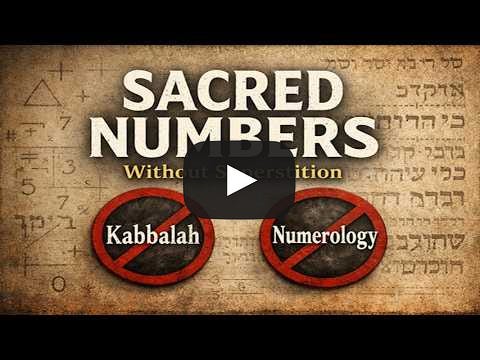
 As we come to the end of one year and stand on the threshold of the next, Rabbi Mintz and I decided to do something a little different. Instead of rushing forward, we listened backward. We rebroadcast a conversation we recorded in December 2022, back when Madlik Disruptive Torah was still being recorded live, in front of an audience, on Clubhouse. The audio quality isn’t perfect—and we’re not apologizing too hard for that—because it reminds us of something we miss: the immediacy, the questions, the shared curiosity of learning Torah together in real time. The episode is called “Seventy Faces” (Shiv’im Panim), and it explores one of Judaism’s most persistent—and misunderstood—fascinations: numbers. Not numerology as superstition or fortune-telling, but numbers as structure, symbol, and lens. As it turns out, this conversation feels especially relevant now, as we cross a numeric threshold ourselves: ending one year, beginning another, counting forward while looking back. Seventy Souls: When the Torah Insists on a NumberThe conversation begins with a simple but unavoidable textual observation. The Torah does something unusual when Jacob’s family descends to Egypt:
The Torah doesn’t just mention the number once—it insists on it. A full genealogy is provided, children of Leah, Rachel, Bilhah, and Zilpah are carefully enumerated, and only then does the text step back and declare: it adds up to seventy. Even more striking: if you actually count, the numbers don’t quite work. As Rashi famously notes, you only get to sixty-nine. His answer is both audacious and profound: the missing seventieth is Yocheved, Moses’ mother, who was born on the way—between Canaan and Egypt. The nation begins not with tidy arithmetic, but with someone born between worlds. Seventy Nations, Seventy LanguagesThis isn’t the first time the rabbis encounter the number seventy. At the end of the Flood narrative, the Torah lists the descendants of Noah’s three sons in Genesis 10. The Torah never says how many nations emerge—but the rabbis count them anyway. Once again, they arrive at seventy. From this emerges a sweeping rabbinic idea:
And then comes one of the most beautiful teachings in rabbinic literature. The Talmud teaches:
Torah is not diminished by plurality. It is revealed through it. The metaphor the rabbis use is striking: Torah is like a hammer striking a rock. The hammer doesn’t destroy the stone—it releases sparks. Meaning multiplies when a text is refracted, translated, argued, and re-heard. Seven, Seventy, and the Architecture of CreationIf seventy matters, it’s because seven matters first. Seven days of creation. Seven cycles of time. Seven, seventy, and forty-nine (seven squared) form the backbone of biblical rhythm: Shabbat, Shemitah, Jubilee. One of the most compelling modern explorations of this structure comes from Umberto Cassuto. Cassuto argued—against higher biblical criticism—that the Creation narrative is meticulously composed around sevens:
Cassuto’s point isn’t mystical. It’s literary. The Torah reads less like an accidental compilation and more like a carefully structured composition—closer to a sonnet than a scrapbook. This isn’t numerology as magic. It’s numerology as architecture. Counting as a Sacred ActAt this point, the conversation takes a turn. If numbers matter so much, what about Gematria—assigning numerical values to letters? Here, caution enters the room. Drawing on the scholarship of Professor Saul Lieberman, we note that classical gematria appears surprisingly late. The very word gematria comes from Greek, related to geometry. Lieberman shows that Jews likely borrowed numerical notation systems from Hellenistic culture. And yet, counting itself is ancient and sacred. The Sofrim—the early scribes—didn’t just copy the Torah. They counted its letters, words, and verses. The Talmud even laments the loss of this precise art. To count Torah was to turn it over again and again, discovering its inner rhythms. The danger, as later excesses like Bible Code speculation show, is not counting—it’s counting without restraint. As Rabbi Mintz puts it: counting only matters if it yields Torah. Seventy Judges and the Case Against UnanimityPerhaps the most radical appearance of seventy comes in the legal realm. God commands Moses to appoint seventy elders to help lead the people (Numbers 11:16). From this emerges the Sanhedrin, Judaism’s supreme court of seventy judges. And then comes a shocking rule:
Unanimity is not justice. It’s a failure of imagination. If no one can see another side, the system itself is suspect. Truth, in Judaism, requires dissent. Like Seventy Years: Time, Memory, and GenerationsAt the close of the conversation, a listener makes an association to the new year, a new number with untold significance. That prompts one last textual turn—from the Haggadah. Rabbi Elazar ben Azariah famously says:
Is he referring to age? To generational memory? To the seventy years of Babylonian exile? Seventy becomes not just a number of people or nations, but a measure of lived time—of carrying one era into the next. Why Torah Has Seventy FacesThe tradition that gives this episode its original name teaches that every verse of Torah has seventy faces—at least. Not infinite relativism. Not anything-goes interpretation. But disciplined plurality. As we end one year and begin another, that idea feels especially urgent. Perfection is not unanimity. Completeness does not mean closure. Meaning emerges when texts—and people—are allowed to show more than one face. May the year ahead invite us to keep counting what counts. Shabbat Shalom—and let the force of seventy be with you. Sefaria Source Sheet: https://www.sefaria.org/sheets/455577
|
Tuesday, 23 December 2025
Ending a Year with Seventy Faces


Subscribe to:
Post Comments (Atom)

-
Dear Reader, To read this week's post, click here: https://teachingtenets.wordpress.com/2025/07/02/aphorism-24-take-care-of-your-teach...
-
How i recognise psychosis and manage it in myself as an Autistic person ͏ ͏ ͏ ͏ ͏ ͏ ͏ ͏ ͏ ͏ ...


No comments:
Post a Comment