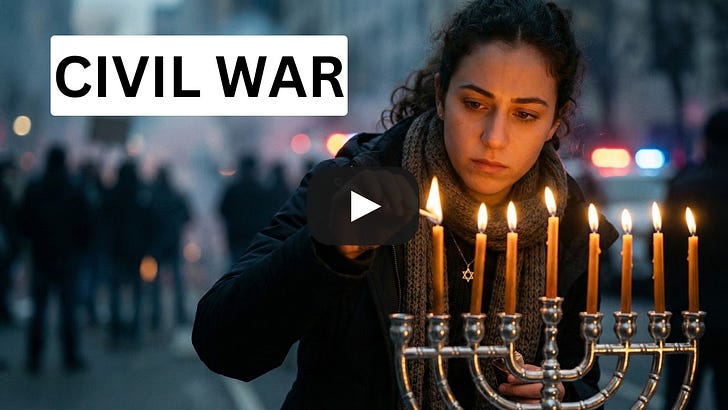
 We grow up hearing that Hanukkah is the story of the few against the many. It is, in other words, one of the least Jewish Jewish holidays—because it asks us to forget the fighting, forget the politics, forget the fractures inside our own community. It asks us to focus on a miracle instead of a machloket (a dispute). But what if the miracle wasn’t the point? This week on Madlik Disruptive Torah, we’re talking about Hanukkah — We’re talking about something far more uncomfortable: Hanukkah as a Jewish Civil WarBecause behind the legend, behind the miracle, behind the songs we teach our kids, the Hanukkah story hides a truth we rarely tell.
And the real question — the question for us today — is not how the Maccabees defeated the Greeks, The Enigma at the Heart of the HolidayIn Hebrew school and in our liturgy, it’s all about:
But this miracle is an anomaly.
And yet, in all of rabbinic literature, there is only one place where the oil miracle appears — buried deep in Shabbat 21b. Adam adds:
Why one mention? The Real Story: Internal Friction, Not External EnemiesWhen we turn to Maccabees I, the opening scene looks less like anti-Greek resistance and more like political realignment:
These so-called “Hellenizers” were less assimilated cosmopolitans and more, political actors, Judean elites with economic interests tied to the Seleucid empire. This is not a culture war.
And the key scholarly line quoted:
This is a civil war, not a miracle story. How the Hanukkah Story Became Our Own Culture WarWe Jews have always projected our present anxieties onto the Maccabees. Today’s Political AnalogyI said it bluntly:
This frame appears today in newspaper columns, op-eds, and political speeches — the ancient factional struggle repurposed to fight the culture wars of the modern State of Israel. Louis Brandeis’s VersionIn 1912, Brandeis had his own take and told American Jews that Hanukkah was:
In his telling, the Maccabees become the plain people, the populists, the grassroots activists pushing back against entrenched and scheming ruling class. Not religious purists against the cultural assimilated. Herzl as a Hellenist?In a pre-state JPS volume, another writer (Hortense Levy Amram) compares Judah Maccabee and Theodor Herzl:
The idea that Judah Maccabee, a peasant farmer and Theodor Herzl an assimilated journalist were accidental leaders is profound. That Herzl — father of Zionism — is reimagined as the ideological descendent of the Hellenists shows that the paradigm has less to do with the ideological position held and more to do with leading from below. As Brandeis writes:
Why the Rabbis Hid the StoryGiven all this, the Rabbinic move becomes clearer.
So the Rabbis redirected the holiday:
Because:
And living through exile, oppression, and winter, they were probably right. A Surprising Turn: The Pedagogy of Early IsraelThen comes the twist — While adults told miracle stories, the community oriented pioneers who founded the State of Israel told its children something else entirely. In a book of children’s stories for the holidays (Sefer HaHagim HaGadol), I recently picked up in a used book co-op in Tel Aviv:
The helper candle. What were the educators of early Israel trying to teach? Story 1: “I Don’t Want to Be the Shamash”(Rachel Rosner) A girl is cast as the Shamash in her class play. But her classmate Ravital wants the part:
Only later does Miri realize:
The role she dismissed becomes the role of leadership. Story 2: “The Shamash”(Miri Zelazadam) The eight candles stand tall, proud of their light and lineage. The Shamash answers:
This is Brandeis again— Story 3: “The Ninth Candle”(Hannah Nir) The Shamash speaks directly:
Its work consumes it:
But it feels no bitterness:
The poem ends:
The Hanukkah Message We Need TodayThe more I read these children’s stories, the more I realized they were not naïve — In a society already torn by political divisions, culture wars, ideological splits, and contested visions of the future, early Israeli educators were teaching: A Jewish society survives not because of its heroes, The ones who:
As I said in the episode:
The Civil War We Forgot — and the Unity We Can Still ChooseWe began with Hanukkah as a civil war. We end with Hanukkah as a meditation on service. In a moment when Israel — and the Jewish world — feels dangerously polarized, perhaps the ancient Rabbis and modern Israeli educators agree on this: We do not need more Maccabees. People who help. Shabbat Shalom & Chanukah SameachEnjoy the light. Sefaria Source Sheet with full text of Hanukah Children’s Stories quoted above in Hebrew and English: https://www.sefaria.org/sheets/695661
|
Wednesday, 17 December 2025
The Civil War We Forgot — A New Look at Hanukkah



Subscribe to:
Post Comments (Atom)
Book review - The Narrow Road to the Deep North, by Richard Flanagan
Some consider it a modern classic ... ͏ ͏ ͏ ͏ ͏ ͏ ͏ ͏ ͏ ͏ ͏ ͏ ͏ ͏ ...

-
Dear Reader, To read this week's post, click here: https://teachingtenets.wordpress.com/2025/07/02/aphorism-24-take-care-of-your-teach...
-
How i recognise psychosis and manage it in myself as an Autistic person ͏ ͏ ͏ ͏ ͏ ͏ ͏ ͏ ͏ ͏ ...


No comments:
Post a Comment