When Shiloh Comes: Religion at Its Best and WorstHow a biblical verse still shapes how faith can heal—or harm—the world
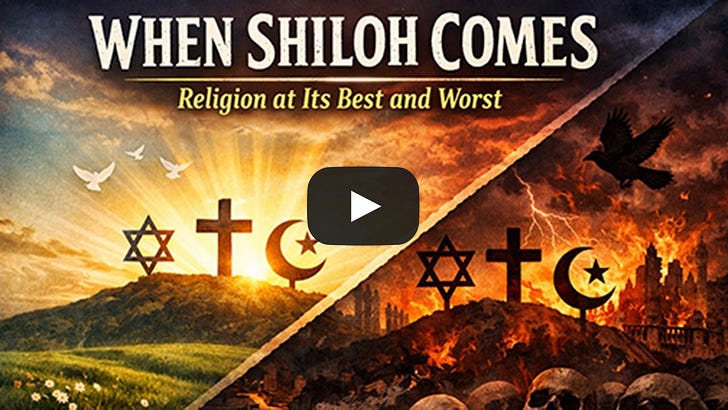 For the second week in a row, we’ve decided to return to a prior conversation—this one recorded live on Clubhouse in December 2023. We’re rebroadcasting it not only because we’re taking time off with our families, but because it resonates today as powerfully as it did then. The episode is called “When Shiloh Comes.” It begins with a single, enigmatic verse at the very end of the book of Genesis, and it quickly becomes a meditation on the extraordinary power of religion—its ability to inspire moral courage, shape civilizations, and, when distorted, justify cruelty and violence. As we close one year and prepare to begin another, this conversation feels less like a look backward than a necessary pause—to ask what kind of religious future we are actually building. One Verse, Three ReligionsAs Jacob gathers his sons at the end of his life, he offers a series of blessings that are part poetry, part prophecy. In his words to Judah, we encounter one of the most contested verses in the Bible:
https://www.sefaria.org/Genesis.49.10 For Jews, Christians, and Muslims alike, this verse has been read as pointing toward ultimate authority, redemption, and destiny. But who or what “Shiloh” refers to has been debated for centuries.
A single line of Torah becomes a shared text—and a contested one.
Poetry, Not ProoftextsOne crucial point we emphasize in the episode is that Jacob’s blessings are poetry. Biblical poetry resists literal closure. It invites interpretation—and once interpretation enters history, it shapes real lives. That is why Genesis 49:10 became fertile ground for competing messianic visions. And that is why it matters how we read.
Rashbam: Learning Across Enemy Lines During the CrusadesOne of the most striking figures in our conversation is Rashbam—Rabbi Samuel ben Meir, Rashi’s grandson. Rashbam lived in 12th-century northern France, during the Crusades—an era of massacres, forced conversions, and religious terror inflicted on Jewish communities by Christians acting in the name of faith. And yet, at the very same time, Jewish and Christian scholars were studying the same Bible. Rashbam was keenly aware of Christian interpretations of Genesis 49:10. In his commentary, he explicitly rejects the Christological reading of Shiloh, insisting instead on a contextual, grammatical (peshat) understanding of Judah’s political continuity. What makes Rashbam extraordinary is not just disagreement—but confidence. He does not retreat into polemic. He engages the text rigorously, even when rival interpretations surround him. Even more provocative is his reading of Genesis 18, the story of Abraham and the three visitors.
Where earlier Midrashim struggled with how Abraham could turn away from God to welcome guests, Rashbam suggests something radical: the divine presence itself was manifest within the three figures. This interpretation closely parallels interpretive moves found among contemporary Christian theologians grappling with Trinitarian theology. This does not mean Rashbam adopted Christian doctrine. It means he was unafraid of shared intellectual space, even while religious violence raged around him.
Rabbi Yaakov Negan: When Religion Is the Problem—and Must Become the SolutionIf Rashbam offers a medieval model of courage, Rabbi Yaakov Negan offers a contemporary one. Rabbi Negan, a leading thinker in Jewish–Christian and Jewish–Muslim dialogue, frames one of the most unsettling truths of our time:
It is tempting—especially after religious violence—to imagine a world without religion. Rabbi Negan rejects that fantasy. Religion is too deeply woven into identity, memory, land, and meaning. The real question is not whether religion will shape the future, but how. Drawing on classical Jewish sources—especially the moral vision articulated by figures like the Meiri—Rabbi Negan argues that the true dividing line is not theology but ethics: whether a religion affirms the dignity of every human being created in the image of God. When religion sanctifies murder or terror, it forfeits its legitimacy. When it mobilizes compassion and responsibility, it becomes one of humanity’s most powerful moral forces.
A Living Epilogue: Yochanan, the Rosh Kollel of ClubhouseThe episode concludes with a voice that brings theory into lived reality. Yochanan—known on Clubhouse as the Rosh Kollel of Clubhouse—is a former Hasidic Jew with encyclopedic Torah knowledge who left his community and is rediscovering the wider world. (And suing his prior community for not providing him with a secular education). In one unforgettable moment, he shares that he recently had a party and celebrated his first birthday ever, at the age of forty-six. It is a small detail—and a profound one. Because religion is not only about civilizations and crusades. It is about lives shaped, constrained, liberated, and reimagined. Until Shiloh ComesRashbam and Rabbi Yaakov Negan, separated by nine centuries, are answering the same question: What does it mean to be faithful without becoming narrow? This episode does not offer a final answer. But it insists that learning matters—and that we cannot afford either cynicism or silence. As Rabbi Negan reminds us:
May our learning make us braver, not crueler. Sefaria Source Sheet: https://www.sefaria.org/sheets/533990
|
Wednesday, 31 December 2025
When Shiloh Comes: Religion at Its Best and Worst


Subscribe to:
Post Comments (Atom)
Issue 1 of NeuroHub Zine is out: a new library for neurodivergent voices
Free to read, a new issue every Friday, your own saveable library, and room for your work too. ...
-
Dear Reader, To read this week's post, click here: https://teachingtenets.wordpress.com/2025/07/02/aphorism-24-take-care-of-your-teach...
-
A slightly unconventional guide to your first time ͏ ͏ ͏ ͏ ͏ ͏ ͏ ͏ ͏ ͏ ͏ ͏ ͏ ͏ ͏ ...


No comments:
Post a Comment