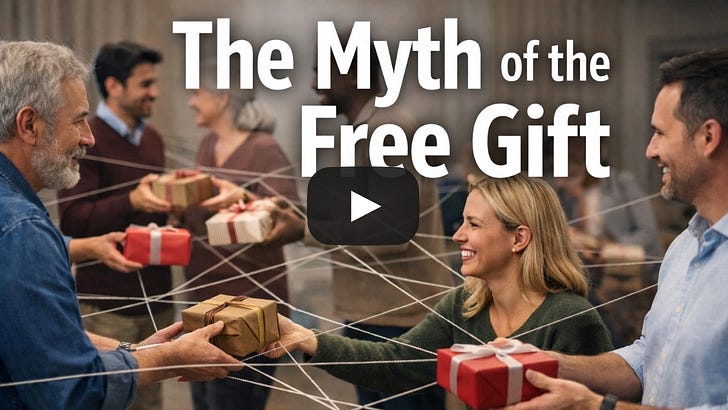
 There is no such thing as a free gift. Not in anthropology. In 1925, the French sociologist Marcel Mauss published a short but explosive study called The Gift: Forms and Functions of Exchange in Archaic Societies. His thesis was simple and unsettling: the “pure” gift is a myth. Across cultures and civilizations, gifts are never free. They create obligation. They generate return. They bind giver and recipient into cycles of reciprocity.
This week’s parsha, Terumah, seems at first glance to be about generosity. Gold. Silver. Copper. A fundraising campaign for the Mishkan (Tabernacle). But the Hebrew is strange.
Not give. Everett Fox translates carefully:
Giving is taken as something obligatory, required, essential. The ability to give becomes the grammar of a covenantal society. And the Torah immediately clarifies the raw materials:
This is not abstract virtue. It is structured exchange. Rashi’s French and the Language of AppeasementRashi sharpens the point. On “ידבנו לבו” — “whose heart moves him” — Rashi explains:
Apaisement. Appeasement. Conciliation. Rashi returns to this idea in Genesis 33 when Jacob sends gifts ahead of his reunion with Esau:
Rashi comments:
A gift repairs. Even sacrifice is framed this way. In Leviticus:
Rashi again translates:
Sacrifice, too, is a gift meant to conciliate. To establish relationship. Mauss would have understood this immediately. In an earlier study on sacrifice, he described it as: Exchange. Not abstraction. The Only Mandatory Gift in JudaismWe do not generally have halachot of gifting. We have laws of charity. We have obligations of support. But gifting? There is only one place in the Jewish calendar where we are commanded to give a gift to a peer. Purim. The Book of Esther records:
And:
Two separate mitzvot. Matanot la’evyonim is charity. Mishloach manot is not. The Talmud in Megillah (7a) parses the grammar:
This is structured exchange. Calibrated reciprocity. But the emphasis on duality reflects reciprocity. Later authorities debate the purpose. The Terumat HaDeshen suggests it ensures everyone has enough for the Purim meal — a practical rationale. But Rav Shlomo Alkabetz, author of Lecha Dodi, argues something deeper: mishloach manot engenders friendship and brotherhood. It counters Haman’s accusation:
The gift heals dispersion. It says: We are not fragmented. We are bound. Ironically, or tellingly, Alkabetz offered this opinion in his book Manot HaLevi, which he sent to his father-in-law as “mishloach manot,” Just a thought… share (or like) an episode of Madlik this Purim and according to Alkabetz your Shalach manot is done! The Language Inside the GiftThe Talmud’s stories make this concrete. Rabba sends a sack of dates and roasted flour.
Marei bar Mar sent back to him a sack full of ginger and a cupful of long peppers, a much more expensive gift. Abaye comments wryly:
In describing that same incident, Abaye describes how when he arrived at the Purim meal of Marei bar Mar he thought he was full, but after eating from the feast he exclaimed: This explains the folk saying that people say:
My grandmother who grew up in a tenement in the Lower East side with a single mother household and seven siblings used to say: “We were poor, but we didn’t know it.” Clearly the choice of food speaks. The gift communicates. Another passage describes sages exchanging entire meals with one another to fulfill the mitzvah. Not charity. Not surplus. Reciprocity. This reminds me of the Allegory of the long spoons, attributed to Rabbi Haim of Romshishok also told in other traditions — about heaven and hell. In both places, people sit around a banquet table with their arms bound. In hell, they starve. In heaven, they feed one another. Maimonides codifies:
And if one lacks means?
At minimum, reciprocity is preserved. Even the halachic discussion of whether we make a blessing on mishloach manot highlights something profound: the mitzvah depends on the recipient. If the other does not receive, the mitzvah collapses. A gift requires a response. Economics Can’t Explain EverythingMauss wrote in opposition to utilitarianism — the idea that all human behavior can be explained bgy supply and demand and Adam Smith’s “invisible hand”. He studied practices like the potlatch, where chiefs destroyed wealth publicly to create cycles of honor and obligation. What looked irrational was in fact structured reciprocity. Markets explain pricing. They do not explain why two elderly people sit on a park bench and share lunch from paper bags. They do not explain why Purim requires cooked food — as Rabbi Shlomo Riskin once suggested — so that I eat from your kitchen and you from mine, turning kashrut from barrier into bridge. They do not explain why the Torah describes giving as taking. The Grammar of GivingIn Hebrew, the word נתן — to give — reads the same forward and backward. According to Rabbi Haskel Lookstein this showcases that giving is reciprocal. Terumah and Purim are not about philanthropy. They are about communication. Gifts to God. The Torah does not treat gifting as sentimental generosity. It treats gifting as language. And like any language, it has structure, intention, and consequence. There is no such thing as a free gift. But there is such a thing as a gift that builds a world. The full source sheet for this episode is available on Sefaria: https://voices.sefaria.org/sheets/709029). Listen on Spotify:
Join us on Madlik Disruptive Torah as we continue to explore how ancient texts illuminate the structures beneath modern life.
|
Wednesday, 18 February 2026
There Is No Such Thing as a Free Gift



Subscribe to:
Post Comments (Atom)
Mindfulness For Neurodivergent Minds
The Mindfully Divergent Program ͏ ͏ ͏ ͏ ͏ ͏ ͏ ͏ ͏ ͏ ͏ ͏ ͏ ͏ ͏ ...

-
Dear Reader, To read this week's post, click here: https://teachingtenets.wordpress.com/2025/07/02/aphorism-24-take-care-of-your-teach...
-
CALL FOR APPLICATIONS: AOM 2025 PDW ͏ ͏ ͏ ͏ ͏ ͏ ͏ ͏ ͏ ͏ ͏ ͏ ͏ ͏ ͏ ...


No comments:
Post a Comment