I only realised this week that the great Scottish political theorist Tom Nairn had died at the end of January, at the age of 90. The Scottish writer Gerry Hassan assessed his large legacy in an article in The Scottish Review. Hassan, a friend of Nairn's, reminded us that Nairn had been influential over a long period of time in a whole range of political debates: about the nature of Britain's politics and constitution, about Scotland and indepoendence, and more broadly about notions of nationalism:
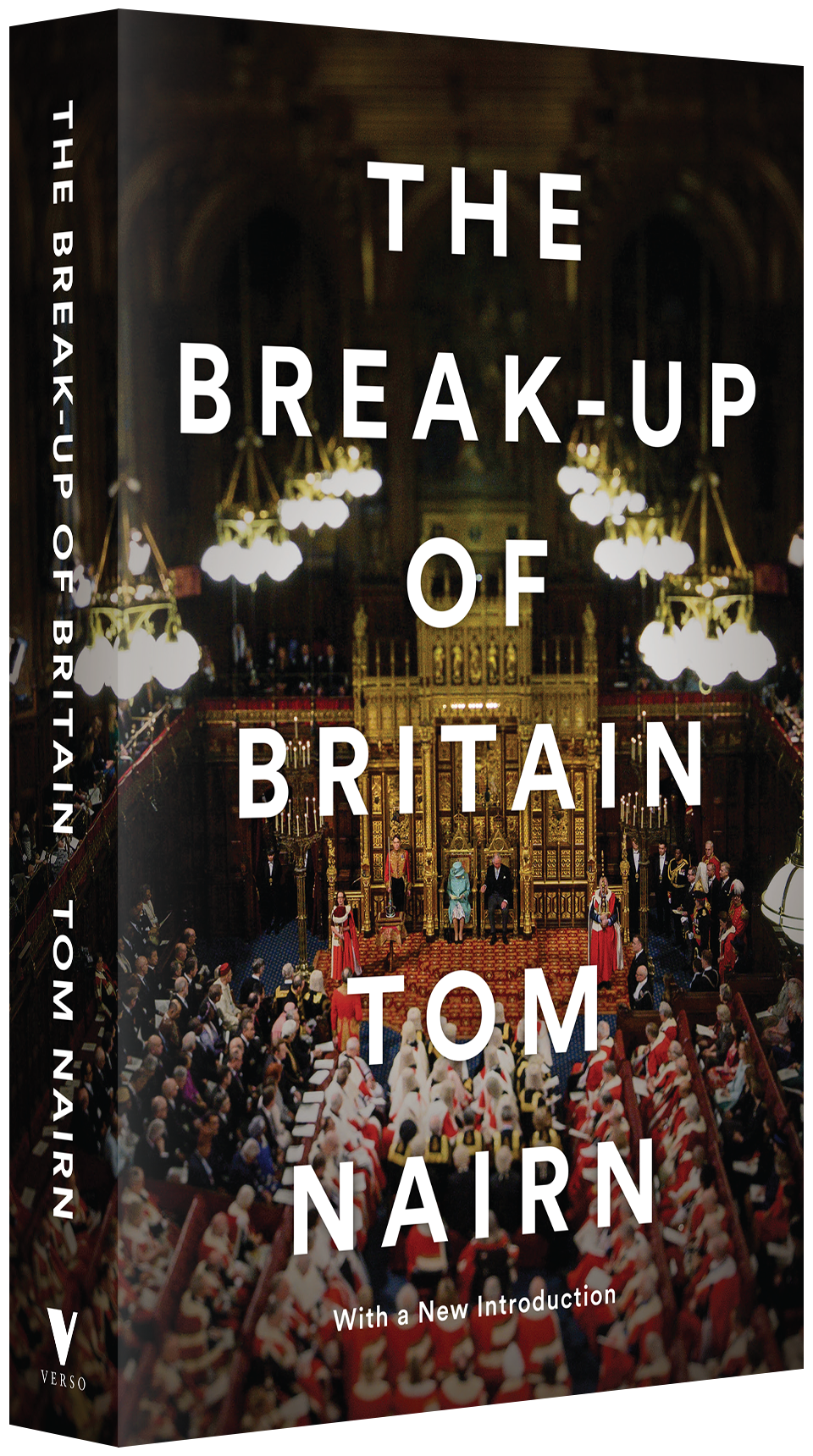
Nairn's great magnum opus was The Break-Up of Britain, first published in 1977, and which went through four editions: the third published by myself in 2002, the last in 2021 with a foreword by Anthony Barnett. Subsequent books such as After Britain: New Labour and the Return of Scotland (2000) and Pariah: Misfortunes of the British Kingdom(2002) updated his critique of what he called 'Ukania', while The Enchanted Glass (1988) located monarchy as central to the creation of 'the glamour of backwardness' which offered protection to the undemocratic, unreformed state and political system.
(Image: Verso Books)
Feudal state
The 1977 date of The Break-up of Britain marked the year of the Queen's Silver Jubilee, and perhaps the book and the Sex Pistols' song are two ends of the same cultural strand. The idea that Britain still remains in part a feudal state, because it had an incomplete revolution, is from Nairn's work. The rising bourgeoisie was accommodated within the pre-democratic framework of the 17th century. (Another version of this is that it had a revolution—in the mid-17th century—but it had it too early.) But the same tension was seen in the post-war period, when the Labour party tried to make progressive change possible but constantly bumped into the limits "of a political order built to maintain privilege, inequality and deference":
The British state today is still characterised by backwardness, its reactionary nature and anti-democracy. As Nairn put it, the monarchical state has been used to incorporate the forces of progress in the 20th century and tame them, then to act as a catalyst for the reconfiguration of power, which happened in the latter half of the 20th century and early 21st century, and which has deformed society, life chances and opportunities.
Nairn's analysis also put the tensions between the different countries in the United Kingdom, and the dominance of England within it, at the heart of his analysis. In the 1970s, when others were looking at political economy, he was noting the multi-national nature of the UK, with emerging forms of cultural difference in Scotland, Wales, and the north of Ireland at odds with the increasingly right-wing English nationalism of Enoch Powell and then Margaret Thatcher:
He presciently argued that this latter force would increasingly unbalance the union and define itself in opposition to the increasingly integrationist European project. This acute, penetrating analysis has been confirmed in subsequent decades, and still has relevance to the future of the UK.
(Tom Nairn at 80. Photo: Open Democracy)
Neo-nationalism
His approach to Scottish nationalism was also influential. He was critical of early expressions of nationalism, which he saw as being about reaction and anti-progress. However, as forms of nationalism in Scotland evolved, taking a long view, he identified its expression as being part of a modern national identity rather than it looking backwards to 1789 and 1848. He called this 'neo-nationalism'. Some obituarists have suggested that the current SNP, with its inclusive place-based nationalism connected to a progressive politics, is a reflection on Nairn's perspective. Hassan has a more nuanced view:
Nairn noted the evolution of a more confident, progressive, pro-European SNP in recent decades; in particular under Alex Salmond's period as First Minister. But he would have noted in Nicola Sturgeon's near decade as First Minister the return to a politics of closure, control and not opening up, trusting others or building popular alliances.
At the same time, the controversy over leadership candidate Kate Forbes' remarks about equal marriage reflects this sense of a progressive nationalism that Nairn championed in his writings.
Janus
Over at New Left Review Perry Anderson assessed Nairn's legacy, bracketing him with the American radical Mike Davis, who also died recently. Nairn's radically different view of British politics was partly due to the years he spent in Italy in the 1950s, speaking fluent Italian and studying the work of the Italian theorist Antonio Gramsci. A long series of articles in New Left Review paved the way for both The Break-Up of Britain and an earlier book, The Left Against Europe?
In the course of this sequence, he rallied to the national cause in Scotland, and opened out his range beyond Ukania, as he would later call it, to a worldwide theory of nationalism conceived in the image of a 'Modern Janus'—an effigy looking both backwards and forwards, to the past and to the future—which it had been Marxism's great failure never to understand. The turning-point of the twentieth century had been 1914, rather than 1917: not class but nationality was the motor of modern history.
In his later writings, after the end of the Cold War, he concluded that nations were "the fundamental vectors of democratic emancipation."
The growth of a democratic nationalism, no longer ethnic but civic in outlook, was the deep underlying trend of world history since the Second World War, and offered the best hope for humanity.
Globalisation
This didn't go so well after 9/11, and Nairn thought that the United States "had hijacked globalization" for reactionary ends, helped by the UK. But he also saw a fundamental conflict between nationalism and neoliberalism:
the Anglo-American attempt to 'cram the genie of democratic nationalism back into the neo-liberal bottle' had provoked 'a gathering storm of resentment and shame' against it, and would fail. The only site of collective agency capable of developing a credible alternative to neo-imperialism and neo-liberalism, wrenching the world free of their iron maidens, was the nation-state.
Obviously he was right about this, but this plays out in different ways. Orban and Modi are also alternatives to neo-imperialism. Nationalism looks backwards as well as forwards.
And one thing that came to my mind, reading these two articles and other obituaries, as we watch the anniversary of the Russian attack on the Ukraine, is that we are watching a war between competing versions of nationalism, the reactionary and the more civic. Nairn has been ill for some time, but I was intrigued to find that a month into the war James Meek had made a similar comparison, likening post-2014 Ukraine to Nairn's description of Scottish aspirations to "a new interdependence".
If you want to read more of Nairn's thinking without having to read his books, his publisher Verso Books posted a substantial and academic article by Nairn from The Break-up of Britain, written in the 1970s, on "the twilight of the British state."
——
This article is also published on my Just Two Things Newsletter.





No comments:
Post a Comment