
Graphic by riddlez46.
Cutting-edge X-ray technology is providing researchers with unprecedented insights into the ancient world of dinosaurs. On World Dinosaur Day, scientists are unveiling the hidden secrets of the Harbury Ichthyosaur, a marine reptile that inhabited Earth millions of years ago, using advanced X-ray imaging techniques and 3D reconstruction.
Scienceblog.com
They can X-Ray....
...hold on!!! World Dinosaur Day? Why have I never heard of World Dinosaur Day?!?!?!? I need to mark the calendar! I will be up in Oregon, but I will need to do something to celebrate World Dinosaur Day, June 1, 2024... stay tuned. Now, back to the blog...
They can X-ray 200 million year old fossils, oh yes they can. Those paleontologists are so darned clever!
Embryos with teeth. Blood vessels. Stomach contents. Identifying what the genus was from a jumbled mix of squished bones. Where the nostrils go! X-Rays, CT scanners, and particle accelerators are showing scientists a whole new world inside tiny, eroded bits of rock.
Teeny Little Dinosaurs
Dinosaurs grew big, but they started small. Some of the eggs were no bigger than chicken eggs, and the shells were thin. Even though fossil is a rock with a dinosaur embryo inside, trying to scrape a 3-5 inch embryo out would destroy it. One clutch of eggs found in South Africa belonged to Massospondylus carinatus, a well-known species. Scientists could identify some of the embryos, but they couldn't exactly open the eggs to see the rest.
In 2015, French scientists at the European Synchrotron Radiation Facility (ERSF) facility finally got a chance to peer inside. Synchrotons are extra-powerful visualizing tools connected to 3-D imaging capabilities, and they turn out to be super useful in fossil investigation. In this case, the paleontologists were able to see teeth--two sets of teeth, in fact. They could also tell from the bone structure that this would have eventually walked mainly on two legs.
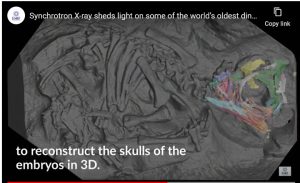
Dinosaur embryos X-rayed--they had teeth! Earthsky.org.
They could compare the embryos to those of living relatives (remember letter "L") and see that this animal shared similarities with chickens and crocodiles. They could tell, for instance, that t one was 60% developed, another 17%, and another 90% even though some sad event had turned all the eggs to fossils. As Prof. Jonah Choiniere (home to the Stormberg Giants) put it, it's amazing that in 250 million years, embryo development inside of eggs has not really changed.
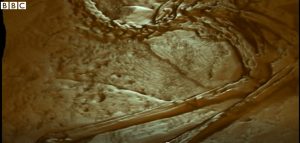
3D synchrotron view of archaeopteryx
The Blood Vessels in those Spindly Little Legs
I was talking about archaeopteryx just yesterday, but here's another skeleton that got the X-ray treatment. Because these bird-dino links had such thin, hollow bones, their smashed bits are hard to distinguish. The paleontologists have known for 150 years that these fossils had feathers, but could not see much more.
But once they ran those pancaked fossils through the ERSF, the fancy cyclotron-synchrotron in France, they could create an image of the archaeopteryx fossil that could be magnified and examined in fine detail. Even though the bones were smashed,they could measure their relative size and reconstruct their bodies with far more accuracy, especially with computer modeling. It took several years--you can even see the first press release in 2014 when they started using the X-rays and another in 2018 when they announced findings--but this is how they determined that archaeopteryx was able to fly "like a pheasant," in small bursts.
I did read up on cyclotron and synchrotons for you. I even read a paper that said it would explain how they work "in a form accessible to readers without a theoretical physics background." Then a little further down that promise turned into here's a ..."little you should know before starting to read ...(3) An electromagnetic wave with wavelength λ propagating along the direction z is described by wavefunctions of the form...
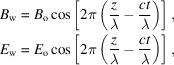
This was their idea of making it accessible to non-theoretical physicists? I know what a cosine is, what pi is, and how to do math. But that's too mathy, even for me. I tried reading some more. Nope. Read some more. Double nope. OK, then, this is my version of what a synchroton does. Little tiny things... particles... electrons...whatever... spin around in this giant machine circle and give off rays, which can take really sophisticated pictures. And because the electrons are super tiny and going super fast, they can take pictures in more detail than other machines like CT scanners. (Next step is to ask my physicist son to explain it language that a mother would understand). The ERSF does look impressive. And expensive. It's very blue, reminds me of the alien ship in Close Encounters. Where's Richard Dreyfuss when you need him?

The ERSF spinny thingy in France, wikipedia.
More Fun with Jumbles of Bones and X Rays
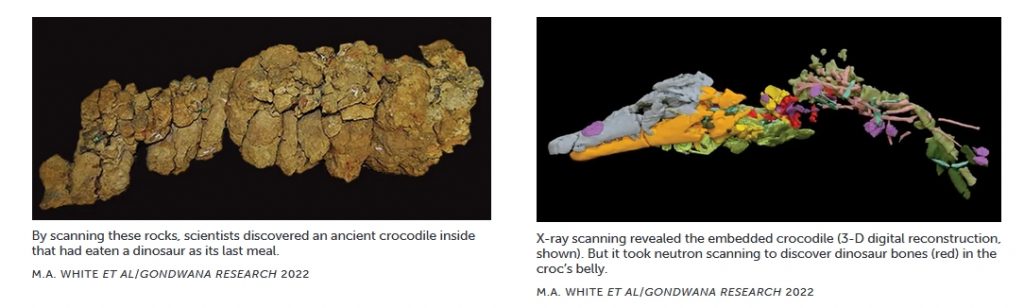
Here are two more fun things that they did with dinosaurs and X-rays. First, they had some old rocks that they knew had some ancient beast inside, because it broke off when a bulldozer rolled over it. They knew roughly the age of the rocks, both because of nearby rocks and from carbon and other dating technology. However, these rocks were too fragile to extract bones from and so full of iron that normal x-ray imaging couldn't see anything.
When they put the rocks under a CT scan, like the kind used on people, they discovered what the beast was. This was Confractosuchus, a big nasty ancient crocodile, big enough that it had eaten a dinosaur. The thing had dinosaur bones, a teenaged ornithopod, in its stomach.
Think that's fun? There was also a case where X-rays were used to identify an ichthyosaur. Mary Anning probably could have told them it was an ichthyosaur. She'd spent a lifetime of digging the water-loving reptiles painstakingly out of the Lyme Regis rock. But this one was just a jumble of bones, found up near the Arctic in Svalbard. They are now in an Oslo museum and had been nicknamed "Oda," but the fossil was pretty nondescript.
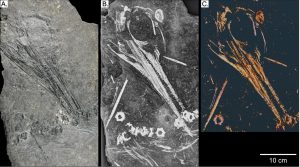
The Oda ichthyo-triptych. Photo from New York Times.
Using first a radiograph and then a CT scan, they could clearly see the details of the skull and bits of vertebrae that were superimposed on it. Part of the reason for the clarity is that the mineral which flowed in the water to turn it into a fossil was barite, which happens to be the thing most used to create contrasts in x-rays.
For this particular animal, they could even see different layers of skin and signs of melanin cells, which led to them to argue that it was (a) warm-blooded and (b) had countershading. The countershading was a way of hiding from predators and also suggested they could see colors. Being able to argue that ichthyosaurs were warm-blooded is interesting because they were solid water creatures, giant dolphin-like reptiles. On the other hand, dolphins are warm-blooded, so maybe these ancient reptiles having thermoregulation isn't that strange. But figuring that out from this smashed fossil is another thing entirely.
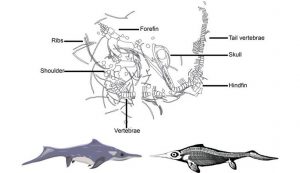
The smashed ichthyo bits still revealed a lot! Graphic by Audrey Roberts at nhm.ac.uk.
Paleo-snoutology
The last interesting x-ray dinosaur example I'll mention has to do with nostrils. Way back with letter A, I talked about the extra hole in the head that the dinosaurs had. If you look at their skulls, all the holes were pretty big.
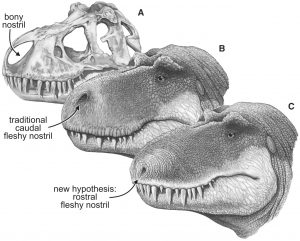
The Proper Type of Smell. Photo from Science.
Often, the dinosaur nostrils in early paintings were depicted fairly high relative to where the eyes are. But Dr. Lawrence Witmer, who runs the DinoNose project.... DinoNose? the Stormberg Giants? these guys are so creative!! Dr. Witmer x-rayed living animals--you guessed it--crocodiles and birds and looked at where their nostrils are relative to the hole. Repeatedly he found that the nostrils were down in front, not up in back of the hole.
Nostrils near the mouth might be better for several reasons. First, that design might produce a heightened sense of smell closer to what's being smelled. The longer the snout, the more that's true. Secondly, having the smell occur near the mouth enhances a sense of taste. Finally, having the nostrils too far back would bring air into the nasal cavity where it could be trapped rather than circulate into the lungs. Very inefficient.
Why then, way back in the early dinosaur days, did they put the nostrils much further up in the skull? Some of the early giant sauropods were thought to hang out in swamps. Scientists thought their bones would be too heavy to walk around, so they assumed they were primarily water animals. (But then why would they have long necks? And why would natural selection lead to an adaptation for an animal that limited them? Darwin sez noooooo.)
If you've seen any really old picture books, the dinosaurs might have been drawn like this. The nostrils are high, because it was assumed that the dinosaurs might go into deeper water, then breathe while most of their body was underwater, kind of like a whale or crocodile.
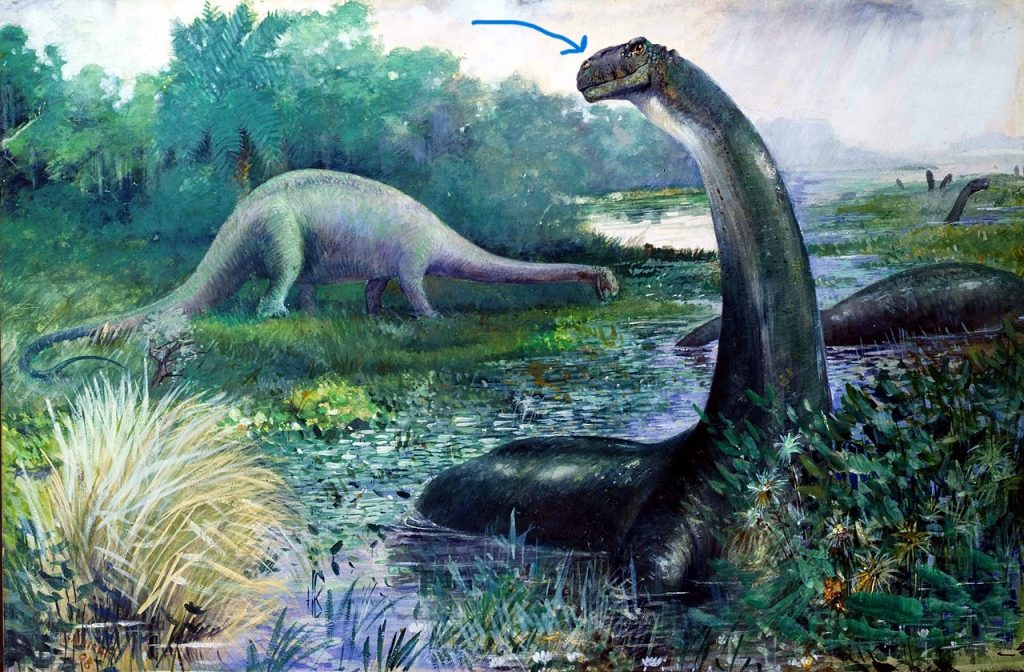
Outdated view of the sauropods as water creatures, wikipedia.
Yeah, but if they were meant to be swimmers, why didn't they just adapt to have fins instead of? ... oh, never mind. Darwin is just shaking his head at those nostrils.
It's the end of April, but I still have two more posts to go, so bear with me for two more days.




No comments:
Post a Comment