You will be astonished, gentle reader, to learn that the question of whether worker pay has kept up with productivity growth turns out to depend on 1) how you measure worker pay; and 2) how you measure productivity growth. Scott Winship considers the alternatives and issues in "Understanding Trends in Worker Pay over the Past 50 Years" (American Enterprise Institute, May 2024).
For a taste of what is at stake in this dispute, consider first a figure from the annual Economic Report of the President published by the White House Council of Economic Advisers Annual in 2022:
As Winship points out, versions of this figure, showing how worker compensation has not kept up with productivity, are a hardy standby in reports that seek to show unfairness in the US economy.
But when you look at the labelling of the figure, you notice that "productivity" is "net total economic productivity," which refers to the entire economy, with the "net" meaning that depreciation of capital has been subtracted out." The "nonsupervisory compensation" raises questions of what workers are being included here.
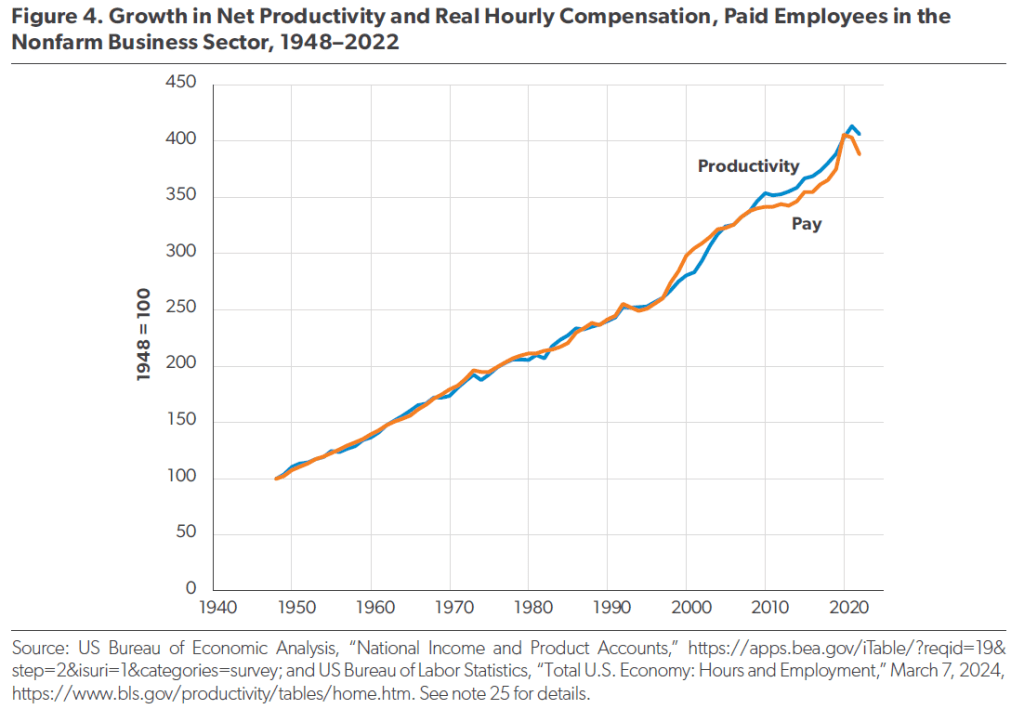
When Winship does his preferred calculations, one of the graphs looks like this:
Notice that productivity and pay now line up closely. Notice also that the variables are defined a little differently. Now "productivity" is in the "nonfarm business sector," meaning that government, nonprofits, and agriculture are left out. All "paid employees" in this part of the economy are counted, which leaves out the self-employed, and may not be the same as "nonsupervisory workers" in the previous graph. Or here's an alternative measure from Winship.
Again, pay and productivity are lining up. In this case, "productivity" is measured in the "nonfinancial corporate sector," which is a subset of the "nonfarm business sector" that also leaves out finance.
I should emphasize that all of the underlying data here is from official US government sources like the Bureau of Economic Analysis and the Bureau of Labor Statistics. Thus, a fundamental underlying lesson here is that what may seem to be small differences on the labels of figures actually represent rather different concepts. Here's are a few of the issues that Winship points out:
The category of "nonsupervisory" workers from the first figure leaves out about 20% of private sector employees, as well as excluding government and a growing share of self-employed workers. Thus, comparing this group to "total economic productivity" might mislead.
Part of the gross domestic product that measures the entire economy is called "gross housing value added." For renters, this is measured as what they pay in rent. For owned homes, the government statisticians figure out "imputed" rent--that is, the rent a homeowner would have paid themselves for living in their own house. As Winship writes:
One reason that economy-wide productivity has increased faster than compensation is that gross housing value added has increased more than the parts of GDP that involve goods and services primarily produced by workers.19 But this divergence does not actually indicate that workers are not being paid in accordance with their value to employers. The housing sector of the economy should be left out of analyses comparing productivity and pay, which is one reason many researchers look at the nonfarm business sector.
Winship argues that if one compares apples-to-apples, "Over 75 or 100 years, aggregate worker pay has closely tracked increases in productivity. Pay differences across industries, across firms within industries, and within firms all seem to correspond with productivity differences."
However, he also argues that productivity differences have occurred unequally across the US economy--between industries, between firms in a given industry, and even within individual firms--and so even if average wages track average productivity, the distribution of both productivity and wages has become more unequal. He writes (footnotes omitted):
We lack individual-level measures of productivity, but much of the evidence we have points to growing productivity inequality across individual workers. First, productivity inequality has increased across industries. For instance, industries with workers who have higher educational attainment have higher productivity. Industries with a higher level of education in 1989 saw stronger productivity growth through 2017.
Productivity inequality has also increased across firms. Moreover, both wage inequality and productivity inequality have risen primarily across firms in the same industry, as opposed to within firms or across industries. Research finds that firms with workers who are more productive pay them higher wages—with everyone from the lowest-paid to the highest-paid employees benefiting. Moreover, increases in a firm's productivity lead to increases in its employees' pay.
Growth in productivity inequality across firms resembles growth in their wage inequality. One study analyzing firms in the US from 1977 to 2007 found that both productivity inequality and wage inequality between firms rose, with productivity inequality rising more. These increases occurred within each of eight industries as well. ... Not only has productivity inequality grown across industries and firms, but it likely has increased within firms too. A recent paper finds that firms with higher productivity have a larger wage gap between their highest- and lowest-paid workers. Even more strikingly, increases in firm productivity raise the pay of all the firm's employees, but not equally. The highest-earning workers in a firm with productivity growth receive a bigger earnings boost than do the lowest-earning workers. These findings suggest that more productive firms are more productive disproportionately because of the highest earners—that their productivity is greater than that of lower-paid workers.
I have written several times over the years about the growing divergence in productivity across industries and firms, even firms within the same industry (for example, see here, here, and here. It seems to be an international phenomenon. Over time, those firms lagging in productivity will adapt or shrink, but the process can take some time.




No comments:
Post a Comment