Intentional and Unintentional HolinessAre there times were we should strive not to be present or in the moment?
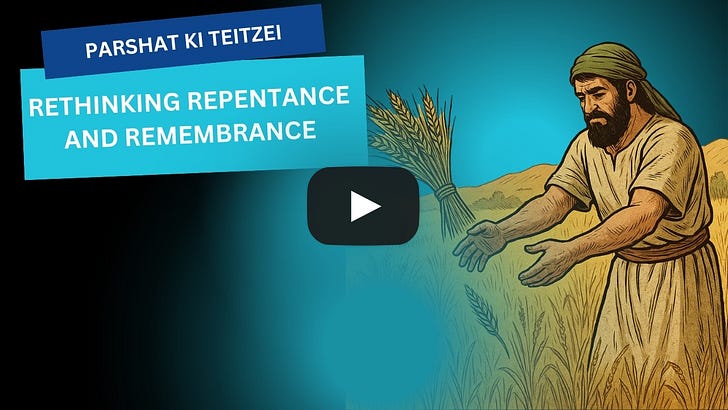 Intentional and Unintentional Holiness By Geoffrey Stern | Madlik Substack
As we enter the month of Elul and approach the High Holidays, many of us instinctively tighten our grip on spiritual practices. We double down on prayer, intensify our focus, and strive for flawless kavanah (intention). But what if true holiness sometimes emerges when we loosen our hold? In this week's Torah portion, Ki Teitze, we encounter a surprising perspective on mitzvot (commandments) that challenges our assumptions about intentionality and control. Let’s explore how embracing the unintentional might deepen our spiritual practice and transform our relationship with the Divine. The Paradox of Intentional ForgetfulnessThe Torah presents us with a seemingly straightforward commandment:
It sounds simple, until the Rabbis complicate it. They provide examples where one is actually allowed, even compelled, to look away and pass over this commandment. A kohen encountering a lost object in a cemetery, or a dignified elder for whom returning a small object would be beneath their status, may rightfully avert their gaze. This nuance invites us to reflect: Is there wisdom in selective awareness? In knowing when to show up and when to step back? Letting Go: The Mitzvah of ShichechaConsider another fascinating mitzvah:
This law of shichecha (forgotten produce) flips the usual logic of mitzvot. Instead of deliberate action, this mitzvah sanctifies forgetting. The missed sheaf becomes holy precisely because we did not notice it. What might this teach us about spiritual life?
Rethinking Divine MemoryAs Rosh Hashanah approaches—Yom Hazikaron, the Day of Remembrance—we declare:
We affirm God’s perfect memory. And yet, we ask God to be selective:
This request mirrors shichecha. We want God to emulate human forgetting—to choose compassion over omniscient judgment. We’re asking the Divine to practice what we preach: intentional unawareness in service of mercy. The Spiritual Power of SerendipityAnother commandment in Ki Teitze introduces the importance of chance:
The phrase "ki yikarei" (if you happen upon) is critical. This mitzvah isn’t planned or sought out. It depends on serendipity. Ibn Ezra comments “These words have the meaning of chance. It is close in meaning to “meet.” and I would add, that a Jewish holiday is called a Mikre Kodesh… a holy meeting/gathering… or should we say… a holy chance meeting? What can we learn from that?
Reframing TeshuvahAs we engage in teshuvah (repentance), these mitzvot suggest a powerful reframing:
The Takeaway: Holiness in the UnplannedKi Teitze expands our understanding of holiness. It’s not just about precision, intention, and planning. It’s also about:
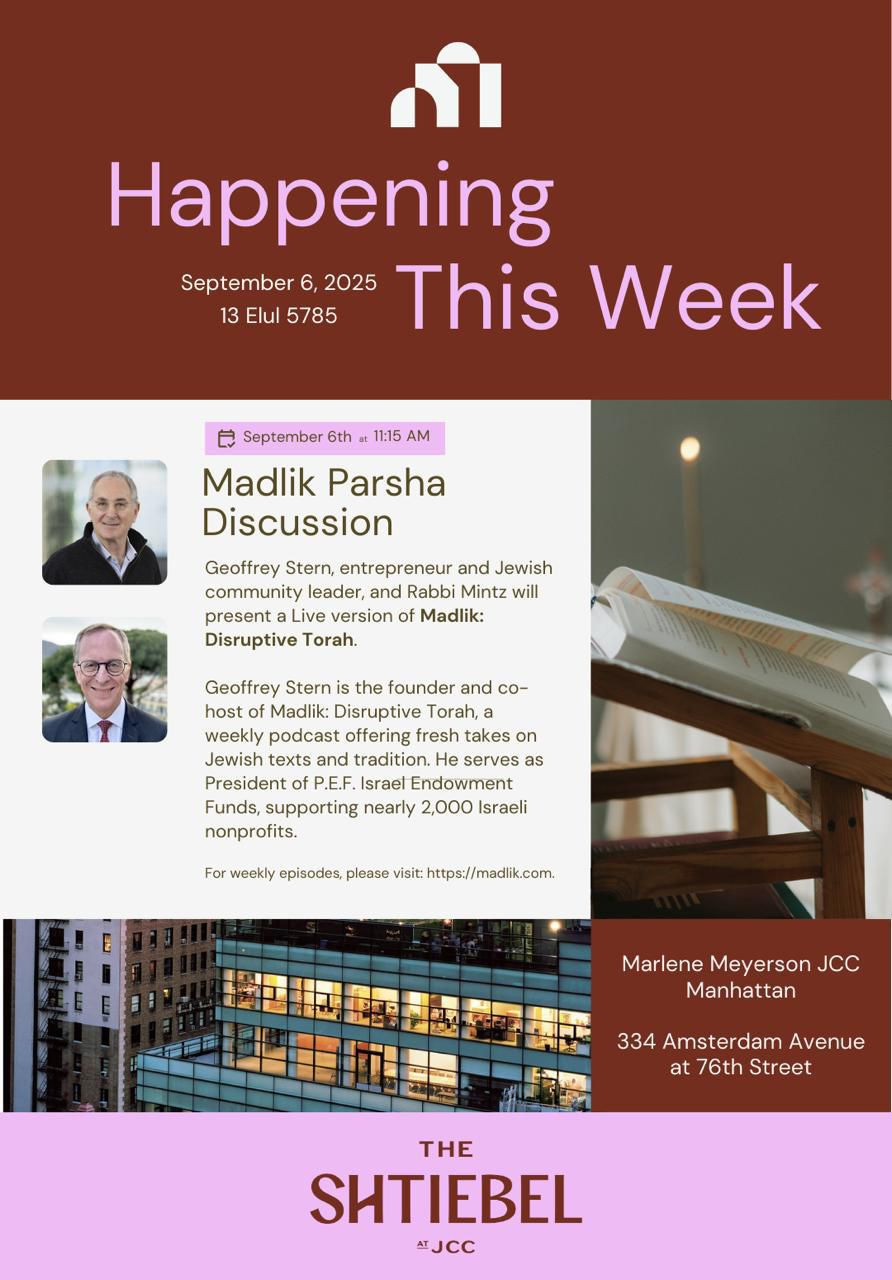
As you move through Elul and into the High Holidays, consider loosening your grip on spiritual perfection. Allow space for the sacred in the spontaneous, the forgotten, and the serendipitous. Even God chooses what to remember. Perhaps it's time we gave ourselves permission to do the same. Sefaria Source sheet: https://www.sefaria.org/sheets/672300 Transcript: Geoffrey Stern: As Elul begins, we often think repentance means tightening control and doubling down on attention, praying with flawless kavanah. Rosh Hashanah is called Yom Hazikaron, a day of remembrance where there is no forgetfulness before the throne of your glory. Yet, Parashat Ki Teitzei insists sometimes the mitzvah happens when you forget when you look away when you let go. Suddenly, the Torah suggests something different. Sometimes the holiest act is precisely when you lose focus, forget, or let go. Holiness can be found in both deliberate action and unintended accident, from recognizing the mitzvah in the sheaf you forgot, from admitting the slip-ups you never intended. Holiness is not only in what we hold onto with intention; it is also in what we release at the end of the day when we pray to the God of remembrance. What we pray for is that God, like humans, will sometimes remember selectively. Welcome to Madlik. My name is Geoffrey Stern, and at Madlik, we light a spark or shed some light on a Jewish text or tradition. Along with Rabbi Adam Mintz, we host Madlik Disruptive Torah on your favorite podcast platform. And now on YouTube and Substack, we also publish a source sheet on Sefaria, and a link is included in the show notes. This week's Parasha is Ki Teitzei. We are commanded when to regard and when to disregard lost objects, the gleanings of the threshing floor we are to leave, and the mother bird, we are told to let go when we take her fledglings. Are we to conclude that which is unintentional is as important as the intentional? Join us for intentional and unintentional holiness. Well, welcome Rabbi from Ita, Italy. You're in Pisa, I'm in Lucca tonight. Adam Mintz: The wedding is in Lucca tomorrow. And this is such an amazing topic and it really brings together the whole world and so many different generations. Intentional and unintentional holiness. Let's run with it. Our first one of the month of Elul. Geoffrey Stern: And before we do, just a few short announcements. Rabbi, this is a very special week for us because, Rabbi, your synagogue is making aliyah. You're moving to the JCC of the West Side of Manhattan on 76th and Amsterdam. And for the inauguration, we are having Madlik live. We will be there in person. I will be there this coming Shabbat. And for you listeners who can make it, rest assured we are going to do different material than we are doing now. Although I will give you a little tease. We are going to be talking about the language of Halachah and we are going to be discussing a few Halachot today. And if we're successful, you yourself will see that Halachot are literally a language, and we just have to listen. So with that, let's begin. We are in Deuteronomy 22, and it says if you see your fellow Israelite’s ox or sheep gone astray, do not ignore it. Everett Fox says do not hide yourself from them. You must take it back to your peer. If your fellow Israelite does not live near you or you do not know who the owner is, you shall bring it home, and it shall remain with you until your peer claims it; then you shall give it back. You shall do the same with that person's ass, you shall do the same with that person's garment, and so too shall you do with anything that your fellow Israelite loses and you find you must not remain indifferent. Or as Fox says, you are not allowed to hide yourself. So we have this amazing halacha. In the Hebrew, it says, you shall not hide yourself. You shall not ignore it. You shall not disappear. It's all about returning something that is lost but also not losing yourself, not hiding from yourself. The Hebrew word of the root עָלַם (halam) can mean to hide oneself. Usually, hiding the eyes from it can mean to disregard, take one's attention away. It can mean to turn a deaf ear, practicing concealment. And so you could see how it started me thinking, Rabbi, about presence when we need to be present when we have to let go of our presence. And Rashi comes up and says immediately, you shall not see any of your brother’s herd go astray and hide yourself from them, says Rashi, close his eyes tight, as though one does not see it. Adam Mintz: That's a great Rashi, right? Geoffrey Stern: And you know, it's kind of like a few weeks ago when we were talking about, or last week when we were talking about Shokhad, and you commented on the literary nature that it says because it blinds your eyes. Here too, Rashi adds that little essence of you can't close your eyes. Adam Mintz: I just want to say all New Yorkers are very familiar with this because everybody is taught by their parents when they're a kid and they ride the New York City subways, don't see anything, right? If something happens on the subway, make it as if you don't see. That's exactly what the Torah means. Rashi didn't have a subway in France in the 11th century. That's exactly the same idea. We do it today. Make it as if you don't see. Geoffrey Stern: The opposite of see something, say something. And the other part of that is don't look anybody in the eye. You know, if you see somebody who looks a little weird, don't look them in the eye. Don't establish eye contact. So, Rabbi, there couldn't be a more simple, straightforward commandment than this. You've got to return somebody's lost object. You cannot hide your eyes. But the second Rashi brings up what the rabbis do here. It says this is the plain sense of the verse. Our rabbis, however, said that the omission of the particle lo before the verb hitalamta suggests that there are times when you may hide yourself from it. In other words, it should have said v'lo hitalamta me'hem because it doesn't. There are exceptions to the rule. Of course, we know that's what the rabbis are famous for, finding the exceptions, the nuances to the rule. And it kind of reminds me of this thing of not passing over another commandment. Here you are, you have to do a mitzvah. You're walking along and you have to return something. The rabbis seem to be saying, but there are instances where you don't have to do this mitzvah. And again, everything that we're going to be talking about today is never 100% clear when you have to hide your eyes and when you don't hide your eyes. Adam Mintz: Let me just explain what that case is of passing over a mitzvah. You're in shul. You know, many people just go to shul on Shabbat, so this doesn't happen. But for people who go to services during the week, very often there are poor people who come by, and they ask for charity during services. Do you have the right to not give them charity because you are in the middle of your services, you're in the middle of davening? Do not pass over a commandment. The fact that you're involved in one commandment doesn't exempt you from another commandment. That's a really good question, Geoffrey, because it's easy to say, I don't have to give charity. I have such intention in my prayers, I don't have to give charity. But it says, no, don't pass over a commandment. Geoffrey Stern: I mean, if I remember correctly, when you put away your tefillin, you have to make sure you know where the tefillin shel rosh is and the shel yad is. Because God forbid you should reach for the rosh before the yad. Then how can you put it back? You've already grabbed a mitzvah. You can't be ma'avirin al ha-mitzvot. Adam Mintz: You're making the shel rosh feel bad, which is also amazing. You personify the stone, which is great. Geoffrey Stern: So we're going to be talking about the language of mitzvot, but here we are, deep into the weeds, Rabbi. All of these things have lessons for life, too. So here we are. The Sifre comes and explains why, in fact, there are times where you don't have to not hide your eyes. Where you can hide your eyes. So it says as follows. Speaker A: Sometimes the Sifrei says you do ignore them, and sometimes you do not ignore them. How so? If he was a Kohen and it were in the cemetery—so you're a Kohen, you're passing by a cemetery, you see a lost object. You're not allowed to go in there. Here, we add the additional thing of it's a lo ta'aseh, a prohibitive commandment. Or if he were an elder, older, and were it beneath his dignity. So now what happens if you're an elderly person and you see something to return? Is this within your purview or not? Or, and this is interesting, if his labor were greater than that of his neighbor—in other words, if the finder was to return the item, reimbursing him for his lost wages would cost more than the value of the item. In all of these three cases, he is exempt, it being written. And you ignore. Sometimes you do ignore, sometimes you do not. So again, the language of the halacha is telling us that, first of all, nothing is simple. And we have a verse that says, you cannot hide your eyes. Sure enough, the rabbis come in and say, there are times when you can hide your eyes. And then the nuance is, yes, there are times, as your parents would say, when you're on the subway, or otherwise, there are times you don't look, and there are times that you have to look. I love the nuance, but I also love the fact that this is not black and white. We live in a world of nuance, and the rabbis are even advertising it, showcasing it. Adam Mintz: I'll just say, you know, how do the rabbis know that? Because the word that you should hide your eyes, it suggests the fact that that's a real. That's something to do. Not always, but, you know, why do they say it in that way? It makes it seem as if that's a reasonable reaction to things. And we have to decide one is that appropriate and one that's not appropriate. Geoffrey Stern: I love it. And then the second time, Rashi comments, he goes even further. When at the end of the verse, it says, thou may not hide thyself. He says, you must not cover your eyes, pretending not to see it—Ki ilu ein chava o' e oto. So now we're talking about two different levels. When you're supposed to hide your eyes, when you're not. And do you pretend as though you don't see other people looking upon you? I just love how they can complicate such an obvious, straightforward thing. But again, it shows that everything is complicated. There are no straight and true laws. So now we get to the second halacha that talks about intentionality, oversight. And this is what we call Shichecha, where you forget. And it's in Deuteronomy 24:19. And it says, when you reap the harvest in your field and overlook a sheaf in the field, do not turn back to get it. It shall go to the stranger, the fatherless, and the widow, in order that your God may bless you in all of your undertakings. I love this word Shichecha, which... And you forget it. So here we are almost commanding somebody. And you can imagine, Rabbi, I started by saying during Elul, we focus on Kavanah, we focus on doing everything just perfectly. I can assume that there are psychological types, maybe very anal people. Maybe we all have this part of ourselves that we have to do everything just right. And for those people, Elul and the High Holidays is like a godsend. That's how they would love to live, where everything finds its place. And boom, out of left field, literally the field, we get this law that says when you bring up your harvest and things drop, you have to let them go, you have to leave them for the poor. And I just love the fact that when we refer to the trilogy of laws in this kind of context, there's Leket, Shichecha, and Peah—the gleanings, the forgotten produce, and the corners of the field. These are all laws, Rabbi, that teach us, in a sense, to let go. And if you believe, Rabbi, that we do the commandments to kind of copy God, 'Le'hadmot imitatio Dei,' then in a sense, are we not saying that this is a godly trait to sometimes just let go? Adam Mintz: Yeah, well, for sure. I thought you were gonna point out, of course, also true, that we call this one Shichecha; we name it after the fact that you forgot it. Right. Leket means gleanings and Peah, means the corners. But Shichecha, can you imagine referring to a law, an agricultural law, as the thing that you forgot? It shows the centrality of forgetting. Geoffrey Stern: It does. And because we are in the High Holidays, I said to myself, I've heard that word Shichecha before. And in the Siddur, when we talk about Zichronot, Malchiyot, and Shofarot, we talk about the trilogy of remembering, of shofar, and the kingship. There is this beautiful saying that says, Ki ein shichecha lifnei kisei kevodecha, that there is no forgetting before God's holy throne. And we call Rosh Hashanah Yom Hazikaron. It is the day of remembrance. Geoffrey Stern: And so what I wanted to explore here is, do we want. Are we truly trying to imitate God, or are we trying to project onto God and say, you know, even on Yom Hazikaron, we want you to do what you tell us to do, which is to sometimes let go and be a little selective in your memory? If you're picking, if you're harvesting, and a few sheaves escape from you, that is the mitzvah of Shichecha. And again, we say in the Zichronot, there is no forgetfulness before the throne of glory. And in the Sefaria notes, I have it quoted in full. And then, Rabbi, we do something amazing. We start to list all of the things we want God to remember. And big surprise, Rabbi, in that list is not the golden calf. In that list is not Korach. In that list is not the bitter waters. We say to God, you remember everything that has been forgiven. But then we get very selective in our memory. And I found a beautiful commentary in TheTorah.com that says as follows. Although we ask God to remember in this Zichronot blessing, we are not actually asking God to remember everything, both the good and the bad. The Mishnah is explicit about this. The Mishnah says, ein mas kirin zikron malchus v' shofar shel paraniot. We don't remember anything that we got punished for. We are asking God to be selective. When we say God never forgets, we are holding up our fingers as quotation marks. Rabbi, I think there is—and I'm not, I don't think I'm creating this as a drash—I really do think that there is a dialogue between this law of Shichecha and what we want God to remember, too. We're teaching ourselves that memory should be selective, that you don't have to remember every sheaf, not every grain has to be harvested. You can leave things for the poor. You can have a little rachmanus. Is it drash? Maybe. Adam Mintz: That's amazing. And I'll just say another drash that on Rosh Hashanah, you know, each holiday has its name in this, in the prayer service. And Rosh Hashanah is not called Rosh Hashanah in the service. It's called Yom Hazikaron, the day of remembrance. That is our obsession on Rosh Hashanah. And exactly like you said, Geoffrey, it's the balance between. Between the fact and shichechat lifnei kisei, that's scary. God doesn't forget anything is scary. But if God didn't remember anything, we also would be sunk. So you see that, right, Geoffrey? That's a very delicate balance. He can't remember everything, but he has to remember something. And that's the challenge of Rosh Hashanah, of finding the sweet spot. Geoffrey Stern: Absolutely. So the professor Mark Zvi Brettler has an article in TheTorah.com, it's Zichronot, asking an omniscient God to remember. Do we really want God to remember all that we did? And he writes, instead, we are asking God to use selective memory, a feature that is well-documented in scientific literature, where it is sometimes called selective forgetting. Speaker A: We ask, for example, God to recall our outcry in Egypt, the ancestral covenant, His compassion, Israel's early loyalty to God itself, a very selective presentation of the wilderness period, and many other positive things in the past. By implication, we are asking God not to remember Israel's past misdeeds, such as the golden calf, the sin of the scouts, and our own personal sins. The depiction of God as remembering selectively is very striking. Usually, we think of religion as claiming that people must be godlike. But this prayer insists that God be human-like; God, like a loving parent, should remember the good and overlook or even forget the bad. He's literally. He's not tying into Shichacha, but he is saying this should be a mitzvah where God is copying us. It is indeed much easier. Adam Mintz: That's brilliant, right? That's absolutely brilliant that on Rosh Hashanah all year long we try to be like God, but on Rosh Hashanah, we ask God to be like us. Geoffrey Stern: Be like us. Following God's command, be like us when we harvest the wheat and God told us, you can let go of a few grains. It is indeed much easier to change our ways if we imagine that God, like us, engages in selective memory and might be convinced to forget the wrongs we have done in the previous year. So, quite ironically, on one level, the real message of the festival's early name of Yom Hazikaron, the Day of Remembrance, is that we hope that God will indeed forget. I just thought that was wonderful. And again, especially in the life of Professor Bretton. Adam Mintz: Was fantastic, and he really identifies, you know, such a. Such a. Such a fundamental point in Rosh Hashanah. Geoffrey Stern: So. And again, I will argue that the mitzvah of Shichacha for every one of us, but there are clearly those of us who want to put every peg into every hole and want. It must be different, difficult to go to the harvest and to let those grains drop. It must be difficult to plow your field and leave the corners. And I do think that the Halacha itself has a language that if we listen to it, it's teaching us something. And I think this might very well be the primary lesson that we all need to be a little understanding and a little forgiving. And that's why it goes right to the poor and the widow and those who are less fortunate for love, just for the love of God. That could be you walking there. I think it is in the message. Adam Mintz: I think there's no question. We'll take it back to the beginning. And it's in human nature that if you see somebody having trouble on, you know, on. On West End Avenue, you tend to look away. You tend to say, I don't want to get involved. It requires a special effort to say, I'm gonna get involved. So in both cases, the Torah comes to tell you that you need to fight the inclination to do what's right. Geoffrey Stern: And there are no easy answers. You've got to make that decision each time. So now we're getting to a third Halacha in our Parasha. And this is in Deuteronomy 22:6. It says, if along the road you chance upon a bird's nest in any tree or on the ground with fledglings or eggs, and the mother sitting over the fledglings or on the eggs, do not take the mother together with her young. Let the mother go and take only the young, in order that you may fare well and have a long life. So there are two things going on here. Number one, if you chance upon a bird's nest, is intriguing. The serendipity of this commandment, this happenstance. And then what is the lesson here, ? Is it similar to the lesson of leaving the sheaves? We are leaving something. If you're a hunter, Rabbi, the idea is you get it all. You had a good day. I got the mother, I got the birds, I got the whole harvest. So Rashi says, if a bird's nest chances to be before thee, he writes, if it chances to be, this excludes that which is already at hand in thy court. So in other words, what exactly that means, I'm not sure of. Rabbi. Maybe if you're a farmer. But the idea is that this chance, this serendipitous part of this commandment, is intrinsic to it. And I love that too, because if we're learning anything about intentionality or lack thereof, the one thing that ruins every unintentional is an unintentional situation when it comes to you from left field, I just want to say, what. Adam Mintz: Does it mean by chance? By chance means that, you know, if it's in your backyard and you can have a family meeting about how to handle it, that's not what the Torah is talking about. The Torah is talking about by chance. You have to make a decision on the spur of the moment. That's what you said. That's about, you know, turning your eyes away from something that goes wrong on West End Avenue. Geoffrey Stern: I love it. I love it. The Ibn Ezra says the word yikar chance is similar to nikro nikrete as it happened by chance. These words have the meaning of chance. It is close in meaning to meet. A mikra can also be a meeting between two people. And I love that too, because most of what we learn in life is not what we intended to learn. It's that chance meeting, whether it's interpersonal or whether Geoffrey Stern: it's preparing for a podcast and you stumble across a commentary that you've never heard of before. We have to be open to those experiences. And then we have a very long and famous Ramban. We're not going to quote it in full. For those of you who are interested in the whole concept of Ta'amei HaMitzvot, that there are meanings and reasons for our commandments, I suggest that you read it. Geoffrey Stern: But he gets into a number of lessons here, and the first thing that he says is an environmental one. He says, now, he who kills the dam and the young in one day, or takes them when they are free to fly, as though he cuts off that species. So I love that we have a medieval environmentalist here. He also talks about the moral lesson for us. You should not Geoffrey Stern: have a cruel heart and be dispassionate, even if what you're doing is right, even if it is within your rights. We shouldn't do things like destroy a whole family. That could make our soul tough and unfeeling. And again, to Rabbi, we're going to be discussing it this Shabbat, but what he's talking about is the language of the mitzvot that the mitzvah is teaching us something. We learn it by seeing it, by doing it. It's almost. It's not something that you have to find in a commentary. And he says it is for our good. And what he is really, I think, teaching us is the lesson of all of the commandments that we've looked at today, which is that there is a language there. There are things that we can learn from them in a meeting as we meet them by bim mikra. We can learn. In Geoffrey Stern: this particular case, what we're learning is about the serendipity of life. What we're learning about is the letting go. We're not in total control. And we are taught to be not in total control by a God who plays the game as if he's not in total control. He says he's all-knowing. He says he's all-remembering. And he chooses to remember selectively. This is the lesson that we are getting from God and Geoffrey Stern: that we then can teach and learn for those who are dependent on us, whether it's the widow, whether then it's the poor. I think grouping these commandments together gives us so much to think about in terms of that which is unintentional. And so I'll finish with the Al Cheit. There are many Al Cheitz that we say on Yom Kippur about things that we've done. We haven't honored our parents, we haven't spoken the truth. But in terms of what we discussed today, Geoffrey Stern: Al Cheit shechatanu lefanecha bezadon u be' shgaga for those things that we did intentionally and unintentionally. And I think both of them can be flipped. There are also mitzvot that we need to do that are based on the unintentionality of the moment and the opportunities that arise from there. I think it's a wonderful way to look at the season that we're in, Elul, and to open it up so that it's not simply putting a round peg into a round hole. Geoffrey Stern: A round peg into a round hole. Adam Mintz: I think it's fantastic. And, of course, the idea of sinning unintentionally, of committing a crime unintentionally, that we understand the difference between murder and manslaughter and all those things, but the idea that in Judaism, the commandment, a positive commandment, can also be intentional, unintentional. That's brilliant. Geoffrey Stern: Fantastic. Well, I hope all of you will join us if you're in New York City. This coming Shabbat, 344 Amsterdam Ave, 76th in Amsterdam, Kehilat Rehim Ahuvim. Services start at 9:30, and we will have Madlik live at 11:15. Hope to see you all there. Shabbat Shalom. Adam Mintz: Shabbat Shalom.
|
Wednesday, 3 September 2025
Intentional and Unintentional Holiness





Subscribe to:
Post Comments (Atom)
Three Newspapers and a Broken Water Fountain
One paper stopped arriving. Another outgrew the list that started it, then learned how to say goodbye. ͏ ͏ ͏ ͏ ͏ ...

-
Dear Reader, To read this week's post, click here: https://teachingtenets.wordpress.com/2025/07/02/aphorism-24-take-care-of-your-teach...
-
A slightly unconventional guide to your first time ͏ ͏ ͏ ͏ ͏ ͏ ͏ ͏ ͏ ͏ ͏ ͏ ͏ ͏ ͏ ...


No comments:
Post a Comment