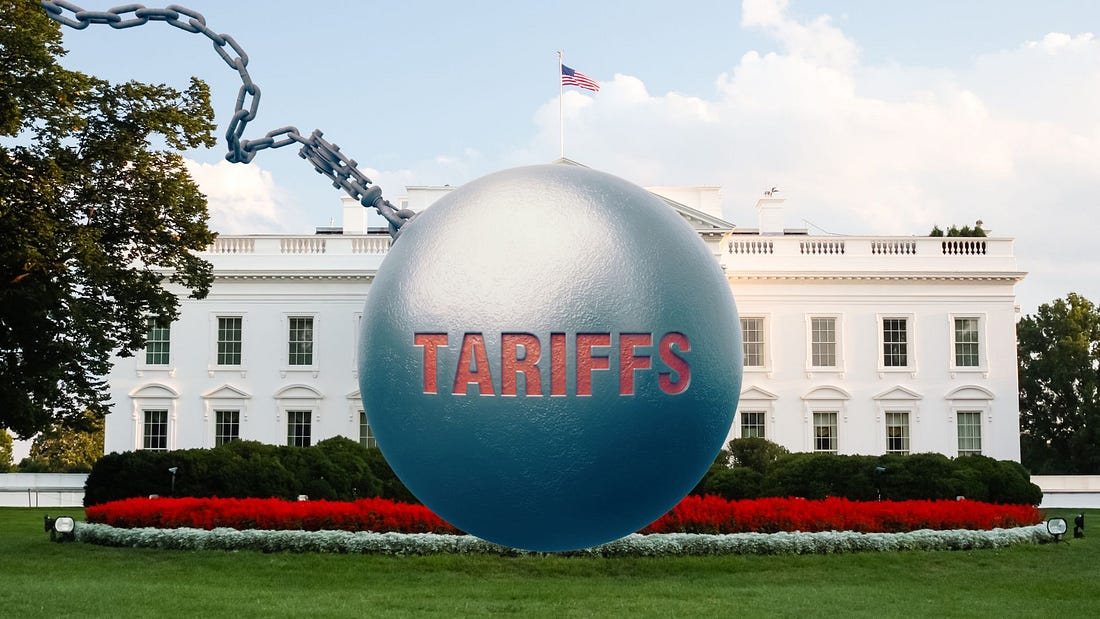
Trump’s Tariff Policy: Economic Masochism or a Power Play for the Wealthy?Trump's tariff policy is part of a wider power play designed to consolidate power and transfer wealth to those at the top.
Welcome to Change Oracle Don’t recognize this sender? Unsubscribe with one click Richard Matthews recently imported your email address from another platform to Substack. You'll now receive their posts via email or the Substack app. To set up your profile and discover more on Substack, click here.
Strip away the political messaging, and America’s tariff strategy has little to do with national security; it’s a mechanism for power consolidation and discreet wealth transfer to the elite. These tariffs are doing a lot of harm without much good, and the evidence suggests they are not achieving the American administration’s publicly stated objectives. History indicates that when limited, targeted, and temporary, tariffs can be useful in certain specific contexts. Historically, broad-spectrum tariffs like the ones being imposed by U.S. President Donald Trump have caused immense harm. Tariffs are taxes on imported goods, and they are a form of economic nationalism often framed as a national security issue. Whether or not we subscribe to the dubious national security claim, there is a growing body of contemporary evidence -- from inflation to the burgeoning trade deficit -- that indicates tariffs are harmful on multiple levels. Tariffs have not, and according to many economists, they cannot reshore manufacturing. While they are generating revenue, there is reason to believe that the net benefits of tariffs as a source of federal revenue will be short-lived. Any gains will pale in comparison to the adverse consequences. Tariffs are inefficient, and they breed uncertainty. They disrupt supply chains, reduce trade volumes, and increase consumer vulnerability. They also hurt people and businesses, especially small and medium-sized businesses (SMEs). To appreciate just how far Trump and the Republican Party’s support for tariffs depart from conservative orthodoxy, consider the words of former president Ronald Reagan in what he described as “sound economic reasons” for opposing tariffs. Reagan said, “imposing such tariffs or trade barriers and restrictions of any kind are steps that I am loath to take”. He chided those who advocate for tariffs, saying they are putting America’s prosperity and millions of jobs at risk, “to go for the quick political advantage…for the sake of a short-term appeal”. The Short-Term Illusion and Long-Term Damage of Tariffs“You see, at first, when someone says, Let’s impose tariffs on foreign imports,’‘ it looks like they’re doing the patriotic thing by protecting American products and jobs. And sometimes for a short while it works -- but only for a short time.”
Tariffs can appear to be effective if they are applied in very specific circumstances. They raise the price of imported goods, making domestic alternatives more competitive while boosting government revenue. But they often backfire over longer time frames. Trade wars are one of the reasons tariffs tend to fail in the medium and long term. Tariffs and retaliatory measures, including counter-tariffs, drive up costs for businesses and consumers. Tariffs make businesses less competitive and foster government dependency. Tariffs also reduce efficiency and innovation within firms and more broadly across the economy. Although the U.S. economy is showing signs of weakness, some take solace from data that shows it is stronger than anticipated. However, others argue the real impact of tariffs has yet to hit home. The IMF signaled concern, suggesting that it is “premature” to minimize the impact of tariffs. Many economists believe that the U.S. is living on borrowed time. What History Tells us About Tariffs“Many economic analysts and historians argue that high tariff legislation passed back in that period called the Smoot-Hawley tariff greatly deepened the depression and prevented economic recovery.”
Targeted tariffs have historically been useful when they are temporary. They can be used to protect emerging industries, secure national interests, respond to unfair trade, raise government revenue in developing nations, or stabilize economies during crises. Tariffs work best when combined with domestic investment and innovation, not when they are politically motivated or controlled by special interests. Tariffs have proven to be particularly destructive when applied in response to a global downturn. There is a historical precedent from the 1930s that can help us understand the implications of Trump’s tariff policy. The average tariff rate in the U.S. is the highest it has been since the passage of the Smoot-Haley Tariff Act in 1930. This Act caused world trade to collapse, worsening the Great Depression. The history of tariffs indicates that short-term gains soon give way to serious, systemic medium- and long-term harm. As reviewed in a recent NBER macroeconomic analysis, tariffs and trade wars have been shown to lead to contracting GDP, rising inflation, and a widening trade deficit. The Hidden Costs of Tariffs on American Households“Tariffs are taxes, and like all taxes, they are paid by consumers, not by exporters.”
Trump’s contention that exporters are the ones who pay for the tariffs is simply not true. Contrary to Trump’s narrative, the cost of tariffs is borne by American importers and ultimately by Americans. The NBER analysis of Trump’s first term indicates that domestic consumers and importing firms are the ones who paid the tariffs not the foreign exporters. The American Economic Association came to a similar conclusion for imported Chinese goods. Companies are increasingly passing these costs on to consumers. As reported by Investopedia, several recent analyses indicate, “U.S. consumers are footing much of the bill for tariffs, and are likely to pick up an increasing share of the import taxes in the coming months”. Conservative estimates suggest that in 2025, consumers paid $592 billion for Trump’s import taxes. Higher consumer costs are increasing the cost of living. Economists at Goldman Sachs recently concluded that as of September 2025, customers are paying 55 percent of the tariffs. However, that number is expected to increase to 70 percent in 2026. Higher costs being imposed by Trump’s tariffs are being paid for by Americans through their consumer purchasing. No wealth is being created through tariffs, the money is being redistributed from the many to the few. Tariffs are being used to offset the lost revenue due to the tax cuts for the wealthy contained in Trump’s Big Beautiful Bill. Tariffs are another way that average Americans are paying to allow the richest Americans to avoid paying their fair share of taxes. How much are tariffs costing the average American family?“Tariffs … harm foreign workers but domestic American workers as well … every workingman in the country is injured for the illicit benefit of certain classes.”
Trump’s trade war is hurting people all around the world, including average Americans. Decades ago, Ronald Reagan said, “Trade barriers hurt every American worker and consumer”. Recently, Democratic Senator Chris Murphy succinctly described Trump’s tariffs as “an absolute disaster for regular working people.” The US expects to collect $50 billion a month in revenue from tariffs without raising taxes. While this may sound good, the money is coming out of the pockets of average Americans. A 10 percent tariff is estimated to cost the average American household $1,700 per year. The tariff rate we saw in May 2025 will result in an estimated $4,000 per year cost. At levels scheduled to take effect on November 1, 2025, the cost will be even greater. Tariffs force average Americans to pay more so that wealthy people can enjoy a reduced tax burden. How Tariffs Affect Inflation and Consumer SpendingSo, soon, because of the prices made artificially high by tariffs that subsidize inefficiency and poor management, people stop buying.”
Tariffs are driving up prices, and this is driving down demand. This combination of inflation and slowing demand is driving concerns about stagflation. According to a bevy of Nobel Prize-winning economists, tariffs drive inflation. Months ago, the IMF warned of the dangers of inflation associated with these tariffs, and we have multiple indications that they are driving higher prices, as indicated by economic data, academic research, businesses’ expenses, and people’s first-hand experiences. There is a clear trend of rising prices as it relates to food, energy, rent, public transportation, apparel, accessories, and autos. Economists have increased inflation forecasts and lowered expectations for growth in the U.S. The combination of inflation (annualized 2.9 percent in August) and the hiring slowdown evident in recent labor market data is feeding concerns about stagflation. As reported by Investopedia, two recent analyses (Goldman Sachs and the Federal Reserve Bank of St. Louis) independently corroborate the finding that Trump’s tariffs are driving up inflation, with more price hikes on the horizon, as businesses pass the cost of trade to consumers. The Consumer Price Index is expected to be 3.1 percent over the year in September, which is higher than it has been in 18 months. Inflation has been consistently increasing since Trump announced his tariffs in April. According to a slew of analyses, tariffs are a major reason behind the inflationary spiral we are seeing. The Federal Reserve Bank of St. Louis estimated that the annual inflation rate increased by almost half a percentage point in August due to tariffs. We are in the very early stages of tariff impacts, but inflation is already reducing consumer purchasing power. While the impact of tariffs is only beginning to show in the data, companies are expected to increasingly pass the cost of these tariffs on to consumers, and this will keep driving inflation. Stagflation sets in as prices rise, and the labor market slows. Have Tariffs Increased Domestic Production or Investment?“Raising tariffs doesn’t increase domestic spending; it simply makes imports more expensive and reduces overall economic efficiency.”
While tariffs have been touted as a way of increasing domestic spending, there is no historical evidence to suggest that tariffs ramp up domestic production and increase local trading. This finding is corroborated by recent polls. As reported by Fortune, 62 percent of senior executives said they were not planning to invest more in the U.S. In a Wall Street Journal article, Yale management professor Jeffrey Sonnenfeld explained that tariffs are eroding the confidence of CEO’s and making it less likely that they will make any new investments in the U.S. The complexity of increasing domestic spending through tariffs is illustrated by Trump’s 45 percent tariffs on Canadian lumber. Tariffs on Canadian lumber may not stimulate long-term investments in US forestry, but they will hurt the economy. Tariffs drive up prices on lumber, especially softwood lumber, and this directly increases housing costs and harms the building sector. Lumber, especially softwood lumber like pine and spruce, is critical to U.S. home construction (new homes or new housing starts). The U.S. imports around 40 percent of its softwood lumber, 80 percent of that comes from Canada. There is no way that the U.S. can replace these imports, and the kind of wood it can harvest domestically is mostly not of the types preferred by builders. This concern not only applies to lumber. Many businesses say U.S. manufacturers will not be able to produce the products they need at a scale they require. Do Tariffs Bring Back Manufacturing Jobs?“Tariffs won’t bring back manufacturing jobs. They will simply raise prices and invite retaliation.”
The complex dynamics associated with using tariffs to increase domestic spending are even more complex in the context of efforts to reshore manufacturing. Although tariffs are being portrayed as a way of bringing manufacturing back to the U.S., they are not achieving the stated objective, as evidenced by the fact that there has been no increase in year-over-year manufacturing investments in 2025. As reviewed in a Politico article, “Trump’s reshoring push is tripping over itself” adding “His policies are punishing them when they try.” Business leaders are concerned about the administration’s approach, and they are concerned about the durability of Trump’s tariff regime and rapidly shifting policy positions. Business leaders are being paralyzed by uncertainty. The result is that the business community has offered a lot of promises, but little real action. In some cases, there is a paradoxical effect in which increased prices from tariffs are incentivizing production outside the U.S. (e.g. steel production). In other cases, tariffs on intermediate goods are hurting American companies (e.g. semiconductors and auto parts). Reshoring is proving difficult because even if manufacturing plants are built in the U.S., there are insufficient skilled domestic workers to staff these facilities. To make matters worse, the Trump administration is killing or paring back programs that could drive investments, increase domestic manufacturing, and provide jobs. “Trump’s tariffs make absolutely no sense as economic policy to try to bring back jobs to the United States,” Senator Murphy explained, adding, “The jobs are not going to show up”. Although the tech industry has seen signs of increased U.S. production, the relative cost of labor makes reshoring uneconomic. Most consumers will not absorb the massive price increases associated with reshoring manufacturing. Ben Steil, Senior Fellow and Director of International Economics (CFR), called the effort to reshore manufacturing through tariffs “impossible”. According to a post-tariff survey, almost two-thirds of American firms in China plan to maintain their investments in the country. As quoted by Politico, Cameron Johnson, a senior partner at Shanghai-based supply chain consultancy Tidalwave Solutions, said the tariff strategy has “blown up,” adding “None of this stuff is going to be reshored…so medium- and lower-end U.S. firms are either bailing from the market or they’re going out of business.” Tariffs and the Trade Deficit: Are They Making Things Worse?“Tariffs are taxes, and like all taxes they burden the economy and increase the deficit and the national debt.”
One of the stated goals of tariffs is to generate revenue to pay down the U.S. national debt that now exceeds $37.9 trillion. However, as reported by Fortune, the national debt is rapidly increasing, and tariff revenues are shaky. The debt-to-GDP ratio (currently at 124%) will keep rising despite tariff revenues and temporary deficit relief. J.P. Morgan’s David Kelly explained, the reason markets are not panicking yet is because America is “going broke” slowly. The situation could quickly deteriorate as the economy softens, and investors continue to move away from U.S. assets. According to a report released by the Congressional Budget Office (CBO), tariffs will reduce the federal debt by $4 trillion over the next decade. However, the CBO report did not account for inflation or recession, both of which will substantially decrease federal revenue (increasing prices will reduce demand for tariffed goods, so revenues will decline in lockstep with declining imports). CNN estimated that provisions in Trump’s Big Beautiful Bill are expected to increase the federal debt by an estimated $4.1 trillion between 2025 and 2034. Even without factoring inflation on tariff revenues, this is more than the tariffs are forecast to bring in. How the trade deficit has changed since the start of Trump’s tariff war“Tariffs don’t reduce the trade deficit. They actually increase it by making American exports less competitive.”
Although one of the purported goals of tariffs was to reduce the U.S. trade deficit, it Is currently growing at a record pace. Since Trump’s inauguration, the U.S. has set records for the biggest monthly trade deficits in the country’s history. As reported by Forbes, in January, the deficit soared to $153.28 billion as Trump began threatening the world with a tariff-driven trade war. The trade deficit remained above $100 billion for the first three months of 2025, as importers tried to get products into the country before tariffs took effect in April. The trade deficit then declined until July, when it hit $117.13 billion, a jump of more than one-third from the $85.67 billion total in June. As of July, the U.S. deficit topped a record setting $809 billion, up 22.43 percent compared to the $661 billion figure from 2024. According to the U.S. Congress Joint Economic Committee, over the 12 months through July 2025, the U.S. ran a total trade deficit of $1.06 trillion. In trade of goods, the U.S. ran a deficit of $1.37 trillion. The U.S. trade deficit is expected to continue to rise as the tariffs take effect. The Global Fallout: Retaliation and Trade Wars“High tariffs inevitably lead to retaliation by foreign countries and the triggering of fierce trade wars. The result is more and more tariffs, higher and higher trade barriers, and less and less competition.”
Even if tariffs are used to reduce the income tax burden on average Americans, any gains will be wiped out by reciprocal tariffs. Many countries (Canada, the EU, India, Russia, and China) have imposed retaliatory tariffs on the U.S. The U.S.–China trade war (2018–2020) is a recent example of the adverse impacts of tariffs and counter-tariffs. In 2025, China imposed retaliatory measures that included restricting of exports of critical rare-earth materials. This prompted Trump to announce that he was imposing an additional 100 percent tariff on top of the 30 percent tariffs already imposed on China. The growing trade war prompted a market sell-off worth $2 trillion. Immediately after Trump announced additional tariffs against China, the Dow fell 1.9 percent, the S&P declined 2.7 percent, and the Nasdaq was down 3.5 percent. Cryptocurrencies also fell, with bitcoin registering an 8 percent decline. China has indicated that it is going to retaliate against the latest round of Trump tariffs. As reported by the Guardian, a spokesperson for the commerce ministry laid out Beijing’s response to Trump’s threats saying, China will “resolutely take countermeasures” adding, “If the United States insists on going the wrong way, China will surely take resolute measures to protect its legitimate rights and interests.” The ripple effect on global trade and markets“First, homegrown industries start relying on government protection in the form of high tariffs. They stop competing and stop making the innovative management and technological changes they need to succeed in world markets.”
American consumers and businesses will pay for Trump’s tariffs, but there are also other ways that the U.S. is incurring economic losses and non-monetary costs. This includes widespread market uncertainty that discourages investment. There are clear signs that foreign investors are stepping back from dollar-backed assets and US Treasuries. A Bloomberg analysis indicates that Trump’s tariffs will cost the global economy 1 trillion by 2030 and cause hundreds of thousands of people to lose their jobs. A quick summary of some of these costs can be attributed to delays and production risks associated with reconfiguring suppliers in the face of supply chain disruption. Tariffs add costly additional bureaucracy, including regulatory and compliance burdens, and they can lead to a technological slowdown due to retaliatory measures that restrict access to foreign materials. More generally, tariffs are costly because they breed inefficiency and erode competitive discipline for industries shielded from competition. In the U.S. at present, higher import costs have been largely offset by generous tax breaks and immediate expensing afforded by Trump’s Big Beautiful Bill. There are also billions of dollars of lost revenue due to a precipitous decline in visitors to the U.S. (the decline in Canadian visitors alone accounts for an $8.5 billion loss). Other, ancillary non-monetary costs associated with tariffs include tarnished American prestige and an end to the country’s ability to project soft power. What happens when other countries respond with counter-tariffs?“Tariffs make the United States less competitive and more vulnerable to retaliation from our trading partners.”
Although Trump endlessly repeats the refrain that the U.S. does not need anything from anybody, this is simply not true. The U.S. is strategically dependent on imports for critical minerals (particularly rare earth minerals), energy materials (e.g. electricity and crude oil), advanced manufacturing inputs, pharmaceuticals, tropical food products, and electronics—many of which are essential for its economy, technology, and national security. The United States is vulnerable because foreign countries are financing a large share of U.S. government spending. This includes almost half of defense spending. As of June 2025, foreign countries collectively held $9.1 trillion in U.S. Treasury bonds. If we take $814 billion (military spending in 2024) and divide by $1,833 billion (deficit), around 45 percent is paid for by Treasury bond issuance. This translates to $300–$400 billion borrowed to fund military expenditures. American vulnerability is evident in the increased U.S. Treasury yields that indicate weakening demand for government debt and suggest rising expectations of future inflation. A coordinated offloading of US Treasury Bonds would be painful for the sellers, but it would cause financial turmoil in the U.S., increasing financing costs, and potentially leading to violent selloffs (fire sale dynamics) and the weakening of the U.S. dollar. Tariffs, Corruption, and DemocracyTariff laws violate the principle of democracy by creating a favored class.”
Tariffs can undermine democracy by favoring special interests over the broader public, reducing transparency and accountability in policymaking, and distorting consumer choice and economic freedom. When used to protect specific industries, tariffs often bypass democratic debate and disproportionately harm consumers and other sectors, especially lower-income groups. They can also fuel nationalism, concentrate power in the executive branch, and damage international democratic alliances. Over time, these effects erode public trust in democratic institutions and open the door to authoritarian or populist movements. Senator Murphy contends that tariffs are part of Trump’s efforts to cripple democracy. “Trump’s tariffs are not an economic policy, it’s not a trade policy, it’s a political weapon designed to collapse our democracy,” Murphy said. More than a century ago, Woodrow Wilson exposed the rationale behind Trump’s tariffs when he said, “Democracy is harder to maintain behind a tariff wall”. Tariffs are part of a systematic effort to wrest control away from democracy and democratic processes. As explained by Murphy, “[Trump] is trying to destroy democracy that is why he is going law firm by law firm, university by university to try to bully them into pledging loyalty to him. The tariffs are going to do the same thing to private industry.” How tariffs create opportunities for political favoritism“Trump’s tariff policies don’t make sense…its an attempt to collapse the economy so that all these companies can come to him to make pledges of political loyalty…”
Tariffs create corruption risks because they give the government discretionary power over who pays what, which opens the door to bribery, favoritism, and political manipulation. Governments can use tariff enforcement as a political weapon, targeting rivals or rewarding allies, which erodes the rule of law and strengthens corrupt patronage systems. As former President Wilson wrote, “The tariff corrupts both politics and business; it poisons the very spirit of free government.” When political approval is required for tariff exemptions and special licenses, it incentivizes lobbying, favoritism, and kickbacks to secure special treatment. The complexity and constantly shifting dynamics of tariff schedules are conducive to corruption. This makes it easier for officials to exploit loopholes or demand informal payments to “help navigate” the bureaucracy. Domestic companies that benefit from tariffs have a strong incentive to influence policymakers to keep or raise tariffs, creating a breeding ground for corporate lobbying, cronyism, and political capture. High tariffs also make smuggling profitable. Smugglers often pay bribes to border officials to move goods illegally, leading to entrenched corruption networks. There is evidence of such corruption in countries like Brazil, India, and Nigeria. The Trump administration has been accused of corruption by people like New York University Stern School of Business professor Scott Galloway. He alleged that Trump’s tariff policies have enriched his MAGA cronies in the “greatest day of insider trading and grift in history.” Tariffs give Trump leverage to force companies to make contributions, champion his policy agenda, and police their employees. Tariffs are being used as a means of exerting control and forcing obedience. As explained by Senator Murphy, “each big company or each big industry is going to have to come to Trump, get some tariff relief in exchange for political loyalty, in exchange for a commitment to buy Trump cryptocoin, or a commitment to make sure their workers and employees don’t speak out against Trump.” Who Really Benefits from Trump’s Tariffs?“Protectionism is a war upon labor. Its tendency is to make the rich richer and the poor poorer. It is government for the producers of wealth, not for the people.”
Tariffs are harmful to Americans, particularly people and families in the low and middle-income brackets. They also hurt American farmers and the millions of SMEs that are reliant on imported materials and goods. Large-scale domestic producers, such as those in sectors shielded by tariffs (for example, steel, aluminium, and car parts), gain through reduced foreign competition and higher prices. Big agricultural businesses and politically connected firms also benefit, thanks to substantial bailout packages during tariff wars – as, of course, does the US Treasury, which pockets the tariff revenue. Tariffs offer political benefits. Tariffs give the impression of strength, and they command global attention. Perhaps most importantly, they defray the costs of tax cuts for corporations and the wealthiest Americans contained in Trump’s Big Beautiful Bill. Tariffs are yet another way that Americans are being forced to bear the costs of socially regressive economic policy designed to benefit the wealthy. Tariffs are also a means of control as they provide points of leverage. They can be used as a cudgel to exert pressure domestically and on other countries. Are Trump’s Tariffs Breaking the U.S. Economy?“[In a tariff regime] Markets shrink and collapse; businesses and industries shut down; and millions of people lose their jobs.”
Tariffs are costing a fortune. According to an S&P Global white paper, the cost of tariffs is estimated to be a staggering $1.2 trillion as of September 2025. “It would be hard to think of a more elegant way to reduce prosperity this fast,” Galloway said of Trump’s tariffs. “We’re talking about a destruction in shareholder value such that your parents can’t retire as quickly,” he said. As explained in the Investopedia article, multiple studies reveal that “Tariffs have had a significant effect on the economy as a whole as well as personal finances, with more impact to come as prices are expected to continue rising in the coming months.” Galloway called tariffs “stupid” and said Trump is “blackout drunk” at the “wheel of the global economy”. “The injury will take years, if not decades, to heal,” Galloway said, referring to the damage done by tariffs. Billionaire investor and founder of Bridgewater Associates, Ray Dalio, famous for having predicted the 2008 financial crisis, said, Trump’s tariffs have broken the world economic order, and there is no escaping the damage that these tariffs have caused. Tariffs are increasing the national debt and as Dalio explained, this is “unsustainable because of the large imbalance between debtors and lenders.” Dalio argues that debt is driving an economic breakdown due to the “interconnectedness” of trade and capital flows, which is affecting all risk assets simultaneously. He describes Bitcoin’s dive after Trump’s “liberation day” as a “classic breakdown of the major monetary, political, and geopolitical orders”. Dalio anticipates many countries will bypass the United States altogether. He joins with others in raising the prospect that the U.S. dollar will cease to be the world’s global reserve currency. Dalio, Jamie Dimon, CEO of JPMorgan Chase; Stanley Druckenmiller, founder of the Duquesne Family Office; hedge fund investor Bill Ackman and many others have all indicated that Trump’s tariffs are harmful to the economy. The prevailing sentiment about tariffs was summarized 140 years ago by the political economist Henry George, who wrote, “What protectionism teaches us is to do to ourselves in time of peace what enemies seek to do to us in time of war.” What Is Trump’s Real Tariff Agenda?“The real purpose of tariffs is to erect monopoly, to enrich a few at the expense of the many.”
Tariffs provide limited short-term benefits, but any gains are far outweighed by the litany of adverse impacts. Short-term gains have historically caused medium- and long-term pain. Tariffs drive inequality, so while they are great for many wealthy people, they will hurt almost everyone else. Americans are the ones who pay for the tariffs, and they are also impacted by the adverse impacts on the broader economy (e.g. inflation/stagflation). There is little evidence to support the claims that tariffs achieve the publicly stated objectives. Tariffs have not increased domestic spending, nor have they succeeded in reshoring manufacturing. However, tariffs do increase the trade deficit and inflate the national debt. Reciprocal tariffs combine with economic impacts and ancillary costs that make it hard, if not impossible to argue the merits of tariffs. Tariffs expose American vulnerabilities, while breeding corruption and undermining democracy. How tariffs fit into Trump’s broader strategy for power“When plunder becomes a way of life for a group of men in a society, they create for themselves a legal system that authorizes it.”
Tariffs are all about gaining leverage. “[E]very business has to come to the White House and make a deal with Trump in which he gives them tariff relief in exchange for a pledge of political loyalty” Senator Murphy said, adding “everything Donald Trump is doing is in service of staying in power forever, either him or his family or his handpicked successors.” In the final analysis, tariffs do not serve the interests of America or most Americans. Trump’s tariffs have been called economic masochism and a self-inflicted crisis. However, closer inspection reveals there is self-interest and even method behind Trump’s actions. Tariffs are a part of a wider power play designed to consolidate power and transfer wealth to the tiny minority at the very top of the economic pyramid.
|
Thursday, 23 October 2025
Trump’s Tariff Policy: Economic Masochism or a Power Play for the Wealthy?





Subscribe to:
Post Comments (Atom)
The 'Hear Her' Training workshop is back!
We will be running an online training workshop in March for women who want to learn more about running for election ...

-
Dear Reader, To read this week's post, click here: https://teachingtenets.wordpress.com/2025/07/02/aphorism-24-take-care-of-your-teach...
-
A slightly unconventional guide to your first time ͏ ͏ ͏ ͏ ͏ ͏ ͏ ͏ ͏ ͏ ͏ ͏ ͏ ͏ ͏ ...


No comments:
Post a Comment