For Argument’s Sake: Nobody Wants ThisSarah laughs, Abraham argues, God blinks and Joanne discovers the secret sauce. What if faith isn’t obedience but heated conversation — a running argument with a touch of sarcasm?
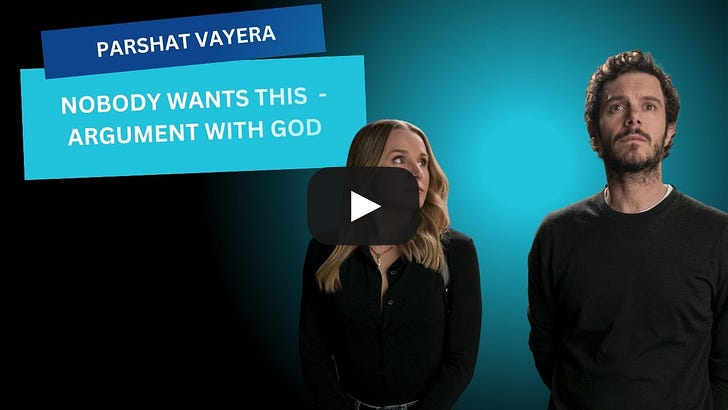 Season 2: Episode 8 “A Better Rabbi” [after counseling an estranged husband)
… and Joanne moves an inch closer to embracing this crazy religion…. It’s a throwaway line in the Netflix series Nobody Wants This—until you realize it might hold the key to understanding not only Judaism, but this week’s Torah portion, Vayera. Because Vayera gives us three seemingly unconnected scenes: Sarah laughing at the promise of a miraculous birth, Abraham arguing with God over Sodom, and the near-sacrifice of Isaac. But when you view them together—like a triptych—they reveal a single, complex portrait of faith as animated dialogue. Joanne was right: Judaism does encourage argument. But she might have added that it also encourages humor—that laughter, like argument, is a form of dissent. Judaism sanctifies disagreement, whether expressed aloud or, just as often, whispered inside the mind. Scene One: The Laugh — The Argument WithinGenesis tells us that when Sarah overheard the angels’ promise, she “laughed to herself” (Genesis 18:12). The Hebrew phrase b’kirbah literally means “within herself.” Her laughter was silent, inward—a debate unspoken. A chapter earlier, Abraham had done the same: “Abraham fell on his face and laughed” (Genesis 17:17). His body reacts, but his words are restrained. Both husband and wife experience the same inner conflict between wonder and disbelief—but only Sarah is confronted for it. As The Torah: A Woman’s Commentary notes, “When Abraham heard that he would have a child with Sarah, he fell on his face and laughed... Yet only Sarah’s laughter is challenged.” These women commentators provocatively suggest that God’s rebuke to Sarah may have been a test for Abraham—to see whether he would defend her. Instead, he stays silent. Another commentator in the same volume goes further: “Sarah was afraid. Whom does she fear? Most assume she fears God. I contend that she fears Abraham.” In this reading, Sarah’s laughter and her denial—“I did not laugh”—are not faithlessness but but a rebuke of her husband, who like Adam, let’s the blame fall on his wife for a sin that he too committed. (when will they ever learn….) Her inner laughter, then, is not derision but defiance—an early proud example of human (alt. female) resistance. Faith as Laughter, Laughter as DefianceThere’s something profoundly Jewish about meeting miracles with incredulity. Christianity’s story of miraculous (virgin) birth is framed by awe and worship; the angels sing. But our matriarch and patriarch, faced with the same absurdity (birth after menopause), roll over laughing. It’s not disbelief—it’s protest wrapped in humor, a way of saying: This makes no sense, you’ve got to be kidding! If Joanne in Nobody Wants This loves that Judaism encourages argument, she could also love that it encourages laughter. Both are ways of staying in relationship—refusing to walk away from the impossible, even as we question it. Laughter, like argument, keeps us human. It’s not only a survival mechanism—it’s a form of defiance. Scene Two: The Argument — The Dialogue WithoutWhen God tells Abraham His plans for Sodom, something remarkable happens. The text prefaces it with God’s soliloquy:
The Ramban (Nachmanides) reads this verse with exquisite sensitivity: God said this to Himself. In other words, even God has an inner debate. Before God invites Abraham into the argument, He has one within His own mind. And Abraham responds in kind—with both internal and external conversation. He “approached” (vayigash) God and began his audacious plea:
The rabbis never shied from calling this a confrontation. In Bereshit Rabbah, they say Abraham “came forward for battle,” interpreting vayigash as a term of combat. Rabbi Yehuda says he came to fight. Rabbi Nehemia says he came to reconcile. Rabbi Pinhas says he came to pray—which, in Judaism, amounts to the same thing. Prayer, the rabbis teach, is doing battle in words. And yet, even here, there’s also an unspoken dialogue. Before Abraham speaks, we are told “Abraham remained standing before the Lord.” Silence hangs in the air. A pause before protest. A hesitation that reminds us: not all arguments are verbal. Scene Three: The Silence — The Argument HiddenAnd now we come to the Akedah—the Binding of Isaac. At first glance, this Abraham appears utterly transformed: obedient, submissive, silent. But in light of the first two scenes, that silence feels charged, not empty. If Sarah’s laughter and Abraham’s debate were internal conversations made visible, then here we witness the inverse—an internal storm contained. The story begins:
That opening phrase—“after these events”—links the Akedah directly to the laughter of Sarah and the argument over Sodom. The Ramban explains that nisa, “test,” is related to nes, meaning “miracle” or “banner.” A nisaon doesn’t test the unknown—it reveals the hidden. L’hotzi hadavar min hakoach el hapo’al—to bring potential into actuality. In this light, the Akedah is not so much a test of Abraham but a revelation of Abraham’s deepest nature—the same pugnacious, questioning nature we saw before. When God commands, “Take your son… and offer him there as a burnt offering on one of the heights that I will show you,” Abraham says nothing. But we, the readers, now have license to assume an inner debate raging in his mind. The Torah has trained us to hear the silent argument beneath the words and in this case the utter disbelief in the project. When Abraham tells his servants, “Stay here with the donkey. The boy and I will go up there; we will worship, and we will return to you” (Genesis 22:5), we can hear defiance in his tone. As if to say: Don’t believe everything you’ve heard. There’s no way this ends with my son’s death… “we will return to you” When Isaac asks, “Father, where is the sheep for the offering?” Abraham replies, “God will see to the sheep for the burnt offering, my son.” (Genesis 22:7–8) Imagine his voice trembling—not with obedience, but with barely contained indignation. The firestone in one hand, the knife in the other, he glares toward heaven as if daring God to provide the alternative. And God does.
But read with irony, this verse reveals a deeper truth. Perhaps it is not Abraham who has been tested, but God who has been confronted—drawn to the brink of moral collapse and forced to blink…. or alternatively, God who is smiling with pride over Abraham’s stoic resolve. Like the miracle, the nisaon brings what was hidden to light. Abraham’s silence, far from submission, becomes the loudest argument of all. The Triptych of DissentSeen together, these three stories capture the origin of a religion and culture that encourages us to argue.
Each stage refines the art of argument—moving from the mind, to the mouth, to the soul. Faith That Fights BackJudaism’s genius lies in its ability to sanctify dissent. The Torah doesn’t erase the inner voice; it amplifies it. God thinks to Himself. Sarah laughs to herself. Abraham argues with himself—and with God. And through that web of dialogues, a people learns that the transcendent lives not in certainty, but in the conversation between conviction and doubt. In Nobody Wants This, Joanne’s “inch” toward conversion is an inch toward that realization. A faith that welcomes disagreement, that values laughter and argument as sacred acts—that’s a religion worth wanting. What we want is a third season where the real dialogue begins. Note to the creators: Rabbi Adam and I are available as disruptive Torah consultants. Sefaria Source Sheet: https://www.sefaria.org/sheets/686496 Transcript: Geoffrey Stern: This week I was binging the second season of Nobody Wants This, a romantic comedy that explores the unlikely relationship between an outspoken, non-Jewish podcast host and an unconventional, newly single rabbi. The young rabbi has just admitted there are no answers, just different opinions, and his not-yet Jewish girlfriend lights up: “A religion that encourages me to argue. Love that.” It’s a throwaway line until you realize it might be the key to the whole Abraham story. Because this week the Torah gives us three scenes that look unrelated until you tilt your head. First, angels announce a miracle child, and Sarah laughs quietly, honestly, and she gets called out. Second, Abraham stands toe to toe with God over Sodom, haggling the number down like a street smart ethicist. Third, the Binding of Isaac, where rabbinic memory insists that even the patriarch of faith had arguments on the tip of his tongue. What if these aren’t separate stories at all, but one experiment, repeated under different conditions, testing whether a people can build a relationship with the divine not by submission, but by conversation? Judaism’s love language is dispute, not outrage for its own sake, but the kind of arguing that makes the world more merciful and the truth precise. Sarah’s laugh is an inner dissent. Abraham’s bargaining is civic courage, and the Akedah’s midrash is protest sublimated into loyalty. Together they suggest a radical claim that God invites human pushback and history moves when we take that invitation seriously. For argument’s sake, let’s follow the laughter in the tent, the negotiation at the edge of Sodom, and the near sacrifice on Moriah and see how Jewish disagreement turns fear into faith and faith back into responsibility. Welcome to Madlik. My name is Geoffrey Stern, and at Madlik, we light a sparkler, shed some light on a Jewish text or tradition. Along with Rabbi Adam Mintz, we host Madlik Disruptive Torah on your favorite podcast platform and now on YouTube and Substack. We also publish a source sheet on Sefaria, and a link is included in the show Notes. This week we read Parshat Vayera. We explore the overt and covert friction and conflict in the narratives of the prediction of a child to Sarah, the trial of Sodom, and the binding of Isaac. We view it through the lens of texts and a tradition which embraces dispute. So join us for argument’s sake. Adam Mintz: And this is an amazing topic today, so let’s get going. Geoffrey Stern: So if I achieve nothing else, Rabbi, you’re gonna see the whole two series of Nobody Wants This. A person like you who’s involved with conversion, you just have to see It. I can’t believe you hadn’t really. You’ve heard about it, but you hadn’t actually seen it. Adam Mintz: I told Sharon after you mentioned it, we’re gonna see it. So you did it. Geoffrey Stern: What’s amazing is it is won amazing awards. And the sites that rate our series, I think it’s at 95%. I mean, It must be a broad audience is interested in its comic, its love, but it’s ethnic. It’s about religion. I just find it fascinating, not only that it was produced and got a second season, but that people are watching it and enjoying it. And so I thought, why not tie it into this week’s parsha? Now, the dialogue that I want to start with comes after Noah. The rabbi is doing his foray into couples therapy, but he’s only talking to the husband. And after a while, he stops preaching and he starts listening. And that’s where he realizes that there are no answers. So the dialogue picks up then, and he says, this is Rabbi Noah speaking: “Honestly, it was one of my proudest moments as a rabbi. We spent hours talking about marriage, examining it, re-examining it, pulling it apart and debating it.” Joanne, the girlfriend, says, “So what’s he going to do?” “I don’t know. That’s the thing about Judaism. We love to talk about things from every direction. You know, I was being too rigid in how I was looking at it before.” “I love analyzing things from every direction.” She says, “I know, it’s very Jewish of you.” He says, “A religion that encourages me to argue. Love that. Sorry, hold on. I’m just texting her mom.” And at that point, she actually was writing to herself. “I think I just moved an inch.” And that inch is towards conversion. So here is a woman who was attracted to our faith because of our embrace of dispute. Rabbi, have you ever come across that? Adam Mintz: Of course they love the energy. You know, what you would say? The beit midrash (Study Hall) energy, the bes medrash energy. There’s nothing like it. Geoffrey Stern: Okay. So I said, we’re going to have three little scenes here. So the first one is in Genesis 18, where the angels come. And they said to him, where is your wife Sarah? Speaking to Abraham. And he replied, they’re in the tent. Then one said, I will return to you next year, and your wife Sarah shall have a son. Sarah was listening at the entrance of the tent, which was behind him now. Abraham and Sarah were old, advanced in years. Sarah had stopped having her periods. And Sarah laughed to herself, saying, now that I’ve lost the ability, am I to have enjoyment with my husband so old? Then God said to Abraham, why did Sarah laugh, saying, shall I in truth bear a child, old as I am, Is anything too wondrous for God? I will return to you at the same season next year, and Sarah shall have a son. Sarah lied, saying, I did not laugh, for she was frightened, came the reply, you did laugh. So this is great. The segue from this sitcom, if you will, is perfect because there it was, couples therapy. And here we’re talking about not necessarily a relationship between man and God, but two individuals maybe monitored by God. And there are so many amazing points here. But the first thing that struck me is that, you know, the whole book of Genesis, Rabbi, if you think about it, is the story of miraculous birth. Every one of the matriarchs has problems having a child. In the case of Sarah, she’s 90 years old. She has no right biologically to have a child. So it’s a miraculous birth. Obviously, another religion, Christianity, is born on the virgin birth. But the response that our patriarchs and matriarchs have to the idea of a miraculous birth is they fall down laughing. And I find that to be kind of amazing because it’s part and parcel of this, I wouldn’t say argumentativeness, but this ability to look at things and say that makes no sense at all. Are you kidding me? I just think that’s a wonderful way to start. Adam Mintz: It is amazing. I would just add, isn’t it amazing that you know, that God said, you laughed and she denies it? Can you imagine denying things to God? Like, it’s one thing. We deny things to one another. Who knows what the truth is? But this is God. What does she think? Geoffrey Stern: So here’s where we live in an amazing moment, Rabbi. We live in a moment where women are starting to write commentaries on the Torah. And so in The Woman’s Commentary, which is in the Sefaria notes, why is Sarah laughing? Some interpreters have concluded erroneously that Sarah’s laughter was divisive. When Abraham heard that he would have a child with Sarah, he fell flat on his face. A few verses before, Abraham also laughed, and he literally fell on his face and he said the same thing. So what The Women’s Commentary is saying is actually that God is testing Abraham to see if he’s going to stand up for Sarah and protect Sarah. It’s kind of like Adam and Eve. We do remember where Eve ate from the fruit. She gave it to Adam. And when God confronted Adam, he goes, I didn’t do it. She gave it to me. Here he laughed out loud. And a few verses, she laughs. But this, the next commentary, comes right to your question. Sarah was afraid. Whom does Sarah fear? Most interpreters assume that Sarah is afraid of God. I contend, says this woman commentator, that she fears Abraham. Sarah has no reason to fear God, who apparently comes to her rescue in the house of the Pharaoh, blesses her and promises her. Remember all those stories where Abraham is coming down to Egypt and he pawns off Sarah as his sister, not his wife? God saves her all of those times. God was always there. However, she does have reason for fearing Abraham. He does not seem to object. When she is taken to Pharaoh’s palace, he allows Hagar to treat her disrespectfully. And insofar as the reader knows, he has not informed her that they will be having a child. It’s a fascinating new take on it, because the verse does not say who asked the question and who she was afraid of. Adam Mintz: Yeah, I mean, that is so interesting. Geoffrey Stern: Right? Adam Mintz: And that’s what I’m pointing out. You know, that last verse that she laughs and she’s afraid and God says, don’t do it. It’s so. ... the fancy word is it’s enigmatic. You’re just not sure what’s going on, what the Torah is trying to teach you. Now, of course, you have to know that later on, when Isaac is born, he’s called Yitzchak, after the laughter. So obviously this laughter is not just a mistake. This identifies who he is. Geoffrey Stern: It’s not such a bad thing. Again, it shows, as you say, enigmatic. It shows that there’s no right side, there is no heroes here, and there’s no correct position. I also love the fact that we’re getting into what people and God are thinking. She says within herself, Ibn Ezra says, in her mind, God reveals Sarah’s inner thoughts. In the pasuk that talks about Abraham also, it seems to be that Abraham was thinking, this is crazy, but didn’t say it. And this is going to become very important. I think when we look at the Akeidah, this emphasis on dialogue and on disparate opinions does not only operate in the verbal universe, it also operates inside of the minds of the protagonists. And it has value. Humor has value. I was gonna say that if the girlfriend had said that this is a religion that loves dispute, she might have also said, and it loves humor and it loves laughter. Because the response that she gives her way of, I would say, going against reality, of standing up to something that made no sense, was to laugh. And so In a sense, laughter itself is a form of dispute or of taking another position and getting more involved in the questions. I just love all of the different elements that come to fore here. Adam Mintz: Yeah, I mean, it’s fantastic. Okay, let’s go to the next story, because each one of these stories is connected to the next story. So let’s move on to the Sodom story. Geoffrey Stern: Okay, so now we have Sodom. And the angels have given Abraham this great news. And the angels go down to Sodom and God says, shall I hide from Abraham what I am about to do? And here the commentaries also say, God is thinking it, he’s not saying it. I just love the fact that in these stories we are giving such value to the inner mind and to the conflict and the questions that humans and gods might have. Since Abraham is to become a great populous nation and all the nations of the earth are to bless themselves by him, for I have singled him out that he may instruct his children and his posterity to keep the way of God by doing what is just and right in order that God may bring about for Abraham what he had promised him. So he goes through a whole description of who he is to Abraham and says, I can’t hide this from him. Then God said, and now he’s talking out loud, I assume, and he’s talking to Abraham. The outrage of Sodom and Gomorrah is so great and their sin is so grave. I will go down to see whether they have acted altogether according to the outcry that has reached me. If not, I will take note. So then the angels go down and it says, while Abraham remained standing before God, Abraham came forward and said, will you sweep away the innocent along with the guilty? So here, I think, you know, I have a book. It’s called Arguing with God, a Jewish tradition. This is the argument of Abraham with God is, I would say, a piece of evidence #1 in this. And he stands up to God. We’re gonna see what the rabbis talk when they say he came forward, but he is making his move and he is saying, how is this possible? Adam Mintz: Now, I just wanna tell you that’s an interesting argument. You sweep away the innocent along with the guilty. I mean, maybe the answer is that’s what God does. That if most people are guilty, then he sweeps away the innocent with the guilty. Abraham assumes that God is bound by our sense of morality. That’s a very important point, that we try to imitate God, and God, in a way, imitates us. Geoffrey Stern: And in a sense, God set this scene up because in verse 18, he says, since Abraham is to become a great and populous nation, and he goes through all the things that Abraham has projected onto him. So really the scene is being set. But you’re absolutely correct. It’s both of their perceptions of each other. So Abraham, as we all know, starts with 50. Far be it from you to do such a thing, to bring death upon the innocent as well as the guilty, so that innocent and guilty fare alike. Far be it from you. Shall not the judge of all the earth deal justly? Says Abraham. And then he says, after God says, yes, if there are 50, he goes, I venture to speak to my Lord. Who am I but dust and ashes? But what happens if there are less than 50? What happens if there are 40? What happens if there are 30? And as he goes down, he says, let my Lord not be angry if I go on. Let my Lord not be angry if I speak but this last time. So I think that you’re absolutely right, that what makes this story so powerful is that man speaks truth to power, so to speak. He stands up to God. But I don’t think that that’s what makes this story as historic as it is. In other words, there are foreign sources of kings doing the same thing. Even in our own text, Avimelech, a non-Jewish king, approached her and said, oh, Lord, will you slay people even though they are innocent? It’s a situation where he takes Sarah, Sarah’s not his wife, and he’s about to have calamity fall on the whole people. He says to God, will you slay people even though they are innocent? We have Hittite documents that you can find in the source sheet that also talk about, “let not the good ones perish with the evil ones”. Rabbi, what I will argue is that what makes this story so powerful is that it became more than just at that moment of do or die. It became a way of conversing with God. It became a motif, it became a genre in Judaism. And that’s why you can write a book called Arguing with God: a Jewish Tradition. And I think that comes out in the commentaries that first of all we have in Beresit Rabba, where it adds to the arguments that Abraham makes. It kind of piles on. So the rabbis didn’t kind of try to modify and minimize the arguments that Abraham has. They actually tried to maximize it it. So they said, you took an oath saying you would not bring a flood upon the world. Are you seeking to evade your oath? Says the rabbis. And you think you can get away with the fact that you’re not using water, you’re going to burn them. That doesn’t stand up. So the rabbis put words into Abraham’s mouth to make his argument even stronger. He says, if you wish to have a world, there can be no strict justice. And if you wish strict justice, there can be no world. Beautiful poetry from the Rabbis! But you seek to hold the rope at both ends. They accuse God of. You wish to have a world, and you wish to have strict justice. Choose one of them. Rabbi, you can’t make this stuff up. These are religious sages that are emphasizing, that are putting on steroids. What. What Abraham said. He says, if you do not ease up a bit, the world will be unable to endure. It’s just beautiful. Adam Mintz: A beautiful, amazing midrash. Geoffrey Stern: Yes. So here’s where I love it. Abraham approached. I said that before he approached God in order to engage in this argument. Would you even destroy the righteous with the wicked? Abraham approached and he said, Rabbi Yehuda, Rabbi Nehemia, and the rabbis. Rabbi Yehuda says the term approaching means for battle. Yorav and the people who were with him approached Aram. He brings a verse. Rabbi Nehemia said, approaching means conciliation, as it says. And he quotes a verse. Rabbi Pinchas, Rabbi Levi, and Rabbi Yohanan. When one passes before the ark, meaning to say, when one begins prayer, especially when one leads the prayer, one should not say to him when inviting him to lead prayers, go and perform, Go and do battle, or go and wage the battle of the congregation, but rather go and do battle in prayer. So the rabbis took this argument of Abraham with God at Sodom, and they made it into an everyday aspect of prayer. How many religions approach prayer as battle with God? It’s just amazing. Adam Mintz: Well, you know, it’s amazing for a couple of reasons. Number one is it looks as prayer as a battle. That’s never the way we look at prayer. We look at prayer as being something that’s kind of, you know, friendly and genteel. That’s number one. But the other thing which is amazing is the fact that he’s doing battle with God. Geoffrey Stern: Right? Adam Mintz: I mean, that’s really a chutzpah. What do you mean, do battle with God? Geoffrey Stern: It’s absolutely a chutzpah. It really takes this story, and it makes it into a template. It makes it into a paradigm. And there are so many Hasidic stories. There are so many stories of rabbis getting up and, you know, the Clausenberger Rebbe, when he’s supposed to say the curses In a low voice, he says them out loud and he goes, let God hear what he’s done. I mean, these are deeply religious people. Adam Mintz: I know who you heard that story from. Geoffrey Stern: I heard it. Adam Mintz: The same person, Rabbi (Shlomo) Riskin, of course. Geoffrey Stern: So you know, the Hasidim, we all know, they wear a hat, they have payos, and they wear a long coat. But what you might not have noticed is when they pray, they put a gartel, a belt around them. Some people think that’s to separate the top half from the bottom half. I heard it’s to bind their loins before battle. That comes from this concept that praying is going into a debate. Prayer is going into that back and forth that you described before of the beis medrash. What’s amazing about the Sodom story, more than the story itself, is how the rabbis took it. I find that to be amazing. Adam Mintz: Amazing. Absolutely amazing. Geoffrey Stern: So in the Sifre, it says what Abraham did was a paradigm shift. It says, before the advent of Father Abraham, the Lord judged the world with severity. The men of the flood sinned. He flooded them like sparks. He scattered them at the tower of Babel. But when our Father Abraham came to the world, afflictions materialized in place of destruction. So now they’re explaining why life is tough, okay, but we don’t get all destroyed. Life is tough in a sense. You know, they used to. There’s something in the Talmud that says Mikabel Isurim B’Ahava, you have to take punishment with love. The idea, I think again, Rabbi, is that it stopped being black and white and it started to be, you take a bout, you take a hit. It’s part of this conversation that God and we, as we go through life, we hit a bump, we hit a challenge. It’s part of that conversation as well. But I think that what they’re recognizing also is that that Abraham in this episode, makes a powerful paradigm shift. Adam Mintz: No question about it, right? All these things. So battle and argument and the unique relationship that our forefathers had with God. It’s a kind of relationship that we would never imagine to have with God. Geoffrey Stern: Yep, yep. And the rabbis did everything that they could to enlarge this story, to take this story, and to make it something that can be used in all of life’s doings. So when Abraham says, far be it from you to do something like this, Rabbi Abba said, from doing “this” is not written, but rather to do something “like this”, neither it nor something similar, nor something lesser than it. In other words, he was saying, it doesn’t apply only to Sodom and Gomorrah. It applies to every little minutia of our life. We are entitled, we are empowered to say, is this fair? Is this right? And that is the position I think, that the Jews have taken typically in history and in society. Whether you call it a muckraker, whether you call it a reformer, it’s someone who doesn’t let even the smallest thing pass without questioning it, without turning it over, without evaluating it, and then speaking out. Adam Mintz: Yeah, there’s no question about that. That’s great. Geoffrey Stern: The Lord said, if I find in Sodom 50 righteous people within it, I will forgive the entire place. I am silent for him with his claims. God said to Abraham, for you and for the branches that emerge from you. I will be silent for Abraham who said, far be it for me to do something like this for Moses who said so. Then he goes and says, look at how this has happened in the future. Why, Lord, will your wrath be inflamed against your people? That is Moses speaking. Why did you take this people across? That’s Joshua speaking. Why do you stand far off? Why do you hide yourself in times of trouble? This is Job. The midrash traces the question that Abraham asks at Sodom through the Bible’s history up until Job and and Job’s forebears. In this book, it brings night and Elie Wiesel. It’s all part of that same tradition that questioning God and asking him how he can do this, how he can even hide himself, is legitimate and is actually the core of the relationship. Adam Mintz: Not only legitimate, it’s part of the tradition. Geoffrey Stern: Yes, absolutely. And what I want to do now is go to the really challenging story. Because after I looked at the first two stories the way I did, I looked at the third story differently. And of course, what I had in my mind was I had the fact that arguments can occur in your mind and arguments can occur through silence. And so now we have these events. It says God put Abraham to the test in Genesis 22, saying to him, abraham, he answered, here I am. Take your son, your favored one, Isaac, whom you love, and go to the land of Moriah and offer him there as a burnt offering on one of the heights that I will point out to you. So you can understand Abraham hearing this, God actually says, “offer him as a burnt offering”. And saying in his mind, let’s see how this all works out. How can this possibly be? Yes, in Sodom he said it outright, but in the announcement of the birth of Isaac, maybe he laughed internally. I think what we are now is we’re a little more sensitive to the silent questioning that could go on. So early next morning, Abraham saddled his ass and took with him two of his servants and his son Isaac. He split the wood for the burnt offering. He set out for the place for which God had told him. On the third day, Abraham looked up and saw the place from afar. Then Abraham said to his servants, you stay here with the ass. The boy and I will go up there, we will worship, and we will return to you. So now when Abraham is speaking, enunciating, he goes, don’t believe anything that you’ve heard till now. We’re both coming down. Abraham took the wood for the burnt offering and put it on his son Isaac. He himself took the firestone and the knife, and the two walked off together. Then Isaac said to his father, father. And he answered, yes, my son. And he said, here are the firestone and the wood, but where is the sheep for the burnt offering? And Abraham said, it is God who will see the sheep for the burnt offering. My son. Again, he’s not talking to God, but he’s making a statement that God is going to have to come through here and bring that sheep. And the two of them walked on together. And we all know how the story ended. Do not raise your hand against the boy or do anything to him, for now I know that you fear God since you have not withhold your son, your favorite son, from me. You can look at this equally as a dialogue, and you can look at it if you give Abraham a little bit of a benefit of the doubt that he is actually standing up to God. He’s waiting for that Deus Ex Machina to come down and to save his son as he knows he must, because he knows what God has to do to live up to his perception of him. It just. I think that the preparation that we have from the other stories is not so much questions why Abraham acts so differently here, but possibly gives us an insight into how he acts, what he says, what he doesn’t says when he pauses. I think it’s an interesting different read. Adam Mintz: I think, Geoffrey, what we’re really talking about here is the fact that Abraham is the first one, and arguably with Moses, the only two people who actually have dialogues with God. You know, there are plenty of prophets, but nobody has a dialogue with God. And, you know, it’s a chutzpah. They actually challenge God and they discuss with God, and God pulls back, and that’s a remarkable thing. And I think the Torah is trying to teach us a very important lesson. And that is the fact that we learn that God actually dialogues with human beings and we learn from that dialogue. Geoffrey Stern: And I think that our perception of God evolves as well. I won’t say God evolves, but I’ll say the point of these stories is because there is this interaction, this battle between man and God. Both of them have to change and they change in our texts and in our traditions and in our prayers more than anywhere else. So I think Nobody Wants This; I hope, I want a third season and where we get into the back and forth and we learn more about the battles. But even what we’ve seen till now, I think it’s an amazing insight into Judaism and the attraction, I think, of Judaism, that dynamism of Judaism and. Adam Mintz: Why don’t you say Geoffrey, in the third season? They’re going to be watching Madlik together. Geoffrey Stern: I hope so. We’re available. We are available as consultants anytime. Shabbat Shalom. Enjoy. We’ll see you all next week. Adam Mintz: Shabbat Shalom.
|
Wednesday, 5 November 2025
For Argument’s Sake: Nobody Wants This






Subscribe to:
Post Comments (Atom)
The Steam Tunnel Repair That Disappeared
RIOC studied it, designed a repair, called it a public-safety problem and repeatedly placed millions of dollars into its capital plans. T...

-
Dear Reader, To read this week's post, click here: https://teachingtenets.wordpress.com/2025/07/02/aphorism-24-take-care-of-your-teach...
-
A slightly unconventional guide to your first time ͏ ͏ ͏ ͏ ͏ ͏ ͏ ͏ ͏ ͏ ͏ ͏ ͏ ͏ ͏ ...


No comments:
Post a Comment