The Other End of the LeashWhat a winter thaw on Roosevelt Island revealed about pigeons, geese, and the small decisions neighbors make
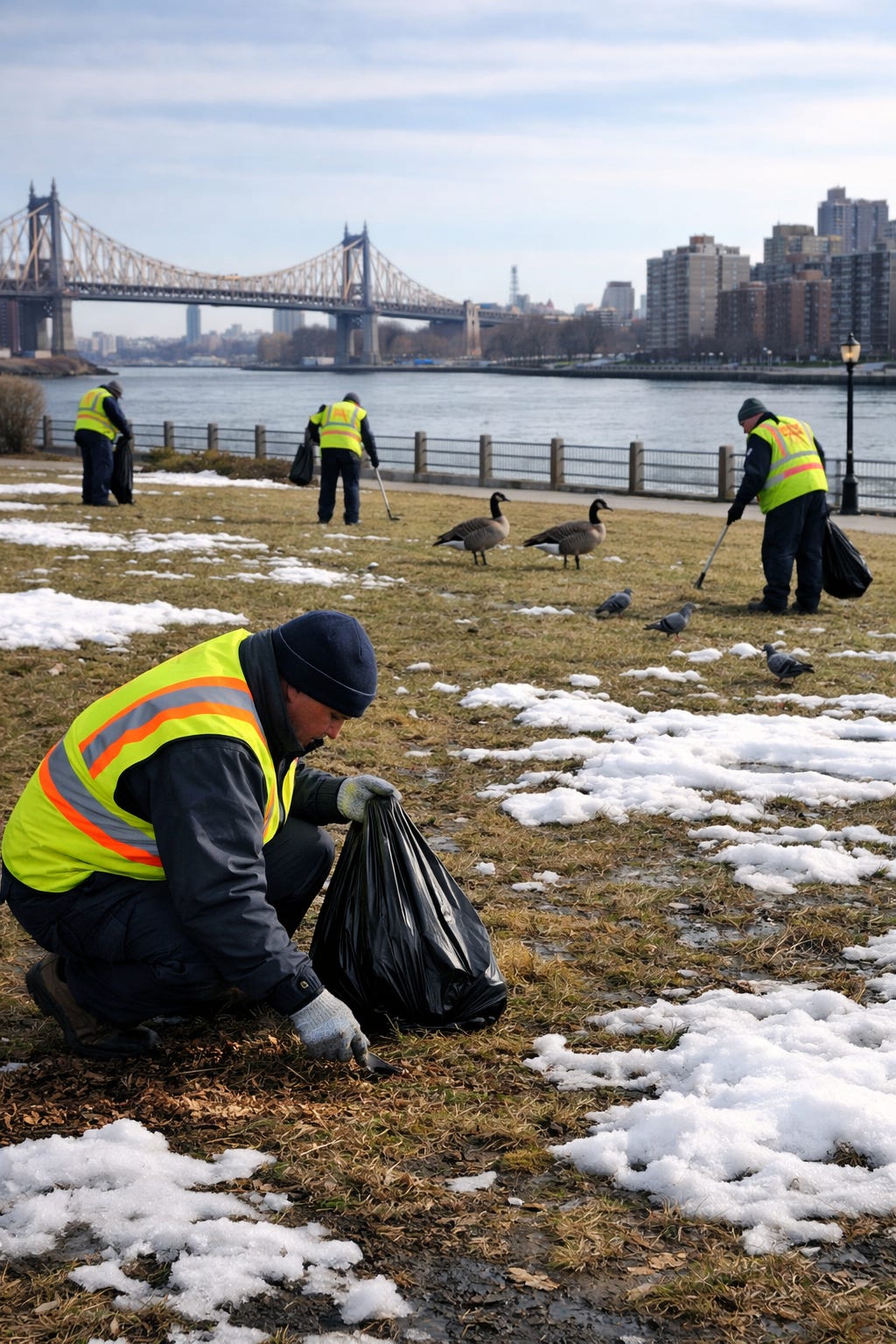
The first thing winter reveals when it loosens its grip is not green grass. It is honesty. On my walks these days I move slowly, not by choice but by necessity. Breathing, for me, has become something that must occasionally be negotiated with my lungs rather than taken for granted. So I pause often. I watch the river. I watch the paths. And as the snow began melting this past week, the Island began revealing what it had quietly stored beneath the white blanket of winter. But before the ground revealed its secrets, something else caught my attention. A group of RIOC staff were moving slowly across the lawns and pathways in the north of the Island. Not one or two workers, but several of them, spaced out across the grass as if they were searching for something that had been lost. The whole scene had the seriousness of a forensic investigation. I half expected someone to shout, “Don’t touch anything!”
They moved carefully, eyes scanning the ground between the patches of melting snow. They moved with the focus of people who already knew what they were going to find and were deeply disappointed about it. One would pause, bend down, collect something in a bag, then move forward again while the others continued their quiet sweep across the landscape. The way they were searching, I briefly thought perhaps someone had dropped a diamond ring. The methodical search made me wonder if something precious had been lost. Although judging by the expressions on their faces, it was clearly not something anyone was excited to recover. It had all the seriousness of a crime scene investigation. Only later did I understand what they were looking for. The Plaza That Quietly ChangedYears ago, residents in the north of the Island had a different complaint. Motorgate Plaza had become known for its pigeons, and pigeons are not shy about leaving their presence behind. Emails circulated. People grumbled. Visitors would wrinkle their noses as they crossed the plaza. And then, gradually, the complaints stopped. Not because the pigeons suddenly developed better manners. Pigeons, like certain public figures, remain stubbornly resistant to self-improvement. The change came because someone inside RIOC decided the plaza mattered. Dhruvika Amin Patel, RIOC’s Chief Financial Officer, asked that the area be regularly washed and maintained. A small team of staff began cleaning the plaza consistently. Day after day. Week after week. The pigeons remained. But the plaza changed. The interesting thing about work done well is that it disappears. Once the plaza became clean again, the conversation vanished with the problem. No one stops in the middle of a plaza to praise the invisible people who keep it that way. Human nature is wonderfully consistent. We complain loudly about messes and remain mysteriously silent about the people who clean them. People will write three emails about a dirty plaza. They will write exactly zero about a clean one. The great tragedy of doing a job well is that everyone assumes it was always that way. The Geese of the Southern PromenadeIf one walks toward the southern end of the Island, a different kind of mess greets you. The geese have claimed that territory with a kind of cheerful determination. The geese approach public space with the quiet confidence of Related scouting the Island for its next tower. Anyone who has walked those paths knows the small green reminders they leave across the grass and pavement. The geese have never once mistaken the promenade for anything other than their personal living room. The geese, it must be said, behave exactly like longtime residents: territorial, noisy, and deeply convinced the place belongs to them. And yet, oddly, their presence feels different. Geese possess the rare New York talent of making eye contact while refusing to move. Perhaps it is because the geese belong to the ecosystem here. The wildlife sanctuary has created something rare for a place surrounded by water and skyscrapers: a small living community where animals still behave like animals. Much of that quiet balance rests on the shoulders of Rosana Ceruzzi, who tends to the animals day after day with a patience that rarely makes headlines. The geese are messy, yes. But their mess feels natural. It reminds us that this Island, despite its buildings and committees, is still a place where nature occasionally insists on having a say. What the Snow RevealedAs the thaw continued this week, I noticed something else happening across the Island. RIOC staff were walking the paths with bags and tools, carefully collecting what the snow had hidden for months. The sort of job that makes archaeology seem glamorous by comparison. Hundreds of dog droppings. Not pigeon droppings. Not goose droppings. Dog droppings left behind by residents who had walked their pets, watched them finish their business, and then decided someone else would eventually handle the rest. RIOC has placed bag dispensers throughout the Island. They are there like small reminders of a shared agreement. The dispensers offer bags. They do not, unfortunately, provide motivation. The tools are available. It turns out the Island has solved the technology problem. The remaining challenge appears to be human nature. The bags are free. The effort, apparently, is negotiable. Yet this week a group of workers spent their days bending down again and again to collect what their neighbors chose not to. The Small Decisions That Shape a PlaceCommunities are rarely defined by their grand debates or their public meetings. More often, they are shaped by thousands of tiny decisions made when no one else is watching. Neighborhoods are shaped by habits. Good ones build a place. The other kind requires a cleanup crew. Do we hold the door for someone whose hands are full? Do we pick up the piece of trash that is not ours? Do we bend down with a small plastic bag when our dog finishes what dogs inevitably do? The Island has always prided itself on being a thoughtful place, a place where neighbors know one another and where shared spaces matter. But walking the paths this week, watching staff quietly clean up after hundreds of small moments of neglect, I found myself wondering a simpler question. What kind of neighbors are we becoming? Because a place, I’ve come to believe, becomes what its residents repeatedly decide is not their problem.
A Different Kind of OwnershipEvery dog on this Island successfully completes its portion of the task. The failure rate begins immediately afterward. Perhaps the measure of a community is not how clean the paths look after the maintenance crews have finished their rounds, but how willing its residents are to care for the ground beneath their feet. The next time we see something left behind, maybe the answer is not to wait for someone else to solve it. Maybe we simply pick it up. Not because it is our dog. But because it is our Island. This newsletter travels best hand to hand. If you know someone who would read this all the way through, they are probably who it is for. Subscribe for free to receive updates on new posts and support our work.
|
Friday, 20 March 2026
The Other End of the Leash





Subscribe to:
Post Comments (Atom)
Six years ago, Tony Abbott ...
Sometimes you can't escape your past! ͏ ͏ ͏ ͏ ͏ ͏ ͏ ͏ ͏ ͏ ͏ ͏ ͏ ͏...

-
Dear Reader, To read this week's post, click here: https://teachingtenets.wordpress.com/2025/07/02/aphorism-24-take-care-of-your-teach...
-
CALL FOR APPLICATIONS: AOM 2025 PDW ͏ ͏ ͏ ͏ ͏ ͏ ͏ ͏ ͏ ͏ ͏ ͏ ͏ ͏ ͏ ...


No comments:
Post a Comment