The Return of Empire: America and the End of LawWhat Trump’s Power Politics Reveals About the Rules Based Order
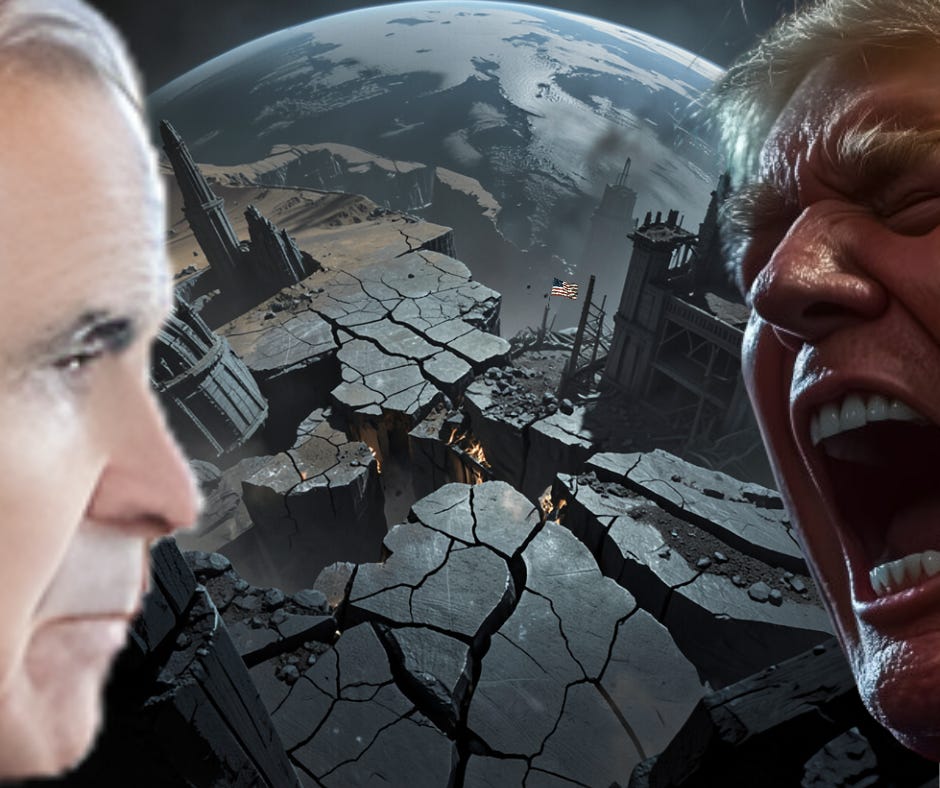
For decades, the world was told a reassuring story: international politics operated within a rules-based order. Sovereignty was protected by law, disputes were handled by institutions, and even the most powerful states were constrained by shared rules. That narrative is now unraveling. Under Donald Trump’s leadership, the United States has begun to openly replace the rule of law with the rule of power—deploying sanctions, economic coercion, and political pressure not merely to defend interests, but to remake the system. What is emerging in its place is something far older and more brutal in world history, a return to empire—an age defined not by law but by domination, war, exploitation, and the systematic impoverishment of the weak by the powerful. This new age of lawlessness is the defining geopolitical shift of the early twenty-first century. Washington has abandoned its influence in global rule-making in favor of power politics. Agenda-setting within shared institutions has been replaced by enforcing hierarchy within its own hemisphere. This is a fundamental reorientation of American grand strategy away from internationalism and toward regional imperial primacy. In Davos earlier this year, Canadian Prime Minister Mark Carney described the period we are living through as the “beginning of a harsh reality” where there are “no limits, no constraints.” We now live in a system in which rules are subordinate to power, and international law applies only when it aligns with the interests of those strong enough to enforce it. Power is Replacing LawWe are entering a new geopolitical reality in which power, not rules, determines legitimacy. President Trump is not only running roughshod over norms he is flagrantly flouting modern-day legal precedents. The UN climate chief said international law is being ‘trampled’ by “those that believe the power of law should be replaced by the law of power.” The Atlantic’s Anne Applebaum called what Trump is doing “rule by law, meaning the law is what the leader or the political party says it is.” Trump ignores the rule of law with predictable regularity. His military adventurism, killing shipwrecked sailors, threatening to annex Greenland, and make Canada the 51st state, are but a few examples. As explained by Guterres, what matters to the American President is the exercise of “power and influence.” General Sir Richard Barrons, Senior Consulting Fellow at Chatham House, explained, “We now operate in a world where the U.S. is dominated by its own definition of its national self-interest, and that is broadly defined by an American administration which will do what it thinks it can do on the basis that it has the power to do it.” This is not just an international concern; the rule of law is also under siege in the United States. Trump is using the DOJ, the DoD, the IRS and other government departments and agencies to bury incriminating evidence, go after his enemies and advance his imperial agenda. As reported by the Washington Post, dozens of retired federal and state judges have warned that the rule of law is unravelling in the United States due to unprecedented political pressure, threats, and defiance of court orders. The rules-based order is not collapsing because its rivals destroyed it. It is fading because the very power that once claimed to uphold it has decided it no longer needs it. Levers of PowerTrump brings to bear all the levers of the presidency as well as some extrajudicial powers. Intimidation is the name of the game. He enforces obedience by making it clear that dissent invites reprisal. So, foreign leaders flatter him they give him gifts, and awards, hoping they can bribe him and avoid being targets of his wrath. As explained by Prime Minister Carney, “there is a strong tendency for countries to go along to get along, to accommodate, to avoid trouble, to hope that compliance will buy safety.” Tariffs are Trump’s favorite cudgel. He uses them to bully other countries to do his bidding. As Carney said, “great powers have begun using economic integration as weapons, tariffs as leverage, financial infrastructure as coercion, supply chains as vulnerabilities to be exploited.” To this end, Trump uses the full force of the world’s most powerful economy to extort allies and adversaries alike. In addition to financial leverage, he has also shown his willingness to use military force. Trump uses these levers to monetize trade relationships. He even sees geopolitical crises as an arena for transactional deal-making and financial gain. This is evident in Russia’s unprovoked war against Ukraine, Israel’s genocide in Gaza, the abduction and incarceration of the Venezuelan president, and the sustained air assault in Iran that killed the country’s Supreme Leader, hundreds of government officials, and thousands of others. Trump pressured European allies to shoulder the financial burden in Ukraine, while negotiating a deal that gives the U.S. preferential access to Ukraine’s rare earth resources. He has framed the devastation of Gaza as a potential development opportunity, promoting a vision in which postwar rebuilding could transform the territory into the “Riviera of the Middle East.” American military forces abducted the Venezuelan head of state and claimed the country’s oil reserves, and Trump loyalist, US Senator Lyndsey Graham said, ‘We’re going to make a ton of money’ from the war in Iran.” Trump wields the full arsenal of presidential authority to bend allies and adversaries to his will. These instruments of influence—economic pressure and diplomatic leverage—are mechanisms for shaping the behavior of other states. These levers are backed up by the ever-present threat of armed force. New World OrderWashington is crippling multilateralism and undermining the rule of law in pursuit of a new world order. Trump is targeting global legal institutions that constrain his power. When he undermines efforts to solve global problems collectively, he is not only taking aim at co-operative agreements, trade rules, and institutions, he is also taking aim at the liberal democratic principles and the values that undergird democracy. He is striking at the very heart of what has defined the West since the Second World War. Disrupting the global economy and unraveling security arrangements are meant to weaken democratic systems and democracy itself. This is not just exit-oriented populism; Trump’s aggressive unilateralism has made breaking multilateral rules government policy. We must come to terms with the fact that this is the end of the rules-based system as we know it. “Stop invoking rules-based international order as though it still functions as advertised,” the Canadian Prime Minister said, adding, “Call it what it is – a system of intensifying great power rivalry, where the most powerful pursue their interests, using economic integration as coercion.” European President Ursala von der Leyen bluntly stated, “the EU can no longer rely on rules-based system”. Trump is dismantling the guardrails of democracy and replacing them with a system defined by loyalty, impunity, and unchecked executive control. He is destroying the rules-based order so that he can reshape it. This is how Putin transformed Russia from a fledgling democracy back into an authoritarian regime. It’s also the same illiberal script used by Viktor Orbán in Hungary. Conditional SovereigntyThe U.S. is using economic integration as leverage to undermine national autonomy. Trump is recreating a world in which great powers see sovereignty through the lens of strategic advantage rather than legal principle. Institutions are bypassed when they constrain action, and smaller states lose agency as they are coerced into alignment. While the U.S. is projecting a maximalist interpretation of its own national sovereignty, Washington is actively weakening the sovereignty of other states. Trump demands compliance. Nations that dare to resist face sanctions, trade restrictions, political isolation, or worse. When sufficient pressure is applied, staying in Washington’s good graces matters more than protecting one’s own national interests. This has transformed sovereignty from a guaranteed right into a conditional privilege. Power, rather than law, now determines the legitimacy of a nation’s right to exist. Oman’s foreign minister, Badr bin Hamad Al Busaidi warned: “We are worryingly close to a world in which certain kinds of foreign intervention – if not outright invasion and annexation of territory – are accepted as a normal part of international relations, rather than as illegal violations of our shared international order.” Now that power is becoming the primary currency of international politics, other states are adopting the same logic. They realize that when sovereignty is conditional for some, it eventually becomes conditional for all. Authoritarian Power PoliticsWashington’s global destabilization efforts are grooming the landscape and laying the foundation for the centralized power of a new authoritarian world order. The Trump administration openly subscribes to the view that “might makes right”. They believe that superior strength, power, or force creates legitimacy and defines justice. This is a textbook description of the power politics of authoritarian regimes. Trump aspires to be a ‘strongman’ who maintains power through intimidation and force. Like other authoritarian leaders, he claims to have unique, superior capabilities (“only I can fix it”) and, like other autocrats, he relies on coercion as a means of control. As explained by Trump’s influential deputy chief of staff, Stephen Miller, “we live in a world, in the real world…that is governed by strength, that is governed by force, that is governed by power.” Miller is an advocate of Realpolitik, a political approach based on hard power, pragmatic opportunism, and national interest, rather than ideals, morals, or international law. A leader practicing Realpolitik assumes that “what is successful is right” and that the international system is a “state of nature” where only power determines the relationships among states. The Trump regime subscribes to social Darwinism, a framework that views society as a competitive, “dog-eat-dog” struggle where the strong are destined to prevail over the weak. This logic is often used to justify social inequality and imperialistic expansion. The Trump administration governs through raw power, coercion, and a ruthless pursuit of dominance, treating international norms and alliances as expendable, leaving a trail of weakened institutions and fractured relationships in its wake. Hemispheric ImperialismThe myopic logic of “America First” is systematically dismantling global stability, and from the wreckage, a new authoritarian hierarchy is being born that is defined by hemispheric imperial ambition. Barrons described Trump’s new world order as “US hemispheric imperialism where it intends to dominate its hemisphere, on terms that it sets, dominated by being by far the greatest military force in this world.” Hemispheric imperialism refers to a strategy in which a state seeks to dominate, control, or exercise decisive influence over other countries within its own geographic hemisphere. It is a regional form of imperialism grounded in the idea that a great power has special rights or prerogatives within its immediate sphere of influence. Within this regional hegemony, a dominant power asserts primacy over neighboring states using various points of leverage. This includes political pressure, economic coercion, and military intervention. The aim is the creation of a consolidated strategic and economic bloc that excludes outside powers. This doctrine is often framed as necessary for national security or regional stability. The classic example is the Monroe Doctrine (1823), through which the United States declared the Western Hemisphere off-limits to European colonization. While initially a defensive posture, it evolved—especially in the late 19th and early 20th centuries—into justification for U.S. interventions throughout Latin America and the Caribbean. Under leaders like Theodore Roosevelt, the doctrine was expanded via the Roosevelt Corollary, which asserted a U.S. right to intervene in Latin American states to stabilize finances or maintain order—effectively institutionalizing hemispheric imperialism. Re-HemispheringThe United States is increasingly embracing a brand of hemispheric imperialism known as re-hemisphering. This is a 21st-century revival of the strategic assumptions in the Monroe Doctrine. This revived form of gunboat diplomacy relies on hard power to secure regional dominance. Re-hemisphering appears prominently in the Heritage Foundation’s Project 2025 blueprint. This strategic concept forcefully reasserts U.S. primacy in the Western Hemisphere. It calls for the United States to shift away from multilateral leadership and global agenda-setting in favor of consolidating U.S. dominance. Like the Monroe Doctrine, re-hemisphering is designed for regional hegemony in an era of great-power rivalry. While the Monroe Doctrine sought to exclude European colonial powers from Latin America, re-hemisphering adapts this strategy for an era of geopolitical rivalry with China and Russia. This involves economic decoupling, the realignment of supply chains, and reshoring manufacturing. The False Promise of Hemispheric DominanceSupporters argue that in an era of great-power competition, an overextended United States must narrow its strategic focus and secure its own neighborhood. By prioritizing the Western hemisphere, they contend, Washington can more effectively secure regional dominance. Critics argue that this approach discards one of America’s greatest strategic assets: its soft power—the capacity to shape agendas, set rules, and build consensus. They also contend re-hemisphereing fundamentally misreads the realities of the modern world. Countries in the Western hemisphere now have diversified economic and diplomatic relationships, making them far less susceptible to domination than in the past. Attempts to impose hierarchy could therefore backfire, pushing these countries closer to rival powers rather than strengthening American leadership. Washington is sacrificing its soft power for questionable short-term leverage. In doing so, it is undermining one of the most effective sources of American influence in the modern international system. Enduring influence depends on credibility, institutions, and cooperation—not only the blunt force of coercion. ‘ Hemispheric dominance is a geopolitical powder keg. When foundations erode and the architecture of global governance fractures, the international system becomes more chaotic, and the risks of major conflagrations increase. Exposing the Sham of the Rules-Based OrderFor decades, the United States presented itself as the architect and guardian of a rules-based international order. The promise was simple: power would be restrained by law, sovereignty would be protected by institutions, and stability would come from shared rules. But as economic coercion replaces cooperation and strategic pressure replaces diplomacy, the vacuousness of that promise has been laid bare. The rules-based order has always served the interests of the powerful. When rules constrain rivals, they are invoked. When they constrain the powerful, they are ignored. Trump’s artless approach to politics and his craven pursuit of power has stripped away the veneer and revealed the fact that rules have always been manipulated to serve the interests of the rule-makers. Trump may have inadvertently exposed the lie of the rules-based order, but he is not the architect; he is merely a symptom of a problem that predates him, a cog in a far bigger systemic problem. American presidents, including Joe Biden and dozens of presidents before him, resist international law. Successive American administrations, both Democrats and Republicans, promote a capricious interpretation of a rules-based order. America resists international law to avoid being constrained by equity, justice, or morality. That is why the United States is not a signatory to the Rome Statute of the International Criminal Court, or the UN Convention on the Law of the Sea. The U.S. embraces the rule-based order when it benefits them and rejects or reinterprets these rules whenever American interests are impeded. Russian foreign minister, Sergei Lavrov, has long derided the US for their “west-centric rules-based order as an alternative to international law”. Although Russia crafts its own self-serving narratives, Lavrov’s criticisms ring true. The United States has engaged in regime change 14 times since 1953.
There were also three notable failed attempts at regime change:
This is the history of American hegemony since World War II. International law only applies when and how the powerful want it to. Carney called the rules-based order a “fiction” and explained: “We knew the story of the international rules-based order was partially false that the strongest would exempt themselves when convenient, that trade rules were enforced asymmetrically. And we knew that international law applied with varying rigour depending on the identity of the accused or the victim.” The collapse of the so-called rules-based order is not a surprise—it is the inevitable consequence of seven decades of selective enforcement, covert interventions, and the systematic bending of law to serve the powerful. What Trump has revealed is not a new pathology but a long-standing truth: international rules have always been a tool of dominance, not a shield of justice. The rules-based order was never about the common good—it was another lever of power, and its collapse exposes a world where the strong write the rules and the weak bear the cost.
|
Wednesday, 11 March 2026
The Return of Empire: America and the End of Law





Subscribe to:
Post Comments (Atom)
Grace Under Scrutiny
The quiet discipline of not correcting every lie. ͏ ͏ ͏ ͏ ͏ ͏ ͏ ͏ ͏ ͏ ͏ ͏ ...

-
Dear Reader, To read this week's post, click here: https://teachingtenets.wordpress.com/2025/07/02/aphorism-24-take-care-of-your-teach...
-
CALL FOR APPLICATIONS: AOM 2025 PDW ͏ ͏ ͏ ͏ ͏ ͏ ͏ ͏ ͏ ͏ ͏ ͏ ͏ ͏ ͏ ...


No comments:
Post a Comment