The Strange History of Rabbinic AuthorityFrom a pair of hands in Leviticus to a faith tradition without a pope
 It begins with a hand. Actually—with two.In the opening verses of Book of Leviticus, a person leans both hands onto the head of a sacrifice and magically transfers personal guilt onto an animal. A strange act. Not prayer. Not speech. Not belief. Transference. And then, somewhere else in the Torah—in Book of Numbers—Moses places his hands on Joshua. Same gesture. But everything has changed. One is personal and ritualistic. Somewhere between those two moments, Judaism creates a powerful dynamic: 👉 Personal and societal agency can be transmitted. The gesture before the institutionThe Hebrew word is the same in both cases: סמיכה — semicha But something subtle—and profound—is happening in the commentary. Rabbi David Zvi Hoffman, commenting on Leviticus 1:4, begins with what looks like a technical point: when the Torah says “his hand” (ידו), it actually means both hands. סמיכה is done with force, with presence—not a light touch, but a pressing. He proves this from multiple verses. But almost without pause, he does something more interesting. He moves—seamlessly—from the laying of hands on a sacrificial animal to the laying of hands by Moses on Joshua. From ritual… From the Temple… No transition. No explanation. No hesitation. As if they are the same act. Before semicha was a title… It was a physical act. Not merely placing (שימה), but pressing. This is not just ritual. This is transference. What exactly is being transferred?Commentators struggle. Everett Fox suggests:
The Chizkuni goes further:
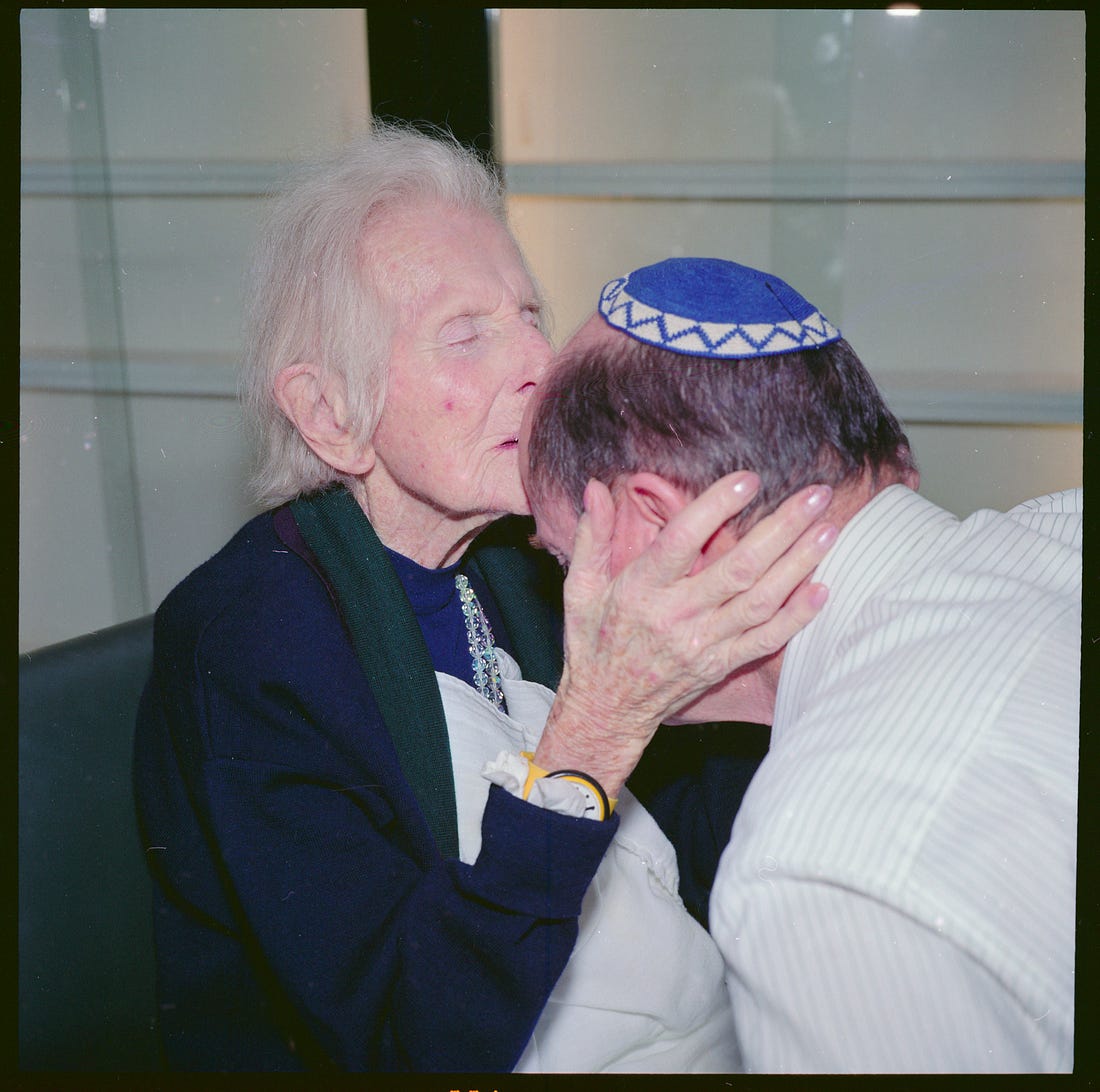
It’s simply what humans do when something matters. And that insight changes everything. Because suddenly semicha is not just a ritual—it is human behavior. We touch what we want to transform. And here, an unexpected parallel emerges. Sigmund Freud called it transference—the process by which feelings, meanings, and unresolved experiences are displaced from one relationship onto another. In psychoanalysis, a patient transfers emotions onto the therapist. We carry the past with us. Read Leviticus again. The worshipper places hands on the animal. Guilt. Semicha, in this light, is not primitive ritual. It is a profound intuition: 👉 That what is internal can be externalized. Long before Freud named it, A Friday night echoFast forward a few thousand years. A parent places hands on a child’s head on Friday night. But it is. The same gesture. Something—call it love, memory, responsibility—is being passed on. You can feel it.
Here is a picture of my 100-year-old grandmother, blessing her son, my dad, whose yahrzeit we celebrate this shabbat. When the individual becomes the communityBut there is one moment where everything comes together. Not the individual bringing a sacrifice. But the entire people of Israel. In Book of Leviticus 4:13–15, the Torah imagines a scenario where the whole community sins:
Not everyone comes forward. Only the elders. The leaders. Those already vested with authority. And here is the confluence. The same act—semicha—that we saw:
now appears in a third form: 👉 collective responsibility mediated through leadership The elders place their hands This is more than practical. It is conceptual. Because what we are witnessing is a fusion:
become one. The leaders do not merely rule. They carry. They absorb the failure of the community And here the deeper innovation comes into focus: Judaism’s deepest innovation may be this: that responsibility itself—personal and collective—can be transmitted. If Moses transfers authority to Joshua… Not just their guilt. But their responsibility. And that reframes everything. Authority is no longer just power. 👉 It is the capacity—and the obligation—to carry others. Which means: In Judaism, to receive semicha is not simply to be empowered— From sacrifice to leadershipNow read Numbers 27 carefully. God tells Moses:
And then Moses does something unexpected. He doesn’t use one hand. He uses both. The same act as in Leviticus. But now: 👉 The object is not an animal. Semicha has crossed a line—from ritual into politics. The chain is bornThe Mishnah in Pirkei Avot opens with what may be the most audacious claim in Jewish literature:
A chain. Not of ideas. Of people. Each one receiving—and transmitting—authority through semikhah. This is Judaism’s answer to the question every tradition must face: 👉 Who gets to speak for God? And then… it breaksUnder Roman rule, semicha is outlawed. According to the Talmud in Sanhedrin, ordination becomes a capital crime. The Sanhedrin disappears. The original semicha—this embodied transmission from person to person—ends roughly 1,600 years ago. And yet… Judaism does not end. The problem no one solvedMaimonides, in his Mishneh Torah, is clearly uncomfortable. He has a plan and tries to reconstruct semicha:
And then, almost quietly, he admits:
It never is. Napoleon’s questionCenturies later, Napoleon Bonaparte asks the Jews a very modern question: 👉 Who speaks for you? He convenes a “Sanhedrin.” Not in Jerusalem. It works—sort of. But something has changed. Authority is no longer transmitted. Judaism without a popeHere is the strange outcome: Judaism survives the collapse of its authority structure No pope. Instead:
Only in parts of the ultra-Orthodox world does the idea of Daas Torah confer sweeping authority on leading rabbis—religious, socio-economic, and political—an approach that stands apart from Judaism’s historically decentralized tradition. A dangerous freedomAs Rabbi Mintz points out, this is both Judaism’s strength—and its risk. Without a pope:
But also:
A surprising Talmudic asideIn Chagigah 16b, the rabbis debate whether women can perform semicha on sacrifices. Technically, the verse excludes them. But the rabbis permit it anyway:
They even bring the sacrifice into the women’s courtyard. Not because it is required. Even here, authority bends toward human dignity. This Talmudic pearl
is used by feminist-leaning Orthodox Rabbis such as Rabbi Daniel Sperber and Avi Weiss to encourage us to bring the Torah into the women’s section and permit women to don tefillin and do other traditionally male-exclusive Jewish rituals. Only on Madlik, and after our exhaustive study connecting the ritualistic semicha with rabbinic semicha do we hazard to suggest a new reading of this Talmudic dictum. Rabbinic Semicha for women is permissible… (you’re welcome). The real inheritanceSo what is semicha today? Not a legal chain. But something deeper: 👉 A belief that meaning, responsibility, and memory can be passed from one person to another. Not perfectly. But intimately. The final imageAn older figure places hands on a younger one. It could be Moses and Joshua. The act is the same. What’s transferred? Everything. Wisdom. Call it Torah. Shabbat ShalomJoin us at Madlik as we continue to explore the places where text, tradition, and human experience collide—and where, sometimes, a simple gesture says more than a thousand words. Sefaria Source Sheet: https://voices.sefaria.org/sheets/714754
|
Wednesday, 18 March 2026
The Strange History of Rabbinic Authority





Subscribe to:
Post Comments (Atom)

-
Dear Reader, To read this week's post, click here: https://teachingtenets.wordpress.com/2025/07/02/aphorism-24-take-care-of-your-teach...
-
CALL FOR APPLICATIONS: AOM 2025 PDW ͏ ͏ ͏ ͏ ͏ ͏ ͏ ͏ ͏ ͏ ͏ ͏ ͏ ͏ ͏ ...


No comments:
Post a Comment