
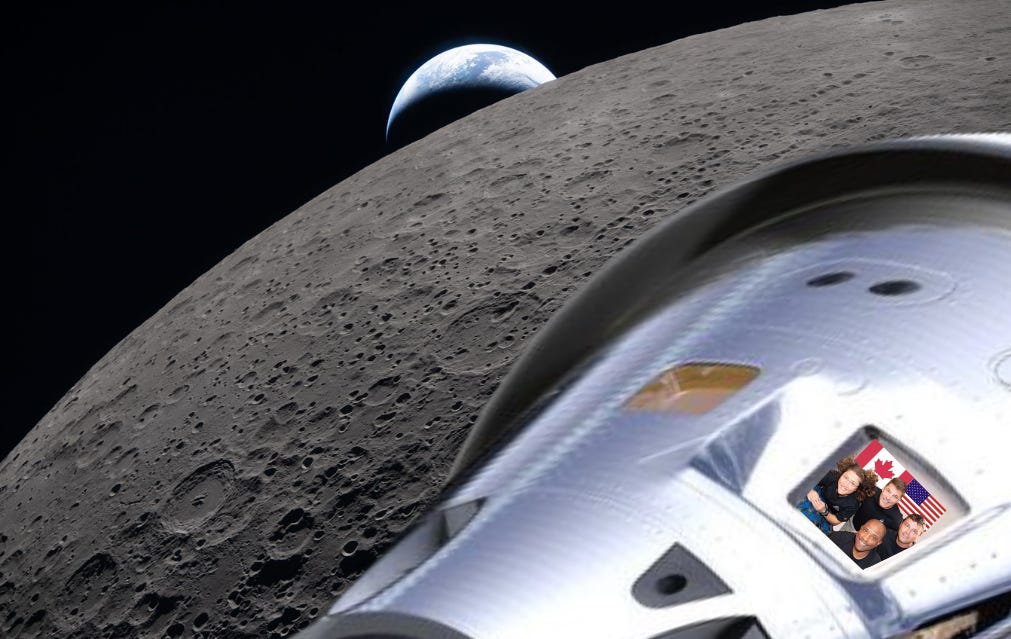
At a time of deepening division, the Artemis II crew offers a vision of our common humanity. By venturing farther from Earth than any humans before them, these astronauts didn’t just explore space; they exposed the fragile unity of our one and only home. Their journey provides a frame of reference that has the power to reshape our worldview. Their experience can help us shift our vantage point and cut through the noise of division in a way that reveals a simple truth: we are all in this together, on a planet with limits we cannot escape. Seeing Earth suspended in the vast darkness of space transforms the ways we relate to our world—and each other. The carbon footprint of a mission like Artemis II is immense, but the perspective this voyage offers has the potential to shift our trajectory—catalyzing a paradigm change whose impact could far outweigh its emissions. From space, astronauts experience the “overview effect,” a jarring realization that Earth is not a collection of divided nations or competing ideologies, but a single, interconnected whole. This insight was echoed by astronaut Christina Koch, who described humanity itself as a crew. We are bound together, interdependent, and responsible for one another. Our survival depends on embracing that truth, and yet, even as the evidence surrounds us, we fail to grasp the perilousness of our predicament. Commander Reid Wiseman and the rest of the Artemis II crew all spoke emotionally about their appreciation for life on Earth. Victor Glover emphasized gratitude that was “too big to be in one body,” while Jeremy Hansen reminded us that what we saw in them was our shared capacity for cooperation, joy, and purpose. The reflections of the Artemis II astronauts remind us that we are inseparably connected—to one another and to all life on the fragile planet we call home. Everything is connected, and everything is at stake. Understanding that we are dependent on this luminous sphere is the kind of perspective that changes everything. The finite vantage point that these Astronauts brought back from space lands with urgency. Our planet is under mounting ecological strain, and societies are fracturing under the weight of inequality, polarization, and conflict. While the Artemis II mission does not solve these crises, it reframes them. That reframing challenges us to see beyond borders and short-term interests, it calls us to understand that our survival is a collective endeavor. The view of Earth from space dispels the illusion of separation and brings common risks into focus. This is the kind of perspective that allows us to see past the things that divide us and recognize a sense of shared identity. This is fundamentally about the realization that we are a single, interconnected human community. Travel to the moon provides the outlook we need to help us finally take care of our planet and each other. It brings into view the need to protect our ecosystems, stabilize our climate, and respect the limits that govern our survival. It reframes value and pushes us toward regenerative models—where resilience, efficiency, and long-term stability replace extraction and short-term gain. In a moment when leaders sow division and undermine basic norms of decency, this mission quietly delivered a powerful message: we are not separate factions, we are one crew. The perspective gleaned from Artemis urges us to demand serious leadership capable of meeting the scale of the challenges we face. Earth is our only home, and keeping it habitable depends on our ability to learn to live together.
|





No comments:
Post a Comment