
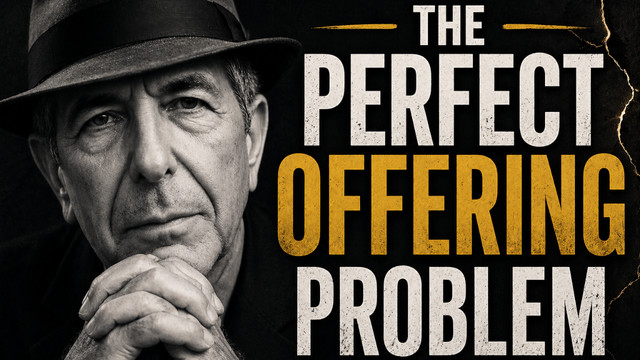
The Perfect Offering ProblemWhy Leviticus demands flawless lives—and how Judaism chose to embrace the cracks

What if the Torah’s highest standard of holiness was never meant for real life? In Parshat Emor, the Torah presents a vision of priestly life that is almost superhuman: untouched by death, untouched by complicated love, untouched even by physical imperfection. No funerals. A life without cracks. But Judaism… ultimately rejects that life. Holiness Begins with Distance — מֵעַמָּיוThe parsha opens:
בְּעַמָּיו — b’amav. Among his people. In this reading the Kohen must step back—from death, from mourning, from the rawest human experience. Even when he is permitted to mourn, he cannot do so fully:
He cannot mourn like everyone else. He cannot even look like someone who mourns. Why?
II. The Perfect RelationshipThen, without pause:
Again:
Most commentaries struggle here—why these women? But the Ralbag gives us a rare clue:
Not legal status—imperfection. The Kohen cannot marry into a story that is less then perfect. The Perfect BodyThen the decisive section:
Without skipping a beat the Leviticus author writes off the Blind. Broken. Scarred. Excluded from service—but not from belonging:
He is inside… but cannot appear inside:
IV. One System — The Perfect Offering ProblemThese are not three laws. 👉 They are one vision. A Kohen must be:
Why? Because he offers:
This phrase appears here—again and again—almost nowhere else. This is a unique theology of the perfect offering. A life that must itself be… perfect. The Theater of Holiness — Rabbi MeirThe Talmud makes the subtext explicit. In Sanhedrin 18a, Rabbi Meir describes the High Priest at a funeral: He follows—but hides.
He participates—but cannot be seen to participate. This is not real Holiness It’s all about the optics of Holiness. A performance of perfection. The Song That Breaks ItAnd then, centuries later, a different voice answers…. a different Cohen. Leonard Cohen writes:
This is the counter-theology. Not the flawless offering… not the לֶחֶם אֱלֹהָיו — Lechem Elohav But the broken one that lets light through. The Garden We Left BehindWe’ve seen this story before. In Genesis, humanity begins, a singular, perfect and immortal individual.
And yet:
Perfection is rejected. And once we leave Eden:
Normative Judaism does not try to undo this. It builds a religion within it. VIII. Enter the ḤalalAnd what of the priest who fails?
We translate: profaned. disqualified. But the root also means:
In Rabbinic Hebrew:
And in Arabic:
Not rejected. Permitted. And it dawns on us that all of the imperfections forbidden to the Cohen are permitted to the rest of us. I would argue that in the case of the widow, maybe the divorcee and radically, even the fallen woman, it is a mitzvah to embraced. Ditto for for the less than perfect amongst us, and for sure our mortality… IX. The Radical MessageWhat if the ḥalal is not excluded… but freed? Freed from:
X. The Judaism That WonThis priestly vision is powerful. But it is not the Judaism that prevailed. Judaism chose:
It chose the crack. XI. What If…What if the Kohen represents a holiness too perfect for real life? And what if the rest of us— The cracked Are not profane… But permitted? Shabbat Shalom. Sefaria Source Sheet: https://voices.sefaria.org/sheets/722306 Listen to on Spotify
|





No comments:
Post a Comment