
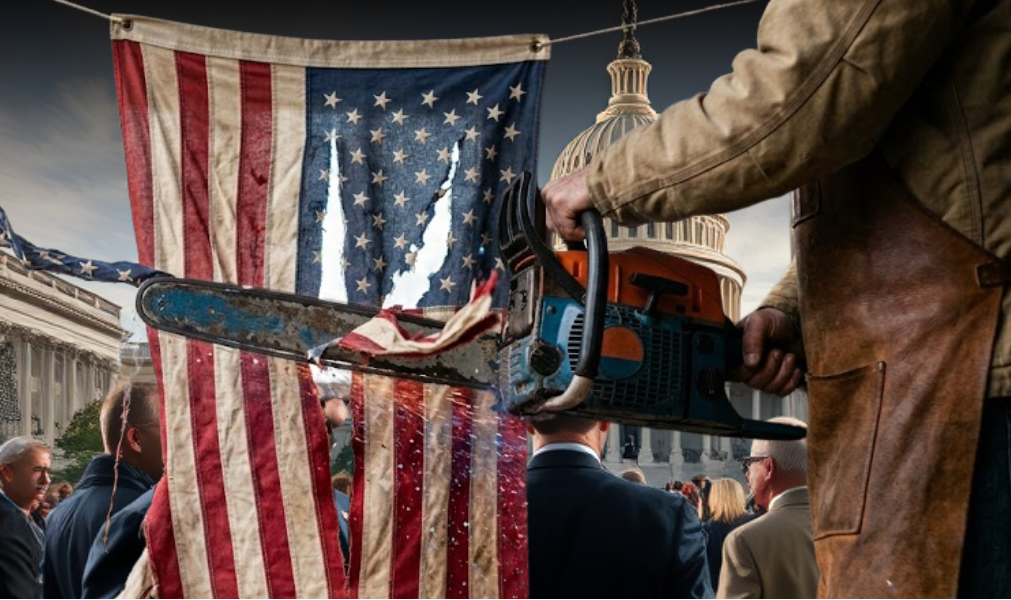
Chainsaw GovernanceThe Reasons Behind the Purge of Federal Watchdogs, Scientists, and Truth-Tellers
The Trump administration has fired senior officials and hundreds of thousands of civil service employees throughout the government. This purge removed some of the most capable federal employees and replaced them with unqualified loyalists. The White House changed the rules to make it easier to fire senior federal civil servants. This resulted in massive job cuts across multiple federal departments and agencies, which has pushed federal employment down to its lowest level since 1966. In addition to firing people outright, the administration applies pressure in ways that force principled officials to resign. These actions send a clear signal to remaining federal employees: job security has nothing to do with competence and everything to do with loyalty to the president. Here is a list of 50 notable U.S. government officials fired or forced out. Inspectors General and Attorneys GeneralAt the outset of his second term in 2025, U.S. President Donald Trump launched a sweeping purge, firing more than 17 Inspectors General (IG) across the federal government and replacing them with loyalists. In addition to firing the IGs responsible for oversight, multiple senior officials were reportedly reassigned or removed in ideological driven loyalty restructuring. Here is a partial list of some of the notable IGs that were fired by Trump. During his first term, Trump fired Intelligence Community IG Michael Atkinson after he forwarded a whistleblower complaint alleging that Trump pressured Ukraine to investigate political rivals in exchange for military aid. These allegations were central to his first impeachment. Steve Linick, the State Department IG, was dismissed while reportedly investigating Secretary of State Mike Pompeo for ethics violations and other improprieties. Glenn Fine, the Acting Defense Department IG was removed after being selected to oversee pandemic relief spending. Other notable IGs that were fired include Mitch Behm, the Acting Transportation IG, Robert Storch, Defense IG, and Mark Greenblatt, Interior IG. In Trump’s first term, Attorney General (AG) Jeff Sessions was forced out after recusing himself and failing to protect his boss from the Russia probe.Acting AG Sally Yates was fired for refusing to defend the president’s travel ban. A bit more than a year into Trump’s second term, Pam Bondi was ousted as AG for her handling of the Jeffrey Epstein files and her failure to aggressively prosecute Trump’s political enemies. These and other DOJ leadership changes further concentrated decision-making among more politically aligned appointees. These dismissals are at the forefront of the administration’s systematic dismantling of the government’s accountability framework. By effectively centralizing decision-making power, they are neutralizing internal checks and balances. Department of JusticeThe Trump administration has aggressively transformed the Department of Justice (DOJ) into an instrument of executive loyalty. Beginning with the strategic removal of independent U.S. Attorneys, this campaign escalated into a full-scale purge of career prosecutors, investigators, and support staff tied to cases deemed to be politically damaging to the sitting president. U.S. Attorneys Preet Bharara and Geoffrey Berman were removed in 2017 and 2020, respectively, after participating in politically sensitive investigations or refusing to align with White House preferences. The president’s purge of the DOJ went into high gear in his second term. In what has been described as loyalty-driven reshuffles, multiple DOJ officials were reassigned, forced out, or fired, particularly those involved in investigations touching Trump or his associates. The Trump administration sacked everyone who worked on Jan. 6 insurrection cases, including supervisors and a line attorney. Dozens of Justice Department employees were fired for their work on Special Counsel Jack Smith’s investigations into Trump’s handling of classified documents and the Capitol attack. These firings affected lawyers, support staff, and U.S. marshals across multiple offices and were carried out through Bondi’s “Weaponization Working Group”. The administration also sought to have Lisa Monaco fired for her investigation into Trump’s criminality, even though she is no longer the Deputy Attorney General and now works at Microsoft. A series of prosecutors were fired because they resisted bringing charges due to a lack of evidence. This includes U.S. Attorney Erik Siebert, who was fired for refusing to indict Trump’s rivals, and Robert McBride, who was dismissed after refusing to prosecute former FBI Director James Comey. The DOJ fired longtime Virginia litigator James Hundley just hours after federal judges appointed him as interim U.S. attorney for the Eastern District of Virginia. In addition to firing prosecutors, Trump also forced many others to resign. Following the killing of Renée Good and others by ICE officers, the Trump administration’s willful neglect of legal protocol prompted the resignations of federal prosecutors in the Minnesota U.S. Attorney’s Office, where nearly 50 of about 135 staff have left since 2025. The result is a Department of Justice ruled by political allegiance rather than the rule of law. By firing veteran litigators, dismantling entire trial teams and forcing mass resignations, the administration is effectively purging institutional expertise and demanding absolute political alignment. The administration is creating a legal system premised on personal loyalty that transforms federal law enforcement into a tool for executive protection and political retaliation. Federal Bureau of InvestigationThe Trump administration has systematically targeted the Federal Bureau of Investigation (FBI), dismantling the leadership and staff involved in sensitive inquiries into the President. This campaign of removals has shifted from high-profile executive dismissals to a broader purge of agents tied to investigations regarding national security and election integrity. During both terms of the Trump administration, removals targeted officials involved in investigations of Trump or who hold views that are not aligned with the administration. During Trump’s first term 4 senior FBI officials were removed for their investigations into whether the president was acting on behalf of the Russian government: FBI Director James Comey was dismissed in 2017, his successor, Andrew McCabe, was removed in 2018 alongside senior counterintelligence official Peter Strzok and FBI lawyer Lisa Page. In Trump’s Second Term, the removals expanded into a broader purge of agents and supervisors tied to the Mar-a-Lago documents search, as well as the January 6 insurrection and efforts to overturn the 2020 election results. In class-action lawsuits, fired FBI agents allege they were unlawfully terminated as part of a “retribution campaign” that targeted them for their connections to politically sensitive investigations that implicate the president. These actions signal a profound shift in federal law enforcement. By clearing the ranks of those who pursued cases involving the president, the administration has effectively replaced institutional independence with a mandate for personal loyalty. PentagonThe Trump administration has launched an aggressive overhaul of the Department of Defense (DoD), replacing top-tier military command with a hierarchy built on personal allegiance. This rapid restructuring has cleared the way for a leadership team defined by political loyalty rather than traditional professional tenure. Trump and his allies have reshaped military leadership through firings, forced resignations, and loyalty-driven replacements. After the 2020 election, Trump removed Defense Secretary Mark Esper after Esper opposed using active-duty troops against protesters. Although he was not fired, Gen. Mark Milley, chairman of the Joint Chiefs, was repeatedly attacked as disloyal and later subjected to the president’s allegations of treason, “punishable by death”. During Trump’s second term, the number of firings of senior military officials skyrocketed. Navy Chief of Staff Jon Harrison was fired amid internal power struggles, followed by Adm. Lisa Franchetti: Chief of Naval Operations, Gen. Charles “CQ” Brown Jr.: Chairman of the Joint Chiefs of Staff, Jim Slife: Vice Chief of Staff of the Air Force, John C. Phelan: Secretary of the Navy, and Gen. Randy George: Chief of Staff of the United States Army. The DoD has also weakened Pentagon oversight by restricting anonymous whistleblower complaints and tightening inspector general procedures. By purging the highest ranks of the Army, Navy, and Air Force while simultaneously gutting internal oversight, the administration has fundamentally reshaped the Pentagon. This shift effectively silences dissent and prioritizes executive control over the independent judgment of the nation’s military leaders. Health and Human ServicesThe Trump administration is targeting the leadership of the nation’s public health infrastructure. This campaign has moved beyond individual dismissals to include large-scale layoffs and the removal of officials who resisted political alignment. In his first term, Trump attacked and then replaced Christi Grimm, the Acting Health and Human Services (HHS) IG, after a report documented PPE shortages and pandemic problems. In Trump’s second term, senior HHS officials were fired, and 10,000 jobs were put on the chopping block. Centers for Disease Control and Prevention (CDC) Director Susan Monarez was axed after the White House said she was not aligned with Trump’s agenda. Her lawyers claimed she was targeted because she did not approve directives at odds with established science, and she refused to dismiss health experts. Her abrupt removal was followed by the resignations of other senior CDC officials amid tensions over vaccine policy, budget cuts, reorganization, and growing concerns that public health agencies were being politicized and scientific expertise sidelined. CDC immunization chief Dr. Demetre Daskalakis resigned in protest, issuing a sharply worded letter accusing the Trump administration and HHS of politicizing the CDC, undermining scientific integrity, distorting data, and making policy decisions that endanger public health. He said he could not continue working in an environment where science was “weaponized” in ways that harm Americans. Several other senior CDC officials also resigned in the aftermath. The administration’s actions targeting HHS have fundamentally weakened the independence of federal health agencies. The resulting brain-drain, coupled with a shift toward political loyalty over scientific integrity, has reshaped these institutions in ways that undermine public health. State Department and National SecurityThe Trump administration has executed an extensive purge of the State Department and the national security apparatus, targeting officials who prioritized institutional independence over personal loyalty. This campaign has escalated from the high-profile dismissal of diplomats and cabinet members to mass layoffs and the removal of intelligence leaders whose findings contradicted the White House narrative. In Trump’s first term, he repeatedly removed or sidelined officials in the State Department who challenged him, were entangled in the Ukraine scandal, or represented institutional independence. Secretary of State Rex Tillerson was dismissed after repeated clashes with Trump and reports that he questioned the president’s competence. Senior national security officials were also pushed out after policy disagreements or perceived disloyalty. National Security Advisers H.R. McMaster and John Bolton were both forced out following clashes with Trump over foreign policy direction. George Toscas, the Deputy Assistant Attorney General in the National Security Division of the DOJ, was dismissed amid loyalty concerns. Christopher Krebs, head of the Cybersecurity and Infrastructure Security Agency, was removed after rejecting the president’s false fraud claim and affirming that the 2020 election was secure. Ambassador Marie Yovanovitch was targeted and removed after resisting Trump’s efforts to pressure Ukraine for political favors. Ambassador to the European Union Gordon Sondland was fired after testifying that there had been a quid pro quo in which military aid to Ukraine was contingent on investigations that benefited Trump politically. Lt. Col. Alexander Vindman and his brother, Lt. Col. Yevgeny Vindman, were both removed from their posts. This followed Alexander’s testimony that Trump had conditioned military aid on receiving information the president could use against his political opponents. The firings drastically accelerated in Trump’s second term. In July 2025, the State Department began mass layoffs of more than 1,300 employees. Defense Intelligence Agency head Lt. Gen. Jeffrey Kruse was dismissed after intelligence findings contradicted Trump’s inaccurate claims about the impact of American airstrikes in Iran. Taken together, these removals illustrate a recurring pattern in which disagreement with Trump’s political interests often preceded dismissal or forced departure. By ousting or sidelining career diplomats, national security advisers, and intelligence heads who oppose him, testify against him, or contradict his public claims, Trump is systematically dismantling internal dissent and oversight. These removals reinforce a recurring pattern where professional testimony and objective intelligence are treated as grounds for dismissal, effectively aligning the nation’s foreign policy and security infrastructure with executive interests. Federal Museums and the ArtsThe Trump administration has extended its campaign of personnel removals to the nation’s cultural heart, exerting intensified ideological pressure on federal museums and arts agencies. This initiative involves sweeping staff reductions and leadership purges designed to align historical interpretation and artistic funding with the administration’s political agenda. At the beginning of Trump’s second term, the administration initiated a purge across federal arts and humanities agencies. The Institute of Museum and Library Services (IMLS) placed almost all its employees on administrative leave. The effects rippled through museums nationwide with staff cuts, reduced programs, fewer exhibitions, and diminished public services. The administration fired all six members of the Commission of Fine Arts; dismissed about 65% of staff at the National Endowment for the Humanities; prompted mass resignations of senior officials at the National Endowment for the Arts; dismissed half the board of trustees at the John F. Kennedy Center for the Performing Arts and oversaw the firing of its president, Deborah Rutter; and placed on leave or terminated nearly half the staff at the GSA’s Center for Fine Arts. The administration also tried to use the threat of firings to reshape museum content. Trump announced his intent to ax National Portrait Gallery Director Kim Sajet, calling her a partisan supporter of diversity initiatives. The White House successfully pressured the Smithsonian’s National Museum of American History to remove a display referencing Trump’s two impeachments. By hollowing out the staffing related to the humanities and the arts, the administration has systematically weakened the independence of American cultural entities. These actions demonstrate a concerted effort to reshape the national narrative by controlling the institutions that preserve it. Together, these moves indicate that federal cultural institutions are being pressured to align staffing and historical interpretation with the administration’s political agenda. Threats and Disciplinary MeasuresThe Trump administration is exerting direct control over independent agencies through disciplinary measures and threats. Trump’s repeated threats to fire Fed Chair Jerome Powell and efforts to fire Federal Reserve Governor Lisa Cook over disputed mortgage fraud allegations illustrate the point. At the U.S. Secret Service, an agent was placed on administrative leave and had his security clearance revoked after posting criticism on social media about slain conservative activist Charlie Kirk. In addition to almost 2,500 firings and forced resignations at the Federal Emergency Management Agency (FEMA), at least 21 employees were placed on leave after signing an open letter criticizing the administration’s disaster preparedness policies, leadership decisions, and workforce reductions. In addition to announcing plans to cut 33 percent of its workforce, the Environmental Protection Agency (EPA) also fired at least eight employees who signed a public letter criticizing the agency’s direction under the Trump administration. This was part of a broader disciplinary response to dissent that also included administrative leave for over 100 staffers. Similar patterns appeared across government, where aides to Transportation Secretary Elaine Chao, DHS officials, and other agency personnel faced retaliation and removal after contradicting Trump or resisting political pressure. In 2026, the Trump administration fired all 24 members of the National Science Board (NSB), which oversees the National Science Foundation (NSF). This follows reports that the NSF has lost over 30% of its staff since early 2025 due to widespread layoffs and resignations. In addition to firings and forced resignation the administration also uses relocation to increase employee insecurity. As an illustration of this point, more than 1,800 NSF employees were abruptly displaced from their Alexandria headquarters. Under the Trump administration, dissent or criticism carries professional consequences. Through the unprecedented dismissal of the entire National Science Board and the systemic retaliation against employees at FEMA and the EPA, the administration has effectively institutionalized a culture of compliance. Disciplinary and punitive actions send a clear message throughout the federal workforce: there is no room for professional integrity, expertise makes you a target, and job security is contingent on silence. Whistleblowers and WatchdogsThe Trump administration has systematically dismantled the federal government’s internal accountability mechanisms by targeting whistleblowers and the watchdogs who protect them. Through strategic rule changes and the removal of key ethics officials, the administration has shifted oversight away from independent offices, effectively allowing agencies to adjudicate complaints against themselves. Ethics and internal investigation officials at Fannie Mae were reportedly removed or forced out after looking into allegations that Trump-aligned officials improperly accessed the mortgage records of political figures (e.g., Letitia James, Adam Schiff, and Lisa Cook). Multiple ethics staff were subsequently fired or resigned, including the chief ethics officer, Suzanne Libby. A former federal prosecutor and whistleblower, Erez Reuveni, complained to Congress that the Justice Department’s internal watchdog offices have failed to investigate serious allegations of misconduct within the Trump administration, including claims that DOJ leaders misled courts, ignored legal obligations, and retaliated against dissenters. Reuveni, who says he was fired after opposing deportation policies, argues the department’s accountability system has collapsed, with the Inspector General refusing to act. Gail Slater, the Assistant Attorney General for the employees Department of Justice’s Antitrust Division, was fired after accusing the Trump administration of exerting political pressure in major merger and antitrust cases. The administration has also moved to close watchdog agencies like the Consumer Financial Protection Bureau. The firing of ethics officers and the dismissal of senior leadership signal the collapse of independent oversight. By sidelining whistleblowers and moving to shutter consumer protection agencies, the administration is eliminating institutional accountability. Firing PatternsDismissals are at the tip of the spear of the Trump administration’s systematic campaign to reshape the federal government. Firing, disciplining and punishing federal employees is about burying facts that challenge executive spin and weaponizing government to quell dissent. The administration is depriving the public of access to credible information by targeting those who produce facts that refute their narrative. This is evident in the weakening of institutions that produce independent, data-driven analysis. The Treasury Department is moving to sharply downsize the Office of Financial Research with plans to cut up to 63% of staff, reduce its budget by 23%, and shrink the workforce from about 196 employees to roughly 70 positions. This will effectively reduce monitoring of threats to U.S. financial stability, thereby weakening oversight and increasing the risk of future economic instability. Further illustrating the pattern, the Bureau of Labor Statistics faced staff reductions, and its chief, Erika McEntarfer, was dismissed after the agency released weaker-than-expected jobs data. This administration is conditioning the system to circumvent responsibility in ways that ensure that they will not be held to account. They are doing this by silencing truth tellers with lawfare based on flimsy pretexts like mortgage fraud. By extinguishing independent oversight, they are making room for self-serving disinformation. The pattern of retaliation against investigators and prosecutors involved in cases related to Trump discourages independent investigations and serves to align federal law enforcement with presidential loyalty. The administration is even attacking the judiciary. Across both of Trump’s terms, judges who criticized political interference or resisted retaliation and hardline enforcement priorities were abruptly dismissed, while others faced pressure through reassignments and buyouts. Trump’s unprecedented firing of over 200 immigration judges in January 2026 was widely seen as an audacious assault that transformed Immigration courts from an independent adjudicative system into an extension of the administration’s enforcement agenda. When Trump doesn’t like the message, he shoots the messenger and replaces them with sycophants. He fires people for releasing objective reports that cast him in an unfavorable light he gets rid of people for resisting directives that clash with established science. He has dismissed almost everyone in a position of oversight, and he has axed almost all the federal employees who have investigated or prosecuted him. He also fires people for failing to retaliate against his political enemies. The hollowing out of advisory boards, the firing of whistleblowers, senior officials, and more than 300,000 government employees across 35 government departments and agencies, reveals an unmistakable pattern. Trump is using these firings as a weapon to go after opponents, sideline expertise, suppress facts, and punish anyone whose findings threaten his false narratives. Consolidating PowerEliminating oversight and intimidating the civil service are part of a broader strategy designed to consolidate power. The firing of hundreds of thousands of employees and senior officials concentrates power and insulates the presidency from accountability. This is an institutionalized strategy that effectively eliminates internal checks and balances, transforming federal institutions into loyalist-led entities. The dismissals, forced resignations, and disciplinary actions are not about management reform. The goal is control. Removing independent officials clears the field for propaganda untethered from evidence. By divesting agencies of technical experts and independent judges, the administration can more easily shape the narrative. The Trump administration is suppressing objective data, dismantling the independence of the judiciary and the civil service. This purge is part of a war on objective reality. Officials whose data, legal judgments, or professional expertise cast the administration in a negative light are treated as enemies. By treating independent data and legal judgment as acts of enmity, the White House is systematically dismantling the centers of authority that traditionally constrain executive power. No recent president has shown a more overt pattern of criticizing, disciplining and firing dissenting voices in government. Anyone who investigated him, contradicted him, upheld institutional independence, or simply told the truth, is at risk of being fired, demoted, disciplined or forced out. The through line is stark and dystopian. The Trump administration is burying the truth and promoting lies that serve their pursuit of authoritarian power. They are attacking independent voices and silencing officials whose expertise exposes the administration’s fake facts and false narratives. While the administration also needs to slash government spending to help fund their tax cuts for the wealthy, the implications of these actions extend far beyond government budgets. Divesting government of the most principled and capable federal experts weakens federal institutions and diminishes the government’s capacity to function. This includes regulating markets, protecting public health, and enforcing the rule of law. Hollowing out career expertise compromises national security and undermines the essential services required to serve the American public. Government dysfunction is not an unfortunate corollary of this administration’s strategy, it is the goal, as is weakening oversight and eliminating dissent. Cutting watchdog offices, research divisions, and career experts means fewer internal checks, less accountability, and more room to consolidate power. These firings are about controlling the narrative, crippling the referees, and replacing facts with the authoritarian whims of a president who dreams of being a king.
|





No comments:
Post a Comment