
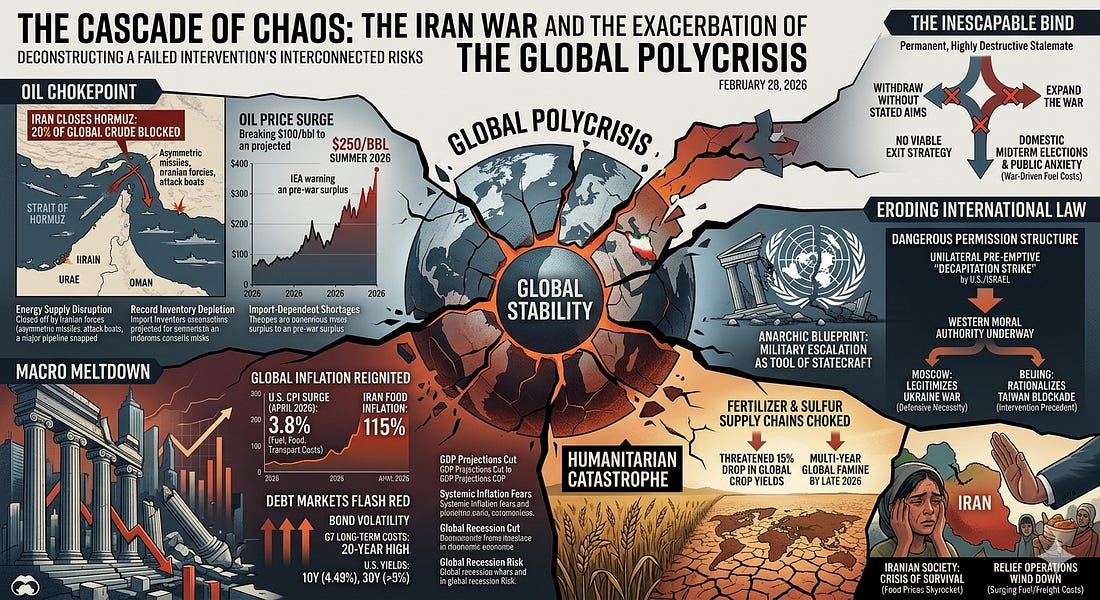
The 2026 war in Iran has unleashed a cascade of damaging consequences. When the United States and Israel launched a high-intensity, pre-emptive “decapitation strike” against Iran on February 28, 2026, the calculated objective seemed straightforward: achieve swift regime change while preserving critical energy infrastructure—like the Kharg Island export terminal—for a future, Western-aligned government. Instead, the strategy has catastrophically backfired. Washington now finds itself locked in a grueling “Mexican standoff” with a resilient Tehran. Far from collapsing under the onslaught, Iran weaponized its asymmetric arsenal to survive the initial bombardment, emerging with a distinct strategic advantage that, for political reasons, U.S. military power cannot counter. The analysis that follows deconstructs the anatomy of this intervention, detailing how a single military campaign reverberated through the entire global network, driving up oil prices, reigniting inflation, destabilizing bond markets, and throttling global agricultural supply chains. The Oil Chokepoint Oil is at the heart of this crisis, as evidenced by the cascading impacts triggered by the largest energy supply disruption in history. In response to American and Israeli bombardment, Iran closed the Strait of Hormuz, choking off the transit of 20% of global crude. This instantly transformed a global oil surplus into a multi-billion-barrel deficit. Global inventories are depleting at a record pace, leaving import-dependent nations facing critical fuel shortages. The Macro Meltdown As a result of interrupted oil flows, the global economic floor is giving way. We are seeing market stagnation and surging costs as oil pushed well past $100 per barrel, a price that, even when the Straits reopen, could persist for years, according to OilPrice. The IEA warned that crude could climb over $250 per barrel this summer if the blockade continues. Consequently, nations worldwide are already cutting their GDP projections. Rising oil prices are driving Inflation. April Consumer Price Index (CPI) in the U.S. surged to 3.8%, driven by increasing fuel, food, and transport costs. Countries around the world are having to contend with higher inflation rates, nowhere more so than Iran, which is dealing with a domestic food inflation rate exceeding 115%. Driven by escalating geopolitical anxiety, global debt markets are flashing red as bond volatility is reshaping global credit. As systemic inflation fears mount, long-term borrowing costs across the G7 have hit a two-decade high, signaling a sharp recalibration of macroeconomic risk. The U.S. bond market remains hyper-reactive to war headlines, inflating the benchmark 10-year Treasury yield to 4.49% while the policy-sensitive 2-year yield has risen to 4.06% and the 30-year yield has pushed past 5%. A similar trend is taking place in Europe and Asia. Despite misplaced stock market euphoria, analysts warn global economies are sleepwalking into a recession. Humanitarian Catastrophe Beyond the balance sheets, the war is accelerating an unprecedented humanitarian catastrophe. Iran’s closure of the Straits of Hormuz has choked off heavy nitrogen fertilizer and sulfur supply chains, threatening a 15% drop in global crop yields and setting the stage for a multi-year global famine by late 2026. Under the U.S.-enforced naval blockade, Iranian society is facing a crisis of survival. Wholesale supply shortages and skyrocketing food prices are making it impossible for families to afford basic nutrition. Tragically, at the exact moment international aid is needed most, surging global fuel and freight costs are forcing relief organizations to wind down their regional feeding operations. Eroding International Law and Multilateral Norms The unilateral, pre-emptive campaign launched by the United States and Israel against Iran has further eroded international law and weakened traditional multilateral norms, effectively creating a dangerous “permission structure” for other revisionist powers to justify their own territorial ambitions. By bypassing consensus-based security alliances and the United Nations to execute a high-intensity “decapitation strike” under the guise of national security, Washington has established a geopolitical precedent that undercuts Western moral authority. Authoritarian regimes can now weaponize this exact framework of pre-emption and localized escalation to normalize their own regional aggressions. Specifically, Moscow can point to the U.S.-led operation in the Middle East to further legitimize its ongoing war in Ukraine as a defensive necessity against external encirclement, while Beijing can reference the Western disregard for traditional sovereignty and international guardrails to rationalize naval blockades and eventual military intervention in Taiwan. The U.S. has yet again weakened the rules-based global order, creating an anarchic blueprint where raw military escalation becomes a universally permissible tool of statecraft. Conclusion: The Inescapable Bind Ultimately, Operation Epic Fury leaves the international community trapped in a permanent, highly destructive stalemate with no viable exit strategy. By attempting to solve a regional security threat through unilateral force, the United States has sparked crises across energy markets, global finance, and food supply chains while accelerating the breakdown of the rules-based international order. Washington can either withdraw without achieving the stated aims or they can expand the war. However, with a forthcoming midterm election and nearly two-thirds of the domestic electorate deeply anxious over war-driven fuel costs, the White House faces a political reality that prevents it from expanding the conflict. The architecture of this war provides a brutal, real-world case study in polycrisis dynamics. What was sold to a polarized public as a localized, surgical intervention has instead unleashed cascading economic and social consequences that will endure long after the Strait reopens.
|





No comments:
Post a Comment