
The End of Oil?Inside the Santa Marta Revolt Against Fossil Fuels and the Collapse of the COP Process
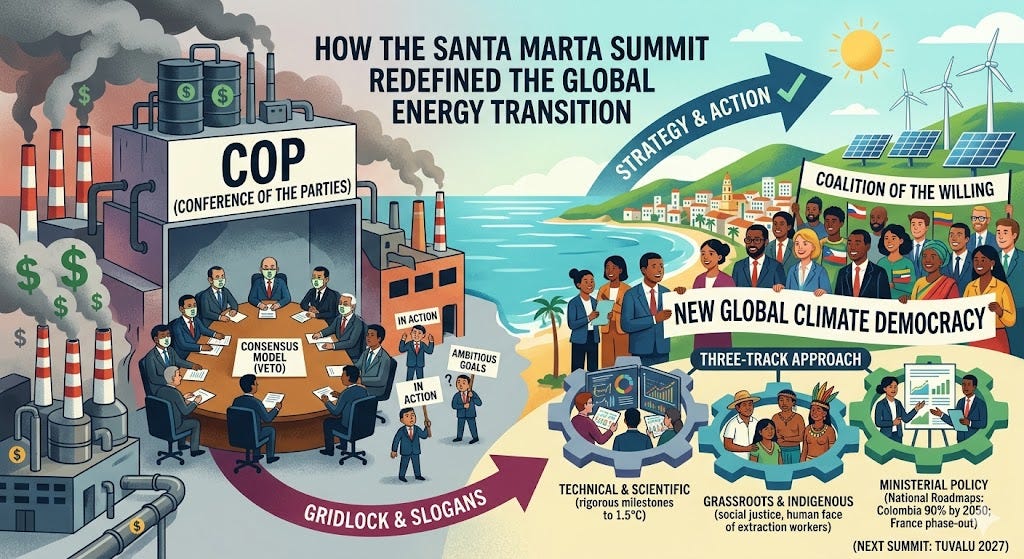
The Santa Marta Summit marks a decisive break with decades of climate gridlock. This is the first major international conference that is explicitly focused on phasing out fossil fuels. Instead of relying on slow consensus politics, participating nations advanced a three-track model integrating scientific research, social justice, and concrete ministerial policy roadmaps aimed at accelerating the global energy transition. From Slogans to Strategy: The Breaking Point that Redefines the Global Energy Transition The Santa Marta summit offers an alternative to the UN’s Conference of the Parties (COP). The global economy remains deeply dependent on fossil fuels, driving multiple crises, yet year after year, petrostates continue to block efforts to phase out coal, oil, and gas. The Santa Marta Summit was born out of frustration with the lack of progress within the UN framework. Under the standard COP consensus model, any single oil-producing nation has veto power. The fossil fuel industry’s control over the COP process was painfully evident at the three most recent summits, COP28, COP29, and COP30. By contrast, the Santa Marta meeting formed a coalition of the willing. By excluding major disruptors like the U.S., Russia, China, and Saudi Arabia, the 57 participating nations—representing one-third of global energy demand—created a space for frank discussions on pathways to dismantle the fossil fuel economy. The “Santa Marta Method”: A Three-Track Approach Unlike the sterile, bureaucratic atmosphere of typical summits, Santa Marta utilized a bottom-up model that integrated three distinct voices: This was an inclusive forum that included grassroots and Indigenous voices. The “People’s Summit” ensured that final high-level dialogues were rooted in social justice. This prevented the transition from being a top-down corporate mandate, addressing the “human face” of workers in extraction zones. A new Science Panel for Global Energy Transition was launched that provides countries with rigorous, year-by-year milestones to align with the 1.5°C heating limit. The conference also included ministerial policy in the form of national roadmaps. Colombia presented a draft to reduce fossil fuel use by 90% by 2050, while France became the first developed nation to release a formal phase-out plan (targeting coal by 2027 and gas by 2050). The Iran War Energy Perspective The summit took place against the backdrop of an historic energy crisis. The war in Iran sent oil prices to four-year highs, and as gas prices skyrocket, it is becoming increasingly apparent that fossil fuels are not just dirty, they are also unreliable and costly. The war makes the case for phasing out fossil fuels and positions renewable sources of energy like solar and wind as smart choices for both national security and the preservation of national sovereignty. As activist Bill McKibben noted, sunlight does not need to pass through the Strait of Hormuz. The Roadblocks: Financing, legal and Political Fragility The coalition faces grueling financial, legal, and political challenges in policy implementation. Developing nations face high borrowing costs, so discussions focused on redirecting a portion of the $1.5 trillion spent annually on fossil fuel subsidies toward a global transition fund. Countries like Colombia risk being sued by multinational corporations for lost revenue if they close extraction sites before leases expire, so the coalition is working on a legal “shield” to protect these nations. Nearly all participating nations are democracies, so a shift in government could theoretically reverse these commitments, highlighting the fragility of the progress. Historic Pivot Nations came together to bypass traditional diplomatic paralysis and begin planning for a post fossil fuel future. This is more than just another climate meeting it is the birth of a new global climate democracy that reframes energy transition as a matter of economic survival and national security. The Santa Marta summit is prioritizing the energy transition as the central pillar of global economic and security strategy. By moving away from incantatory governance (ambitious goals without action), and toward sector-specific roadmaps, this coalition is creating a blueprint for the post-fossil fuel era. As the movement heads toward its next summit in Tuvalu in 2027, the “Santa Marta Spirit” offers a newfound sense of hope. Fifty-seven countries have moved past the question of whether we should phase out fossil fuels, to the technical, political, and financial reality of how it can be done.
|





No comments:
Post a Comment