
Are we entering a digital "dark age"? Or: talking to "other" people (1)Making your research relevant to other disciplines and fields
Catch-up service:
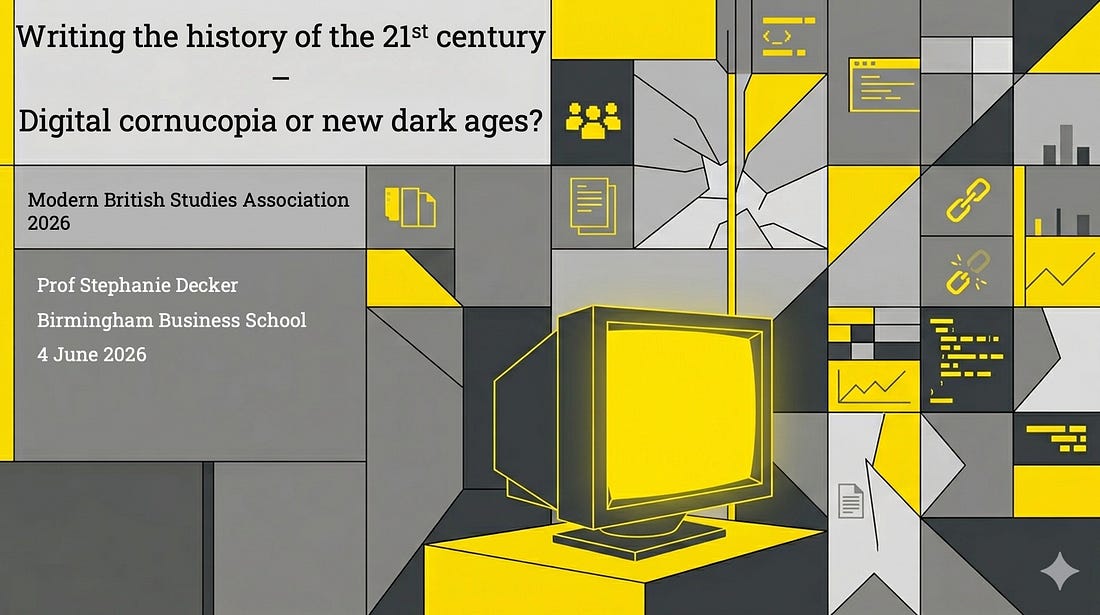
Last week I gave a talk at the Modern British Studies conference in Birmingham. Yes, I also didn't know British Studies was a thing before I was approached. I’ve only been to African Studies conferences before, so I was tickled. My stuff is only British insofar as I am located in Britain. But I was interested because it was about email and the internet, so the history actually overlaps with the time period I have been in Britain. My earliest internet and email were in Germany, but by the time MP3 players and social media became a major thing, I was on these fair isles. Pretty much shortly after we learned that Y2K would not end all civilisation as we knew it, really. (I was at HBS when Lehman Brothers collapsed (which is why I nearly missed the Northern Rock bank run), but back when the depression and austerity started.) To give you an idea of how long that is, consider this: when I am in Germany, I unironically expect trains to be on time. Yes, that long. Back to (Modern) British Studies — in many ways, it was like other area studies meets. I met a lot of historians, a smattering of vaguely sociological people and those with a penchant for literature and culture. Our panel was great: Christine Grandy (Lincoln) talked about her research on email spam — inspired! People (and journalists) were ominously forecasting the death of the internet and email as we know it, c. 2002. It was good to be reminded. Especially of the many Nigerian princes in distress. When I check my spam folder now, it’s a mix of advertising and threatening emails about my online watching habits (really, I’m the wrong mark here). So, quick check: yes, the internet still feels like a darker place now, but my nostalgia has significantly reduced. Laura Carter (Paris) reflected on Friends United and her “lurking” in online fora to research the history and memories of a cohort from a specific school. She did announce her presence as a researcher, but she is not an actively engaged participant in these mnemonic communities. It’s what Massa & O’Mahony (2021) call “non-participant observation” — worth knowing they did it on 4Chan. Ideal place to lurk — or maybe not. One attendee told me that my talk was very helpful, as he had now decided against touching any digital sources. I guess any impact is impact, no? I was also massively upstaged by some pigeons moving into Muirhead Tower. Definitely one of the more exciting talks to deliver. But overall, attending a conference outside my field made me consider how we can make our research relevant to scholars in other fields and disciplines, and how many of our concerns may be shared but divided by different languages and conventions. And I am doing it all again this week!
Let’s get started with email and its past and future history. My talk had the deliberately melodramatic title: digital cornucopia, or new dark ages? It was aimed at historians and other scholars thinking about how anyone will write the history of the twenty-first century. But the argument matters just as much for those of us who study organisations, firms and management, because not just the corporate record is changing under our feet, but organizational activity itself is, and most of us have not yet noticed... Continue reading this post for free in the Substack app
|




No comments:
Post a Comment