
Historical analysis and AI – what the spreadsheet tells us about AI and workAnd why the same story gets used to make contradictory predictions
I’m a keen reader of the many historical analogies that proliferate around AI. But there are so many of them, I keep discovering more, and I suspect it is beyond the ability of a single human to keep up with all of them. As a genre, it has exploded.
It is somewhat reminiscent of the sudden interest in the Great Depression after the 2008 Financial Crisis. But these were still the early years of social media, so many remained in the journalistic domain and were generally well-researched and based on long-form treatments (mostly academic, some journalistic). Kindleberger’s book on the history of financial crises got another outing. This time round is different because everyone suddenly writes historical analogies, frequently to promote their services or make a living on Substack, and the quality and transparency of their research are… well… mostly focused on producing a compelling story and argument. Narrative is narrative, right? Never mind that one is fictional, the other historical. Some serious academics make that argument. But I don’t buy it. And I think historical analogies are a great way to illustrate why they really aren’t. So, I am starting an occasional series on historical analogies and commentary on those that I encounter out in the wilds of social media. Full subscribers get the first read, and I’d love your comments and ideas. After two weeks, I’ll make them freely available and repost them on LinkedIn, because having historians weigh in on overused historical analogies might just be quite important and maybe a public service highlighting the value of the humanities and social sciences. Catch-up service:The AnalogiesThere are so many, and they are used to argue that we should be wary of the threats of AI as much as that we should be optimistic. Let’s start with the one I most enjoyed reading and researching recently… The spreadsheetDisclaimer – I love a good spreadsheet. The spreadsheet analogy is mostly used to reassure people about artificial intelligence and jobs. It goes like this: In 1979, a Harvard MBA student named Dan Bricklin grew tired of recalculating ledgers by hand and built the first electronic spreadsheet, VisiCalc. Within a few years, the spreadsheet had swallowed the work of the bookkeeper, the clerk who spent their days adding columns of figures. And yet the accounting profession did not collapse, but expanded. The machine took over the arithmetic, and the humans moved up to the interesting work. So, this analogy implies that AI will do the same for the rest of us. Great story, and the historical details are essentially correct. It provides succour to worried university graduates when white-collar automation comes up. Tim Harford wrote an entire 2024 essay about it under the title “What the birth of the spreadsheet teaches us about generative AI.” Many aspects make this an enticing analogy: the humdrum nature of the spreadsheet today makes it quaint and appealing to think about it as revolutionising everything. But having worked for years in a business school department of economists and economics-adjacent scholars, I found that one of my favourite colleagues, with whom I co-managed one of our main postgraduate courses, Kirit, had been at the university for ages. In the same office. Which would have made a historian proud: papers stacked everywhere, and the sedimentation layers were sometimes broken up to show stuff from the 80s. Kirit, of course, learned his trade late in the mid-century, running regressions by hand. He once mentioned that, and that he still had papers from this that he would never need again – because today it is all done on the computer (Stata more so than Excel). The technology storySo, it is a damn fine technology story. Don’t underestimate what the spreadsheet means, not just to the quants folk, but to anybody in a management position. Being a research director in the late teens, spreadsheets became central to my armoury. And I’m a qualitative researcher. The origin story is well-documented – sadly, nobody told or taught it to me when I was at Harvard Business School in 2007/08, which seems like a shocking oversight for the Business History group there. An MBA student called Dan Bricklin, class of 1978, was watching a professor erase and rewrite the interlocking figures of a financial model on the blackboard, or so the story goes. Bricklin imagined what he later called a word processor that worked with numbers. With another guy, Bob Frankston, he founded Software Arts and released VisiCalc for the Apple II at the end of 1979. It was the first “killer app”, software so useful that people bought the computer in order to run it. Mitch Kapor’s Lotus 1-2-3 (1983) overtook it on the IBM PC, and Microsoft Excel eventually won the market once the graphical interface arrived. Steven Levy captured the cultural moment early, in a 1984 essay for Harper’s that charted the emerging “spreadsheet way of knowledge”, a faith that the world could be captured in rows and columns. The article is great and well worth a read – evoking a period from an adult perspective that I remember only as a child. Charmingly, it also reproduces a simple screenshot of what a VisiCalc matrix actually looks like – because it was still an “out there” concept for many. 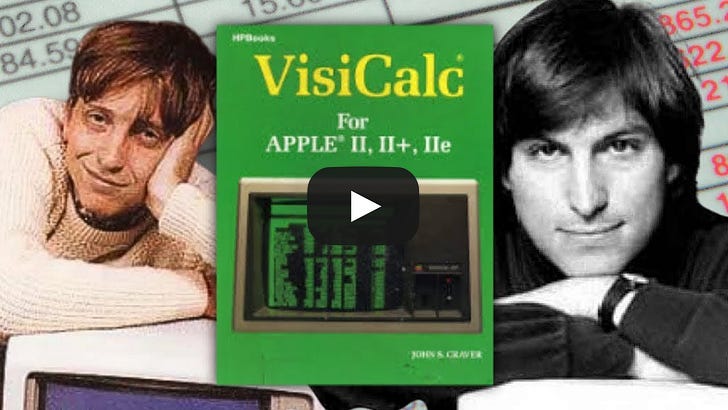
The VisiCalc (and wider spreadsheet) story is so appealing given what a moderate, non-revolutionary technology introduction it was. Nevertheless, employment numbers can be linked to it very clearly: since 1980, roughly the moment VisiCalc took off, around 400,000 jobs for bookkeepers and accounting clerks disappeared in the United States, while about 600,000 jobs for accountants were added. The numbers behind it come from a much-shared 2015 episode of NPR’s Planet Money on “Spreadsheets!”... Continue reading this post for free in the Substack app
|




No comments:
Post a Comment